Exposing iClass Key Diversification Contents Introduction RFID - - PowerPoint PPT Presentation

exposing iclass key diversification contents
SMART_READER_LITE
LIVE PREVIEW

Exposing iClass Key Diversification Contents Introduction RFID - - PowerPoint PPT Presentation

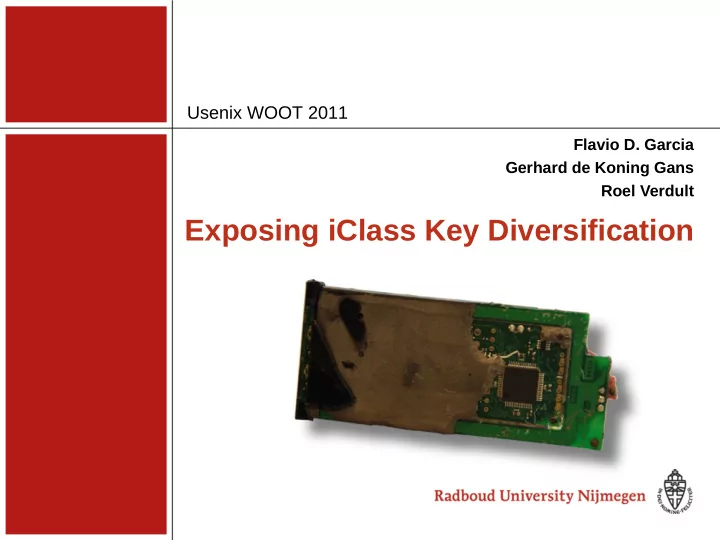
Usenix WOOT 2011 Flavio D. Garcia Gerhard de Koning Gans Roel Verdult Exposing iClass Key Diversification Contents Introduction RFID iClass and Picopass Key Diversification iClass Key Diversification DES and


slide-1
SLIDE 1

Exposing iClass Key Diversification

Flavio D. Garcia Gerhard de Koning Gans Roel Verdult

Usenix WOOT 2011
slide-2
SLIDE 2

Contents

  • Introduction

– RFID – iClass and Picopass – Key Diversification

  • iClass Key Diversification

– DES and Fortify – Reader Control and Key Updates – Finding hash0 and hash0-1

  • Key Recovery Attack
  • Conclusion
slide-3
SLIDE 3

Radio Frequency Identification (RFID)

slide-4
SLIDE 4

Radio Frequency Identification (RFID)

slide-5
SLIDE 5

iClass and PicoPass

slide-6
SLIDE 6

iClass (HID Global)

  • ISO 15693 compatible smartcard
  • Introduced in 2002 as replacement of HID prox
  • Over 300 million cards sold (according to HID)
slide-7
SLIDE 7

iClass (HID Global)

  • Widely used in access control (examples from HID)

– The Bank of America Merrill Lynch – Int. Airport of Mexico City – Navy base of Pearl Harbor

  • Used as secure authentication

– NaviGO (Dell Latitude and Precision) – e-Payment – Billing systems

slide-8
SLIDE 8

iClass

  • One master key for every system
  • Built-in Key Diversification
slide-9
SLIDE 9

Security by Obscurity?

  • We know the examples of

– Mifare Classic – KeeLoq – Hitag2

  • How is the key diversification implemented?
  • Important question since it is built-in!
slide-10
SLIDE 10

Our Contribution

  • Reverse engineering of built-in key diversification

– Encryption of ID – 'Hashing' by hash0

  • By-pass encryption mode of Omnikey Secure Mode

– New library to communicate in Secure Mode

  • Custom firmware for Proxmark3 (RFID Tool)

– To eavesdrop ISO 15693 communication

  • Released all of above (proxmark.org)
  • We show that hash0 can be inverted and give an

attack to find the master key!

slide-11
SLIDE 11

Key Diversification

Request ID 45 card key = diversify(MK,45)

slide-12
SLIDE 12

iClass Key Diversification/Fortification

[Source: PicoPass Datasheets]

slide-13
SLIDE 13

iClass Key Diversification/Fortification

[Source: PicoPass Datasheets]

1. 2.

hash0, h0

slide-14
SLIDE 14

Omnikey (HID Global)

ISO 24727 requires encryption of USB connection

slide-15
SLIDE 15

Omnikey Secure Mode

3DES

iCLASSCardLib.dll

slide-16
SLIDE 16

iClass Memory Layout

Key Slot Value

00 01 02 .. ..

slide-17
SLIDE 17

Authentication Protocol

Card Identity Card Challenge Reader Random Reader 'MAC' Card 'MAC'

slide-18
SLIDE 18

Authentication Protocol

Card Identity Card Challenge Reader Random Reader 'MAC' Card 'MAC'

Used to derive card specific key

slide-19
SLIDE 19

Eavesdropping

Proxmark 3

Supports several HF/LF protocols (ISO 14443a/b) Added eavesdropping for iClass communication

slide-20
SLIDE 20

Implementation side effect: “ISO Tunneling”

ISO 14443 ISO 15693

slide-21
SLIDE 21

Implementation side effect: “ISO Tunneling”

ISO 14443 ISO 15693

Emulate iClass using existing software from libnfc

slide-22
SLIDE 22

Card Key Update

slide-23
SLIDE 23

Card Key Update

fcb4323e6a865626 7698db5d01780a8f

  • 8a2ce9636bfe5ca9

XOR Difference of Card Keys is send over the air

slide-24
SLIDE 24

Determine Input of hash0

DESenc(id,MK) ? DESdec(c,k) = p DESdec(c,k') = p'

Pick any 64-bit string c and compute with two different keys (k and k'):

hash0

slide-25
SLIDE 25

Determine Input of hash0

DESenc(p,k) DESenc(p,k)

c

Same XOR difference!

hash0

slide-26
SLIDE 26

Determine Input of hash0

DESenc(p,k) DESenc(p,k)

c

Card key = hash0(DESenc(id,kc))

Same XOR difference!

hash0

slide-27
SLIDE 27

Recovering hash0

  • XOR Difference
  • Learn Input/Output Relations
  • Step-by-step Recovery of Partial Input/Outputs
  • Reconstruct hash0
slide-28
SLIDE 28

Input/Output Relations

h0(0000000000000001) = 0606000000000000 h0(0000000000000002) = 0400040000000000 h0(0000000100000000) = 0000000000080000 h0(0000000200000000) = 0000000000100000 h0(8000000000000000) = 0306050c07060d00 h0(4000000000000000) = 0306050c04050d00

slide-29
SLIDE 29
slide-30
SLIDE 30
  • r-mask

and-mask

slide-31
SLIDE 31
  • r-mask

and-mask

NEGATION

PERMUTATION

slide-32
SLIDE 32

Structure of hash0

permute negate

slide-33
SLIDE 33

Structure of hash0

mod 70 61 62 63 63 60 62 61 64 permute negate

slide-34
SLIDE 34

hash0

  • We fully recovered hash0
  • It is clearly not

– Collision resistant – One-way

  • We were able to invert hash0

– On average we have 4 candidate pre-images

  • Recovering the master key comes down to a brute force on

single DES (Few days on RIVYERA)

slide-35
SLIDE 35

Key Recovery Attack (Phase 1)

emulated id

Key Update: kmaster →knew The attacker knows knew and therefore learns hash0(DESenc(id,kmaster))

slide-36
SLIDE 36

Key Recovery Attack (Phase 2)

  • For every DES key k check if DESenc(id,k) equals one of

the pre-images from phase 1.

  • When the check above succeeds the corresponding key k

needs to be verified against another emulated id.

  • A single DES key can be broken within days. We checked

the recovered candidates against the master key that we

  • btained from the reader firmware.
slide-37
SLIDE 37
slide-38
SLIDE 38
slide-39
SLIDE 39
slide-40
SLIDE 40

Verification of Results

  • We recovered the master key from firmware

as done by Meriac and Plotz in [HID iClass Demystified, 27

th CCC, Dec 2010]

  • This verified that we found the correct key
slide-41
SLIDE 41

Conclusion

  • Single DES for diversification (broken since 1997)
  • The hash0 function is not:

– pre-image resistant – collision resistant

  • hash0 can be inverted (on average 4 pre-images)
  • ...recover the master key from key update message!
  • One master key for every iClass system
  • iClass Authentication Algorithm

Next step...

slide-42
SLIDE 42

Questions?