
SLIDE 1
Exposing Parallels and Problems within an Entropic Universe
The Great Gatsby and Icarus
Anna Wiechmann 5 May 2015
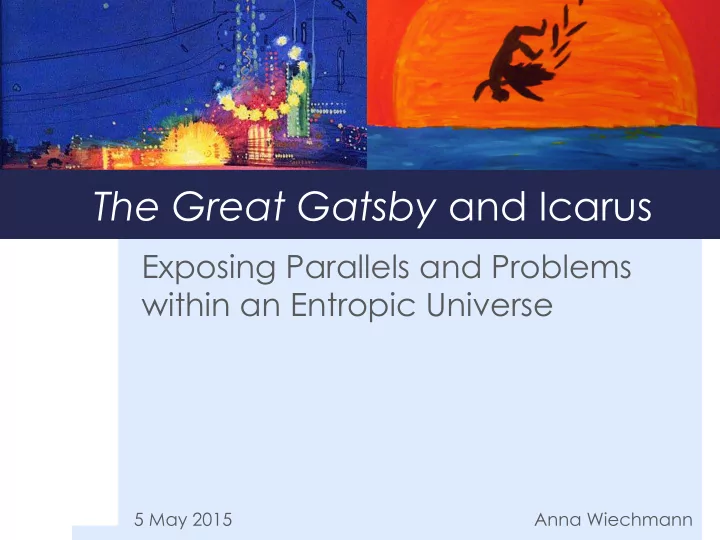
The Great Gatsby and Icarus Exposing Parallels and Problems within - - PowerPoint PPT Presentation
The Great Gatsby and Icarus Exposing Parallels and Problems within an Entropic Universe 5 May 2015 Anna Wiechmann Topic Selection From an Education standpoint: The Great Gatsby has literary merit and was voted the best twentieth century
Anna Wiechmann 5 May 2015
¤ “blurred and patchy” ¤ “ I never at any one time saw [Gatsby] clear myself—for he started out as one man I knew and then changed into myself” ¤ “gave no account (and had no feeling about or knowledge
the time of their reunion to the catastrophe”
¤ It signaled the end of Fitzgerald’s success. ¤ "Even in conception and construction, The Great Gatsby seems a little raw.” ¤ “painfully forced”
Imprisonment Aspirations and the Use of Imitation Illegitimacy in the Means of Ascension Devastating Falls Foil Characters
Jay Gatsby was born and raised in the middle-of- nowhere North Dakota, as a child of inconsequential
actions and identities of his parents, James Gats found himself essentially trapped by an impoverished family, a worthless name, and a lack of
greatness. Icarus was trapped and punished because of his
imprisoned Daedalus on the island of Crete for two reasons: to punish him for helping Pasiphaë to mate with a bull and to prevent him from spreading knowledge about the Labyrinth that he had created.
Jay’s financial and social ascension is drastic and mysterious to the other characters in the novel and readers alike, giving those around him a sense of
Daisy’s affection by imitating her lifestyle. Icarus refused to be content with moderation in his ascent in flight; he did not follow the conservative course that his father demonstrated. Daedalus’ invention imitated the wings of a bird.
Gatsby resorted to bootlegging and organized crime to make his money. In
illegitimately acquired millions
mansion in West Egg, and threw lavish parties every weekend. He flew because of the work, brilliance, and inventiveness
hindrance to his father’s work. He “Stood by and watched, and raised his shiny face/To let a feather, light as down, fall
the yellow wax,/Fooling around, the way a boy will, always,/Whenever a father tries to get some work done,” (Ovid 187-88).
Gatsby’s fall comes in two parts: when Daisy rejects him in New York and when he is murdered by George Wilson, taking the blame for Daisy’s reckless driving. Icarus “soared higher, higher, drawn to the vast heaven/ Nearer the sun, and the wax that held the wings/ Melted in that fierce heat, and the bare arms/ beat up and down in the air, and lacking oarage/ Took hold of nothing,” (Ovid 123-128).
Nick Carraway is more of a realist and recognizes the limitations of the human will and time. Daedalus stands for balance and moderation, Icarus represents the impulsive and passionate.
Nick and Daedalus are both characters whose actions and attitudes serve to stress and highlight the distinctive temperament of their respective protagonists. Their presence strengthens the impact of both stories by highlighting the differences in ideals, attitudes, and behaviors.
Aristotle defined tragedy as being the “mimesis of action which is elevated, complete, and of magnitude; in language embellished by distinct forms in its sections; employing a mode of enactment, not narrative; and through pity and fear accomplishing catharsis of such emotions” Focusing on plot, characters, diction, thought, spectacle, and melody.
Both The Great Gatsby and the Icarus and Daedalus myth have each of these elements.
Inciting Incident Rising Action Complication Climax Peripetia Falling Action Moment of Last Suspense Catastrophe
¤ We live a world where things have a tendency toward decay, but we have this marvelous capacity for hope. ¤ While we need to be aware of the limitations and risks associated with our dreams, ultimately …
¤ Cooper, Lane. The Poetics of Aristotle, Its Meaning and
¤ Fitzgerald, F. Scott. The Great Gatsby. 1925. Hertfordshire: Wordsworth Editions, 1993. Print. ¤ Francis Cugat. Cover of The Great Gatsby. Scribner & Sons,
¤ Ovid. Metamorphoses. Trans. Rolfe Humphries. Bloomington: Indiana University Press, 1955. Print. ¤ RachelWhatsername. Falling Icarus. Deviant Art, 2011. JPEG.