IntroductiontoCryptology(NSchapter2) - - PowerPoint PPT Presentation

introduction to cryptology ns chapter 2 computer and
SMART_READER_LITE
LIVE PREVIEW

IntroductiontoCryptology(NSchapter2) - - PowerPoint PPT Presentation

IntroductiontoCryptology(NSchapter2) ComputerandNetworkSecurity Encryption: plaintext+key ciphertext CMSC414 Decryption:


slide-1
SLIDE 1

2/6/2009shankar

  • cryptoslide1
  • ComputerandNetworkSecurity

CMSC414

CRYPTO

  • UdayaShankar

shankar@cs.umd.edu

2/6/2009shankar

  • cryptoslide2
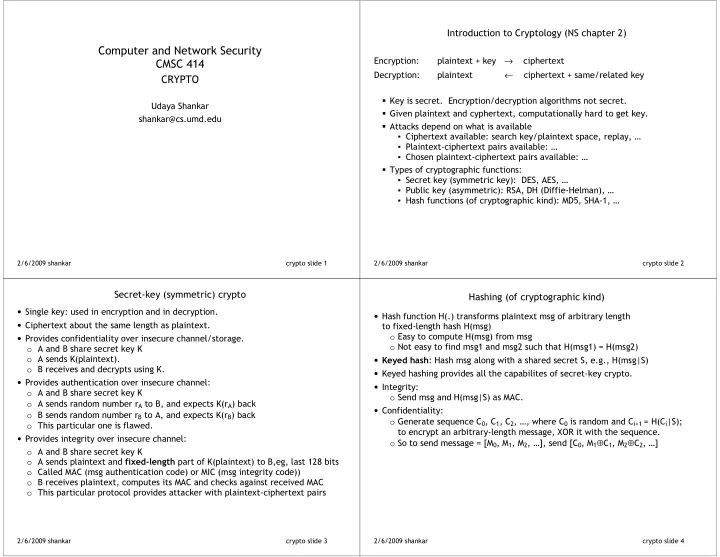
  • IntroductiontoCryptology(NSchapter2)
  • Encryption:

plaintext+key→ciphertext Decryption: plaintext←ciphertext+same/relatedkey

  • Keyissecret.Encryption/decryptionalgorithmsnotsecret.

Givenplaintextandcyphertext,computationallyhardtogetkey. Attacksdependonwhatisavailable ▪ Ciphertextavailable:searchkey/plaintextspace,replay,… ▪ Plaintext7ciphertextpairsavailable:… ▪ Chosenplaintext7ciphertextpairsavailable:… Typesofcryptographicfunctions: ▪ Secretkey(symmetrickey):DES,AES,… ▪ Publickey(asymmetric):RSA,DH(Diffie7Helman),… ▪ Hashfunctions(ofcryptographickind):MD5,SHA71,…

2/6/2009shankar

  • cryptoslide3

Secret7key(symmetric)crypto

  • Singlekey:usedinencryptionandindecryption.
  • Ciphertextaboutthesamelengthasplaintext.
  • Providesconfidentialityoverinsecurechannel/storage.
  • AandBsharesecretkeyK
  • AsendsK(plaintext).
  • BreceivesanddecryptsusingK.
  • Providesauthenticationoverinsecurechannel:
  • AandBsharesecretkeyK
  • AsendsrandomnumberrAtoB,andexpectsK(rA)back
  • BsendsrandomnumberrBtoA,andexpectsK(rB)back
  • Thisparticularoneisflawed.
  • Providesintegrityoverinsecurechannel:
  • AandBsharesecretkeyK
  • AsendsplaintextandpartofK(plaintext)toB,eg,last128bits
  • CalledMAC(msgauthenticationcode)orMIC(msgintegritycode))
  • Breceivesplaintext,computesitsMACandchecksagainstreceivedMAC
  • Thisparticularprotocolprovidesattackerwithplaintext7ciphertextpairs
  • 2/6/2009shankar
  • cryptoslide4

Hashing(ofcryptographickind)

  • HashfunctionH(.)transformsplaintextmsgofarbitrarylength

tofixed7lengthhashH(msg)

  • EasytocomputeH(msg)frommsg
  • Noteasytofindmsg1andmsg2suchthatH(msg1)=H(msg2)
  • :HashmsgalongwithasharedsecretS,e.g.,H(msg|S)
  • Keyedhashingprovidesallthecapabilitesofsecret7keycrypto.
  • Integrity:
  • SendmsgandH(msg|S)asMAC.
  • Confidentiality:
  • GeneratesequenceC0,C1,C2,…,whereC0israndomandCi+1=H(Ci|S);

toencryptanarbitrary7lengthmessage,XORitwiththesequence.

  • Sotosendmessage=[M0,M1,M2,…],send[C0,M1⊕C1,M2⊕C2,…]
slide-2
SLIDE 2

2/6/2009shankar

  • cryptoslide5
  • Publickey(asymmetric)crypto
  • Eachprincipalhastworelatedkeys:
  • privatekey(notshared)
  • publickey(sharedwithworld).
  • Plaintextencryptedwithonecanonlybedecryptedwiththeother.
  • Confidentiality:
  • BtransmitspubkeyA(plaintext).AdecryptsusingprivkeyA.
  • Integrityanddigitalsignature(non7repudiation)
  • AtransmitsprivkeyA(plaintext)
  • AnyonewithpubkeyAcandecryptit

andbeassuredthatitcouldonlyhavebeensentbyA.

  • Butpublic7keycryptoisordersslowerthansecret7keycrypto/hashing,

soitisusedinconjunctionwiththelatter.

  • Tosignamessage:signthehashofthemessage.
  • Toencryptorintegrity7protectamessage:
  • Firstusepublic7keycryptotoestablishaper7sesssionsecret;

eg,Bcreatesper7sessionkeyKandsendspubkeyA(K)toA

  • Thenusesecret7keycryptoorkeyed7hashing.
  • 2/6/2009shankar
  • cryptoslide6

SecretKeyCrypto(NSchapter3)

  • Considermessageofkbitshere.
  • Variable7lengthmessageaddressedlater.
  • Fixed7lengthmessageandFixed7lengthkey→message7lengthoutput
  • DES:647bitmessage,567bitkey
  • Ifkeylengthjistoosmall,insecure.Ifjistoolarge,expensive.
  • WantfunctionSmappingk7bitmsgtok7bitoutputsuchthat:
  • Fordecryption,Smustbe171mappingfrom2Kto2K.
  • Forsecurity,Smustbe“random”:
  • evenifmsg1andmsg2differinjustonebit,
  • S(msg1)andS(msg2)differinmanybits(approxk/2bits).
  • SoScannotbea“simple”function;sofollowingarenogood:

S(msg)=msg⊕key S(msg)=msgbitsinreverseorder

2/6/2009shankar

  • cryptoslide7

SecretKeyCrypto(contd.)

  • “Substitution”table:randompermutationofallN7bitstrings.
  • S(i)isithrowoftable
  • Tableobtainedwithphysical7worldrandomness(eg,cointoss).
  • Pro:Sisperfectlyrandom
  • Con:needtostoretableofsizek.2k.Impracticalfork=64
  • Deterministicalgorithmthatproduces“randomlooking”output.

Wanteachoutputbittobe“influenced”byallinputbits.

  • :mixpermutationsandsubstitutions
  • Dividek7bitblockintop7bitblocksforreasonablysmallp(eg,p=8).
  • Usepxpsubstitutiontables“garble”p7bitoutputblocks.
  • Concatenatethep7bitoutputblockstogetak7bitblock
  • andpermutetogetgarbledk7bitoutputblock.
  • Repeat1,2,3fornrounds,wherenislargeenoughtogetgoodscrambling.
  • ,ie,reversing,isnomoreexpensive.

Oftencanbedonewiththesamealgorithm/hardware.

2/6/2009shankar

  • cryptoslide8

DES

  • Finalpermutationisinverseofinitialpermutation.

Notofsecurityvalue(why?,whatdoesthismean?)

  • initial permutation
  • generate16

487bitkeys K1,K2,...,K16

  • roundi,i=0,1,...,15,uses

Kiandoutputofpreviousround

  • swapleftandrighthalves
  • 647bitinput

647bitintermediate 567bitkey 647bitintermediate 647bitoutput 647bitoutput finalpermutation(inverseofinitial)

slide-3
SLIDE 3

2/6/2009shankar

  • cryptoslide9

DES:GenerationofK1,K2,...,K16

  • 56-bit key

C0 D0 rotate each left by 1 bit in rounds 1,2,9,16 2 bits in other rounds C1 D1 permute 56-bit key, split to form two 28-bit parts 48-bit key K1 Each part: permute, drop some bits to form 24-bit chunk. Join to form one 48-bit key K1 repeat 16 times get Ci, Di, Ki

  • i=1,…,16

2/6/2009shankar

  • cryptoslide10

DESencryptionround

  • DESdecryptionround:givenR(n+1)|L(n+1)→R(n)|L(n)

sameasencryptionwitharrowsreversedexceptformanglerfunction

64-bit input L(n) R(n) L(n+1) R(n+1) 64-bit output key Kn Mangler function XOR key K(n+1)

n=0,…,15

2/6/2009shankar

  • cryptoslide11

DES:decryption=encryptionwithKi’sinreverseorder

  • a1:L0|R0←iperm(dblk);

a2:forn=0,…,15do a3: Ln+1←Rn; a4: Rn+1←Manglern(Rn,Kn+1)⊕Ln;

  • //YieldsL16|R16
  • a5: L17|R17←R16|L16;

a6: crblk←ipermInv(R16|L16); !

  • //keyorder:K1,...,K16
  • b1: R16|L16←iperm(cblk);//a6bkw

b2: forn=15,⋅⋅⋅,0do//a2bkw b3: Rn←Ln+1;

  • //a3bkw

b4:Ln←Mnglrn(Rn,Kn)⊕Rn+1;//a4bkw //setsLntoXsuchthat //Rn+1←Manglern(Rn,Kn)⊕X //YieldsR0|L0 b5: L0|R0←swap(R0|L0); //a5bkw b6: dblk←ipermInv(L0|R0);//a1bkw !

  • //keyorderK16,…,K1
  • 2/6/2009shankar
  • cryptoslide12

DES:Manglerfunction

  • "#$%&'($→

→ → →"#$

  • 327bitRissplitupinto867bitchunks(duplicatingsomebits)
  • 487bitKsplitupinto867bitchunks
  • chunkiofR⊕chunkiofK
  • Put67bitresultinSboxi(differentforeachround)
  • OutputofSboxis47bitchunk
  • Allchunksconcatenatedandpermutedtoget327bitoutput
slide-4
SLIDE 4

2/6/2009shankar

  • cryptoslide13

DES:Weakandsemi7weakkeys

  • ')generateC0=D0=allonesorallzeros
  • *#)generateC0andD0ofalternating0and1
  • +)),-..-$$/$01/$0
  • Proof

AweakDESkeyhaseachofC0andD0tobeallonesorallzeroes. SinceeachCiisapermutationofC0,eachCiisthesameasC0. SinceeachDiisapermutationofD0,eachDiisthesameasD0. Eachper7roundkeyKidependsonlyonCiandDi. Sotheper7roundkeysK1,...,K16areallequaltoeachother. SothekeysequenceK1,...,K16(usedinencryption)isthesameas thekeysequenceK16,...,K1(usedindecryption). Soencryptionanddecryptionarethesame,i.e.,Ex(b)=Dx(b). SoEx(Ex(b))=b.

  • 2/6/2009shankar
  • cryptoslide14

DES:Weakandsemi7weakkeys

  • +),)-

..-$$/$01/$0

  • Proof

Let<K1(x),...,K16(x)>betheper7roundkeysobtainedfromx. Showthatthereisanothersemi7weakkeyysuchthaty <K1(x),...,K16(x)>=<K16(y),...,K1(y)>. Henceforanyblockb:Ex(block)=Dy(block)

2/6/2009shankar

  • cryptoslide15

MultipleEncryptionDES(EDEor3DES)

  • MakesDESmoresecure
  • Encryption:encryptkey1→decryptkey2→ encryptkey1
  • Decryption:decryptkey1→encryptkey2→decryptkey1
  • EE(encryptingtwice)withsamekeyisnoteffective.

Justequivalenttousinganothersinglekey.

  • EEwithkey1andkey2isnotsogood.
  • Given<m1,c1>,<m2,c2>,...,thereisanattackthatrequires256storage.
  • TableAwith256entries<keyKi,E(Ki,m1)>,sortedbycolumn2.
  • TableBwith256entries<keyKi,D(Ki,c1)>,sortedbycolumn2.
  • DojoinofTableAandTableB.
  • Eachmatchprovidescandidate<KA,KB>for<key1,key2>.
  • Use<m2,c2>,etc.toweedoutfalsecandidates.
  • +
  • differentsizesofkeys(64,128,…)
  • differentdatablocksizes(…,64,128,…)

2/6/2009shankar

  • cryptoslide16

RC4encryptionalgorithm

  • Streamcipher(onetimepad),canusevariablelengthkey.
  • Keystreamindependentofplaintext
  • 8x8S7box.eachentryisakey7permutationof0..255

byteS[0..255]←0..255;//S[i]=i bytei:=0;j←0;//counters byteK[0..255]←key|…|key; fori=0to255do j←(j+S[i]+K[i])mod256; swapS[i]andS[j] $ 2 i←(i+1)mod256; j←(j+S[i])mod256; swapS[i]andS[j]; returnS[(S[i]+S[j])mod256];

  • $

⊕withpt/ctfor encrypt/decrypt

slide-5
SLIDE 5

2/6/2009shankar

  • cryptoslide17

EncryptingLargeMessages(NSchapter4)

  • ,$$
  • Padmessagetomultiplenumberofblocks:1/3*-3#-4-0
  • Useblockencryptionrepeatedlytogetciphertext1/*-#-4-0
  • SameMi’sgetencryptedtodifferentCi’s
  • Repeatedencryptionsofsamemsgresultindifferentciphertexts.
  • Ciphertextcannotbechangedtocausepredictablechangetodecrypted

plaintext.

  • 5ECB,CBC,CFB,OFB,CTR,others

_________________________________________________________ /)

  • Obviousapproach:encrypt/decrypteachblockindependently
  • Encryption:Ci=EK(Mi)
  • Decryption:Mi=DK(Ci)
  • notgood:repeatedblocksgetsamecipherblock

2/6/2009shankar

  • cryptoslide18

CipherBlockChaining(CBC)

  • Ci=EK(Mi⊕Ci71),whereC0isarandomIV(initializationvector)
  • TransmitIVandC1,...,Cn
  • reversearrows;changeEKtoDK
  • Mi=DK(Ci⊕Ci71),whereC0isIV
  • +*ModifyCn:garblesMnunpredictablyandMi+1predictably
  • therMi’sunchanged.CanuseaCRCtoovercomethis.
  • +#:ExchangingcipherblockscancounteractCRCtosomeextent

⊕ ⊕ ⊕ ⊕

EK C1 M1

⊕ ⊕ ⊕ ⊕

EK

C2 M2 IV

⊕MiwithrandomRi

  • btainedfromCi71

⊕ ⊕ ⊕ ⊕

EK Cn Mn Cn71

2/6/2009shankar

  • cryptoslide19

OutputFeedbackMode(OFB)

6'$78

  • GeneratestreamcipherB0,B1,...,whereB0isIVandBi=EK(Bi71)
  • ThenCi=Bi⊕Mi
  • Soaone7timepadthatcanbegeneratedinadvance.
  • One7timepad:
  • Attackerwith<plaintext,ciphertext>canobtainBi’s
  • andsogenerateciphertextforanyplaintext
  • $78/96'0
  • Generatestreamcipherink7bitchunks,ratherthan647bitchunks.
  • LetXi=EK(Bi71),whereB0is647bitIV
  • LetYibekleftmostbitsofXi
  • Ci=Yi⊕Mi
  • Biisrightmost64bitsofBi71|Yi

2/6/2009shankar

  • cryptoslide20

CipherFeedbackMode(CFB)

6'$8

  • LikeOFBexceptthatoutputCi71isusedinsteadofBi
  • Ci=Mi⊕EK(Ci71)whereC0isIV
  • Cannotgenerateone7timepadinadvance.
  • $8/96'0
  • Generateciphersink7bitchunks,ratherthan647bitchunks.
  • LetXi=EK(Bi71),whereB0is647bitIV(padwithzerosonleftifneeded).
  • LetYibekleftmostbitsofXi
  • Ci=Yi⊕Mi
  • Biisrightmost64bitsofBi71|Ci
slide-6
SLIDE 6

2/6/2009shankar

  • cryptoslide21
  • CounterMode(CTR)
  • Seetext
  • 3DESonLargeMessages

3DESisusedwithCBConthe“outside”not“inside” UsingwithCBConinsideeliminatesself7synchronizationofreceivedciphertext (ie,ifsomeciphertextisgarbled,everythingislost)

  • 2/6/2009shankar
  • cryptoslide22

MACsfromencryption/decryption(NSchapter4)

  • /$0
  • CBC,CFB,OFB,…donotprotectagainst“undetectable”modificationsby

attackerknowingtheplaintext

  • Ofcourse,ahumanmayfindsomethingfishy.

Socanacomputerthatchecksforstructureinplaintext.

  • Needacryptographicchecksum.
  • Standardway:sendCBC(lastblockinCBCencryption)

alongwiththeplaintextmessageandIV.

2/6/2009shankar

  • cryptoslide23

Ensuringconfidentialityandintegrityofalargemesssage

  • Notok:SendCBCencryptedmessageandCBCresidue.
  • Justrepeatsthelastcipherblock
  • Notok:CBC_Encrypt[plaintext,CBC_residue[plaintext]]
  • Lastblockisencryptionofzero(⊕oflastcipherblockwithitself)
  • Notok:Encrypt[plaintext,noncryptographicchecksum(eg,CRC)]
  • Almostworks.Subtleattacksareknown.
  • Ok:Encrypt_Key2[plaintext,CBC_residue_Key1[plaintext]]
  • Buttwicethework.
  • Key2canberelatedtoKey2(eg,key1=key2⊕C),butstillsamework.
  • Probablyok:CBC_encrypt[plaintext,weakcryptographicchecksum(plaintext]]
  • Probablyok:CBC_encrypt[plaintext,hash[plaintext]]
  • 7$3/70

2/6/2009shankar

  • cryptoslide24

HashesandMessageDigests(NSchapter5)

  • msg→fixed7lengthhashH(msg)
  • Not171sincemsgspaceismuchlargerthanhashspace
  • secureone7wayfunction:

computationallyhardtofindtwomsgsm1andm2s.t.h(m1)=h(m2) +-)$:

  • ConsiderhashspaceofK(ie,hashof(logK)bits)
  • ConsiderNrandomlychosenmessages,m1,m2,…,mN
  • Pr[thereisapairofdistinctmsgs<mi,mj>:H(mi)=H(mj)]
  • =Pr[H(m1)=H(m2)orH(m1)=H(m3)or…orH(mN71)=H(mN)]
  • ≈Sum{overdistinct<mi,mj>pairs}(1/K)
  • =[N(N71)/2][1/K]
  • SoifN=

K thenPris1/2

  • Kshouldbelargeenoughsothatsearchingthrough

K ishard.

  • SoK=2128isok(assumingsearchthrough264ishard)
slide-7
SLIDE 7

2/6/2009shankar

  • cryptoslide25

KeyedHash:Hashwithsecretkey

  • ;,
  • confidentiality
  • authentication
  • integrity
  • Authenticationwithkeyedhash
  • AandBsharesecretkeyKAB
  • AsendsrandomnumberrAtoB.
  • BcomputesH(KAB|rA)andsendsitback.
  • AcomputesH(KAB|rA)(cannotinvertit)andcheckifreceivedvalueequalsit.

MatchauthenticatesBtoA.

  • Similarly,BsendsrandomnumberrBtoAandexpectsH(KAB|rB)back.

2/6/2009shankar

  • cryptoslide26

MAC(messageintegritychecksum)withkeyedhash

  • 7$3+1/*-#-4-0,+
  • Obviousapproach:MAC=H(KAB|msg)
  • NotokbecauseH(m1,m2,…,mn)isusuallyH(H(m1,m2,…,mn71)mn)
  • Soattackercanaddanymn+1andgetitsMACasH(oldMAC,mn+1).
  • Possiblefixes:
  • MAC=H(msg|KAB)
  • MAC=halfthebitsofH(KAB|msg)
  • MAC=H(KAB|msg|KAB)
  • HMAC(defactostandard):MAC=H(KAB|H(KAB|msg))(almost)

2/6/2009shankar

  • cryptoslide27

Encryption/encryption+integritywithkeyedhash

  • 1/*-#-4-0
  • Generate(canbeprecomputed)one7timepad:
  • bi=H(KAB|bi71)whereb0isIV
  • ci=bi⊕mi
  • transmitIVandc1,c2,...,cn
  • Decryptionidentical
  • 1/*-#-4-0
  • Encryptionwithplaintextmixedintoone7timepad
  • bi=H(KAB|ci71)wherec0isIV
  • ci=bi⊕mi
  • Decryptionstraightforward(homework)

2/6/2009shankar

  • cryptoslide28

Hashfromsecret7keyencryption/decryption

<$)

  • Hash(block)=Encryptconstant(eg,0)usingblockasthekey

=/0,)

  • Whenusersetspassword
  • Concatenate77bitASCIIoffirsteightcharstoget567bitsecretkey
  • Generate127bitrandomnumber(called)
  • Encryptthenumber0usingthekeyandasalt7modifiedDES

defendsagainstDES7crackinghardware saltindicatesduplicatedbitsin327bitR487bitmanglerinput

  • Storesaltandciphertext
  • Whenuserenterspassword,
  • comparestoredciphertextwiththatcomputedfrompassword
slide-8
SLIDE 8

2/6/2009shankar

  • cryptoslide29

<)/20

  • Obviousextensionofaboveapproach:
  • Dividelargemessageintok7bitchunksm1,m2,...
  • Ci=encryptionofCi71withmiaskey,whereC0isaconstant
  • LetthelastCibethehashofmessage
  • NotokifCiisusuallytoosmalltobeagoodhash(eg,64bitsinDES)
  • Sufficientfixisto⊕eachstage’sinputwithpreviousstage’soutput:
  • C1=encryptionofaconstantC0_withM1askey
  • Fori>1:Ci=encryptionofCi72⊕Ci71withMiaskey
  • LetthelastCibethehashofmessage
  • Onewaytogenerate128bitsofhashwithDES:
  • Generate647bithashasabove.
  • Generateanother647bithashwithmessageblocksinreverseorder
  • Thisapproachhasaflaw(homework)
  • Betterwaytogenerate128bitsofhashwithDES:
  • Generatetwo647bithashesasabovebutwithdifferentconstants.

2/6/2009shankar

  • cryptoslide30

MD4:327bit7word7orientedhashfunction

  • $$$→

→ → →*#($

  • *Padtomultipleof512bits

←|one1|p0’s|(647bitencodingofp); where[+1++64]isamultipleof512(note:in1..512)

  • #Processin5127bitchunkstoobtain1287bithash
  • 1287bittreatedas4words:d0,d1,d2,d3;
  • 5127bitchunktreatedas16words:m0,m1,…,m15;

Initialize<d0…d3>to<01|23|...|89|ab|cd|ef|fe|dc|...10>; Foreach5127bitchunkcofmsg: e0…e3←d0…d3;//storecurrentmdforuselater //Pass1:mangled0…d3usingm0…m15,manglerH1,permutationJ Fori=0,...,15:dJ(i)←H1(i,d0,d1,d2,d3,mi); //Pass2:mangled0…d3usingm0…m15,manglerH2,permutationJ Fori=0,...,15:dJ(i)←H2(i,d0,d1,d2,d3,mi); //Pass3:mangled0…d3usingm0…m15,manglerH3,permutationJ Fori=0,...,15:dJ(i)←H3(i,d0,d1,d2,d3,mi); d0…d3←d0…d3⊕e0…e3; md←d0…d3;

2/6/2009shankar

  • cryptoslide31

MoreHashFunctions

  • 3#
  • Messageofarbitrarynumberofoctets1287bitdigest
  • LikeMD4except

Step1:padtomultipleof16octets Step2:append167octetchecksum(notcryptographic) Step3:do18passesovermsgin167octetchunks

  • 3>"#$)
  • Messageofarbitrarynumberofbits1287bitdigest
  • LikeMD4exceptfourpassesanddifferentmanglerfunctions
  • <+*"#$)
  • Messageofarbitrarynumberofbitsupto264bits1607bitdigest
  • LikeMD5exceptfivepasses,differentmanglerfunctions,and

atstartofeachstage,5127bitmsgchunk5x5127bitchunk usingrotatedversionsofthemsgchunk

2/6/2009shankar

  • cryptoslide32

HMAC:defactoMACstandard

  • CanuseanyhashfunctionH(eg,MD2,MD4,SHA71)
  • Variable7sizedmessageandvariable7lengthkey

fixed7sizeMACofsamesizeasoutputofH

  • padkeywith0’sto512bits
  • Ifkeyislargerthan512bits,firsthashkeyandthenpad
  • H(msg,⊕[stringof3616octets])
  • H(,⊕[stringof5C16octets])
slide-9
SLIDE 9

2/6/2009shankar

  • cryptoslide33

ABitofNumberTheory(NSchapter7)

  • ?$$
  • Modularaddition,multiplication,exponentiationover@n={0,1,...,n−1}
  • Euclid’salgorithm:gcdandmultiplicativeinverse
  • Chineseremaindertheorem:(xmodpq)<=>(xmodp)and(xmodq)
  • @n*={j:j>0andrelativelyprimeton}
  • Euler’stotientfunctionφ(n)=|@n*|
  • Euler’stheorem
  • ,
  • Allvariablesareintegers(positive,zero,negative)
  • unlessotherwisestated
  • nispositiveinteger

2/6/2009shankar

  • cryptoslide34

?$

  • Foranyx:(xmodn)equalsyinZns.t.x=y+k⋅nforsomeintegerk.
  • Nonnegativeremainderofx/n:

3mod10=3(3=3+0Z10) 23mod10=3(23=3+2Z10) −27mod10=3(−27=3+(−3)Z10)(unlikeinmostproglang)

  • Integersuandvaresaidtobe;if(umodn)=(vmodn)
  • Mathbookssay“equivalentmod7n”,denotedumodn≡vmodn

_________________________________________________________ 3,,

  • Mod7nadditionisordinaryadditionfollowedbyoperation
  • (3+7)mod10=10mod10=0
  • (3−7)mod10=−4mod10=6
  • Note:(u+v)modn=(umodn)+(vmodn))modn
  • ofxisyst(x+y)modn=0
  • denoted−xmodn
  • existsforanyxandn
  • easytocompute:eg,forxinZn,additiveinverseisn−x

2/6/2009shankar

  • cryptoslide35

3,,

  • Mod7nmultiplicationisordinarymultiplicationfollowedbyoperation
  • (3Z7)mod10=21mod10=1
  • (8)Z(−7)mod10=−56mod10=4
  • Note:(uZv)modn=(umodn)Z(vmodn))modn
  • ofintegerxisys.t.(x⋅y)modn=1
  • denotedx71modn
  • 371mod710is7(3⋅7=21=1mod10).
  • x71existsandisuniqueiffxandnarerelativelyprime

ie,gcd(x,n)=1

  • Euclid’salgorithm:efficientlycomputesgcd(x,n)andx71(ifitexists)

2/6/2009shankar

  • cryptoslide36

3,,

  • Modulo7nexponentiationisordinaryexponentiationfollowedby
  • 32mod10=9
  • 33mod10=27mod10=7
  • (−3)3mod10=−27mod10=3
  • Note:(uv)modn≠(uvmodn)modn
  • ofintegerxisys.t.(xymodn)=1
  • 34=81=1mod10,so4istheexponentiativeinversemod710of3
  • Existsandisuniqueiffxandnarerelativelyprime
  • Easytocomputeifnhascertainstructure.

_____________________________________________________________ A

  • Positiveintegerpisprimeiffitisexactlydivisibleonlybyitselfand1
  • Infinitelymanyprimes,buttheythinoutasnumbersgetlarger
  • 25primeslessthan100
  • Pr[random107digitnumberisaprime]=1/23
  • Pr[random1007digitnumberisaprime]=1/230
  • Pr[randomk7digitnumberisaprime]=/(10Zlnk)
slide-10
SLIDE 10

2/6/2009shankar

  • cryptoslide37

Euclid’salgorithmforgcd(x,y)

  • [x,y]hassamedivisors/gcdas[x−y,y],as[x−k⋅y,y],as[xmod7y,y],
  • as[y,xmod7y],as[y,remainder(x/y)]
  • repeat[x,y][y,remainder(x/y)]untilfirstentryis0;

secondentryisgcd

  • storeintermediateremaindersinarrayr

r=[r72r71r0

  • r1
  • r2
  • ...]
  • xyremainder(x/y)remainder(y/r0)remainder(r0/r1)...]
  • /-0)
  • arrayr=[r72r71r0r1r2...]
  • r72x;r71y;
  • integern0;
  • whilern71≠0do
  • rnremainder(rn72/rn71);
  • nn+1;

rn72; //gcd(x,y)

  • Togetmultiplicativeinverse,needtokeeptrackofquotients,differences

2/6/2009shankar

  • cryptoslide38
  • +/-0

arraysr,q,u,v; r72x;r71y; u721;v720; u710;v711; integern:=0; whilern71≠0do//invariantrn=un⋅x+vn⋅y rnremainder(rn72/rn71); qnquotient(rn72/rn71); unun72−qnZun71; vnvn72−qnZvn71; nn+1; //Termination:gcd(x,y)=rn72=un72Zx+vn72Zy rn72,un72,vn72;

  • Ifgcd(x,y)=1then

multiplicativeinversemod7yofx=un72

  • multiplicativeinversemod7xofy=vn72

elsemultiplicativeinversesdonotexist r= [r72 r71r0r1r2...] (remainders) q=[

  • q0q1q2...] (quotients)

u=[u72u71u0u1u2...] (differences) v= [v72v71v0v1v2...] (differences)

2/6/2009shankar

  • cryptoslide39

Chineseremaindertheorem

  • Fork=2,(xmodz1⋅z2)=[x2⋅a⋅z1+x1⋅b⋅z2]modz1⋅z2,where1=a⋅z1+b⋅z2
  • z1=3,z2=4(relativelyprime)

Z3⋅4 1 2 3 4 5 6 7 8 9 10 11 Z3×Z4〈0,0〉 〈1,1〉〈2,2〉 〈0,3〉 〈1,0〉 〈2,1〉 〈0,2〉 〈1,3〉 〈2,0〉 〈0,1〉 〈1,2〉 〈2,3〉

  • z1=2,z2=4(notrelativelyprime)

Z2⋅4

1 2 3 4 5

6 7 Z2×Z4 〈0,0〉 〈1,1〉 〈0,2〉 〈1,3〉 〈0,0〉 〈1,1〉 〈0,2〉 〈1,3〉

  • Ifz1,z2relativelyprime,nonumberin[1..z1⋅z2]ismultipleofz1andz2

Letz1,z2,...,zkberelativelyprime. ThenthemappingZz1,z2,...,zkZz1×Zz2×...×Zzkwhere x<xmodz1,xmodz2,...,xmodzk>is1−1onto(soinvertible). Sofor<x1,x2,...,xk>:exactlyonexinZz1,z2,...,zks.t.(xmodzi)=xi

  • 2/6/2009shankar
  • cryptoslide40

A1#

  • NoteZz1Zz2andZz1×Zz2havethesamenumberofelements(namelyz1⋅z2)
  • Willshowmappingis171andobtaininverse.
  • Foranyintegerx,let
  • (xmodz1)=x1and
  • (xmodz2)=x2
  • ByEuclid:thereexistaandbsuchthat1=a⋅z1+b⋅z2
  • Multiplyingbothsidesbyxandtakingmodz1⋅z2

(xmodz1⋅z2)=[x⋅a⋅z1+x⋅b⋅z2]modz1⋅z2 =[(x2+k.z2)⋅a⋅z1+(x1+j.z1)⋅b⋅z2)]modz1⋅z2 =[x2⋅a⋅z1+x1⋅b⋅z2]modz1⋅z2 LHSdependsonlyonx1,x2,a,b. Soforany<x1,x2>,exactlyonexs.t.(xmodz1)=x1and(xmodz1)=x2

  • Soxandyarethesamemodz1⋅z2

AB#$

  • Ifz1,z2,...,zk,zk+1rel.prime,then(z1⋅z2⋅⋅⋅zk)andzk+1arerel.prime
slide-11
SLIDE 11

2/6/2009shankar

  • cryptoslide41

Zn*

Zn*={x:xismod7nintegerrelativelyprimeton}

  • Z10*={1,3,7,9}whereasZ10={0,1,2,3,4,5,6,7,8,9}
  • 0isnotanelementofZn*becausegcd(0,n)=nforanyn
  • Proof

LetaandbbeinZn*.Bydefinitiongcd(a,n)=gcd(b,n)=1. Sothereexistua,va,ub,vbs.t.ua⋅a+va⋅n=1andub⋅b+vb⋅n=1. Multiplythetwoequations: ua⋅ub⋅(a⋅b)+n⋅(ua⋅vb⋅a+vb⋅ub⋅b+ua⋅vb⋅n)=1 Hence,byEuclidalg,a⋅bisrelativelyprimeton,andsoa⋅bisinZn*.

  • ToshowxZZn*isapermutationofZn*,showthatmappingis171.

(Workoutthedetails) Theorem: Zn*closedundermultiplicationmod7n:forx,yinZn*,x⋅ymod7ninZn*. Also,multiplyingelementsofZn*withanyxisapermutationofZn*.

2/6/2009shankar

  • cryptoslide42

Euler’sTotientFunction

A 8φ(n)=n−1.Obvious. 81)BCφ(n)=(p−1)⋅pa−1 Zn={0,1,2,…,p,…,2⋅p,…,3⋅p,…,…,…,(pa71−1)⋅p,…,(pa)−1}. Onlythemultiplesofpcandividen.Thereare(pa71−1)ofthem. Removingthemfromtheset{1,2,...,n71}yields@n* Soφ(n)=(n−1)−(pa−1−1)=(pa−1)−(pa−1−1)=pa−pa−1=(p−1)⋅pa−1 φ(n):numberofelementsinZn*

  • Fornprime:φ(n)=n−1
  • Forn=pawherepisprimeanda>0:φ(n)=(p−1)⋅pa−1
  • Forn=pZqwherepandqarerelativelyprime:φ(n)=φ(p)⋅φ(q)
  • Forn=p1

a1⋅p2 a2⋅⋅⋅⋅pk akwherep1,...,pkareprime:

φ(n)=φ(p1)a1⋅φ(p2)a2⋅⋅⋅⋅φ(pk)ak

2/6/2009shankar

  • cryptoslide43

81⋅ ⋅ ⋅ ⋅;);,φ(n)=φ(p)⋅φ(q) Letmp=mmodpandmq=mmodq.Abbr“relativelyprimeto”torpt. Firstshowthatmrptp⋅qiffmprptpandmqrptq.

  • Assumemrptp⋅q.Thenthereexistuandvsuchthatu⋅m+v⋅p⋅q=1.

Substitutingm=mp+k⋅p,wegetu⋅mp+p⋅(u⋅k+v⋅q)=1,somprptp. Similarly,mqrptq.

  • Assumemprptpandmqrptq.Thenthereexistup,vp,uq,vq,suchthat

up⋅mp+vp⋅p=1anduq⋅mq+vq⋅q=1. Soup⋅(m−k⋅p)+vp⋅p=1forsomek,or up⋅m+(vp−up⋅k)⋅p=1 Similarly,forsomej,

  • uq⋅m+(vq−uq⋅j)⋅q=1

Multiplyingthetwo,weget [upuqm+up(vq−uqj)⋅q+uq(vp−upk)⋅p]⋅m+(vp−upk)⋅(vq−uqj)⋅p⋅q=1 Somrptn.

  • Sothereisa171correspondencebetweennumbersin@p.q*and@p*×

× × ×@p*.Soφ(n) =φ(p)⋅φ(q). 81*

*⋅

⋅ ⋅ ⋅#

#⋅

⋅ ⋅ ⋅⋅ ⋅ ⋅ ⋅⋅ ⋅ ⋅ ⋅⋅ ⋅ ⋅ ⋅

)*-...-.

(homework)

  • 2/6/2009shankar
  • cryptoslide44

Euler’sTheorem

Proof: LetxbetheproductofalltheelementsofZn*. BecauseZn*isclosedundermultiplication,xisinZn*andx−1exists. Letb1,b2,⋅⋅⋅,bφ(n)betheelementsofZn*listedinsomeorder. Lety=(a⋅b1)⋅(a⋅b2)⋅⋅⋅⋅(a⋅bφ(n))⋅Soy=aφ(n)⋅xmod7n. Buta⋅b1,a⋅b2,⋅⋅⋅,a⋅bφ(n)isalsoZn*permuted.Soy=xmod7n. Thusaφ(n)⋅x=xmod7n.Multiplyingsidesbyx−1yieldsaφ(n)=1mod7n.

  • Proof:ak⋅φ(n)+1=ak⋅φ(n)⋅a=aφ(n)k⋅⋅a=[aφ(n)]k⋅⋅a=1k⋅a=a

ForallainZn*:aφ(n)=1mod7n DE5 Forallain@*andanynon7negativeintegerk:ak⋅φ(n)+1=amod7n FDoesaφ(n)=1mod7nholdforallainZn(notjustZn*)?

slide-12
SLIDE 12

2/6/2009shankar

  • cryptoslide45

2DE/@1⋅ ⋅ ⋅ ⋅;0 Proof:Assumeanotin@n*(o/wfollowsfromEuler’sTheoremVariant). Alsoassumeaisnot0(otherwiseresultholdstrivially). Soaisamultipleofporqbutnotboth.Supposeaisamultipleofq. Decompose(ak⋅φ(n)+1mod7n)intomod7pandmod7q,anduseCRT. ak⋅φ(n)+1mod7p =akφ(n)⋅amod7p

  • =akφ(p)⋅φ(q)⋅amod7p

(becauseφ(n)=φ(p)⋅φ(q))

  • =aφ(p)⋅k⋅φ(q)⋅amod7p
  • =1k⋅φ(q)⋅amod7p(arptp,soaφ(p)=1mod7pbyEuler’stheorem)
  • =amod7p

Similarlyak⋅φ(n)+1mod7q =amod7q SobyCRTak⋅φ(n)+1mod7n=amod7n

  • 82:

Aboveistrueforanynthatisaproductofdistinctprimes. Ifn=p⋅q,wherepandqaredistinctprimesthen ak⋅φ(n)+1=amod7nforallain@nandanynon7negativeintegerk.

2/6/2009shankar

  • cryptoslide46

PublicKeyAlgorithms(NSchapter6)

  • Publickeyalgorithm:prinicpalhas$and,
  • Examples:
  • RSAandECC:encryptionanddigitalsignatures.
  • ElGamalandDSS:digitalsignatures.
  • Diffie7Hellman:establishmentofasharedsecret
  • Zeroknowledgeproofsystems:authentication
  • Mostpublickeyalgorithmsarebasedonmodulo7narithmetic.

2/6/2009shankar

  • cryptoslide47

Recallsomemodulo7narithmetic

  • Modulo7naddition:(a+b)mod7n
  • Anyxhasauniqueadditiveinversemod7n.
  • Easilycomputed.
  • Modulo7nmuliplication:(a⋅b)mod7n
  • Anyxhasauniquemultiplicativeinversemod7niffgcd(x,n)=1
  • Existenceandvalueeasilycomputed(Euclid’salg)
  • Zn={0,1,...,n71}
  • Zn*={numbersinZnthatarerelativelyprimeton}
  • φ(n)=numberofelementsinZn*;easytogetgivenprimefactorization
  • Modulo7nexponentiation:(ab)mod7n
  • Anyxhasauniqueexponentiativeinversemod7niffgcd(x,n)=1.
  • Easytocompute?
  • ForallxinZn*:xφ(n)=1mod7n.(Euler’sTheorem)
  • ForallxinZn*andnon7negativek:xkφ(n)+1=xmod7n.(Variant)
  • ForallxinZnandnon7negativeintegerk:xkφ(n)+1=xmod7n
  • ifn=p⋅qwherepandqaredistinctprimes.(Generalization)

2/6/2009shankar

  • cryptoslide48

RSA(Rivest,Shamir,Adleman)

  • Keysizevariable(longerforbettersecurity,usually512bits,100digits).
  • Plaintextblocksizevariablebutsmallerthankeylength.
  • Ciphertextblockofkeylength.
  • RSAismuchslowertocomputethansecretkeyalgorithms(e.g.,DES)
  • Sonotusedfordataencryption
slide-13
SLIDE 13

2/6/2009shankar

  • cryptoslide49

RSAAlgorithm

  • Generationofpublickeyandcorrespondingprivatekey
  • Choosetwolargeprimes,pandq(pandqremainsecret).
  • Letn=p⋅q.
  • Chooseanumbererelativelyprimetoφ(n)(=(p−1)⋅(q−1))
  • Publickey=<e,n>
  • Findmultiplicativeinversedofemod7φ(n)[i.e.,e⋅d=1mod7φ(n)]
  • Privatekey=<d,n>
  • Encryption/decryption
  • Toencryptmessagemusingpublickey:

ciphertextc=memod7n

  • Todecryptciphertextcusingprivatekey:

plaintextm=cdmod7n

  • Signing/Verifyingsignature
  • Tosignamessagemusingprivatekey:

signatures=mdmod7n

  • Toverifysignaturecusingpublickey:

plaintextm=semod7n

2/6/2009shankar

  • cryptoslide50

G)--)⋅

⋅ ⋅ ⋅1

me⋅d =m1mod7φ(n)[becausee⋅d=1mod7φ(n)] =m1+k⋅φ(n) [definitionofmod] =m

  • [Euler’stheoremgeneralization,applicablebecause
  • 7minZn(inRSA)
  • 7nisproductofdistinctprimespandq]
  • G%+
  • Onlyknownwaytoobtainmfrommeisbyme⋅dwhered=e−1mod7φ(n)
  • Onlyknownwaytoobtainφ(n)iswithpandq
  • Factoringalargenumberishard,sohardtoobtainpandqgivenn
  • 2/6/2009shankar
  • cryptoslide51

Efficientmoduloexponentation

  • Needtogetmemod7n,for5127bit(1007digit)numbersm,e,n
  • Considerasmallexample:12354mod678
  • ?,):Multiplymwithitselfetimesandthentakemod7n.
  • emultiplicationsofincreasinglylargernumbers(m2,m3,…).

Tooexpensive.

  • 12354isapprox100digits(54Zlog10123)
  • ):Multiplymwithitselfandtakemod7n;repeatetimes.
  • emultiplicationsoflarge(1007digit)numbers,andedivisions.
  • Stillexpensive.
  • 3$:Exploitm2x=mx⋅mxandm2x+1=m2x⋅m.
  • Logemultiplications.

2/6/2009shankar

  • cryptoslide52

3/--0 (x0,x1,⋅⋅⋅⋅,xk)einbinary;

  • //x0=1

initiallyym;j0;

  • //y=mx0

whilej<kdo //loopinvariant:y=m(x0,⋅⋅⋅,xj)mod7n yy·ymod7n;

  • //y=m(x0,⋅⋅⋅,xj,0)mod7n

ifxj+1=1thenyy·mmod7n; //y=m(x0,⋅⋅⋅,xj,1)mod7n jj+1;

  • //y=m(x0,⋅⋅⋅,xj)mod7n

//y=memod7n

  • :12354mod678.54=(1101110)2
  • 123(1)mod7678=123
  • 123(10)mod7678=123Z123mod7678=15129mod7678=213
  • 123(11)mod7678=213Z123mod7678=26199mod7678=435
  • 123(110)mod7678=435Z435mod7678=1889225mod7678=63
  • 123(1100)mod7678=63Z63mod7678=3969mod7678=579
  • 123(1101)mod7678=579Z123mod7678=71217mod7678=27
  • 123(11010)mod7678=27Z27mod7678=729mod7678=51
  • 123(11011)mod7678=51Z123mod7678=6273mod7678=171
  • 123(110110)mod7678=171Z171mod7678=29241mod7678=87
slide-14
SLIDE 14

2/6/2009shankar

  • cryptoslide53

%+)

  • findbigprimespandq
  • findingerelativelyprimetoφ(n)(=(p−1)Z(q−1))
  • d=e71mod7φ(n)
  • 8$;/*CC$0
  • Chooserandomnandtestforprime.Ifnotprime,retry.

(recallthatPr(1007digitnumberisprime)=1/230)

  • Testingnforprime:
  • Nopracticaldeterministicway(eg,dividingnbyeveryj< n )
  • Practicalprobabilisticways(ie,nisprimewithhighprob)
  • Probabilistictest1:

Generaterandomnandain1..n; Treatnasprimeifan−1=1mod7n; Prob[testfails]islow(−10−13for1007digitn). Note:converseholdsfromEuler’stheorem Canmaketheteststrongerbytryingseveraldifferenta. But:561,1105,1729,2465,2821,6601,...

  • Probabilistictest2(Miller7Rabin):worksevenforCarmichaelnumbers.

2/6/2009shankar

  • cryptoslide54

8/*0

  • Choosepandqasdescribedabove
  • Chooseeatrandomuntilitisrelativelyprimetoφ(n)

8/#0

  • Fixesuchthatmeeasytocompute(i.e.,few1’sinbinary)
  • Chooseprimespandqsuchthaterelativelyprimeto(p−1)·(q−1)
  • 71"=(11)2[someneeds2multiplications]
  • Needtopadsmallm.

Ifm<n1/3thenmemod7n=m3,soattackercangetmby(me)1/3

  • Needtousedifferentpadsifmissentto3principalswithpublickeys(3,n1),

(3,n2),(3,n3). Attackerhasm3mod7n1,m3mod7n2,m3mod7n3 CRTyieldsm3mod7n1⋅n2⋅n3 Becausem<n1,m<n2,m<n3, attackerhasm3<n1·n2·n3andso(m3mod7n1⋅n2⋅n3)1/3yieldsm.

  • +:e=216+1=65537[somerequires17multiplications]
  • Noneedforpadsinceunlikelythatm65537<n.
  • Noneedforrandompadwhenmsentmorethanoncesinceunlikelythatm

wouldbesentto65537differentrecipients.

2/6/2009shankar

  • cryptoslide55

PublicKeyCryptographyStandard(PKCS)

  • Standardencodingofinformationtobesigned/encryptedinRSA
  • Takescareof
  • encryptingguessablemessages
  • signingsmoothnumbers
  • multipleencryptionsofsamemessagewithe=3
  • (fieldsareoctets)
  • msb

2 atleasteightrandomnon7zerooctets 0 data lsb

  • Notethatthedataisusuallysmall(DES/3DES/AESkey,hash,etc)
  • (fieldsareoctets)
  • msb

1 atleasteightoctets

  • f9FF16

ASN.1encodeddigest typeanddigest lsb

  • 2/6/2009shankar
  • cryptoslide56

Diffie7Helman(Basic)

  • Allowsanytwoprincipalsthatdonothavealreadyhaveasharedsecret

toestablishasharedsecretoveranopenchannel.

  • InitiallyAandBshare:(large)primepandg<p(publiclyknown).

Achoosesrandom5127bitnumberSA,sendsTA=gSAmod7ptoB. Bchoosesrandom5127bitnumberSB,sendsTB=gSBmod7ptoA. AcomputesTB

SAmod7p[=gSB·SAmod7p=gSA·SBmod7p].

BcomputesTA

SBmod7p[=equalsgSA·SBmod7p].

AandBnowsharegSA·SBmod7p,whichcanserveasakey. AttackerknowingTAandTBandpandgcannotobtaingSA·SBmod7p,because logarithmmodulo7nishard.

  • Doesnotprovideauthentication:

AdoesnotknowwhetheritistalkingtoBorC. Asends[senderidA,gSAmod7p]

  • Csends[senderidB,gSCmod7p]

AandCsharesecretgSA·SCmod7p,butAthinksitistalkingtoB

slide-15
SLIDE 15

2/6/2009shankar

  • cryptoslide57

Diffie7HelmanwithPublishedNumbers

  • AssumePKI(publickeyinfrastructure)thatpublishes

foreveryprincipalX:(X,g,p,gSXmod7p)

  • ThenAcanencryptinfowith(gSA·SBmod7p)andonlyBcandecryptit.
  • Notethatinitialhandshakeisnotneededeither.

2/6/2009shankar

  • cryptoslide58

AuthenticatedDiffie7Helman

  • IfAandBknowasecret(eg,sharedsecretkey,publickey),

therearevariouswaysforAandBtoauthenticateeachother:

  • EncryptDiffie7Helmanexchangewithpre7sharedsecret.
  • EncryptDiffie7Helmanexchangewithother’spublickey.
  • SignDiffie7Helmanvaluewithyourprivatekey.
  • FollowingDiffie7Helmanexchange,transmithashofsharedDiffie7Helman

value,sendername,andpre7sharedsecret.

  • FollowingDiffie7Helmanexchange,transmithashofinitiallytransmitted

Diffie7Helmanvalueandpre7sharedsecret.

  • ButifAandBhavepre7sharedsecret,whyresorttoDiffie7Helman?
  • Perfect7forwardsecrecy

2/6/2009shankar

  • cryptoslide59

3$,+) LetpwABbeA’spasswordtoB,andpwBAbeB’spasswordtoA (belowgXmod7pabbreviatedtogX)

  • A

C B send[A,gSA]toB altermsgto[A,gSC]

  • altermsgto[B,gSC]

send[B,gSB]toA <777AandCsharegSC⋅SA777> <777CandBsharegSC⋅SB777> send[gSC⋅SA{pwAB}] decryptwithgSC⋅SA,alterto [gSC⋅SB{pwAB}]

  • decryptusinggSC⋅SB

Aauthenticated(error)

  • 2/6/2009shankar
  • cryptoslide60

Zero7knowledgeproofsystems

  • Allowsyoutoprovethatyouknowasecretwithoutrevealingit.
  • RSAisanexample(secretisprivatekey)

$

  • “Key”generation
  • Achoosesalargegraph(eg,500vertices)GA1.
  • ArenamestheverticestoproduceanisomorphicgraphGA2.
  • GraphsGA1andGA2areA’s“publickey”.
  • ThevertexrenamingtransformingGA1toGA2isA’s“privatekey”.
  • AauthenticatestoBasfollows:
  • AsendsBanewsetofgraphs{G1,⋅⋅⋅,Gk},eachisomorphictoGA1.
  • Brandomlydividesthegraphsintosubset1andsubset2.
  • BchallengesAtoprovidevertex7renamingsestablishingthat

everygraphinsubset1isisomorphictoGA1 everygraphinsubset2isisomorphictoGA2

  • Asuppliesthevertex7renamings,therebyauthenticatingitself.
slide-16
SLIDE 16

2/6/2009shankar

  • cryptoslide61
  • Whydoesitwork?
  • Graphisomorphismisahardproblem:

knowingarenamingtoGA1doesnothelpobtainarenamingtoGA2.

  • SorenamingscouldonlyhavebeengeneratedbyAoriginally.
  • UnlikelythattheyweregeneratedbyC(havingeavesdroppedonmany

previousauthenticationsofA),becausethechoiceofthesubsets1and2is random.

2/6/2009shankar

  • cryptoslide62

Fiat7Shamirvariant

  • Keygeneration
  • A’sprivatekey:alargerandomnumbers
  • A’spublickey:(n,v),

nisproductoftwolargeprimes(asinRSA) viss2mod7n(soonlyAknowssquarerootmod7nofv)

  • Authentication
  • Achooseskrandomnumbers,r1,⋅⋅⋅,rk
  • Asendsr1

2mod7n,⋅⋅⋅,rk 2mod7n,toB

  • Brandomlysplitstheseintosubset1andsubset2,andinformsA
  • Asends

s⋅rimod7nforeachri

2mod7ninsubset1

rimod7nforeachri

2mod7ninsubset2

  • Bcheckswhether

foreachentryinsubset1:(replyi)2=v⋅ri

2mod7n

foreachentryinsubset2:(replyi)2=ri

2mod7n

Ifso,Aisauthenticated

2/6/2009shankar

  • cryptoslide63
  • Whydoesitwork?
  • Findingsquarerootmod7nisatleastashardasfactoring.
  • Knowings⋅rimod7ndoesnothelpobtainrimod7n,andviceversa.
  • SorepliescouldonlyhavebeengeneratedbyAoriginally.
  • UnlikelythattheyweregeneratedbyC(havingeavesdroppedonmany

previousauthenticationsofA),becausethechoiceofthesubsets1and2is random.

2/6/2009shankar

  • cryptoslide64

Zero7knowledgesignatures

  • Azero7knowledgesystemcanbetransformedtoapublickeysignature,but

performanceispoor.

  • Notethatauthenticationisinteractivebutsignatureisnot.
  • Trick:useahashtoprovidea“random”choiceofsubset1andsubset2.
  • Supposehashfunctionchosenprovidesk7bithash(e.g.,k=128).
  • Achooseskrandomnumbers,r1,⋅⋅⋅,rk
  • Aformsmsg[datatobesigned|r1

2mod7n,⋅⋅⋅,rk 2mod7n]

  • Aobtainshashofmsg,andprovidesareplyvectorinwhichthe1’sinthe

hashcorrespondtosubset1andthe0’scorrespondtosubset2: ifhashbitiis1thenthereplyvectorhass⋅rimod7ninpositioni ifhashbitiis0thenthereplyvectorhasri

2mod7ninpositioni

  • Whydoesitwork?

Forgingasignatureonamessagerequireshavingbothpossiblereplies foralltheri’s.