Nice Apr/2005 Checkpointing++ 1 Note for the website version: - - PowerPoint PPT Presentation

nice apr 2005 checkpointing 1 note for the website
SMART_READER_LITE
LIVE PREVIEW

Nice Apr/2005 Checkpointing++ 1 Note for the website version: - - PowerPoint PPT Presentation

Nice Apr/2005 Checkpointing++ 1 Note for the website version: This is the babel fish! somebody on the web c Look for its insightful blue translations! Utke Argonne National Laboratory Nice Apr/2005


slide-1
SLIDE 1

Nice Apr/2005 Checkpointing++ 1

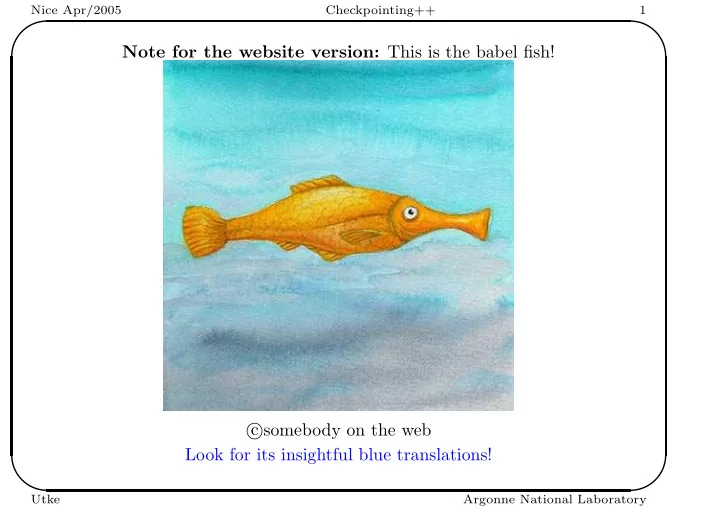
✬ ✫ ✩ ✪ Note for the website version: This is the babel fish! c somebody on the web Look for its insightful blue translations!

Utke Argonne National Laboratory
slide-2
SLIDE 2

Nice Apr/2005 Checkpointing++ 2

✬ ✫ ✩ ✪ Jean, despite his name, quite lamentably does not speak French! He won’t even attempt to pronounce things. He has been trying to learn but it’s nothing to speak of (yet). c somebody else on the web or may be the same person Babel Fish: “Jean, en db´ epit de son nom, tout ` a fait lamentably ne parle pas fran¸ cais! Il n’essayera pas mˆ eme de prononcer des choses. Il avait essay´ e d’apprendre mais il n’est rien ` a parler de (pourtant).”

Utke Argonne National Laboratory

slide-3
SLIDE 3

Nice Apr/2005 Checkpointing++ 3

✬ ✫ ✩ ✪

Automatic checkpoints and adaptive reversal schemes

(Points de contrˆ

  • le automatiques et arrangements adaptatifs d’inversion)
  • J. Utke
  • Merci des poissons de Babel!
  • thanks to Uwe and Michelle
  • keep options for OpenAD extensions
  • automatic checkpointing
  • subroutine argument and result checkpointing
  • semi-automatic checkpointing with hints
  • use of OpenAnalysis
  • consider Fortran and C++

Utke Argonne National Laboratory

slide-4
SLIDE 4

Nice Apr/2005 Checkpointing++ 4

✬ ✫ ✩ ✪

the “easy” part

subroutine 1 call 2; ... call 4; ... call 2; end subroutine 1 subroutine 2 call 3 end subroutine 2 subroutine 4 call 5 end subroutine 4

11 31 32 51 41 21 22

  • What do argument checkpointing for subroutines consist of?
  • arguments, references to global variables
  • OpenAnalysis provides side-effect analysis
  • we ask for four sets: ModLocal ⊆ Mod, ReadLocal ⊆ Read
  • What do these sets consist of? Variable references!

Utke Argonne National Laboratory

slide-5
SLIDE 5

Nice Apr/2005 Checkpointing++ 5

✬ ✫ ✩ ✪

all set for joint mode

11 11 31 31 31 31 32 32 32 32 51 51 51 51 41 41 41 21 21 21 22 22 22

  • we get away with a stack to store checkpoints

(nous partons avec une pile pour stocker des points de contrˆ

  • le)
  • What about result checkpointing?

Utke Argonne National Laboratory

slide-6
SLIDE 6

Nice Apr/2005 Checkpointing++ 6

✬ ✫ ✩ ✪

repeated evaluations for deep call stacks

11 11 31 31 31 31 32 32 32 32 51 51 51 51 41 41 41 21 21 21 22 22 22 11 11 31 31 31 31 32 32 32 32 51 51 51 51 41 41 41 21 21 21 22 22 22

The reevaluation count is reduced but we lose stack storage. (Le compte de r´ e´ evaluation est r´ eduit mais nous perdons le stockage de pile.)

Utke Argonne National Laboratory

slide-7
SLIDE 7

Nice Apr/2005 Checkpointing++ 7

✬ ✫ ✩ ✪

  • ne more layer

11 11 21 21 21 31 31 31 31 41 42 41 41 41 41 42 42 42 42

  • a more suitable storage format is the dynamic call tree
  • it is required by general reversal schemes, where there is no fixed reversal mode

per subroutine

  • for instance, “shallow” parts of the call tree need less tape than joint mode

requires for the “deep” parts (in subroutine units)

Utke Argonne National Laboratory

slide-8
SLIDE 8

Nice Apr/2005 Checkpointing++ 8

✬ ✫ ✩ ✪

general reversal example

11 11 21 21 21 22 22 23 23 31 31 31 32 32 41 41 41

  • we have 4 tape units
  • 22 and23 behave like split, 21 behaves like joint
  • How do we control the behavior?
  • runtime estimates for checkpoint/tape size and recomputation effort → derive

reversal scheme according to memory/runtime limits as dynamic call tree

Utke Argonne National Laboratory

slide-9
SLIDE 9

Nice Apr/2005 Checkpointing++ 9

✬ ✫ ✩ ✪

reducing the checkpoints?

  • always Readcallee ⊆ Readcaller
  • multiple writes of x /

∈ ReadLocal

  • can store only x ∈ ReadLocal (except in callers whose callees don’t store anything)

1 4 2 3 4 4 2 3 2 3 3 4 1 4

(s, t, r) (t, r) (r)

1 4 2 3 4 4 2 3 2 3 3 4 1 4

(s, t, r) (t, r) (r) s t r (r is ’big’)

  • loose stack format; same storage requirements;
  • same number of (’big’) reads; fewer ’big’ writes.
  • How about result checkpoints?

Utke Argonne National Laboratory

slide-10
SLIDE 10

Nice Apr/2005 Checkpointing++ 10

✬ ✫ ✩ ✪

result checkpoints

  • always Modcallee ⊆ Modcaller
  • multiple writes and simultaneous representations of all y /

∈ ModLocal

  • can store only y ∈ ModLocal (except in callers whose callees don’t store anything)

1 4 2 3 4 2 3 2 3 3 4 1 4

r

1 4 2 3 4 2 3 2 3 3 4 1 4

r t (r is ’big’)

  • now 3’s result restore has to traverse the hierarchy to be complete
  • but this isn’t so bad since we have the dynamic call tree anyway

(mais ce n’est pas aussi mauvais puisque nous avons l’arbre dynamique d’appel de toute fa¸ con)

Utke Argonne National Laboratory

slide-11
SLIDE 11

Nice Apr/2005 Checkpointing++ 11

✬ ✫ ✩ ✪

What did you say you store?

I said variable references !

  • v, *v p, V[i], V etc. works ok for cases with “fixed” addresses
  • doesn’t work if i in V[i] is computed in the code
  • store V instead
  • subroutine arguments with user defined types require serialization

struct S{ double d; int i;}; foo (S s){ ...checkpoint(s);...};

  • should serialization follow pointers/references?

think linked list vs. const reference

struct S{ double d; S* n;}; foo (S& s){ ...while (s.n) { x=bar(s.d); s=*(s.n);}...};

  • “checkpoint on read”

foo(S& s){ ...while (s.n) { checkpoint(s.d); x=bar(s.d); s=*(s.n); }...};

Utke Argonne National Laboratory

slide-12
SLIDE 12

Nice Apr/2005 Checkpointing++ 12

✬ ✫ ✩ ✪

...but

  • multiple uses of s.d → checkpoint on first read
  • similar to deciding if V[i] loop reads the same data as a V[j] loop

for (i=0;i<n;i+=2) { ...V[i] ... } for (j=1;j<n;j+=2) { ...V[j] ... }

  • → array section analysis (or remember addresses along with values but this is

expensive)

  • result checkpoints don’t have the “restore mixed with subroutine code” option
  • they could be stored with (stack) addresses
  • heap addresses?

Utke Argonne National Laboratory

slide-13
SLIDE 13

Nice Apr/2005 Checkpointing++ 13

✬ ✫ ✩ ✪ dynamic memory 2nd

  • dynamic memory 1st was at Hatfield in the

context of taping

  • similar issues for checkpointing
  • for taping:

– possible option: don’t do anything for allocations in the reverse sweep – or reverse allocations/deallocations and map

  • for checkpointing:

– no obvious de/allocation pairs – ignore allocations – instead keep addresses in the check- point and restore – address assignments are part

  • f

ModLocal – scope does not fit checkpoints – consider not just memory but any re- source

Utke Argonne National Laboratory

slide-14
SLIDE 14

Nice Apr/2005 Checkpointing++ 14

✬ ✫ ✩ ✪

Oh boy, that’s a whole new can of worms! Le gar¸ con d’Oh, celui est un nouveau bidon entier de vers !

Utke Argonne National Laboratory