
SLIDE 1
Experiences
- f Centers
Routinely Using Probiotics
Probiotics and the Prevention of NEC, Death, and Sepsis
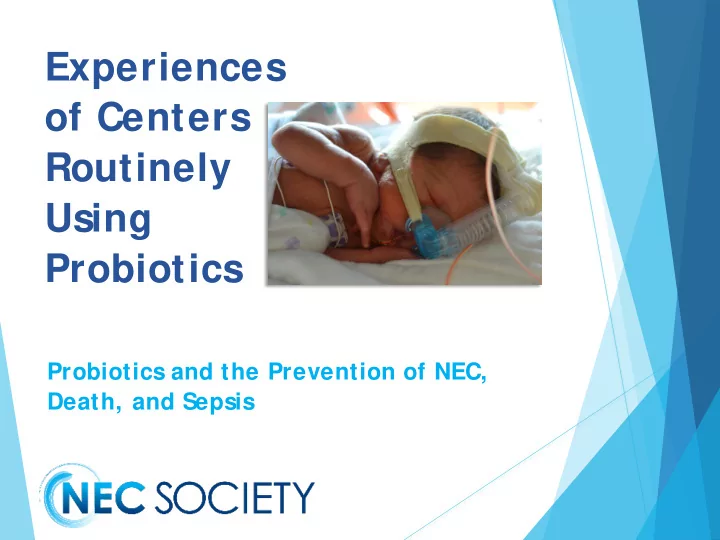
Experiences of Centers Routinely Using Probiotics Probiotics and - - PowerPoint PPT Presentation
Experiences of Centers Routinely Using Probiotics Probiotics and the Prevention of NEC, Death, and Sepsis S ave the dates! Monday, May 6 at 12pmET Practical Considerations and Consent - UC Davis - Emory University - Patient-family
Probiotics and the Prevention of NEC, Death, and Sepsis
Monday, May 6 at 12pmET
Practical Considerations and Consent
June 2 – 5, 2019
NEC Symposium in Ann Arbor, MI
This an educational webinar series. The NEC Society and invited speakers are not marketing any probiotic products, which are not currently FDA approved for the prevention of necrotizing enterocolitis or
Jennifer Canvasser
with son, Micah
Founder, Director of
NEC Society
Vision: create a world
without NEC
Jennifer@
NECsociety.org
Jennifer Canvasser, MS W Founder, Director NEC S
Mark Undewood, MD, MAS Professor of Pediatrics UC Davis, CA S cientific Advisor, NEC S
Ravi Patel, MD, MS c Associate Professor of Pediatrics Emory University, Atlanta, GA S cientific Advisor, NEC S
Intestinal dysbiosis is common and plays a central role in NEC pathogenesis Probiotics decrease the risk of NEC, death and sepsis in VLBW and ELBW infants
Mechanisms: alter microbiota, decrease inflammation, decrease intestinal permeability No clear best product choice Parents want to discuss NEC, human milk and probiotics (resources available at NECSociety.org)
Welcome and introduction
Jennifer Canvasser, MS W and Mark Underwood, MD, MAS
Experiences of centers:
University of Utah
Maggie S ekhon, MD and Brad Y
Northern California Kaiser Permanente
Allen Fischer, MD
S
David Braun, MD
Emory University
Ravi Patel, MD, MS c
Q&A with speakers
University of Utah
University of Utah
Kaiser Permanente, S
Kaiser Permanente, Northern California
Today’s Guest Faculty Speakers
Maggie K Sekhon & Bradley A Yoder Division of Neonatology University of Utah School of Medicine
Prematurity Immature epithelium Intestinal perfusion Inflammation Genetics Immature innate immunity Intestinal dysbiosis Enteral feeding
Prematurity Immature epithelium Intestinal perfusion Inflammation Genetics Immature innate immunity Intestinal dysbiosis Enteral feeding June 2013: Pasteurized donor human milk (PDHM) Sept 2011: Umbilical cord milking (UCM)
5 10 15 20 25 2010 2011 2012 2013 2014 2015 % NEC> Bell 2 Year
Sept 2011: UCM June 2013: PDHM
Prematurity Immature epithelium Intestinal perfusion Inflammation Genetics Immature innate immunity Intestinal dysbiosis Enteral feeding Oct 2016: Probiotics
June 2013: Pasteurized donor human milk (PDHM) Sept 2011: Umbilical cord milking (UCM)
Aim Primary Drivers Secondary Drivers Interventions Prevent probiotic contamination Address provider concerns Pharmacy handoff tool to include section for “probiotics by 72h” Staff specific education sessions EMR order for probiotic Protocol to guide probiotic suspension preparation by pharmacy technician Patient identification process EMR order detection Ensure eligible patients receive probiotic Track probiotic administration Prevent & monitor adverse events Protocol development Education Utilize a probiotic protocol to achieve a 50% reduction in rates of NEC ≥ Bell 2 in infants < 330/7 weeks gestation or <1500g by Oct 2018 Weekly chart review Pharmacist to screen eligible patients and notify providers on daily rounds Establish system for reporting positive blood cultures Nursing protocol to administer probiotic suspension Protocol to start and stop probiotic suspension Establish inclusion and exclusion criteria
Education/consensus building & intervention development Probiotic protocol implementation: Oct 3, 2016 Intervention sustainment
0.14 0.02 0.04
0.61 0.09 0.36
0.00 0.10 0.20 0.30 0.40 0.50 0.60 0.70 0.80 Oct-14 Nov-14 Dec-14 Jan-15 Feb-15 Mar-15 Apr-15 May-15 Jun-15 Jul-15 Aug-15 Sep-15 Oct-15 Nov-15 Dec-15 Jan-16 Feb-16 Mar-16 Apr-16 May-16 Jun-16 Jul-16 Aug-16 Sep-16 Oct-16 Nov-16 Dec-16 Jan-17 Feb-17 Mar-17 Apr-17 May-17 Jun-17 Jul-17 Aug-17 Sep-17 Oct-17 Nov-17 Dec-17 Jan-18 Feb-18 Mar-18 Apr-18 May-18 Jun-18 Jul-18 Aug-18 Sep-18 Oct-18
NEC ≥ Bell 2/100 patient days Month-Year
Education and consensus building Implementation
Oct 2016: Intervention start Upper/lower control limit Average Rate
Sustainment
Nov 2017: First NEC cases (n=2) after intervention start July 2017: Special cause change
GA Birth weight NEC Mon-Year NEC Day
NEC Class Survived? On probiotics? 25 5/7 965 Nov-2017 15 Surgical N Yes 28 2/7 520 Nov-2017 11 Surgical Y Yes 28 5/7 1030 Jan-2018 3 Surgical Y No 26 2/7 705 Mar-2018 8 Bell 2 N No 32 0/7 2010 Jul-2018 16 Bell 2 Y Yes
David Braun, MD Regional PIC, Neonatology Feb 23, 2019
◼ Babies
◼ 41,000 births ◼ 600 little babies (GA < 32 wk or BW <= 1500 g)
◼ NICUs
◼ 5 surgical level 3 NICUs ◼ 4 medical level 3 NICUs ◼ 4 level 2 NICUs
◼ Neonatologists
◼ 65
◼ NICU directors’ committee
◼ 1
◼ # of centers using probiotics
◼ 1
2
◼ 2015 ◼ KP EBM study surveillance team concluded: time for probiotics ◼ 2015-2017 ◼ Numerous discussions ◼ NICU opinion leader ad hoc group ◼ CME sessions ◼ NICU directors’ committee discussions ◼ Outside experts brought in for formal consultation (eg Underwood) ◼ 1:1 discussions ◼ Pharmacy discussions
3
Should we try probiotics at all?
4
What generated discomfort Response
Fear of that there isn’t enough data to support probiotic use Tens of thousands of patients, dozens of RCTs, multiple meta-analyses. Much better literature support than most any intervention AAP says not to use them till FDA approves Quirks of US (FDA) treatment of probiotics (food vs drug) is practical obstacle to approve probiotics as drug Fear of nosocomial infection from contaminants (FDA issue 1) Overall nosocomial infection rate LOWER with probiotics. FDA was basically case report. Use high quality product Fear that organisms in products not of proper ID, viability, or titer (FDA issue 2) Publications distinguish between poor and high quality products Our NEC rates are already low Studies with similar starting NEC rates still show further drop in NEC Don’t we need RCT to adopt probiotics into practice? We’re not allowed to arbitrarily change standard of care. Got formal legal opinion: wide latitude allowed if plausible rationale Change: the only perfectible practice is consistent practice Let’s up our game: choose changes in care rationally, implement consistently and then assess
Which probiotic?
5
Criteria FloraBaby ABC Dophilus Natren (B infantis) Biogaia Protectis (L reuteri) Evivo (B infantis ss) Product quality (titer, constituent consistency) + ++ ++ Safety (no contaminants) ? ? + + Not a powder (FDA issue) + + Not a powder (ease of administration in NICU setting) + + Efficacy (NEC) + + ++ + ++ Efficacy (nosocomial inf) + ++ + Efficacy (colonization, outcompeting pathogens) + + ++ + +++
Safety/efficacy (gut-trophic metabolites) + + + + +++
Agreed to encourage use of Biogaia Protectis or Gerber Soothe Tentative plan to change to Evivo when available
◼ Rationale for ◼ Most appealing of products available at time ◼ Probably change to Evivo (B infantis) when available ◼ Would “break the ice” for using probiotics at all ◼ Target babies ◼ VLBW or GA < 32 wk while feeding and GA < 34 wk ◼ Results: ◼ Marked increase in use ◼ No subjective complaints ◼ No objective change in NEC, infection, length of stay, death SCPMG Consulting and Implementation | Women and Children’s Health Leadership Team | Sponsors Update Q1 2019 6
year NICUs using Probiotics Little Babies receiving Probiotics 2016 1 (7%) 3% 2017 10 (77%) 40%
Evivo now available Discomfort (MD and Pharmacy) with changing to Evivo
7
What generated discomfort Response
Biogaia is going well: why change? “Well”=ease of use, no obvious problems Expect as “well” or with Evivo Biogaia has efficacy: why change? Evivo likely to have significantly more efficacy Evivo is not on formulary and not
Got on formulary Got contract Heavy marketing by Evivo: are we caving to marketing? Marketing doesn’t mean product is worse Worked with Evolve Biosystem to decrease marketing Evivo much more expensive KP cost benefit analysis (drug costs vs acute hospital costs of NEC) Conclusion: same $ for less disease Cost benefit analysis is just theoretical: why not wait for future studies Studies won’t be out for years at very least Likely form of study: Pragmatic (QI) trial So why don’t we be one of those pragmatic (QI) trials? We don’t do studies; we use our personal experience Personal experience is just a mediocre form of a study Why not up our game individually and as a profession? Let’s combine our efforts, let’s coordinate on this “The only perfectible practice is consistent practice”
Agreement to use Evivo exclusively for now
◼ QI initiative (pragmatic trial) ◼ Product: ◼ Evivoliquid ◼ Population ◼ GA< 32 wk or BW<=1500 g or GI baby ◼ Dose: ◼ unit dose (8B CFU) daily ◼ Days to dose ◼ any day an enteral feeding is given ◼ Days not to dose ◼ Days baby not fed a feeding ◼ Postmenstrual age >= 34 wk ◼ When to reassess this regimen ◼ N=2000 babies dosed ◼ 80% power to pick up drop of NEC from 3% to 2%
8
Biogaia or Evivo
9
for Evivo
10
Ravi Mangal Patel, MD, MSc Associate Professor of Pediatrics Emory University School of Medicine and Children’s Healthcare of Atlanta rmpatel@emory.edu
@ravimpatelmd #preventNEC Disclosure: Probiotics are not approved by the US Food and Drug Administration for the prevention of NEC or other diseases in preterm
weight (VLBW) infants (based on VON definition).
part of efforts to decrease NEC and we had began discussions regarding the use of probiotics.
was important in our center’s decision to begin routine use
Decrease NEC in VLBW infants from 15% to below 5% by 12/31/18
Dysbiosis (Abnormal bacterial colonization)
Prematurity
Decreased gut oxygenation 1. Increase maternal breastfeeding 2. Availability of donor human milk 3. Use of human milk fortifiers 1. Reduce indwelling time of feeding tubes 1. Revise feeding protocol 2. Adhere to feeding protocol Inconsistent feeding approaches 1. Reduce acid-suppression use 2. Decrease prolonged antibiotic use 1. Probiotic supplementation Potentially harmful medications 1. Delayed cord clamping 2. Prevent severe anemia Non-human milk feeding
Drivers Aim Interventions
Decrease NEC in VLBW infants from 15% to below 5% by 12/31/18
Dysbiosis (Abnormal bacterial colonization)
Prematurity
Decreased gut oxygenation 1. Increase maternal breastfeeding 2. Availability of donor human milk 3. Use of human milk fortifiers 1. Reduce indwelling time of feeding tubes 1. Revise feeding protocol 2. Adhere to feeding protocol Inconsistent feeding approaches 1. Reduce acid-suppression use 2. Decrease prolonged antibiotic use 1. Probiotic supplementation Potentially harmful medications 1. Delayed cord clamping 2. Prevent severe anemia Non-human milk feeding
Drivers Aim Interventions
Feeding protocol target
2008-Q3 2009-Q2 2010-Q1 2010-Q4 2011-Q3 2012-Q2 2013-Q1 2013-Q4 2014-Q3 2015-Q2 2016-Q1
Donor milk
2008-Q3 2009-Q2 2010-Q1 2010-Q4 2011-Q3 2012-Q2 2013-Q1 2013-Q4 2014-Q3 2015-Q2 2016-Q1
Probiotic use
2008-Q3 2009-Q2 2010-Q1 2010-Q4 2011-Q3 2012-Q2 2013-Q1 2013-Q4 2014-Q3 2015-Q2 2016-Q1
Delayed cord clamping 0% 20% 40% 60% 80% 100%
2008-Q3 2009-Q2 2010-Q1 2010-Q4 2011-Q3 2012-Q2 2013-Q1 2013-Q4 2014-Q3 2015-Q2 2016-Q1
Any human milk 0% 20% 40% 60% 80% 100%
2008-Q3 2009-Q2 2010-Q1 2010-Q4 2011-Q3 2012-Q2 2013-Q1 2013-Q4 2014-Q3 2015-Q2 2016-Q1
Acid suppression use 0% 82% 0% 88% 0% 28% 89% 100% 27% 0%
JUL 16 (n=1) AUG 16 (n=17) SEP 16 (n=21) OCT 16 (n=6) NOV 16 (n=7) DEC 16 (n=5) JAN 17 (n=7)
88%
Kane et al. J Pediatr. 2018
Kane et al. J Pediatr. 2018
including reducing prolonged empiric antibiotic use.
reuteri-containing liquid preparation in 2018.
influence of population characteristics (e.g. antibiotic use) on probiotic effects and choice of specific products.
More information can be found on the NEC S
Contact: Jennifer@ NECsociety.org