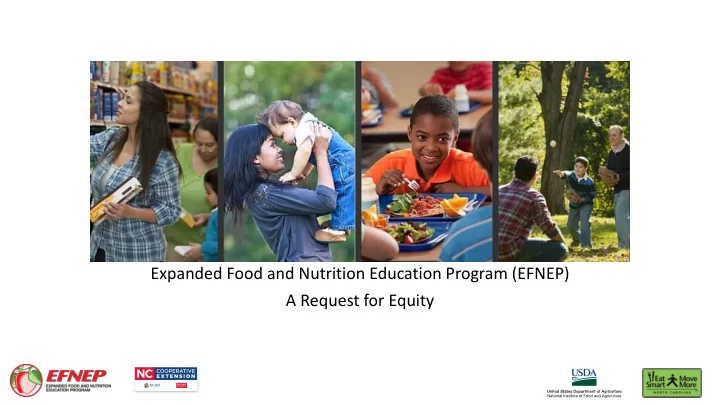
Expanded Food and Nutrition Education Program (EFNEP) A Request for - - PowerPoint PPT Presentation
Expanded Food and Nutrition Education Program (EFNEP) A Request for Equity How the Program Operates Shewana McSwain Lorelei Jones Nutrition Programs Coordinator EFNEP Coordinator NC A&T State University NC State University Diverse
How the Program Operates
Shewana McSwain Nutrition Programs Coordinator NC A&T State University Lorelei Jones EFNEP Coordinator NC State University
Diverse Audience
White, 52% Black, 44% Other, 4%
RACE
Hispanic, 27% Non- Hispanic, 73%
ETHNICITY
What is EFNEP?
- Federally funded nutrition education
program which began in 1969
What is EFNEP?
- Federally funded
nutrition education program which began in 1969
- Serves low-income
families with children and low-income school-aged youth
What is EFNEP?
- Federally funded nutrition education
program which began in 1969
- Low-income families with children
and low-income school-aged youth
- Paraprofessionals (Peer Educators)
trained and working through Cooperative Extension
EFNEP Priorities
Food Resource Management Food Safety Physical Activity Nutrition Food Security
EFNEP Works
Research
- For every $1 invested in EFNEP,
there is up to a $10 savings in potential health care costs.
- EFNEP is the most successful
federally funded nutrition education program in increasing fruit and vegetable consumption
What Makes EFNEP Unique?
- Peer Educators
- Practical, hands-on learning
https://nifa.usda.gov/efnep-research-and-cost-benefit-studies
Positive Behavior Change in Participant
- Increased consumption:
- Fruit: 55%
- Vegetable: 54%
- Whole Grains: 47%
- Increased consumption:
- Fruit: 55%
- Vegetable: 54%
- Whole Grains: 47%
- Increased Physical Activity: 50%
Positive Behavior Change in Participant
- Increased consumption:
- Fruit: 55%
- Vegetable: 54%
- Whole Grains: 47%
- Increased Physical Activity: 50%
- Improved Food Resource
Management Skills: 90%
Positive Behavior Change in Participant
- Increased consumption:
- Fruit: 55%
- Vegetable: 54%
- Whole Grains: 47%
- Increased Physical Activity: 50%
- Improved Food Resource
Management Skills: 90%
- Improved Food Safety: 76%
Positive Behavior Change in Participant
- Improved dietary intake: 97%
- Fruit: 55%
- Vegetable: 54%
- Whole Grains: 47%
- Increased Physical Activity: 50%
- Improved Food Resource
Management Skills: 90%
- Improved Food Safety: 76%
- Improved Food Security: 58%
Positive Behavior Change in Participant
How EFNEP can Address Heart Disease and Stroke Prevention
- Utilize evidence-based strategies that
result in behavior change
How EFNEP can Address Heart Disease and Stroke Prevention
- Utilize evidence-based strategies that
result in behavior change
- Address risk behaviors
- Sodium
- Saturated fat
- Physical inactivity
EFNEP Success in Reducing Sodium, Solid Fat and Added Sugars
56% 56% 57% 60% 2013 2014 2015 2016
Reduced Sodium Intake
53% 54% 57% 59% 2013 2014 2015 2016
Reduced SoFAs Intake
Current EFNEP Outreach
Buncombe Henderson Halifax Northampton Hertford Gates Edgecombe Onslow Carteret Sampson Johnston Lenoir Clay Greene Jones Wake Duplin Bertie Hyde Pitt Nash Wilson Washington Tyrell Beaufort Pender New Hanover Craven Brunswick Macon Gaston Surry Cabarrus Cleveland Rowan Scot- land Forsyth Guilford Caswell Orange Durham Lee Harnett Cumberland Bladen Columbus Tran- sylvania Swain Watauga Wayne Pamlico Dare Ashe Alamance Vance Warren Robeson Cherokee Graham Madison McDowell Rutherford Polk Alleghany Wilkes Caldwell Burke Alex- ander Catawba Lincoln Stokes Rockingham Yadkin Iredell Davie Randolph Chatham Granville Franklin Person Stanly Union Anson Hoke
EFNEP Counties
How EFNEP Funds are Leveraged
County, 17% Grant, 4% Other, 2% Federal, 77%
Total Budget
Federal, 58% County, 36% Grant, 6%
Paraprofessional Salaries and Benefits (70%
- f Total Budget)
Why Equity is needed
How funds requested would be used
70% 10% 20% Paraprofessionals Professionals Education and Teaching Materials
EFNEP Success Story
For more about EFNEP and to see the full video visit: https://www.ncfamilieseatingbetter.org/EFNEP/partners-about.php