Exercise 3.21. Consider the following transition table for an NFA - - PowerPoint PPT Presentation

exercise 3 21 consider the following transition table for
SMART_READER_LITE
LIVE PREVIEW

Exercise 3.21. Consider the following transition table for an NFA - - PowerPoint PPT Presentation

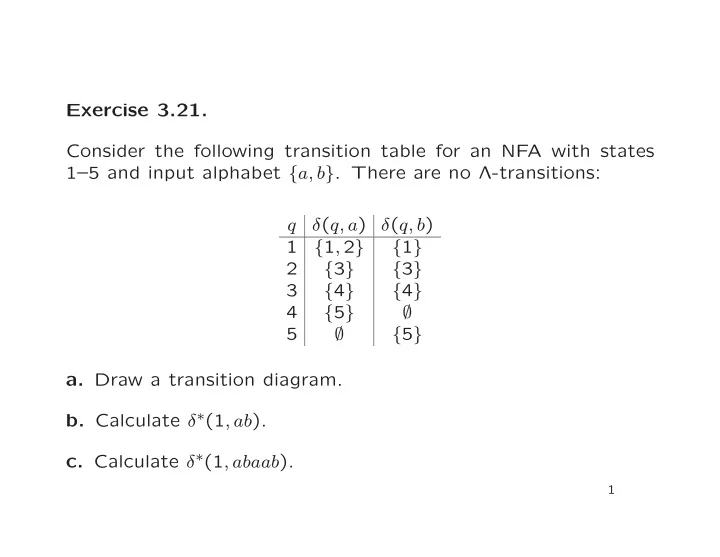
Exercise 3.21. Consider the following transition table for an NFA with states 15 and input alphabet { a, b } . There are no -transitions: ( q, a ) ( q, b ) q 1 { 1 , 2 } { 1 } 2 { 3 } { 3 } 3 { 4 } { 4 } 4 { 5 } 5 { 5 }


slide-1
SLIDE 1

Exercise 3.21. Consider the following transition table for an NFA with states 1–5 and input alphabet {a, b}. There are no Λ-transitions: q δ(q, a) δ(q, b) 1 {1, 2} {1} 2 {3} {3} 3 {4} {4} 4 {5} ∅ 5 ∅ {5}

  • a. Draw a transition diagram.
  • b. Calculate δ∗(1, ab).
  • c. Calculate δ∗(1, abaab).

1

slide-2
SLIDE 2

Exercise 3.22. A transition table is given for an NFA with seven states. q δ(q, a) δ(q, b) δ(q, Λ) 1 ∅ ∅ {2} 2 {3} ∅ {5} 3 ∅ {4} ∅ 4 {4} ∅ {1} 5 ∅ {6, 7} ∅ 6 {5} ∅ ∅ 7 ∅ ∅ {1} Find:

  • d. δ∗(1, ba)
  • e. δ∗(1, ab)
  • f. δ∗(1, ababa)

2

slide-3
SLIDE 3

Exercise 3.37. In each part of Figure 3.36 (on the blackboard) is pictured an NFA. Use the algorithm from the lecture to draw an NFA with no Λ-transitions accepting the same language. b.

3

slide-4
SLIDE 4

Exercise 3.40. Each part of Figure 3.38 (on the blackboard) shows an NFA. Draw an FA accepting the same language. a.

4