Evidence-Based Tools to Enhance Communication in Palliative Care - - PDF document

evidence based tools to enhance communication in
SMART_READER_LITE
LIVE PREVIEW

Evidence-Based Tools to Enhance Communication in Palliative Care - - PDF document

9/12/2018 Evidence-Based Tools to Enhance Communication in Palliative Care Midwest Regional Conference on Palliative & End of Life Care October 8, 2018 Brian D. Carpenter, PhD Meghan McDarby, MA Patrick White, MD Department of


slide-1
SLIDE 1

9/12/2018 1

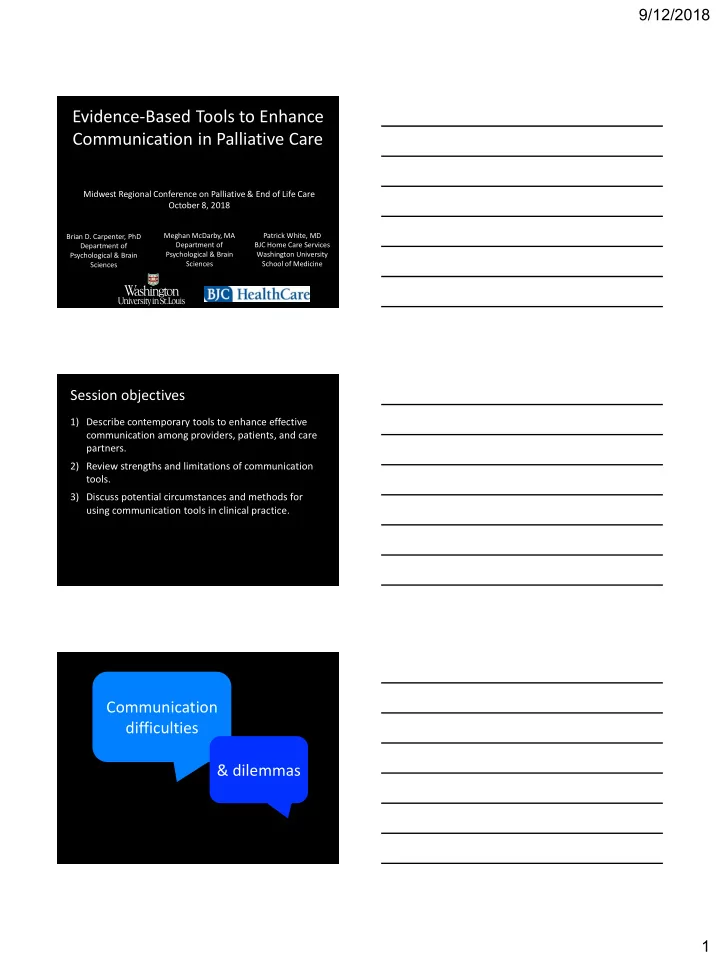
Evidence-Based Tools to Enhance Communication in Palliative Care

Brian D. Carpenter, PhD Department of Psychological & Brain Sciences Meghan McDarby, MA Department of Psychological & Brain Sciences Patrick White, MD BJC Home Care Services Washington University School of Medicine

Midwest Regional Conference on Palliative & End of Life Care October 8, 2018

Session objectives

1) Describe contemporary tools to enhance effective communication among providers, patients, and care partners. 2) Review strengths and limitations of communication tools. 3) Discuss potential circumstances and methods for using communication tools in clinical practice.

Communication difficulties & dilemmas

slide-2
SLIDE 2

9/12/2018 2 Effective communication is…

… the foundation of high-quality, person-centered care. … essential regardless of disease and across the illness trajectory. … associated with better outcomes for patients and care partners. … the primary vehicle for the practice of palliative care. … often, THE desired skill underlying a palliative care consultation.

Professional competencies

“demonstrate interpersonal and communication skills that result in effective relationship-building, information exchange, emotional support, shared decision-making and teaming with patients, their patients’ families, and professional associates.” HPM Competencies Work Group Medicine “Educate and communicate effectively and compassionately with the patient, family, health care team members, and the public about palliative care issues.” American Association of Colleges of Nursing Nursing “facilitating communication among clients, family members, and members of the care team.” National Association of Social Workers Social Work “Demonstrate effective communication and facilitation of goals

  • f care family meetings that align treatment plans with patient’s

values and/or advanced care plans.” Board of Chaplaincy Certification Chaplaincy

Key communication skills

Patients and care partners Sending

Providing information about illness symptoms Relaying treatment response and side effects Expressing values and preferences Asking important questions

Receiving

Comprehending and accepting assessment results & diagnoses Understanding treatment recommendations Comprehending futility Offering emotional support

slide-3
SLIDE 3

9/12/2018 3 Key communication skills

Providers Sending

Providing feedback on test/assessment results Sharing diagnostic & prognostic information Describing treatment options Motivating treatment compliance Offering emotional support & hope Being present & attentive in conversations

Receiving

Synthesizing descriptions of symptoms Understanding impact of illness on function and quality of life Appreciating patient & care partner perspective on goals

Transactional model of communication

du Pre & Foster (2016)

Tools Targeting Competencies of Providers

slide-4
SLIDE 4

9/12/2018 4

Workshops & trainings

provide education to healthcare providers includes education about team collaboration and general communication skills

Self-study training modules

purpose is to increase access to information via individual education benefits include greater accessibility, electronic delivery method

Conversational scripts & templates

enhance provider communication skills ensure that providers ask important information, gather critical details

limited empirical evidence modest empirical evidence limited empirical evidence

Workshops & trainings Difficult Discussions Comskil Self-study training modules COMFORT Conversational scripts & templates SPIKES

limited empirical evidence modest empirical evidence limited empirical evidence

Difficult Discussions

Erickson, J. M., Blackhall, L., Brashers, V., & Varhegyi, N. (2015). An interprofessional workshop for students to improve communication and collaboration skills in end-of-life

  • care. American Journal of Hospice & Palliative Medicine, 32, 876–880.
  • workshop (90 minutes)
  • didactics on EOL communication and family meetings
  • intervention: simulate family meeting
  • participants report higher importance ratings of teamwork and

collaboration

slide-5
SLIDE 5

9/12/2018 5 Comskil

Bylund, C. L., Brown, R. F., Bialer, P. A., Levin, T. T., Lubrano di Ciccone, B., & Kisssane,

  • D. W. (2011). Developing and implementing an advanced communication training program

in oncology at a comprehensive cancer center. Journal of Cancer Education, 26, 604–611.

  • teaching modules (nine, 3-hours each) focused on 26

communication skills

  • role playing simulation with patients
  • increases in levels of self-efficacy
  • greater utilization skills taught during training

COMFORT

Wittenberg-Lyles, E., Goldsmith, J., Ferrell, B., & Burchett, M. (2014). Assessment of an interprofessional online curriculum for palliative care communication training. Journal of Palliative Medicine, 17, 400–406.

  • online modules with didactic information
  • include video clips of hospice team interactions
  • focus on communication, health literacy, and families
  • providers reported greater confidence in communication

SPIKES

Buckman, R. (2005). Breaking bad news: The S-P-I-K-E-S strategy. Community Oncology, 2, 138–142.

  • guide to conversational goals in delivering bad news
  • enhances delivery of important information
  • supports relational aspects of bad news communication
slide-6
SLIDE 6

9/12/2018 6

Tools Targeting Patients & Care Partners

slide-7
SLIDE 7

9/12/2018 7

Question prompt lists

purpose is to empower patients to seek information, express concerns, collaborate on decision-making typical format is written questions or topics taken to appointments as reminder (prompt) for discussion

Appointment coaching

purpose is to teach patients to be active agents during visits, getting the information they need typical format involves

  • ne-on-one meetings

combined with booklets, charts, & videos

Other novel interventions

Stanford Letter Writing Project Sharing Patient Illness Representations to Increase Trust (SPIRIT) Serious Illness Care Program (SICP) Communication in Cancer Care

modest empirical evidence modest empirical evidence limited empirical evidence

Question Prompt Lists

Clayton, J. M., Butow, P. N., Tattersall, M. H. N., Devine, R. J., Simpson, J. M., Aggarwal, G., . . . Noel,

  • M. A. (2007). Randomized controlled trial of a prompt list to help advanced cancer patients and

their caregivers to ask questions about prognosis and end-of-life care. Journal of Clinical Oncology, 25, 715–723.

  • encourages questions about prognosis and end-of-life care
  • includes resources for both patients and care partners
  • tool can be segmented, tailored to patient’s stage in illness

trajectory
slide-8
SLIDE 8

9/12/2018 8 Appointment coaching

Doorenbos, A. Z., Levy, W. C., Curtis, J. R., & Dougherty, C. M. (2016). An intervention to enhance goals-of-care communication between heart failure patients and heart failure providers. Journal of Pain and Symptom Management, 52, 353–360.

  • pre-appointment telephone consultation for heart failure

patients with a nurse

  • discussed barriers and facilitators to communication, heart

failure treatments, and patient preferences for communication

  • helped patient develop “patient-activation outline” shared

with patient and provider

  • role playing and skills enhancement exercises
  • patients initiated more (and more high-quality) goals-of-care

conversations with provider

slide-9
SLIDE 9

9/12/2018 9 Stanford Letter Writing Project

Periyakoil, V.S., Neri, E., & Kraemer, H. (2018) Common items on a bucket list. Journal of Palliative Medicine, 21, https://doi.org/10.1089/jpm.2017.0512

  • patients write a What Matters Most (with Who Matters Most

components) letter to take to physician

  • letter templates available in eight languages; can also be

completed online

  • versions for “in good health” and “have chronic illness”
  • most recent iteration framed as Bucket List
  • empirical results still emerging

Question prompt lists

purpose is to empower patients to seek information, express concerns, collaborate on decision-making typical format is written questions or topics taken to appointments as reminder (prompt) for discussion

Appointment coaching

purpose is to teach patients to be active agents during visits, getting the information they need typical format involves

  • ne-on-one meetings

combined with booklets, charts, & videos

Other novel interventions

Stanford Letter Writing Project Sharing Patient Illness Representations to Increase Trust (SPIRIT) Serious Illness Care Program (SICP) Communication in Cancer Care

modest empirical evidence modest empirical evidence limited empirical evidence

Tools Targeting Communication Within Families

slide-10
SLIDE 10

9/12/2018 10

The Conversation Project Death Over Dinner My Gift of Grace HELLO! Go Wish FAmily CEntered

FAmily CEntered (FACE)

Lyon, M. E., Garvie, P. A., Briggs, L., He, J., Malow, R., D’Angelo, L. J., & McCarter, R. (2010). Is it safe? Talking to teens with HIV/AIDS about death and dying: A 3-month evaluation of Family Centered advance care (FACE) planning – anxiety, depression, quality of life. HIV/AIDS – Research and Palliative Care, 2, 27–37.

  • two-session intervention designed for people with HIV/AIDS
  • includes dyads consisting of a patient and a surrogate decision-

maker

  • Session #1: interventionist completes interview about care

values and preferences and facilitates a conversation about goals and experiences that underlie treatment preferences

  • Session #2: dyad completes advance directive

Conclusions

  • how these resources might be used in practice
  • there is emerging evidence that a range of tools and

interventions may enhance communication among patients, care partners, and providers

  • evidence is limited in its replication and very limited in

evaluation with diverse groups

slide-11
SLIDE 11

9/12/2018 11

Evidence-Based Tools to Enhance Communication in Palliative Care

Brian D. Carpenter, PhD Department of Psychological & Brain Sciences Meghan McDarby, MA Department of Psychological & Brain Sciences Patrick White, MD BJC Home Care Services Washington University School of Medicine

Midwest Regional Conference on Palliative & End of Life Care October 8, 2018