2/24/2020 Disclosure Statement Growing a Culture of Palliative Care - - PDF document

2 24 2020
SMART_READER_LITE
LIVE PREVIEW

2/24/2020 Disclosure Statement Growing a Culture of Palliative Care - - PDF document

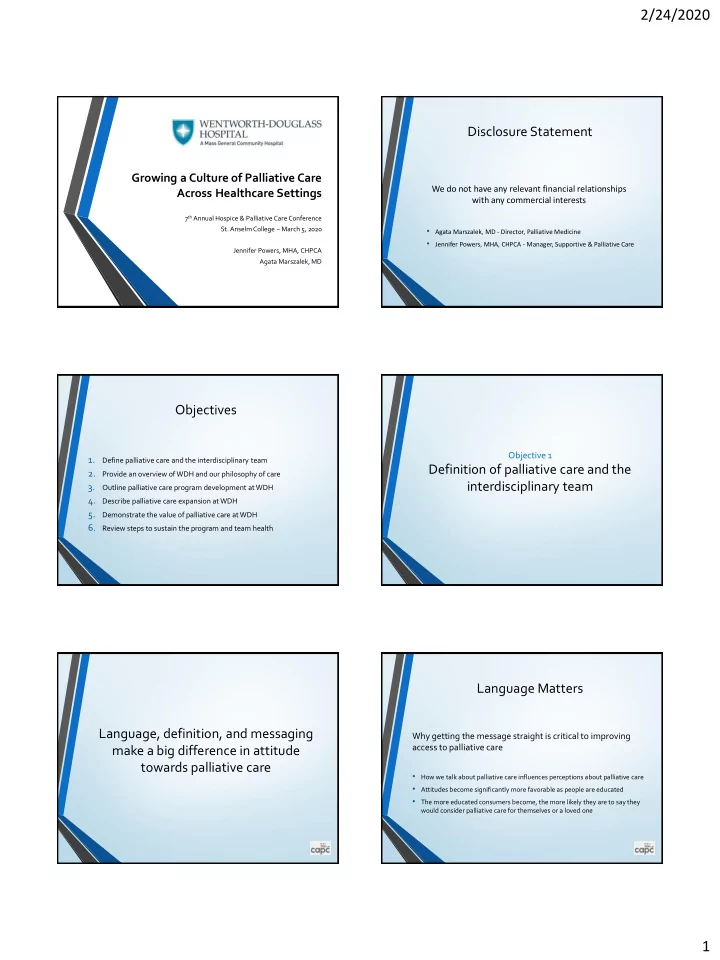
2/24/2020 Disclosure Statement Growing a Culture of Palliative Care We do not have any relevant financial relationships Across Healthcare Settings with any commercial interests 7 th Annual Hospice & Palliative Care Conference St. Anselm


slide-1
SLIDE 1

2/24/2020 1

Growing a Culture of Palliative Care Across Healthcare Settings

7th Annual Hospice & Palliative Care Conference

  • St. Anselm College ~ March 5, 2020

Jennifer Powers, MHA, CHPCA Agata Marszalek, MD

Disclosure Statement

We do not have any relevant financial relationships with any commercial interests

  • Agata Marszalek, MD - Director, Palliative Medicine
  • Jennifer Powers, MHA, CHPCA - Manager, Supportive & Palliative Care

Objectives

1.

Define palliative care and the interdisciplinary team

2.

Provide an overview of WDH and our philosophy of care

3.

Outline palliative care program development at WDH

4.

Describe palliative care expansion at WDH

5.

Demonstrate the value of palliative care at WDH

6.

Review steps to sustain the program and team health

Objective 1

Definition of palliative care and the interdisciplinary team Language, definition, and messaging make a big difference in attitude towards palliative care Language Matters

Why getting the message straight is critical to improving access to palliative care

  • How we talk about palliative care influences perceptions about palliative care
  • Attitudes become significantly more favorable as people are educated
  • The more educated consumers become, the more likely they are to say they

would consider palliative care for themselves or a loved one

slide-2
SLIDE 2

2/24/2020 2

Definition of Palliative Care

Palliative care is specialized medical care for people living with serious illness. It is focused on providing relief from the symptoms and stress of the illness. The goal is to improve quality of life for both the patient and the family.

Definition of Palliative Care

and the interdisciplinary team

Palliative care is provided by a team of doctors, nurses, and

  • ther specialists who work together with a patient’s other

doctors to provide an extra layer of support. It is appropriate at any age and at any stage in an illness, and it can be provided along with curative treatment. Palliative care is based on need, not prognosis.

Interdisciplinary team: MD, APRN, PA, RN, Social Worker, Chaplain, PT/OT, Pharmacist, Dietician

Palliative Care is not Hospice

Palliative Care

  • Not dependent on prognosis
  • Addresses patient and

family needs from diagnosis

  • f a serious illness to death
  • Services are provided in

addition to other curative treatments

Hospice Care

  • Dependent on prognosis
  • Addresses patient and family needs

6 months prior to death, and provides bereavement up to 1 year after death

  • Services are provided for terminally

ill patients who no longer seek curative treatment

What happens when we talk about palliative care and hospice in the same sentence?

“Palliative care and hospice support the patient and family during serious illness.”

Audience remembers palliative care and hospice

“Palliative care supports the best possible quality of life for patients and their families.”

Audience remembers palliative care and quality of life

Objective 2

Overview of Wentworth-Douglass Hospital and our philosophy of care History of WDH

Wentworth-Douglass Hospital opened on August 30, 1906. It has grown to become a nationally recognized, not-for-profit charitable health care organization located in the Seacoast community of Dover, New Hampshire. We have a 114-year history of compassionate care and innovation. 500 nurses 400 providers 2,300 employees

slide-3
SLIDE 3

2/24/2020 3

Overview of WDH

  • Accredited by The Joint Commission, 178 bed Magnet recognized hospital
  • January 1, 2017 we became members of Massachusetts General Hospital and

Partners Health Care System

  • Seacoast Cancer Center on the hospital campus
  • 36 outpatient primary & specialty care practices (Wentworth Health Partners)

“We Care” Philosophy at WDH

  • Patient and family centered
  • Focus on quality and good outcomes
  • Goal is to provide access to the best specialized care

close to home

  • Continue to develop, grow and improve additional

health care services to best serve the community

WDH Mission, Vision, Values

and the Triple Aim Objective 3

Palliative care program development at Wentworth-Douglass Hospital Why did WDH invest in Palliative Care?

The benefits of palliative care are huge

  • Improved patient experience
  • Safer practices
  • Reduced hospital days and patient spending due to advance care planning
  • Less staff burnout
  • Reduced unnecessary hospital utilization

Well-controlled symptoms mean fewer ED visits and hospital admissions Individuals living with a serious illness – such as cancer, COPD, heart disease, frailty, or dementia – face heightened risk of unnecessary suffering, crisis hospitalization, and preventable spending.

Pilot Study

Michele’s RN graduate project

  • Select patient care setting
  • Form primary palliative care team (MD + RN)
  • Provide education (formal, real-time)
  • Screening tool
  • Provide services to patients and families
slide-4
SLIDE 4

2/24/2020 4

Outcome of the pilot study

  • Improved symptom management and reduced caregiver burden
  • Matched treatment options to patient goals
  • Improved patient and family satisfaction with their care
  • Time devoted to intensive family meetings and counseling relieved burden on

referring physicians’ time

  • Developed momentum for the next step…

Patient testimonials “Palliative care made this difficult time a lot easier for me to cope.” “I cannot stress what a difference palliative care made in our lives – not only as a loving couple, but as a family unit.”

Program Start-Up

Step 1 System assessment

  • Identify existing strengths within the hospital system that could benefit

from a palliative care program through partnership, collaboration, and support First champions: Nurses, Hospitalists

  • Meet with multiple stakeholders: Clinicians, Leadership, Board of

Directors First champions: Chief Nursing Officer, Chief Medical Officer

Program Start-Up

Step 2 Needs assessment

  • Identify areas of need to highlight where palliative care programs make

the greatest contribution Expert symptom management Knowledge of patient priorities to improve function and quality of life Attention to physical and emotional distress Support for the primary medical provider and family caregivers

How we got buy-in for a palliative care program

Making the clinical case

The first time Brad met Dr. Agata, he had the most important conversation of his life.

How we got buy-in for a palliative care program

Making the financial case

  • Nearly 75% of hospital admissions are for patients with multiple chronic

conditions

  • Nearly 80% of ED visits and hospitalizations are due to exacerbations of

preexisting conditions and chronic symptoms

  • The sickest 10% of patients account for 65% of total health care expenses

This group is characterized not only by the presence of one or more serious medical illnesses, but also by functional dependency, cognitive impairment, frailty, and heavy reliance on family and other caregivers. Only 11% of them are in the last 12 months of life.

Objective 4

Palliative care program expansion at Wentworth-Douglass Hospital

slide-5
SLIDE 5

2/24/2020 5

Growth in Palliative Care by Region

Access to Palliative Care

Palliative Care Program Expansion

at Wentworth-Douglass Hospital

Inpatient

  • Medical/Surgical Floors
  • Critical Care Unit

Outpatient

  • Emergency Department
  • Seacoast Cancer Center
  • Hospital-based Palliative Care Clinic

The Interdisciplinary Team at WDH

Agata Marszalek, MD Director Sarah MacDuffie, DO Physician Jennifer Powers, MHA, CHPCA Manager Heidi Stucker, APRN Nurse Practitioner Mary Krans, RN Nurse Coordinator Amy Stuart, RN, CHPN Nurse Coordinator Suzanne Schuh, RN Nurse Navigator Marcia Flinkstrom, MSW Social Worker Shelly Snow, MDiv, MEd, APBCC Spiritual Care Robin Whelan, Admin Assistant Jessica Sharkey, Admin Assistant Barbara Stuart, RN, CHPN Staff Nurse (Per Diem) Michele Lovell, APRN Nurse Practitioner (Per Diem) Adrienne Hayes, APRN Nurse Practitioner (Per Diem) Anne-Marie Hardman, APRN Nurse Practitioner (per diem) Shirley Mahoney, APRN Nurse Practitioner (Per Diem)

Services Provided

Symptom management

Cancer-related pain, dyspnea, nausea, anorexia, constipation, fatigue, anxiety/depression

Advance care planning

Goals of care, guidance in decision-making, navigation of health care system

Clear communication

With primary care providers, specialists, family members

Supportive counseling

Spiritual & psychosocial/emotional support for patients and families

Program Volumes

slide-6
SLIDE 6

2/24/2020 6

Objective 5

Demonstrating the value of palliative care at Wentworth-Douglass Hospital

The Importance of Measurement

Structure: What’s in place

What are the characteristics of our service: settings, team and staffing, training, coverage, etc.

Process: What gets done

What percentage of admissions do we see, which patients and services we work with, how often we assess for symptoms

Outcome: What’s achieved

What is the impact of our service on QOL, satisfaction, LOS, readmissions, hospice referrals

Our Portfolio of Metrics

  • Total visits by setting
  • Inpatient integration
  • Stage IV lung cancer integration
  • Documentation of quality metrics
  • Patient and family satisfaction
  • Referring provider satisfaction

Structure Metrics

Settings and Volumes

% Inpatient Integration 2014 8.9 2015 7.6 2016 6.4 2017 6.7 2018 8.7 2019 7.1 % Stage IV Lung Cancer Integration 2014 68 2015 68 2016 67 2017 44 2018 52 2019 Pending

Quality Metrics

Measuring What Matters Consensus recommendations from AAHPM and HPNA

Pain Was patient screened for pain within 24 hours of initial consult? Did the patient receive a med or non-med treatment for pain within 24 hours? Dyspnea Was the patient screened for dyspnea during the initial consult? Documented Plan of Care to manage dyspnea? Nausea Was the patient screened for nausea during the initial consult? Documented plan of care to manage nausea Constipation Was patient screened for constipation during initial consult? Documented Plan of Care to manage constipation Discussion of Emotional or Psychosocial Needs Screening for Spiritual Concerns

Target performance: ≥90% documentation of metrics - MET

slide-7
SLIDE 7

2/24/2020 7

Measuring the Patient Experience

Target performance: ≥85% good + very good

Objective 6

Steps to sustain the program and team health Make Culture Change a Priority

Training of champions in primary palliative care

  • Center to Advance Palliative Care (CAPC) – educational modules
  • Vital Talk – training videos and resources
  • End-of-Life Nursing Education Consortium (ELNEC) – in person training
  • WDH palliative care education programs
  • S&PC Shadowing opportunities

Nursing students Pharmacy residents

Population Health Initiative

Who should provide palliative care?

Palliative Care Specialists 60% PCPs and other non-palliative clinicians 31% Other disciplines (Care Managers, SWs) 9%

Training of primary care physicians and Nurse Care Managers in primary palliative care

  • Serious Illness Conversation Guide
slide-8
SLIDE 8

2/24/2020 8

Primary palliative care training

Vital Talk https://www.vitaltalk.org/

Nurses and Nurse Care Managers Hospitalists Primary Care Providers

Primary palliative care training

https://www.vitaltalk.org/topics/conduct-a-family-conference/

The Power of a Palliative Care Team

Teambuilding

  • Morning huddle
  • Establishing team norms
  • Cultivating positivity

I’ll see it when I believe it (vs. I’ll believe it when I see it)

  • Meyers-Briggs

Embracing diversity in the workplace

Attaining Certification

  • Continuing education, networking

Work-life balance

  • 4-day provider work week

References and Resources

Center to Advance Palliative Care (CAPC) https://www.capc.org/ Vital Talk https://www.vitaltalk.org/ Ariadne Labs https://www.ariadnelabs.org American Academy of Hospice & Palliative Medicine (AAHPM) http://aahpm.org/ Hospice & Palliative Nurses Association https://advancingexpertcare.org/

Questions?

“We’ve been wrong about what our job is in medicine. We think our job is to ensure health and survival. But really it is larger than that. It is to enable well-being.”

~Atul Gawande, Being Mortal

Thank you!