Event-Based Haptics CPSC 599.86 / 601.86 Sonny Chan University of - - PowerPoint PPT Presentation

event based haptics
SMART_READER_LITE
LIVE PREVIEW

Event-Based Haptics CPSC 599.86 / 601.86 Sonny Chan University of - - PowerPoint PPT Presentation

Event-Based Haptics CPSC 599.86 / 601.86 Sonny Chan University of Calgary Project Milestones Wednesday, March 28th Three minutes per project Submit slides on D2L by Tuesday midnight Screen shots and/or movies of your work in


slide-1
SLIDE 1

Event-Based Haptics

CPSC 599.86 / 601.86 Sonny Chan University of Calgary
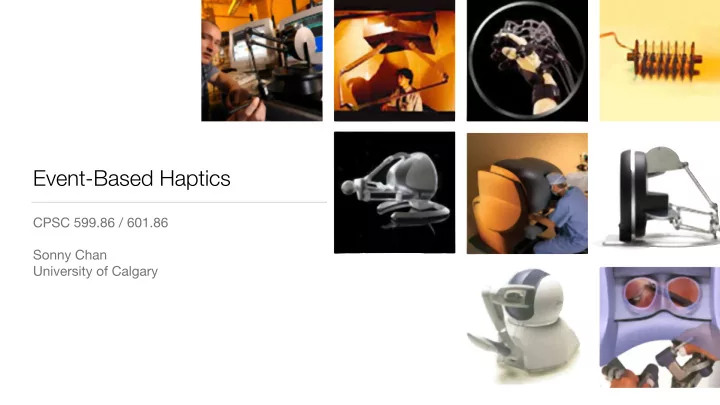
slide-2
SLIDE 2

Project Milestones

  • Wednesday, March 28th
  • Three minutes per project
  • Submit slides on D2L by

Tuesday midnight

  • Screen shots and/or movies of

your work in progress

  • Don’t spend too much time on

presentation aspect

slide-3
SLIDE 3

Motivation

  • Human manipulation is

inherently asymmetric

  • Low-frequency hand motions

elicit high-frequency responses from the environment

  • High-frequency transients are
  • ften lost in haptic simulations
  • How do we get them back?
slide-4
SLIDE 4

Recall Stiffness…

700 N/m 3000 N/m 5000 N/m > 100 N/m > 1000 N/m > 10,000 N/m > 100,000 N/m

slide-5
SLIDE 5

Everything feels like foam!

But what if we did have a device that could render an infinite stiffness?

slide-6
SLIDE 6

Contact Transients

  • Whenever we strike a real-world
  • bject, we can feel a rich, high-

frequency transient

  • What causes this transient?
  • How can we simulate it?
slide-7
SLIDE 7

The Hard Way

Calculating the transient response

slide-8
SLIDE 8

The Easy Way

Recording the transient response

slide-9
SLIDE 9

Strong precedent from the audio community…

slide-10
SLIDE 10

Improving Contact Realism through Event-Based Haptic Feedback

  • Use accelerometer to sample contact transients on real-world objects
  • Detect contact events with virtual objects in the haptic simulation
  • Play back sampled transient in an open loop

[From K. Kuchenbecker et al., IEEE Transactions on Visualization and Computer Graphics 12(2), 2006.]

slide-11
SLIDE 11

Recording the Signal

  • Accelerometers are everywhere!
  • sensor on small board
  • data recording device
  • your smart phone!

฀ ฀

slide-12
SLIDE 12

Playing the Sample

  • Record acceleration
  • Command force
  • How do we reconcile the units?

฀ ฀

???

F = m a

slide-13
SLIDE 13

The Mass Term

  • What mass should we use in our playback equation?
  • Is it device-dependent?
  • What should we use for the Novint Falcon?
  • mass of the grip?

F = m a

slide-14
SLIDE 14

System Identification

  • If we don’t know the right

“mass”, can we somehow empirically find out?

  • We have the tools…
  • Experimental Transfer Function

Determination

฀ ฀

slide-15
SLIDE 15

Again, we’ve already seen this in the audio community…

slide-16
SLIDE 16

Handling Virtual Contacts

  • Once we estimate a mass, do we have everything we need?
  • How might we handle exploring the virtual world in an undetermined way?
  • We can modulate the sample by the contact velocity
slide-17
SLIDE 17

Summary

  • Haptic simulations are often

lacking high frequency transients

  • Event-based haptic feedback

can provide contact transients

  • Record real data with accelerometer
  • Open loop playback in virtual world
  • What are the limitations of this

technique?

slide-18
SLIDE 18

Have Fun

…hitting things with your phones!