
SLIDE 1
Eun-Suk Seo
- Inst. for Phys. Sci. & Tech. and
Department of Physics University of Maryland
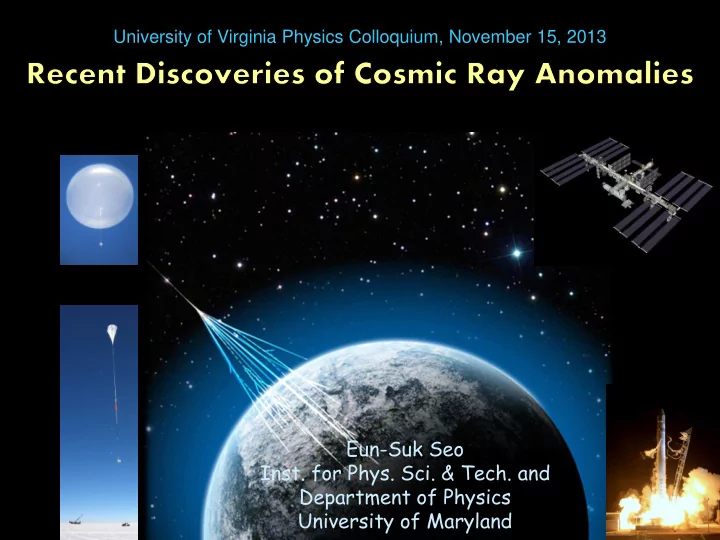
University of Virginia Physics Colloquium, November 15, 2013
Eun-Suk Seo Inst. for Phys. Sci. & Tech. and Department of - - PowerPoint PPT Presentation
University of Virginia Physics Colloquium, November 15, 2013 Eun-Suk Seo Inst. for Phys. Sci. & Tech. and Department of Physics University of Maryland Cosmic Rays: - Highest-energy particles known to mankind Why care? - Made in some of
Eun-Suk Seo
Department of Physics University of Maryland
University of Virginia Physics Colloquium, November 15, 2013
Cosmic Rays Eun-Suk Seo 2
environments of the Universe
to thermal energies, magnetic fields They influence
Cosmic Rays Eun-Suk Seo
rays with an electroscope onboard a balloon
– Reached only ~ 17,000 ft but measured an increase in the ionization rate at high altitude (1936 Nobel Prize in Physics for this work)
Balloon Borne Experiments," E. S. Seo, Invited Review Paper for Topical Issue on Cosmic Rays,
3
Cosmic Rays Eun-Suk Seo 4
BESS ATIC CREAM AMS
How do cosmic accelerators work?
11 orders of magnitude
less than ~ 10 GeV/nucleon
Elemental Charge Super TiGER
ground based Indirect measurements
CREAM SOURCES SNRs, shocks Superbubbles photon emission acceleration
Interstellar medium X,
e-
P He C, N, O etc. Z = 1- 92
gas P He C, N, O etc. gas
Halo Disk: sources, gas
escape
B Be
10Be
Synchrotron
Inverse Compton Bremstrahlung
e+e-
Chandra CGRO Voyager ACE AMS BESS
Energy losses Reacceleration Diffusion Convection
ATIC
B
Exotic Sources: Antimatter Dark matter etc.. Fermi
Cosmic Rays 5 Eun-Suk Seo
The Big Bang was preceded by vacuum. Nothing exists in a vacuum. After the Big Bang there must have been equal amounts of matter and antimatter.
Cosmic Rays 6 Eun-Suk Seo
Inflation (Big Bang plus 10-34 Seconds) Big Bang plus 300,000 Years Big Bang plus 13.7 Billion Years
Now
gravitational waves light
BOOMERANG
Cosmic Rays Eun-Suk Seo 7
dark matter.
products of WIMP’s in the Galactic halo.
Indirect Detection Direct Detection Particle Colliders
2 2
2
r v We do not know what 95% of the universe is made of!
Cosmic Rays Eun-Suk Seo 8
Cosmic Rays Eun-Suk Seo 9
1993 and 2002.
2004 and 2007 – Polar–I: 8.5 days observation – Polar–II 24.5 day observation, 4700 M events 7886 antiprotons detected: no evidence of primary antiprotons from evaporation of primordial black holes.
b1 Rigidity Abe et al. PRL, 108, 051102, 2012
Kinetic Energy (GeV) Antiproton Flux (m-2sr-1s-1GeV-1)
Balloon–borne Experiment with a Superconducting Spectrometer
Cosmic Rays Eun-Suk Seo 10
Balloon–borne Experiment with a Superconducting Spectrometer
X 1/100
x 1/10
6.9x 10⁻⁸
Cosmic Rays Eun-Suk Seo 11
Antiproton /proton Ratio
Asaoka et al., PRL 88, 051101, 2001
Cosmic Rays Eun-Suk Seo 12
e- p
He,... Matter Antimatter Superconducting Spectrometer (MASS) 1989 balloon flight in Canada GF ~21.5 cm2sr Mass: 470 kg Size: 130x70x70 cm3 Payload for Anti-Matter Exploration and Light- nuclei Astrophysics (PAMELA) satellite Launch 6/15/06
Cosmic Rays Eun-Suk Seo 13
Payload for Anti-Matter Exploration and Light-nuclei Astrophysics (PAMELA)
“High energy data deviate significantly from predictions of secondary production models (curves), and may constitute the evidence of dark matter particle annihilations, or the first observation of positron production from near-by pulsars.”
Cited > 300 times in ~ 1 yr
Cosmic Rays Eun-Suk Seo 14
Adriani et al., Nature, 458, 607-609 (2009) Adriani et al., PRL, 106, 201101 (2011)
Cosmic Rays Eun-Suk Seo 15
Alpha Magnet Spectrometer
and -rays with a single instrument
Launch for ISS on May 16, 2011
Precision Measurements
O(104)
Aguilar et al., PRL 110, 141102, 2013 First Result: Precision Measurement
Cosmic Rays of 0.5-350 GeV
Tracker
Flight data Monte Carlo Simulations
Cosmic Rays 16 Eun-Suk Seo
~16 billion events per year
Alpha Magnet Spectrometer
Cosmic Rays Eun-Suk Seo 17
150 GeV electrons show 91% containment of incident energy, with a resolution of 2% at 150 GeV
Beam test: electrons Seo et al. Adv. in Space Res., 19 (5), 711, 1997; Ganel et al. NIM A, 552(3), 409, 2005 Flight Data
620 GeV Kaluza-Klein particle boosting factor 230
Cited > 200 times in ~ 9 mo
ATIC 1+2, AMS, HEAT BETS, PPB- BETS, Emulsion chambers
ATIC discovers mysterious excess of high energy electrons
Chang et al., Nature, 456, 362-365 (2008)
Cosmic Rays Eun-Suk Seo 18
LAT
stripTracker (1.5 X0)
CsI Calorimeter (8.6 X0 )
Coincidence Detector (ACD)
Cosmic Rays Eun-Suk Seo 19
2008.06.11
e
+
e–
Calorimeter Tracker ACD
Abdo, A. A. et al., PRL 102, 181101, 2009 Latronico, Fermi Symposium, 2009
Cited > 150 times in ~ 1 yr
Ahn et al. (CREAM Collaboration) ApJ 714, L89, 2010
20
Charge Detector (Charge Z=1-40)
1 Layer of 14 Plastic Scintillators ( 32 x 10 x 450 mm3)
Imaging Calorimeter (Particle ID, Direction)
Total Thickness of Tungsten (W) : 3 X0 Layer Number of Scifi Belts: 8 Layers ×2(X,Y)
Total Absorption Calorimeter (Energy Measurement, Particle ID)
PWO 20 mm x 20 mm x 320 mm Total Depth of PWO: 27 X0 (24 cm) Cosmic Rays Eun-Suk Seo
Launch target 2014
450 mm
Shower particles
Seo et al. Adv. in Space Res., 33 (10), 1777, 2004; Ahn et al., NIM A, 579, 1034, 2007
Tungsten Scintillating Fiber Calorimeter
Cosmic Rays Eun-Suk Seo 21
Long Duration Balloon (LDB) flights and have accumulated 161 days of data. – This longest known exposure for a single balloon project verifies the instrument design and reliability.
Balloon Flights in Antarctica Offer Hands-On Experience
CREAM has produced >12 Ph.D.’s
The instruments are for the most part built in- house by students and young scientists, many of them currently working in the on-campus laboratory.
Seo’s lab at UMD
Seo’s lab at UMD Cosmic Rays Eun-Suk Seo 22
Instruments are fully recovered, refurbished & reflown. Typical duration: ~1 month/flight
Cosmic Rays Eun-Suk Seo
Distribution of cosmic-ray charge measured with the SCD. The individual elements are clearly identified with excellent charge
this plot has no physical significance
23
Yoon et al. ApJ 728, 122, 2011; Ahn et al., ApJ 715, 1400, 2010; Ahn et al. ApJ 707, 593, 2009 Excellent charge resolution from SCD
PAMELA Results (Sparvoli, ISCRA 2012)
Cosmic Rays Eun-Suk Seo
< 200 GeV/n = 2.77 ± 0.03 > 200 GeV/n = 2.56 ± 0.04 CREAM C-Fe He CREAM = 2.58 ± 0.02 AMS-01 = 2.74 ± 0.01
24
PAMELA (Adriani et al., Science 332, 69, 2011)
(Ahn et al., ApJ 714, L89, 2010)
Yoon et al. ApJ 728, 122, 2011; Ahn et al. ApJ 714, L89, 2010
CREAM-I P = 2.66 ± 0.02 He = 2.58 ± 0.02 It provides important constraints on cosmic ray acceleration and propagation models, and it must be accounted for in explanations of the electron anomaly and cosmic ray “knee.” AMS-02 (Choutco et al., #1262; Haino et al.
#1265, ICRC, Rio de Janeiro, 2013)
CREAM spectra harder than prior lower energy measurements
Cosmic Rays Eun-Suk Seo 25
Yuan & Bi, arXiv:1304.2687v1 & 1304.2687v1, 2013
Taking into account the spectral hardening of elements for the (AMS/PAMELA/ATIC/FERMI) high energy e+ e- enhancement
Cosmic Rays Eun-Suk Seo 26
TeV Particle Astrophysics, Irvine, CA , 26-29 August 2013
Spectral breaks observed in CR spectrum solves the puzzle with the knee and beyond
Need to extend measurements to higher energies
Cosmic Rays Eun-Suk Seo 27
Cosmic Rays Eun-Suk Seo
Cosmic Ray Propagation
Consider propagation of CR in the interstellar medium with random hydromagnetic waves.
Steady State Transport Eq.:
The momentum distribution function f is normalized as where N is CR number density, D: spatial diffusion coefficient, : cross section… Cosmic ray intensity Escape length Xe Reacceleration parameter
k j k jk j j ion j j j e j
,
j k jk j j ion j j j j j j
S q f dt dp p p p p f K p p p f v m z f D z
, 2 2 2 2
1 1
2
) ( ) (
2
p f p A E I
j j j
28
Cosmic Rays Eun-Suk Seo
relative abundances of secondary cosmic rays (e.g., B/C) in addition to the energy spectra of primary nuclei will allow determination of cosmic-ray source spectra at energies where measurements are not currently available
high energies to distinguish among the propagation models
What is the history of cosmic rays in the Galaxy?
Ahn et al. (CREAM collaboration) Astropart. Phys., 30/3, 133-141, 2008
29
investigate the low fluxes of high-energy cosmic rays.
NASA’s share of the Japanese Experiment Module Exposed Facility (JEM-EF).
Cosmic Rays 30
Increase the exposure by an order of magnitude
(CREAM for the ISS)
Eun-Suk Seo
Cosmic Rays 31
SCD BCD BSD
4 layer Silicon Charge Detector
Carbon Targets (0.5 int ) induces hadronic interactions
TCD C-targets CAL
Calorimeter (20 layers W + Scn Fibers)
Top & Bottom Counting Detectors
20 photodiodes and a plastic scitillator for e/p separation
Trigger Boronated Scintillator Detector
separation
Eun-Suk Seo Ahn et al., NIM A, 579, 1034, 2007; Amare et al. 33rd ICRC, #0630, 2013 Park et al. 33rd ICRC, #1015, 2013 Hyun et al. 33rd ICRC, #1017, 2013 Anderson et al. 33rd ICRC, #0350, 2013
Cosmic Rays Eun-Suk Seo 32
FRGF (JEM-RMS)
SCD C-targets CAL Mass: ~1300 kg inc. GFE Power: ~ 600 W Nominal data rate: ~350 kbps
TCD BCD BSD 185 cm
FRGF (SS-RMS)
Plan to be launch ready in 2014
Cosmic Rays 33
Space-X lifts off from KSC Space-X arrival on the ISS Extraction of CREAM With SSRMS Placement of CREAM
EFU#9 EFU#2
Eun-Suk Seo
SSRMS handoff to JEMRMS
mission can take the next major step to 1015 eV, and beyond, limited only by statistics.
minimum exposure would greatly reduce the statistical uncertainties and extend CREAM measurements to energies beyond any reach possible with balloon flights.
Cosmic Rays 34
Eun-Suk Seo
NASA Maryland Penn State UNAM LPSC SungKyunKwan Kyungpook Northern Kentucky NASA JSC CERN
Mexico U.S.A Switzerland France South Korea
Cosmic Rays 35 Eun-Suk Seo
MSFC KSC GSFC WFF
“Cosmic Ray Observatory on the ISS”
AMS Launch May 16, 2011 ° ISS-CREAM Sp-X Launch 2014 JEM-EUSO Launch Tentatively planned for 2017 CALET on JEM HTV Launch 2014
Current Status: ISS is complete and utilization underway
Cosmic Rays 36 Eun-Suk Seo
http://cosmicray.umd.edu
Cosmic Rays 37 Eun-Suk Seo