Ethical Considerations in Preparedness Planning for Pandemic - - PowerPoint PPT Presentation

ethical considerations in preparedness planning for
SMART_READER_LITE
LIVE PREVIEW

Ethical Considerations in Preparedness Planning for Pandemic - - PowerPoint PPT Presentation

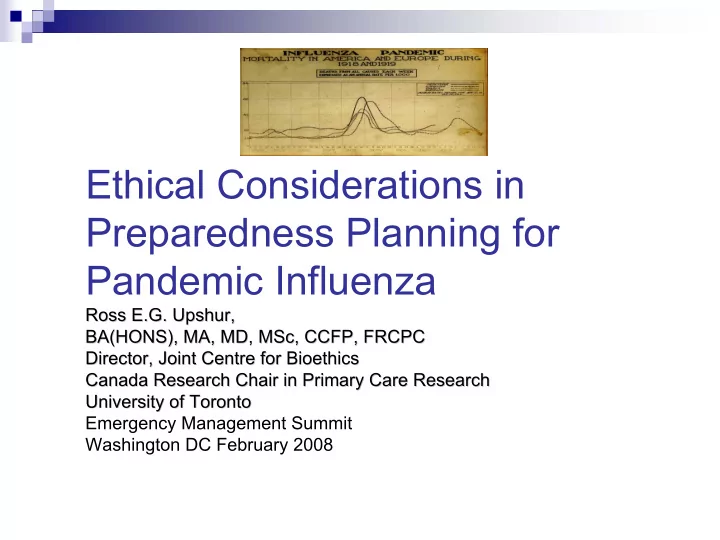
Ethical Considerations in Preparedness Planning for Pandemic Influenza Ross E.G. Upshur, Ross E.G. Upshur, BA(HONS), MA, MD, MSc MSc, CCFP, FRCPC , CCFP, FRCPC BA(HONS), MA, MD, Director, Joint Centre for Bioethics Director, Joint Centre


slide-1
SLIDE 1

Ethical Considerations in Preparedness Planning for Pandemic Influenza

Ross E.G. Upshur, Ross E.G. Upshur, BA(HONS), MA, MD, BA(HONS), MA, MD, MSc MSc, CCFP, FRCPC , CCFP, FRCPC Director, Joint Centre for Bioethics Director, Joint Centre for Bioethics Canada Research Chair in Primary Care Research Canada Research Chair in Primary Care Research University of Toronto University of Toronto Emergency Management Summit Washington DC February 2008

slide-2
SLIDE 2

6.1 Time series of respiratory ambulatory visits to primary care providers, age and gender aggregated, 1992-2002 100,000 200,000 300,000 400,000 500,000 600,000 700,000 800,000 900,000 Jan-92 Jul-92 Jan-93 Jul-93 Jan-94 Jul-94 Jan-95 Jul-95 Jan-96 Jul-96 Jan-97 Jul-97 Jan-98 Jul-98 Jan-99 Jul-99 Jan-00 Jul-00 Jan-01 Jul-01 Jan-02 Jul-02 Month/Year Number of visits Note: "Respiratory ambulatory visits" include all ambulatory visits to a physician for COPD, asthma, pneumonia or repiratory infectious diseases.

slide-3
SLIDE 3

Outline

Rationale for ethics & pandemic planning Development of an ethical framework Framework as a guide for decision making Key recommendations from Stand on Guard for

Thee

Additional considerations Discussion

slide-4
SLIDE 4

Will it be a ‘health tsunami’

  • r ‘health Y2K’?
slide-5
SLIDE 5

Evolution of Ideas

Sunnybrook Pandemic Planning Committee

requests ethics assistance

Working Group formed through Joint Centre for

Bioethics U of T

Ethics in a Pandemic Influenza Crisis: Framework

for Decision Making

Adopted into Ontario Plan and Toronto Academic

Health Sciences Network Plan

Stand on Guard for Thee WHO Global Consultation

slide-6
SLIDE 6

What is bioethics?

Bioethics involves critical reflection on

moral/ethical problems faced in health care settings toward:

deciding what we should do explaining why we should do it and describing how we should do it

(Dr Barb Secker)

slide-7
SLIDE 7

Headline News

slide-8
SLIDE 8

Canadian Headlines

slide-9
SLIDE 9

“ Collective forethought & a broad consensus would go far in helping to tackle the unique moral & ethical dilemmas that will arise when a catastrophic event occurs.”

Iserson & Pesik 2003

slide-10
SLIDE 10

Rationale Ethical Guidelines

  • Government and health care leaders will need to

make decisions based on values

Values based leadership may be the glue that

holds society together in an intense crisis

History will judge today’s leaders on how well

they prepared for and acted during the crisis and whether they treated people in an ethical manner

slide-11
SLIDE 11

Ethics & SARS – What did we learn?

Singer et al 2005 BMJ Ethics and SARS: lessons from Toronto Ten key ethical values

slide-12
SLIDE 12
slide-13
SLIDE 13

Collateral Damage

Bernstein & Hawryluck 2003 Critical Care

Trust, truth-telling & relationships with

colleagues

Public infection & infection control ICU Professional integrity & relationships with

patients/families

Resource allocation

slide-14
SLIDE 14

Ethics & Disaster & Bioterrorism What can we learn? Triage

Iserson & Pesik 2003

Civilian Triage

Most ill or vulnerable prioritized

Battlefield Triage

Save those soldiers who can

serve & protect

Triage following Disasters

(natural, man-made & industrial)

Balance between civilian &

battlefield triage

Triage following biochemical

terrorism

Optimal use of resources to

benefit most people- Senior clinicians decision-makers

slide-15
SLIDE 15

Lessons from Katrina

Darr, K. Katrina: Lessons from the Aftermath. Hospital Topics 2006, 84(2) p30-33 During a crisis situation like Katrina or impending avian flu pandemic “rules of thumb and situational ethics are not likely to produce societally desirable results”.

slide-16
SLIDE 16

Katrina & the varying perceptions for priority setting in evacuation

Hospital → most critically ill

patients first

Firefighters → least ill

patients first & most ill later

Helicopter Pilots → pregnant

women & babies

slide-17
SLIDE 17

How should influenza vaccine be distributed?

From: Emanuel & Wertheimer Public Health. Who should get influenza vaccine when not all can? Science 2006 312 (5775) : 854-5

Examples of differing perspectives:

National Vaccine Advisory Committee & Advisory Committee on

Immunization Practices (NVAC & ACIP)

Life-cycle Principle LCP Investment refinement of LCP

slide-18
SLIDE 18
slide-19
SLIDE 19

Why an Ethical Framework?

Decision-makers need a moral compass during public health crisis. Proportion of crisis unknown- framework needed that will guide. Difficult decisions will have to be made. How, why, when & by whom?

slide-20
SLIDE 20

Ethical Framework as a Guide in Decision-making

Decision–making for and during a pandemic influenza outbreak ought to be:

1) guided by ethical decision-

making processes &.

2) informed by ethical values.

slide-21
SLIDE 21
slide-22
SLIDE 22

Guiding Values

Individual Liberty Protection of the

public from harm

Proportionality Privacy Equity Duty to Provide Care Reciprocity Trust Solidarity Stewardship

slide-23
SLIDE 23

Ethical Processes: A4R (Norman Daniels)

Ethical Decision-Making Processes are:

Open and Transparent Reasonable Inclusive Responsive Accountable

slide-24
SLIDE 24

Decision Review Process: Essential Features (Jennifer Gibson)

Anticipating the need for decision review

process prior to crisis

Assessing pre-existing mechanisms -

ensure they are sufficient & adhere to ethical principles

slide-25
SLIDE 25

“In the midst of a crisis where guidance is incomplete, consequences uncertain, & information constantly changing, where hour by hour decisions involve life & death, fairness is more important rather than less.” Bell et. Al. 2004

slide-26
SLIDE 26

Key Ethical Issues

1.Duty to Care 2.Restrictive Measures 3.Priority Setting 4.Global Governance

slide-27
SLIDE 27

Ethical Issue 1: Duty to Care

Recommendations

1. Professional colleges and associations should provide, by way of their codes of ethics, clear guidance to members in advance of a major communicable disease outbreak, such as pandemic flu. Existing mechanisms should be identified, or means should be developed, to inform college members as to expectations and obligations regarding the duty to provide care during a communicable disease outbreak. 2. Governments and the health care sector should ensure that: a. care providers’ safety is protected at all times, and providers are able to discharge duties and receive sufficient support throughout a period of extraordinary demands; and b. disability insurance and death benefits are available to staff and their families adversely affected while performing their duties. 3. Governments and the health care sector should develop human resource strategies for communicable disease outbreaks that cover the diverse occupational roles, that are transparent in how individuals are assigned to roles in the management of an outbreak, and that are equitable with respect to the distribution of risk among individuals and

  • ccupational categories.
slide-28
SLIDE 28

Recommendations

1. Governments and the health care sector should ensure that pandemic influenza response plans include a comprehensive and transparent protocol for the implementation of restrictive measures. The protocol should be founded upon the principles of proportionality and least restrictive means, should balance individual liberties with protection of public from harm, and should build in safeguards such as the right of appeal. 2. Governments and the health care sector should ensure that the public is aware

  • f:
  • i. the rationale for restrictive measures;
  • ii. the benefits of compliance; and
  • iii. the consequences of non-compliance.

3. Governments and the health care sector should include measures in their pandemic influenza preparedness plans to protect against stigmatization and to safeguard the privacy of individuals and/or communities affected by quarantine or other restrictive measures. 4. Governments and the health care sector should institute measures and processes to guarantee provisions and support services to individuals and/or communities affected by restrictive measures, such as quarantine orders, implemented during a pandemic influenza emergency. Plans should state in advance what backup support will be available to help those who are quarantined (e.g., who will do their shopping, pay the bills, and provide financial support in lieu of lost income). Governments should have public discussions of appropriate levels of compensation in advance, including who is responsible for compensation.

Ethical Issue 2: Restrictive Measures

slide-29
SLIDE 29

Recommendations

1. Governments and the health care sector should publicize a clear rationale for giving priority access to health care services, including antivirals and vaccines, to particular groups, such as front line health workers and those in emergency services. The decision makers should initiate and facilitate constructive public discussion about these choices. 2. Governments and the health care sector should engage stakeholders (including staff, the public, and other partners) in determining what criteria should be used to make resource allocation decisions (e.g., access to ventilators during the crisis, and access to health services for other illnesses), should ensure that clear rationales for allocation decisions are publicly accessible and should provide a justification for any deviation from the pre- determined criteria. 3. Governments and the health care sector should ensure that there are formal mechanisms in place for stakeholders to bring forward new information, to appeal

  • r raise concerns

about particular allocation decisions, and to resolve disputes.

Ethical Issue 3: Priority Setting

slide-30
SLIDE 30

Ethical Issue 4: Global Governance

Recommendations

1. The World Health Organization should remain aware of the impact of travel recommendations on affected countries, and should make every effort to be as transparent and equitable as possible when issuing such recommendations. 2. Federal countries should utilize whatever mechanisms are available within their system of government to ensure that relationships within the country are adequate to ensure compliance with the new International Health Regulations. 3. The developed world should continue to invest in the surveillance capacity of developing countries, and should also make investments to further improve the

  • verall public health infrastructure of developing countries.
slide-31
SLIDE 31

In addition…

Mechanism to expedite research ethics

review during a public health crisis

Ethical treatment of animals – culling of

birds

Compensation for farmers Huge disparities between rich & poor

people/nations hit by health crisis

slide-32
SLIDE 32

JCB Working Group Members:

  • KAREN FAITH BSW, Med, MSc, RSW

Sunnybrook Health Sciences Centre Joint Centre for Bioethics University of Toronto

  • JENNIFER L. GIBSON PhD

Joint Centre for Bioethics University of Toronto

  • ALISON THOMPSON PhD
  • St. Michael’s Hospital, Joint Centre for

Bioethics

  • PETER A SINGER

Joint Centre for Bioethics, University of Toronto

  • C SHAWN TRACY

Sunnybrook Health Sciences Centre

  • DR. ROSS UPSHUR

Sunnybrook Health Sciences Centre, Joint Centre for Bioethics University of Toronto

  • KUMANAN WILSON

University Health Network

slide-33
SLIDE 33

Your feedback is welcome: Joint Centre for Bioethics University of Toronto http://www.utoronto.ca/jcb/home/main.htm

slide-34
SLIDE 34

Additional Resources

Bensimon CM, Tracy CS, Bernstein M, Shaul RZ, Upshur RE. A

qualitative study of the duty to care in communicable disease

  • utbreaks. Soc Sci Med. 2007 Dec;65(12):2566-75.

Bensimon CM, Upshur RE. Evidence and effectiveness in

decisionmaking for quarantine. Am J Public Health. 2007 Apr;97 Suppl 1:S44-8.

Thompson AK, Faith K, Gibson JL, Upshur RE. Pandemic influenza

preparedness: an ethical framework to guide decision-making.BMC Med Ethics. 2006 Dec 4;7:E12

Ruderman C, Tracy CS, Bensimon CM, Bernstein M, Hawryluck L,

Shaul RZ, Upshur RE.On pandemics and the duty to care: whose duty? who cares? BMC Med Ethics. 2006 Apr 20;7:E5.

WHO Addressing Ethical Issues in Pandemic Influenza Planning

http://www.who.int/ethics/influenza_project/en/index.html