Estate Planning for Second Marriages and Blended Families - - PowerPoint PPT Presentation

estate planning for second marriages and blended families
SMART_READER_LITE
LIVE PREVIEW

Estate Planning for Second Marriages and Blended Families - - PowerPoint PPT Presentation

Presenting a live 90 minute webinar with interactive Q&A Estate Planning for Second Marriages and Blended Families Incorporating Pre and Postnuptial Agreements, Meeting Obligations to Children and Spouses, and Maximizing Tax Benefits


slide-1
SLIDE 1

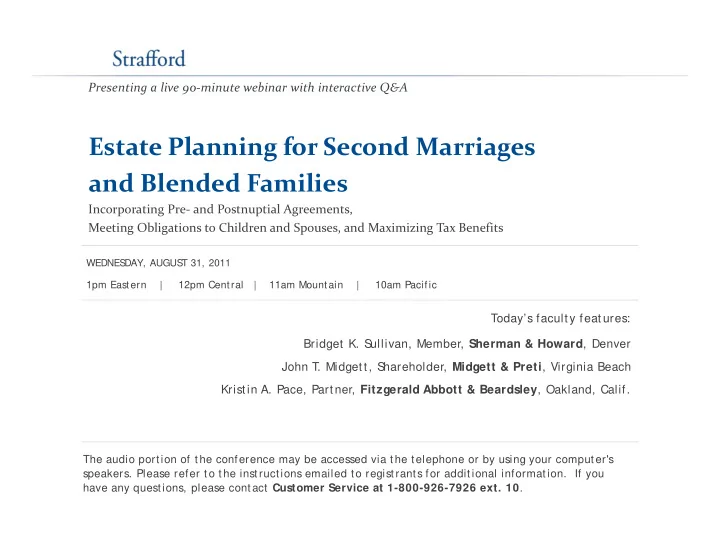
Presenting a live 90‐minute webinar with interactive Q&A

Estate Planning for Second Marriages and Blended Families

Incorporating Pre‐ and Postnuptial Agreements, Meeting Obligations to Children and Spouses, and Maximizing Tax Benefits

T d ’ f l f

1pm Eastern | 12pm Central | 11am Mountain | 10am Pacific WEDNES DAY, AUGUS T 31, 2011

Today’s faculty features: Bridget K. S ullivan, Member, Sherman & Howard, Denver John T . Midgett, S hareholder, Midgett & Preti, Virginia Beach Kristin A. Pace, Partner, Fitzgerald Abbott & Beardsley, Oakland, Calif.

The audio portion of the conference may be accessed via the telephone or by using your computer's

  • speakers. Please refer to the instructions emailed to registrants for additional information. If you

have any questions, please contact Customer Service at 1-800-926-7926 ext. 10.

slide-2
SLIDE 2

Conference Materials

If you have not printed the conference materials for this program, please complete the following steps:

  • Click on the + sign next to “ Conference Materials” in the middle of the left-

hand column on your screen hand column on your screen.

  • Click on the tab labeled “ Handouts” that appears, and there you will see a

PDF of the slides for today's program.

  • Double click on the PDF and a separate page will open.

Double click on the PDF and a separate page will open.

  • Print the slides by clicking on the printer icon.
slide-3
SLIDE 3

Continuing Education Credits

FOR LIVE EVENT ONLY

For CLE purposes, please let us know how many people are listening at your location by completing each of the following steps:

  • Close the notification box
  • In the chat box, type (1) your company name and (2) the number of

attendees at your location

  • Click the S

END button beside the box

slide-4
SLIDE 4

Tips for Optimal Quality

S d Q lit S

  • und Quality

If you are listening via your computer speakers, please note that the quality of your sound will vary depending on the speed and quality of your internet connection. If the sound quality is not satisfactory and you are listening via your computer speakers, you may listen via the phone: dial 1-866-869-6667 and enter your PIN when prompted Otherwise please send us a chat or e mail when prompted. Otherwise, please send us a chat or e-mail sound@ straffordpub.com immediately so we can address the problem. If you dialed in and have any difficulties during the call, press *0 for assistance.

Viewing Qualit y

To maximize your screen, press the F11 key on your keyboard. To exit full screen, press the F11 key again press the F11 key again.

slide-5
SLIDE 5

Estate Planning for Second Estate Planning for Second Marriages and Blended g Families

Crafting Estate Plans to Incorporate Pre- and Post-Nuptial Agreements

John T. Midgett john.midgett@midgettpreti.com

5

j g @ g p

slide-6
SLIDE 6

Overview

 “Marriage is the triumph of imagination over  Marriage is the triumph of imagination over

  • intelligence. Second marriage is the triumph
  • f hope over experience.” – Oscar Wilde

p p

6

slide-7
SLIDE 7

Challenges and Issues

 Ethical Issues of Joint Representation  Ethical Issues of Joint Representation  Titling of Assets

Beneficiary Designations

 Beneficiary Designations  Choices of Fiduciaries

7

slide-8
SLIDE 8

Ethical Issues of Joint Representation

 Model Rules of Professional Conduct  Model Rules of Professional Conduct

 Rule 1:7 – a lawyer shall not represent a client if

the representation involves a current conflict of p interest.

 ACTEC Commentaries

 RE: MRPC 1.7: Some conflicts of interest are so

serious that the informed consent of the parties is i ffi i t t ll th l t d t k insufficient to allow the lawyer to undertake or continue the representation (a “non-waivable conflict).

8

conflict).

slide-9
SLIDE 9

Some Indications of Potential Conflicts

  • f Interest

 Pre-Nuptial Agreement  Pre Nuptial Agreement  Post-Nuptial Agreement

Either or both spouse has a child or children

 Either or both spouse has a child or children

from a prior relationship G t Di it i A t f th P ti

 Great Disparity in Assets of the Parties  Great Disparity in the Ages of the Parties  Past Representation of a Single Party

9

slide-10
SLIDE 10

Issues the Lawyer Should Consider

 Laws of Intestate Succession  Laws of Intestate Succession  Elective Share Laws

Statutes favoring “Omitted Spouses”

 Statutes favoring Omitted Spouses  Joint Tenancy issues  Beneficiary Designations on Life Insurance

and Annuities

 Beneficiary Designations on Qualified

Retirement Plans

10

slide-11
SLIDE 11

Laws of Intestate Succession

 Statutory “will”  Statutory will  Is the share for the surviving spouse too little

  • r too large?
  • r too large?

 How are children to be treated?

 Children from prior relationships  Children from prior relationships  Children with surviving spouse?  The spouse’s children from prior relationships?  The spouse s children from prior relationships?

11

slide-12
SLIDE 12

Elective Share Laws

 Surviving spouse may be entitled to a  Surviving spouse may be entitled to a

percentage of the TOTAL estate, including non-probate assets p

 Usually involves litigation to determine

 Expensive  Expensive  Divisive

12

slide-13
SLIDE 13

“Omitted Spouse” statutes

 Testator made a will (avoiding intestacy) but  Testator made a will (avoiding intestacy) but

subsequently marries

 Invokes statutory presumption that Testator  Invokes statutory presumption that Testator

did not intend to disinherit spouse

13

slide-14
SLIDE 14

Joint Tenancy Issues

 Joint Tenancy with Surviving Spouse  Joint Tenancy with Surviving Spouse

 With Rights of Survivorship  Without Rights of Survivorship  Without Rights of Survivorship

 Joint Tenancy with Children

 With Rights of Survivorship  With Rights of Survivorship  Without Rights of Survivorship

14

slide-15
SLIDE 15

Beneficiary Designations – Life Insurance

 Coordinates with Pre or Post Marital  Coordinates with Pre or Post Marital

Agreements?

 Who is in control of proceeds?  Who is in control of proceeds?  Balancing economic needs

E h li t b i d d th

 Each policy must be examined and the

beneficiary changed, if needed

15

slide-16
SLIDE 16

Beneficiary Designations – Qualified Retirement Plans

 Consider Pay-out options available to  Consider Pay out options available to

surviving spouse

 Who controls balance if any at survivor’s  Who controls balance, if any, at survivor s

death

 Trusts as beneficiaries  Trusts as beneficiaries

 “Oldest Beneficiary” rule for measuring lives  Marital deduction issues – Battle between RMD  Marital deduction issues – Battle between RMD

and mandatory income payout. See Rev. Rul. 2006-26.

16

slide-17
SLIDE 17

Issues the Lawyer Should Consider

 Presence and Effect of Pre- and Post-Nuptial  Presence and Effect of Pre and Post Nuptial

Agreements

 Presence and Effect of Divorce Decrees and  Presence and Effect of Divorce Decrees and

Property Settlement Agreements

 Buy-Sell Agreements  Buy-Sell Agreements

17

slide-18
SLIDE 18

Issues the Lawyer Should Consider

 Family Dynamics  Family Dynamics

 Putting the “fun” in dysfunctional

 “What we have here is a failure to communicate!”- from

the movie Cool Hand Luke

 Jealousy and Greed

C t l d M t

 Control and Management  Balancing the interest of “Yours, Mine and Ours”

18

slide-19
SLIDE 19

Estate Planning for Second Marriages and Second Marriages and Blended Families

Discussion of Prenuptial and Postnuptial Agreements

August 31, 2011

Bridget Sullivan, Esq.

Sherman & Howard L.L.C. 633 17th Street, #3000 Denver, CO 80202 (303) 299 8130 (303) 299-8130

slide-20
SLIDE 20

Bridget K. Sullivan, Esq.

Bridget Sullivan is a Member in the Tax & Probate Department of Sherman & Howard’s Denver office. She

g , q

p practices in the areas of estate planning, wealth transfer planning, estate administration, trust administration, and litigation related to trusts and estates. Ms. Sullivan ga o e a ed o us s a d es a es s Su a focuses on sophisticated estate planning techniques and prenuptial agreements. She has counseled clients on a variety of wealth transfer strategies and charitable giving variety of wealth transfer strategies and charitable giving techniques to accomplish family giving objectives while minimizing the impact of gift, estate, generation-skipping transfer, and income taxes. transfer, and income taxes.

  • Ms. Sullivan graduated from Yale Law School in 1990.

She is named in Best Lawyers in America for Trust and

20

She is named in Best Lawyers in America for Trust and Estates and is named as a Colorado Super Lawyer.

slide-21
SLIDE 21
  • 1. INTRODUCTION
  • The principal purpose of a marital agreement is to

alter the rights otherwise provided by law of one or both spouses to the property of the other spouse, both spouses to the property of the other spouse, whether upon termination of the marriage by divorce or by death or both. Many states have a marital agreement act which determines the marital agreement act, which determines the rights of parties who have entered a marital agreement, the types of matters that parties may agree to and the enforceability of marital

  • agreements. In most states, marital agreements

are enforceable under the terms of state law are enforceable under the terms of state law unless a party did not execute the agreement voluntarily or was not provided full and fair financial disclosure prior to signing the agreement

21

financial disclosure prior to signing the agreement.

slide-22
SLIDE 22

2 REASONS FOR HAVING A MARITAL AGREEMENT

  • 2. REASONS FOR HAVING A MARITAL AGREEMENT
  • Create certainty with respect to the disposition of

property at the end of a marriage.

  • Protect family legacy assets and provide assurance

to the senior generation which may have built the to the senior generation which may have built the family wealth.

  • Protect family owned or closely held business

interests.

22

slide-23
SLIDE 23
  • Protect the interests of children from a prior marriage.
  • Protect family trusts in a divorce.

P id it d t i t t th l lth

  • Provide security and certainty to the less wealthy

spouse.

  • Simplify and reduce the expense that often

Simplify and reduce the expense that often accompanies divorce or litigation upon death of the spouse.

23

slide-24
SLIDE 24
  • 3. RIGHTS OF SURVIVING SPOUSE UPON DEATH OF

OTHER SPOUSE

  • Waivers of Surviving Spouse Rights

A marital agreement may govern the rights of the OTHER SPOUSE – A marital agreement may govern the rights of the parties in the event of the termination of the marriage by death of either party. – The agreement may include a partial or complete waiver of property rights arising at death. The agreement may also include a promise to – The agreement may also include a promise to provide for a substitute transfer of property to the waiving spouse.

24

slide-25
SLIDE 25

– While both parties to a martial agreement may agree to waive – in whole or in part – their respective property rights arising at death, each party remains free to leave more property to the other than would be required by the agreement. – A release and waiver of “all rights upon death” or g p equivalent language in a marital agreement encompasses the waiver of several statutorily granted spousal rights and priorities. These g a ed spousa g s a d p o es ese statutory rights and priorities include the right to a spouse’s elective share (sometimes referred to as the statutory or forced share), the right to receive the the statutory or forced share), the right to receive the family allowance and exempt property allowance, and the priority to serve as personal representative, executor or administrator.

25

executor or administrator.

slide-26
SLIDE 26
  • Status as Surviving Spouse

– A person who is divorced from a decedent or whose marriage has been annulled is not a surviving spouse However a decree of separation does not

  • spouse. However a decree of separation does not

terminate the status of husband and wife for death

  • purposes. A husband and wife are considered

married regardless of whether a divorce action has married regardless of whether a divorce action has been instituted. – A marital agreement can modify these provisions, g y p , stating specifically that a separation decree or the filing of an action for divorce terminates all surviving spouse rights spouse rights.

26

slide-27
SLIDE 27
  • Intestate Share of Surviving Spouse

Intestate Share of Surviving Spouse

– If a person dies without a will, the decedent’s property will be distributed in accordance with the applicable statute of intestate succession. intestate succession. – Under many states, the surviving spouse’s share of the intestate estate is dependent upon the circumstances of the parties, including whether there are adult or minor the parties, including whether there are adult or minor children of the marriage, whether the decedent has adult

  • r minor children from another relationship, and whether

the decedent is survived by one or both parents. y p – Under the law of many states, the surviving spouse receives the entire intestate estate (1) when the decedent has no surviving descendants or ancestors or (2) when all

  • f the decedent’s surviving descendants are also

descendants of the surviving spouse and there are not

  • ther descendants of the surviving spouse who survive

th d d t (i it lik l fi t i f b th

27

the decedent (i.e., it was likely a first marriage for both spouses).

slide-28
SLIDE 28
  • Spouse’s Elective or Statutory Share

– At common law, dower refers to the legal right or interest that a wife acquired in the estate of her husband. It consists of the right to one-third of the husband’s real propert C rtes is the common la life estate gi en to

  • property. Curtesy is the common law life estate given to

a husband in the real property of a deceased wife. Many states have abolished dower and curtesy, replacing these common law rights with statutory rights to an elective or common law rights with statutory rights to an elective or forced share. – Absent a marital agreement, the surviving spouse has the right to an elective share of the augmented estate right to an elective share of the augmented estate. Uniform Probate Code states, such as Colorado, have adopted a right to elect an amount not greater than 50%

  • f the “augmented estate”). Under the Uniform Probate

g ) Code, the percentage of the augmented estate to which the surviving spouse is entitled is determined by the length of time the spouses were married, but is

28

essentially as follows:

slide-29
SLIDE 29

If the Decedent and the Spouse The Elective Share Were Married to Each Other: Percentage Is:

  • Less than 1 year

Supplemental amount only 1 year but less than 2 years 5% of the augmented estate

  • 1 year but less than 2 years

5% of the augmented estate

  • 2 year but less than 3 years

10% of the augmented estate

  • 3 year but less than 4 years

15% of the augmented estate y y g

  • 4 year but less than 5 years

20% of the augmented estate

  • 5 year but less than 6 years

25% of the augmented estate b l h f h d

  • 6 year but less than 7 years

30% of the augmented estate

  • 7 year but less than 8 years

35% of the augmented estate

  • 8 year but less than 9 years

40% of the augmented estate 8 year but less than 9 years 40% of the augmented estate

  • 9 year but less than 10 years

45% of the augmented estate

  • 10 year or more

50% of the augmented estate

29

slide-30
SLIDE 30
  • Augmented Estate

Th t d t t i i d f t d b – The augmented estate is comprised of property owned by the decedent at death as well as certain pre-death gifts to the surviving spouse and to third parties. The augmented i d estate is a statutory concept created to prevent disinheritance of a spouse through transfers to others while at the same time equitably accounting for inter vivos and testamentary transfers to the spouse.

  • Pretermitted Spouse

– Absent a marital agreement if a married person dies – Absent a marital agreement, if a married person dies having executed his or her will prior to the marriage, and such will does not provide for the surviving spouse, then the surviving spouse has the right to take a share of the the surviving spouse has the right to take a share of the estate as a “pretermitted spouse.” The pretermitted spouse’s share of the estate is generally equal to the spouse’s intestate share

30

spouse’s intestate share.

slide-31
SLIDE 31
  • Family and Exempt Property Allowances

Absent a martial agreement in many states a surviving – Absent a martial agreement, in many states a surviving spouse is entitled to the family and exempt property

  • allowances. These allowances are in addition to the

intestate or elective shares These are generally modest intestate or elective shares. These are generally modest amounts.

  • Priority to Serve as Personal Representative or Executor

In many states the priority to serve as personal – In many states, the priority to serve as personal representative or executor is established by the decedent’s

  • will. However, in the absence of a will or if the will fails to

nominate someone who can act in such position the nominate someone who can act in such position, the surviving spouse has priority to act. Thus, absent a marital agreement, if a decedent dies intestate or if all persons nominated in the will fail to qualify, the spouse would have q y, p priority to serve as personal representative or executor even if that was not the decedent’s wish. This priority to serve can be waived in a marital agreement.

31

slide-32
SLIDE 32
  • Federal Law Rights to Retirement Plan Assets

Th i hi i ht i d b fit d lifi d – The survivorship rights in and benefits under qualified retirement plans are governed by federal law, including ERISA and other provisions of the Internal Revenue Code it is federal law and not state law that governs Code, it is federal law, and not state law, that governs when and how a participant may obtain a valid waiver of survivorship rights and interests in such plans. A participant in a retirement plan cannot obtain a valid participant in a retirement plan cannot obtain a valid waiver of spousal survivorship rights prior to the parties’

  • marriage. Thus, the general waivers of “all rights upon

death” or even a specific waiver of rights to a retirement plan, will not constitute an effective waiver of spousal survivorship rights in a retirement plan. Notwithstanding this fact, marital agreements often include waivers of i i i ht t ti t t Th surviving spouse rights to retirement assets. These waivers must be coupled with mutual promises to execute separate retirement plan waivers after the parties are married Such a waiver might read as follows:

32

  • married. Such a waiver might read as follows:
slide-33
SLIDE 33

“Each party hereby waives any and all rights to Each party hereby waives any and all rights to any pension plan, profit sharing plan, deferred compensation plan or retirement benefits and cash accumulations in life insurance which have cash accumulations in life insurance which have

  • r might have accrued for the benefit of the other,

unless specifically designated as beneficiary. Each party agrees to execute the documents Each party agrees to execute the documents necessary to effectuate that waiver as required by the terms of the pension plan, profit sharing plan, deferred compensation plan or retirement benefit deferred compensation plan or retirement benefit plan, state law or federal law.”

33

slide-34
SLIDE 34
  • 5. WAIVERS OF SURVIVING SPOUSE ENTITLEMENTS IN

MARITAL AGREEMENTS MARITAL AGREEMENTS

  • Waiver of statutory and common law rights upon

death death.

– A release and waiver of “all rights upon death” or equivalent language in a marital agreement encompasses the waiver of statutorily granted spousal rights and priorities. Such waivers can be done in a general waiver or in a more specific laundry list of

  • waivers. I generally prefer the laundry list, as it serves

as an educational template, generating questions from the client and a detailed discussion of spousal rights upon death.

34

slide-35
SLIDE 35

– My laundry list (covering Colorado law) generally appears as follows: as follows:

  • “Specific Waiver. Upon the death of either of us, the
  • ther waives the following:

– The right to take an intestate share under Colo.

  • Rev. Stat. 15-11-102 or 15-11-301;

– The right to an elective share under Colo. Rev. Stat. The right to an elective share under Colo. Rev. Stat. 15-11-201, and to take any interest in the augmented estate under Colo. Rev. Stat. 15-11- 202; 202; – The right to an exempt property allowance under

  • Colo. Rev. Stat. 15 11-403;

– The rights of an omitted spouse under Colo. Rev.

  • Stat. 15-11-301;

– The right to a family allowance under Colo. Rev.

35

g y

  • Stat. 15-11-404;
slide-36
SLIDE 36

– The right to a homestead interest under Colo. g

  • Rev. Stat. 38-41-201 and 38-41-204 (as to each
  • ther, but not as to third parties);

– The right to act as a personal representative or – The right to act as a personal representative or trustee of the estate or trust of the other, unless specifically nominated or designated by the other; All i ht t i l fit h i l – All rights to any pension plan, profit sharing plan, deferred compensation plan or retirement benefits and cash accumulations in life insurance which h i h h d f h b fi f h have or might have accrued for the benefit of the

  • ther, unless specifically designated as

beneficiary; each of us agrees to execute the documents necessary to effectuate that waiver as required by the terms of the pension plan, profit sharing plan, deferred compensation plan or

36

retirement benefit plan, state law or federal law;

slide-37
SLIDE 37

Any rights to contest any disposition of property by – Any rights to contest any disposition of property by the other by any inter vivos trust; – Any provisions of the Colorado Marital Agreement Act, Colo. Rev. Stat. 14-2-301 through 310 in conflict with this Agreement; and – Any rights either of us might have to claim any y g g y portion of the estate of the other under the laws of any jurisdiction other than Colorado which are of like or similar purpose to the enumerated Colorado like or similar purpose to the enumerated Colorado statutes that provide dower, curtesy, forced heirship, community property or marital property interests or any other right to claim against the interests or any other right to claim against the estate of a deceased spouse by a surviving spouse.”

37

slide-38
SLIDE 38
  • Limitations on Waivers If There Are Children of the

Marriage

– Note, in cases of young couples marrying with family wealth who do not have children from previous marriages, wealth who do not have children from previous marriages, sometimes these waivers of rights upon death are appropriate only if there are no children of the marriage. However if there are children of the marriage it may not – However, if there are children of the marriage, it may not make sense to have the less wealthy spouse waive “all rights upon death.” If the wealthier spouse fails to follow up with estate planning or with proper estate planning the up with estate planning or with proper estate planning, the less wealthy spouse, now the parent of the children of the marriage, may be disinherited.

38

slide-39
SLIDE 39
  • Community Property Waivers

I ti i C l d hi h h d t d th U if – I practice in Colorado, which has adopted the Uniform Probate Code state and is not a community property

  • state. An exhaustive discussion of community property is

t id th f thi tli

  • utside the scope of this outline.

– Generally, community property is owned by both spouses

  • equally. Community property does not include property
  • wned by a spouse prior to marriage, property gifted from
  • ne spouse to the other, property inherited by a spouse
  • r property which was separate property prior to the time

p p y p p p y p the spouses moved to the community property

  • jurisdiction. The titling of property is not determinative of

its status. Earned income of the spouses is community p y

  • property. Income from separate property is community

property in some jurisdictions and not in others.

39

slide-40
SLIDE 40

– Frequently, parties execute a marital agreement in one state and move to another jurisdiction. All practitioners should be a d

  • e to a ot e ju sd ct o

p act t o e s s ou d be careful to draft waivers of rights upon death broadly enough to cover rights granted in any jurisdiction. A well drafted waiver of rights upon death will include a specific waiver of any property rights based on the laws of community property. (See the waiver in 3.a, xi, supra.) – From an estate planning perspective, one benefit of preserving community property is that the entire property receives a step-up in basis at the death of the first spouse. I.R.C. 1014 (b)(6). Under Section 1014(b)(6), even though l h d d ’ h lf i i i l d bl i

  • nly the decedent spouse’s one-half interest is includable in

his gross estate, the entire community property obtains a stepped up basis. This is perhaps the greatest advantage of community property Because of this advantage a lawyer community property. Because of this advantage, a lawyer preparing a marital agreement for clients in a community property state or clients who have migrated from a community property state will want to consider whether to retain the

40

property state will want to consider whether to retain the community property character of certain assets.

slide-41
SLIDE 41

6 SUBSTITUTE TRANSFERS IN EXCHANGE FOR WAIVERS OF SURVIVING SPOUSE RIGHTS WAIVERS OF SURVIVING SPOUSE RIGHTS

  • It is common for parties who enter into mutual

waivers of rights upon death to agree to make waivers of rights upon death to agree to make substitute transfer to each other, either during the marriage or at the time of death. Like most provisions of a marital agreement the wealthier provisions of a marital agreement, the wealthier party may seek complete waivers from the less wealthy party in exchange for certain promised gift transfers during marriage and/or certain transfer upon death. The amount, timing and manner of fulfilling the substitute transfers is subject to fulfilling the substitute transfers is subject to negotiation.

41

slide-42
SLIDE 42

– Federal Gift Tax Marital Deduction Issues Gift t S D i M i T f t th

  • Gifts to a Spouse During Marriage. Transfers to the

spouse during the marriage will qualify for the unlimited deduction for gift tax purposes, so long as such transfers are made outright to the surviving spouse or to a qualifying are made outright to the surviving spouse or to a qualifying

  • trust. I.R.C. ' 2523. A gift of a life estate or terminable

interest will not qualify for the gift tax marital deduction, unless such transfer is a qualified terminable interest as unless such transfer is a qualified terminable interest as described in I.R.C. ' 2523(f). Outright gift transfers are

  • bviously simplest from the perspective of qualifying for the

gift tax exclusion. However, clients may be adverse to g , y such outright transfers and may wish to make transfers in trust for the spouse. If an inter vivos trust is created for the spouse, be sure the p , trust qualifies as a QTIP trust. If a QTIP trust is created and funded during the marriage, be sure to make a timely QTIP election. The IRS provides no relief for a late filed

42

QTIP election for an inter vivos QTIP trust.

slide-43
SLIDE 43

There are several significant advantages of a lifetime QTIP t t i it l t tti QTIP trust in a marital agreement setting.

  • First, it allows the wealthier spouse to provide an

income stream to the less wealthy spouse during the g marriage and after the wealthier spouse’s death.

  • Second, at the death of the beneficiary spouse,

regardless of the order of deaths the trust assets will regardless of the order of deaths, the trust assets will pass to the beneficiaries selected by the wealthier spouse (presumably the children from the first marriage) marriage).

  • The unified credit and GST exemption of the less

wealthy spouse can be fully utilized, saving the lthi ’ b fi i i t t t wealthier spouse’s beneficiaries estate tax.

43

slide-44
SLIDE 44
  • Cautions. Be wary of provisions which transfer a

property to the less wealthy spouse during the property to the less wealthy spouse during the marriage, such as title to a residence, but provide that if a divorce were to occur the residence shall revert to the wealthier spouse This may be attractive from an the wealthier spouse. This may be attractive from an estate planning perspective and it may be attractive to the less wealthy spouse because she will hold the id t i ht ( th th i it l t t) t th residence outright (rather than in a marital trust) at the wealthier spouse’s death. However, this arrangement may not qualify for the gift tax deduction as an outright t f t th l lth R th it ill lik l transfer to the less wealthy spouse. Rather it will likely be treated as a terminable interest because the interest transferred to the less wealthy spouse will terminate or fail upon an event (the divorce) and because the donor retains in himself an interest in such property (the right of the property to revert to the

44

donor upon a divorce). I.R.C. ' 2523(b).

slide-45
SLIDE 45

– Also be wary of drafting provisions which require the wealthier spouse to make transfers during the marriage wealthier spouse to make transfers during the marriage

  • r upon termination of the marriage to the children of the

less wealthy spouse. Such contemplated gifts should lif f th ift t l l i ( tl qualify for the gift tax annual exclusion (currently $12,000 or $24,000 if the spouses will gift split) or the exclusion for payment of certain educational or medical I R C ' 2 03

  • expenses. I.R.C. ' 2503.

45

slide-46
SLIDE 46

– Gift Splitting. A marital agreement may request the less wealthy spouse to agree to gift splitting during the wealthy spouse to agree to gift splitting during the marriage, thereby allowing the wealthier spouse to maximize gifting to descendants. Be specific about whether the less wealthy spouse is consenting to gift whether the less wealthy spouse is consenting to gift splitting for annual exclusion gifts only or whether he/she is also consenting to use of his or her lifetime gift tax exemption exemption.

46

slide-47
SLIDE 47
  • Federal Estate Tax Marital Deduction

– The substitute transfer of property described in a marital agreement should qualify for the federal estate tax marital

  • deduction. If the form of the transfer qualifies for the

unlimited marital deduction, the property transferred will pass free of the federal estate tax at the transferring party’s death. When a martial agreement provides for a p y g p marital deduction qualifying transfer, such as a QTIP trust, the agreement should explicitly allocate liability for the estate tax arising at the survivor’s death (presumably, but g (p y, not necessarily, from the assets of the QTIP trust). – The following common forms of testamentary spousal transfers will qualify for the unlimited marital deduction transfers will qualify for the unlimited marital deduction.

47

slide-48
SLIDE 48
  • An outright, unrestricted transfer of property;

A f f lifi d i bl i

  • A transfer for a qualified terminable interest property

(QTIP) trust;

  • A transfer to an estate trust or a power of appointment

p pp trust ;

  • A transfer to a qualified domestic trust (QDOT) for a

non-citizen surviving spouse; non citizen surviving spouse;

  • A transfer of the right to unitrust or annuity payments

from a charitable remainder trust.

48

slide-49
SLIDE 49
  • QTIP Trusts

– Estate planners frequently use QTIP trusts to provide for a second spouse, particularly when a party wishes to preserve wealth for children of a prior marriage. A p p g testamentary marital trust, created under the decedent’s will or revocable trust will qualify for the marital deduction as a QTIP trust if:

  • Property passes from the decedent to the QTIP trust;
  • The governing instrument requires all income to be

distributed at least annually to the surviving spouse; distributed at least annually to the surviving spouse;

  • No other beneficiary may have any rights in the trust during

the surviving spouse’s lifetime; and

  • The personal representative or executor makes the
  • The personal representative or executor makes the

corresponding election on the federal estate tax return filed for the decedent’s estate. I.R.C. ' 2056(b)(7).

49

slide-50
SLIDE 50
  • The obvious benefit of the QTIP trust is that the

surviving spouse need not be given a general power of appointment over the trust and therefore may be prevented from disinheriting the remainder men of the prevented from disinheriting the remainder men of the trust (presumably, the deceased spouse’s children from a prior marriage).

  • Another advantage of the QTIP trust is that if the

surviving spouse has a minimal estate of his or her

  • wn, the unified credit of that less wealthy surviving

, y g spouse can be utilized for the benefit of the wealthier spouse’s beneficiaries. The same is true of the less wealthy surviving spouse’s generation skipping transfer wealthy surviving spouse s generation skipping transfer tax (GST) exemption.

50

slide-51
SLIDE 51

– Standards and Guidelines for Principal Distributions. Provided that the surviving spouse is entitled to the g p income from the trust, at least annually, the surviving spouse need not be given any other beneficial interests to the principal of the trust. Additional access to principal, the principal of the trust. Additional access to principal, however, is frequently given to the surviving spouse for health, support, and maintenance. Many times the marital agreement will specify under what circumstances principal agreement will specify under what circumstances principal may be accessed by the surviving spouse.

51

slide-52
SLIDE 52

– Selection of Trustees.

  • The marital agreement may specify that a third party

The marital agreement may specify that a third party will serve as sole trustee or as co-trustee with the surviving spouse to ensure better protection to the trust assets for the remainder beneficiaries.

  • “Neutral” trustees and successor trustees are

generally advisable. The surviving spouse as sole trustee generally provides less protection to principal g y p p p p than the deceased spouse may want.

  • On the other hand, a child of the decedent (the step-

child of the surviving spouse) as trustee may cause g p ) y family discord.

  • A surviving spouse might be allowed to select a

trustee among a group of mutually agreeable potential g g p y g p trustees.

  • Or, a surviving spouse could be authorized to appoint

an institutional trustee.

52

slide-53
SLIDE 53

– Selection of Assets.

  • The marital agreement may provide specific directions
  • The marital agreement may provide specific directions

with regard to what assets will be directed into the QTIP trust for the benefit of the surviving spouse. f

  • If there is a closely held business, both spouse’s may

favor terms prohibiting such closely held stock from passing to the QTIP trust.

  • If the wealthier spouse holds promissory notes from

children, the less wealth spouse may want to include a provision specifically prohibiting those types of assets p p y p g yp from being used to fund the QTIP trust.

53

slide-54
SLIDE 54

– Residence.

  • Frequently, the marital agreement will address the use

and disposition of the residence by the non-owner spouse after the death of the owner spouse. spouse after the death of the owner spouse.

  • If the residence is transferred to the QTIP trust, it will

be important to include provisions in the QTIP trust so that the surviving spouse’s rights to the residence will that the surviving spouse s rights to the residence will constitute the necessary qualifying income interest (i.e, the surviving spouse must have the right to demand that unproductive property be made productive) that unproductive property be made productive).

54

slide-55
SLIDE 55
  • Use of Life Insurance in Conjunction with a Marital

Agreement

– Some parties to a marital agreement favor a waiver by the less wealthy spouse of all rights upon death of the less wealthy spouse of all rights upon death of the wealthy spouse coupled with a death benefit paid to the surviving spouse pursuant to a life insurance policy. If the wealthy spouse owns the policy and designates his – If the wealthy spouse owns the policy and designates his

  • r her spouse as the beneficiary, the policy proceeds will

be included in the decedent’s estate, by will qualify for the estate tax marital deduction estate tax marital deduction. – If the surviving spouse is both the owner and the beneficiary of the policy, the policy proceeds will not be included in the decedent’s gross estate.

55

slide-56
SLIDE 56

– The parties to the marital agreement may want to address specifically what type of policy is to be acquired to satisfy the specifically what type of policy is to be acquired to satisfy the provisions of the agreement. Term insurance vs. permanent insurance. Th ti t th t l t t if th t – The parties to the agreement also may want to specify that the beneficiary spouse be the owner of the policy. – The agreement should specifically address which party will have the obligation to pay the premiums.

56

slide-57
SLIDE 57

– If you represent the beneficiary spouse, consider drafting a backstop provision which will give the surviving spouse a backstop provision which will give the surviving spouse a right to claim against the decedent’s estate if, for any reason, such insurance is not in place at the death of the spouse whose life was to be insured spouse whose life was to be insured. – Consider using a QTIP trust or an irrevocable life insurance trust as the beneficiary of the insurance policy if th lth i h t h th li d the wealthy spouse wishes to have the policy proceeds remaining after the surviving spouse’s death pass to his or her children from a previous marriage.

57

slide-58
SLIDE 58
  • Joint Tenancy

– Clients should be advised regarding the implications of joint tenancy and the possibility of defeating all of the careful planning for death in the marital agreement by holding property as joint tenants with rights of survivorship. – Consider including a provision in the marital agreement which gives the wealthier spouse credit for joint tenancy c g es t e ea t e spouse c ed t o jo t te a cy transfers against any required devises to the surviving

  • spouse. I generally include the following language:

58

slide-59
SLIDE 59
  • “Effect of Jointly Held Property, Beneficiary

Designation Property or Transfer on Death Property Designation Property, or Transfer on Death Property Payable to Joe. If Jane predeceases Joe, the

  • bligation to provide Joe with an outright disposition of

cash or marketable securities having a fair market cash or marketable securities having a fair market value of $500,000 under paragraph ______ shall be deemed satisfied to the extent of the date of death l f h k t bl iti i b value of any cash or marketable securities passing by beneficiary designation or transfer on death designation and to the extent of one-half of the date of d h l f h k bl i i i death value of cash or marketable securities passing by joint tenancy or tenancy by the entireties as a result

  • f Jane’s death.”

OR

59

slide-60
SLIDE 60

“If Jane predeceases Joe, the obligation to provide Joe with $2,000,000 in a marital trust under paragraph ____ shall be deemed satisfied to the extent of the date of death value of any property passing by beneficiary y p p y p g y y designation or transfer on death designation and to the extent of one-half of the date of death value of joint tenancy or tenancy by the entireties property passing to y y y p p y p g Joe as a result of Jane’s death. If the value of property passing to Joe by beneficiary designation, transfer on death designation, joint tenancy or tenancy by the death designation, joint tenancy or tenancy by the entireties should exceed the required amount payable to Joe pursuant to paragraphs _____, then Jane’s estate shall have no further obligation to Joe under this shall have no further obligation to Joe under this Agreement, nor shall Joe have any obligation to return funds to Jane's estate.”

60

slide-61
SLIDE 61
  • 7. DIVORCE AND TRUSTS – PROTECTING TRUSTS IN

A MARITAL AGREEMENT A MARITAL AGREEMENT

  • The development of the law in most states regarding

treatment of interests in trusts as property for treatment of interests in trusts as property for purposes of property division in a dissolution proceeding has been quite varied and, at times, inconsistent inconsistent.

  • It is critical that the drafter of prenuptial agreements

understand the law of his or her state which governs g treatment of trusts in divorce.

61

slide-62
SLIDE 62
  • Best to address all trusts of which your client is a
  • Best to address all trusts of which your client is a

beneficiary (even a remainder beneficiary) in the marital agreement to ensure that those trust interests are not subject to litigation if the marriage ends in divorce. Bottom Line: Your client should have a prenuptial Bottom Line: Your client should have a prenuptial agreement if he or she is the beneficiary of trusts.

62

slide-63
SLIDE 63
  • 8. DISCLOSURE OF ASSETS, LIABILITIES, INCOME,

AND BENEFICIAL INTEREST IN TRUSTS AND BENEFICIAL INTEREST IN TRUSTS

  • In order for a prenuptial agreement to be

enforceable each OF the parties to a marital enforceable, each OF the parties to a marital agreement will need to make full financial disclosure. Each party should prepare (or have prepared) the following:

– A net worth statement, detailing with reasonable accuracy all assets, liabilities, financial obligations, accuracy all assets, liabilities, financial obligations, and net worth. Hard to value assets such as closely held business interests, should be valued on a reasonable basis if no formal valuation exists The reasonable basis if no formal valuation exists. The basis for such “reasonable estimate” should be provided to the other party and his or her counsel.

63

slide-64
SLIDE 64

– Income information for the last three years. All b fi i l i t t i t t h ld b di l d – All beneficial interests in trusts should be disclosed, even if your client is a remote or remainder beneficiary. A copy of the trust agreement and a detailed statement regarding the assets of the trust should be included.

  • These should be provided to each party and the
  • attorneys. They will also be attached as exhibits to the
  • attorneys. They will also be attached as exhibits to the

prenuptial agreement.

  • Failure to disclose adequately is a significant ground

for challenge of marital agreements. Err on the side of

  • ver disclosure.

64

slide-65
SLIDE 65
  • 9. TREATMENT OF DEBT
  • Generally, prenuptial agreements define separate

and marital debt, so that if there were to be a divorce, it is clear how debt should be allocated. divorce, it is clear how debt should be allocated.

– Generally, all debt which one party enters the marriage with is defined to be his or her separate debt and vice versa debt, and vice versa. – You would then want to define debt which is incurred during the marriage as either separate debt or joint debt, depending on the nature of the debt, and the clients’ expectations for how that debt will be treated.

65

slide-66
SLIDE 66

11.COORDINATION OF ESTATE PLANNING DOCUMENTS WITH THE MARITAL AGREEMENT DOCUMENTS WITH THE MARITAL AGREEMENT

  • Maintenance of Testamentary Documents

– If the marital agreement requires that wills, trusts, g q , , beneficiary designations, deeds, or other documents be prepared to reflect the agreement reached, this can be done by one of two methods: (1) the marital agreement can be drafted as a specific roadmap which will contain the essential terms of the documents that will be prepared at a later date, or (2) the marital agreement can include tl d d t d d t hibit concurrently prepared and executed documents as exhibits to the agreement. – If the parties execute a marital agreement which provides a l i “ ll i ht d th” i il general waiver or “all rights upon death” or similar language, be sure to advise your client to maintain updated estate planning documents after the marriage if your client does in fact wish to leave property to the spouse

66

does in fact wish to leave property to the spouse.

slide-67
SLIDE 67
  • Enforcement for Breach

f – If the marital agreement requires a spouse to devise property to the surviving spouse, the agreement constitutes a contract to devise property. – Be sure to consult your state laws regarding contracts to make a will or devise to ensure that the marital agreement satisfies any specific requirements. y p q – The surviving spouse would then be treated as a claimant against the decedent’s estate and would have to comply with the claims statutes with the claims statutes. – If you represent the spouse who is to receive the devise in accordance with the marital agreement, consider including l hi h t d th i i ’ ti f language which extends the surviving spouse’s time for making a claim and which reimburses the surviving spouse for attorney’s fees incurred in connection with the claim.

67

slide-68
SLIDE 68
  • New Estate Planning Clients – Verify Whether a Marital

Agreement Exists

– New estate planning clients may not mention the existence

  • f an old marital agreement. Estate planning attorneys
  • f an old marital agreement. Estate planning attorneys

should specifically confirm with clients whether or nor a marital agreement exists, and if one does, obtain a copy. Have a discussion with both spouses about whether a joint – Have a discussion with both spouses about whether a joint representation makes sense in light of the marital agreement or whether one party may want to engage separate counsel to review the estate planning documents separate counsel to review the estate planning documents

  • n his or her behalf.

68

slide-69
SLIDE 69
  • Estate Planning Clients with Grown Children

– When preparing estate planning documents for wealthy clients with grown children, consider having a discussion with those clients regarding whether the children have or should have marital agreements in place. This may affect whether a client decides to leave property outright

  • r in a lifetime trust to an adult child.

69

slide-70
SLIDE 70

ESTATE PLANNING FOR SECOND ESTATE PLANNING FOR SECOND MARRIAGES AND BLENDED FAMILIES Tax Issues Unique to the Blended Family and Structuring Estate Plans Using Trusts

Kristin A. Pace, Esq. Fitzgerald Abbott & Beardsley LLP g y 1221 Broadway, 21st Floor Oakland, California 94612 (510) 451-3300 kpace@fablaw.com p @

August 31, 2011

slide-71
SLIDE 71

Tax Issues Unique to the Blended Family Family

How do recent changes to the estate, g gift and GST taxes affect the blended family? y

71

slide-72
SLIDE 72

Tax Reform Act of 2010 (the “Act”)

  • Increased Exemption
  • Portability

Portability

  • Planning for the sunset of the Act at the

end of 2012 end of 2012

72

slide-73
SLIDE 73

Tax Reform Act of 2010 (the “Act”)

Increased Exemption

  • Formula funding problems
  • Under-funded spouse
  • Gift splitting

p g

73

slide-74
SLIDE 74

Increased Exemption

  • Formula funding problems
  • Beware of unintended results
  • Beware of unintended results
  • Depending on who the beneficiaries of the bypass

trust are, spouse or children could wind up with a reduced share of the trust estate

  • Economic volatility can affect beneficial interests in

the QTIP trust and the bypass trust depending on yp p g type of funding formula utilized (i.e. pecuniary marital vs. pecuniary bypass)

74

slide-75
SLIDE 75

Increased Exemption

  • Under-funded spouse
  • Outright gift to spouse during lifetime does

not work well in the blended family setting

  • Transmutation Agreements
  • Lifetime QTIP trust as an alternative
  • Ethical issues

75

slide-76
SLIDE 76

Increased Exemption

  • Gift splitting
  • Annual exclusion planning
  • Exemption planning
  • Exemption planning
  • Ethical issues

76

slide-77
SLIDE 77

Tax Reform Act of 2010 (the “Act”)

Portability

  • Very limited applicability, but could work well if

underfunded spouse dies first

  • Remarriage: portability only applies to the last

deceased spouse’s unused exemption

  • Expires December 31, 2012

p ,

  • Need to file 706 in order to take advantage of

portability regardless of estate value

77

slide-78
SLIDE 78

Tax Reform Act of 2010 (the “Act”)

Planning for the sunset of the Act at the d f 2012 end of 2012

  • Planners should revisit the use of formula

Planners should revisit the use of formula clauses to avoid unexpected results

  • In the immortal words of Yogi Berra, we

g may be facing “déjà vu all over again”

78

slide-79
SLIDE 79

Pl i f th t f th A t t Planning for the sunset of the Act at the end of 2012

What “déjà vu all over again” could look like: like:

  • December 2012 may look a lot like

December 2010 December 2010

  • Presidential election could delay action in

Congress g

  • Polarization in Congress could also result

in delays

79

slide-80
SLIDE 80

Use of Trusts in Creating Blended Family Estate Plans Family Estate Plans

  • QTIP trusts: testamentary and lifetime
  • Bypass trusts
  • Alternative trusts
  • Who should act as trustee?

80

slide-81
SLIDE 81

Use of Trusts in Creating Blended Family Estate Plans Family Estate Plans

  • QTIP trusts: testamentary and lifetime

y

  • All income to surviving spouse: accounting income
  • vs. net taxable income
  • Disadvantage: No other current beneficiaries

allowed

  • Funding issues: partnership interests, IRAs, non-

income producing assets income producing assets

  • Should surviving spouse be given limited power of

appointment?

81

slide-82
SLIDE 82

Use of Trusts in Creating Blended Family Estate Plans Family Estate Plans

  • Bypass trusts

yp

  • Who should be the beneficiaries?
  • Spouse

p

  • Children
  • Sprinkling trust
  • F nding iss es
  • Funding issues
  • Legacy assets if children are beneficiaries

82

slide-83
SLIDE 83

Use of Trusts in Creating Blended Family Estate Plans Family Estate Plans

  • Alternative trusts

Alternative trusts

  • Irrevocable Life Insurance Trust
  • N

Ch it bl U it t

  • Non-Charitable Unitrust
  • Charitable Planning
  • Intentionally Defective Grantor Trusts:

Planning for the Family Business

83

slide-84
SLIDE 84

Alternative Trusts

Irrevocable Life Insurance Trust

  • Create an inheritance for spouse or children
  • Especially useful when second spouse is

close in age to children from first marriage close in age to children from first marriage

  • Advantage: No estate tax on proceeds if

trust is properly structured

  • Disadvantage: Inflexibility if spouse is

named as beneficiary

84

slide-85
SLIDE 85

Alternative Trusts

Non-Charitable Unitrust

  • Advantage: Can help to alleviate tension

between income and remainder beneficiaries

85

slide-86
SLIDE 86

Alternative Trusts

Non-Charitable Unitrust Sample Provision: Provision:

“The Trustee shall pay to or apply for the benefit of the Surviving Spouse each year the greater of (a) the the Surviving Spouse each year the greater of (a) the entire net income from the Marital Trust or (b) four per cent (4%) of the fair market value of the Marital Trust determined as of the end of the preceding year Trust determined as of the end of the preceding year, in monthly or other convenient installments as the Surviving Spouse may request, but in no event less

  • ften than annually.”

86

y

slide-87
SLIDE 87

Alternative Trusts

Charitable Planning

  • Charitable Lead Trusts: “Jackie O Plan”
  • Charitable Remainder Trusts

87

slide-88
SLIDE 88

Alternative Trusts

Intentionally Defective Grantor Trusts: Planning for the Family Business Planning for the Family Business

  • Can be used for succession planning (i.e. transfer
  • f business to the next generation)

g )

  • Advantages:
  • Spouse is entitled to income stream from

Promissory Note y

  • Spouse’s status is reduced to that of a creditor
  • Children are left to manage the business without

interference from spouse

88

slide-89
SLIDE 89

Alternative Trusts

Intentionally Defective Grantor Trusts

  • Disadvantages
  • Complex planning transaction
  • f
  • Business must have cash flow to support the

Promissory Note

89

slide-90
SLIDE 90

Use of Trusts in Creating Blended Family Estate Plans Family Estate Plans

  • Who should act as Trustee?

Who should act as Trustee?

  • Need to consider the purpose of the

trust trust

  • Need to consider the make up of the

trust beneficiaries

  • Consider corporate or professional

fiduciary

90

slide-91
SLIDE 91

Use of Trusts in Creating Blended Family Estate Plans Family Estate Plans

  • Who should act as Trustee?

Who should act as Trustee?

  • Why is this important?
  • Trustee chooses the team
  • Lawyer
  • Investment advisor
  • CPA
  • Trustee makes tax elections
  • Trustee funds the trust
  • Trustee invests trust assets

91

  • Trustee invests trust assets
slide-92
SLIDE 92

Issues Relating to Children

 Title to Assets  Title to Assets

 Joint Tenancy

 Without survivorship  With survivorship

 Payable on Death or Transfer on Death

Provisions

92

John T. Midgett, Shareholder Midgett & Preti

slide-93
SLIDE 93

Issues Relating to Children

Beneficiary Designations Beneficiary Designations

 Life Insurance  Annuities  Qualified Retirement Plans  Outright payment  Conduit Trusts  Conduit Trusts

93

John T. Midgett, Shareholder Midgett & Preti

slide-94
SLIDE 94

Issues Relating to Children

 “Anti-Vulture” Distributions  Anti Vulture Distributions

Leaving assets to children at death may eliminate potential conflict between the children (especially p ( p y those from a prior marriage) and the surviving spouse by minimizing the necessity for the children to circle the spo se like lt res a aiting children to circle the spouse like vultures awaiting his/her death to “get our rightful inheritance”.

94

John T. Midgett, Shareholder Midgett & Preti

slide-95
SLIDE 95

Issues Relating to Children

 Outright Distribution v Use of Trust  Outright Distribution v. Use of Trust  Structuring Distributions in Trust

 “Pot” or Common Trusts v Separate shares  Pot or Common Trusts v. Separate shares  Handling great diversity in ages of children

 Distributions upon attaining certain age  Distributions upon attaining certain age  Distributions at specified dates

 Who should control?

95

John T. Midgett, Shareholder Midgett & Preti

slide-96
SLIDE 96

Issues Relating to Children

 Child as an Agent under a Durable Power of  Child as an Agent under a Durable Power of

Attorney

 Conflicts with surviving spouse  Conflicts with surviving spouse  Conflicts with other siblings – Whole/Half/Step  Compensation Issues

p

 Communication/Reporting

96

John T. Midgett, Shareholder Midgett & Preti

slide-97
SLIDE 97

Issues Relating to Children

 Child as an Agent under Advance Medical  Child as an Agent under Advance Medical

Directive

 Conflicts with surviving spouse  Conflicts with surviving spouse  Conflicts with other siblings – Whole/Half/Step  Dealing with the Emotional Issues

g

 Communication/Reporting

97

John T. Midgett, Shareholder Midgett & Preti

slide-98
SLIDE 98

Issues Relating to Children

 Child Acting as Trustee of Trust  Child Acting as Trustee of Trust

 Control over the surviving spouse’s share?

 Conflicts of Interest?  Contempt?

 Communication issues  Compensation Issues

98

John T. Midgett, Shareholder Midgett & Preti

slide-99
SLIDE 99

Issues Relating to Children

 Child as Executor  Child as Executor

 Many of the same problems as serving as

Executor

 Requires resident of state where Decedent lived  Probate as a public forum for family disharmony

y y

99

John T. Midgett, Shareholder Midgett & Preti