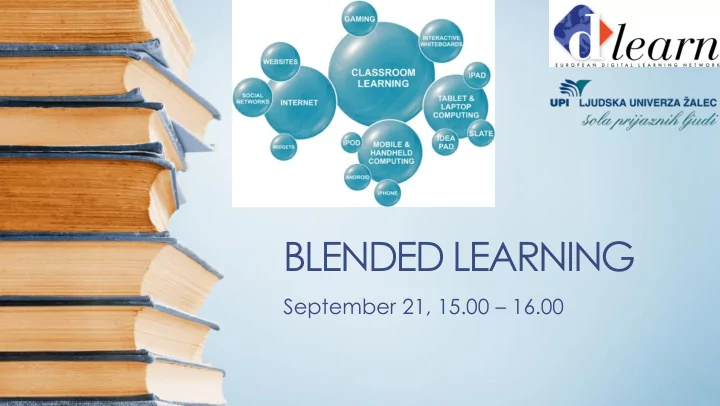
BLENDED LEARNING September 21, 15.00 16.00 WEBINAR PREVIEW - - PowerPoint PPT Presentation

blended learning
SMART_READER_LITE
LIVE PREVIEW

BLENDED LEARNING September 21, 15.00 16.00 WEBINAR PREVIEW - - PowerPoint PPT Presentation

BLENDED LEARNING September 21, 15.00 16.00 WEBINAR PREVIEW Definitions of blended learning The role of the student The role of the teacher Blended learning models Challenges and success factors Framework for creating a


slide-1
SLIDE 1

BLENDED LEARNING

September 21, 15.00 – 16.00

slide-2
SLIDE 2

WEBINAR PREVIEW

  • Definitions of blended learning
  • The role of the student
  • The role of the teacher
  • Blended learning models
  • Challenges and success factors
  • Framework for creating a blended learning course
  • Example of blended learning (video)
  • Questions and answers
slide-3
SLIDE 3

What is/isn‘t blended learning?

  • Students take notes on their lap tops during teacher‘s explanation.
  • At home one group of students of English watch a Youtube video about advantages
  • f blended learning while the other group watch a video about disadvantages. In the

classroom they go deeper into the topic and finally take part in a pro-and-contra debate on blended learning.

  • An adult student from Mexico is taking an online course in digital marketing.
  • Students do French grammar practice on their tablets in the classroom.
  • Peter is taking a course about data mining via Coursera (MOOC).
  • In the classroom, primary students rotate between different stations (work in small

groups, online work, project work).

slide-4
SLIDE 4

What does blended learning mean to you?

slide-5
SLIDE 5

Different definitions

  • Combination of face-to-face learning and distance

learning (Frendo, 2005)

  • Face-to-face + e-learning (Smith & Baber, 2005)
  • Combination of methodologies (P-P-P and TBL)
  • Combination of technologies
  • Blended learning combines face-to-face components

and appropriate use of technology (Sharma, Barret; 2007)

slide-6
SLIDE 6

The Clayton Christensen Institute

Blended learning is a formal education program in which a student learns:

  • at least in part through online learning, with some element of

student control over time, place, path, and/or pace;

  • at least in part in a supervised brick-and-mortar location away

from home;

  • and the modalities along each student’s learning path within a

course or subject are connected to provide an integrated learning experience.

Source: http://www.christenseninstitute.org/blended-learning-definitions-and-models/

slide-7
SLIDE 7

What does it bring to the student?

  • 1. PERSONALISATION
  • 2. STUDENT OWNERSHIP
  • 3. RELATIONSHIPS
  • 4. MASTERY-BASED EDUCATION
slide-8
SLIDE 8

How does teacher‘s role change?

TRADITIONAL ROLE

  • LECTURER
  • USING FIXED GROUPS
  • FOCUS ON CONTENT
  • EXPLAINER

NEW ROLE

  • FACILITATOR
  • DYNAMIC GROUPINGS
  • FOCUS ON CONTENT, SKILLS,

MINDSET

  • INTERVENER
slide-9
SLIDE 9

BLENDED LEARNING MODELS

  • Flipped classroom
  • Rotation (station rotation and lab rotation)
  • Flex
slide-10
SLIDE 10
slide-11
SLIDE 11

Station rotation

slide-12
SLIDE 12
slide-13
SLIDE 13
slide-14
SLIDE 14

Face-to-face vs online part ratio

HYBRID DUAL TRACK INTEGRATED

50 % - 50 %

slide-15
SLIDE 15

3 factors of success according to Sharma

  • APPROPRIACY
  • COMPLEMENTARITY
  • ATTITUDE

+ TRAINING

slide-16
SLIDE 16

Some powerful statements

  • Let computers do what they do best so that teachers can do

what they do best.

  • Teachers build relationships, help students draw connections,

create light bulb moments.

  • The teacher shouldn‘t be the sage on the stage, but a guide on

the side.

slide-17
SLIDE 17

Example of Blended learning Highlander Institute:

https://www.youtube.com/watch?v=-BGoqKN_Od0

slide-18
SLIDE 18

Framework for creating a blended learning course (Sharma, 2016)

STEP 1: CONTEXT STEP 2: COURSE DESIGN STEP 3: LEARNERS AND TEACHERS/TUTORS STEP 4: EVALUATING AND DEVELOPING THE BLEND

slide-19
SLIDE 19

STEPS

STEP 1: CONTEXT Reasons and limiting factors STEP 2: COURSE DESIGN What? Lead mode, setting the pace, time allocation Pedagogic purpose Arrangements of modes in the timetable

slide-20
SLIDE 20

Framework for creating a blended learning course

Methodology Complementarity Where?

  • STEP 3: LEARNERS AND TEACHERS

Who and what roles Interaction patterns Level of autonomy Support

slide-21
SLIDE 21

Framework for creating a blended learning course

  • STEP 4: EVALUATING AND

DEVELOPING THE BLEND How will the blend be evaluated? How will the blend evolve?

slide-22
SLIDE 22

Some references

Author Year Title Publisher

Pete Sharma & Barney Barrett

2007 Blended Learning: using technology in and beyond the classroom Macmillan

Edited by Bryan Tomlinson and Claire Whittaker

2013 Blended Learning in English Language Teaching: Course Design and implementation British Council

Edited by Mike McCarthy 2016 The Cambridge Guide to Blended Learning for Language Teaching

CUP

Blended learning course: www.coursera.org/learn/blend

slide-23
SLIDE 23

Tina Baloh UPI-ljudska univerza Žalec (Žalec Adult Education Centre) tina.baloh@upi.si Fore more webinars go to: www.dlearn.eu