ESTABLISHING FIRST NATIONS HEALTH & WELLNESS Gathering Wisdom - - PDF document

establishing first nations health wellness
SMART_READER_LITE
LIVE PREVIEW

ESTABLISHING FIRST NATIONS HEALTH & WELLNESS Gathering Wisdom - - PDF document

12/12/2016 Image credit: Juan Solorzano ESTABLISHING FIRST NATIONS HEALTH & WELLNESS Gathering Wisdom INDICATORS FOR THE NEXT 10 YEARS Dr. Perry Kendall and Dr. Evan Adams November 30, 2016 1 Live Graphic Recording From the Chief Medical


slide-1
SLIDE 1

12/12/2016 1

ESTABLISHING FIRST NATIONS HEALTH & WELLNESS INDICATORS FOR THE NEXT 10 YEARS

Gathering Wisdom

  • Dr. Perry Kendall and Dr. Evan Adams

November 30, 2016 Image credit: Juan Solorzano

1

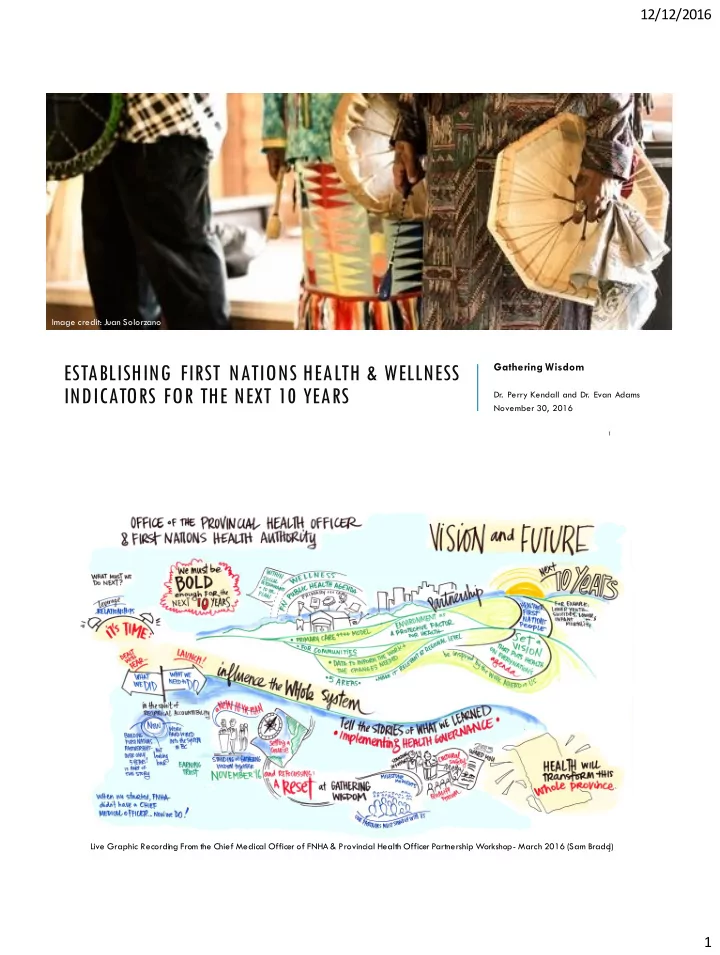
Live Graphic Recording From the Chief Medical Officer of FNHA & Provincial Health Officer Partnership Workshop

  • March 2016 (Sam Bradd)

2

slide-2
SLIDE 2

12/12/2016 2

  • Aboriginal Health Physician Advisor Position
  • Deputy Provincial Health Officer Position
  • PHO:FNHA Partnership (MOU)
  • FNHA Chief Medical Officer Position

PARTNERSHIP BASED ON TRUST AND RESPECT

AN EMERGING PARTNERSHIP

3

STRONGER TOGETHER: PHO & FNHA PARTNERSHIP

4

slide-3
SLIDE 3

12/12/2016 3

THE TEAM

  • Collaboration between the Office of the

PHO, Office of the CMO and other FNHA departments.

  • Project leads: Lindsay Beck, Kathryn

Berry, Adrienne Bonfonti and;

  • Working Group Members: Dr. Shannon

McDonald, Dr. Shannon Waters, Harmony Johnson, Judith Eigenbrod, Laurel Lemchuk-Favel, Rebecca Love, Ashraf Mohammed, Megan Misovic, Anita Christoff

5

TODAY MARKS A MILESTONE MOMENT

6

slide-4
SLIDE 4

12/12/2016 4 Support FNHA’s vision for Healthy, Self-Determining, & Vibrant BC First Nations Children, Families, & Communities by:

  • Establishing a renewed set of 15 indicators, that we

will measure and report on for the next 10 years.

  • Building off the 7 health indicators established in the

Transformative Change Accord First Nations Health Plan.

7

ORIGINAL 7 TRANSFORMATIVE CHANGE ACCORD FN HEALTH PLAN INDICATORS

Indicator Source Infant mortality Vital Statistics Children with healthy Body Mass Index (BMI) (Note: This indicators was previously obese children) Survey/Canadian Community Health Survey Youth suicide Vital Statistics Diabetes prevalence Ministry of Health Age-standardized mortality rate Vital Statistics Life expectancy Vital Statistics Number of practicing, certified FN HCPs To be determined

8

* The final interim update is scheduled for release in 2017 to report on data up to 2015.

slide-5
SLIDE 5

12/12/2016 5

9

YOUTH SUICIDE RATE

( RAT E PER 10,000 POPULATION)

Progress since Baseline

Projected to meet Target

PROJECTIONS: SI before TCA: 3.53 Current: 2.23 Previous (2010) : 2.18 Target: 2.10 OR before TCA: 0.66

10

DIABETES AGE-STANDARDIZED INCIDENCE RATE

( RAT E PER 100 POPULATION)

slide-6
SLIDE 6

12/12/2016 6

BRINGING TOGETHER KNOWLEDGE

The renewed set of indicators and associated reports will bring together knowledge to support and inform policy, initiatives and approaches at various levels (community, Nation, within and across sectors and levels of government).

11

First Nations Perspective on Wellness

SETTING A VISION FOR FUTURE WORK

  • We were challenged to set a vision for

future work.

  • Recommendations, targets and actions to be

developed.

  • Reports on progress to be issued every 2

years.

12

slide-7
SLIDE 7

12/12/2016 7

DEVELOPING THE SET OF INDICATORS THROUGH TWO-EYED SEEING

Two-Eyed Seeing is “learning to see from one eye with the strengths of Indigenous knowledges & ways of knowing, & from the other eye with the strengths of Western knowledges & ways of knowing…& learning to use both these eyes together, for the benefit of all,” championed by Elder Albert Marshall (Mi’kmaw Nation).

Source: Stiefel M, Nolan K. 2012. IHI Innovation Series white paper. Cambridge, Massachusetts: Institute for Healthcare Improvement. First Nations Perspective on Wellness 13

PEELING BACK THE LAYERS: TOWARDS DEVELOPING THE INDICATORS

Image credit: University of Northern British Columbia

14

slide-8
SLIDE 8

12/12/2016 8

15

ROOTS OF RESILIENCE: ENHANCING WELLNESS & REDUCING INEQUITIES

LINKED TO IMPROVED HEALTH AND WELLNESS OUTCOMES

  • First Nations are taking back control &

are acting to address the structural

  • rigins of these inequities, by increasing

local control over land, resources, services & decision-making structures.

  • Existing strengths, such as Aboriginal

ways of knowing & being, including connection to land, culture, language, community, & family balance, self- reliance etc.

16

slide-9
SLIDE 9

12/12/2016 9

SHIFTING THE PARADIGM: SICKNESS TO WELLNESS, DEFICITS TO STRENGTHS

Many First Nations have especially good health and wellness outcomes.

  • We will focus on wellness outcomes, not only “health” or disease/illness.
  • utcomes.
  • We will explore and celebrate their sources of strength & resilience

build, share & spread those successes!

17

RENEWED POPULATION HEALTH AND WELLNESS INDICATORS: THE FRAMEWORK

18

slide-10
SLIDE 10

12/12/2016 10

INDICATOR DEVELOPMENT

  • From over 50, down to 15 indicators
  • Informed by previous FNHA Wellness Indicator Work

(regional engagement sessions, Gathering Wisdom)

  • Informed by innovative public and population health

policy and discourse

19

OTHER INDICATORS CONSIDERED

  • Violence Against Women: Covered in the PHO/FNHA CMO Aboriginal Women’s Health Report & the Murdered &

Missing Indigenous Women’s Inquiry.

Social, Cultural, Economic, Environmental Land, Nations, Community, Family Mental, Physical, Spiritual, Emotional Health & Wellness Outcomes Health System FNHA Programs

Justice Air and water quality Nurturing spirit: Balance Chronic diseases/conditions Cancer screening Physical Activity Programs Income Elders sharing knowledge with community Self-rated overall health Body Mass Index Immunizations Number of steps from Fitbit challenges Number of Aboriginal Businesses Perceived community safety, strengths, challenges, progress/change, participation in cultural events Positive Mental Health Scale Diabetes and related comorbidities Access to maternal supports and services Medical transportation Investment in Training / Infrastructure Social and community support Mental Mastery Scale Hospitalizations of children Attachment to a primary care provider First Responder Training Collaboration between different

  • rganizations & agencies

Forums for sharing best practices Illicit drug use Exposure to second hand smoke Resource intensity for hospitalized person Traditional medicines benefits coverage Housing in need of minor and/or major repairs Number of communities with completed Comprehensive Community Plans Healthy eating: Fruits and vegetables Growth chart Confidence to ask questions relating to my

  • r my family's wellbeing

Aboriginal Head-start program Access to private/public transportation Community Gardens Communicable diseases Health Education Programs in Community Children in care Self-identified healers in community HIV Cascade of Care Pre and post-natal education

slide-11
SLIDE 11

12/12/2016 11

Indicator Data Aboriginal Knowledge Education: Graduation rates Ministry of Education To be determined – stories, art, songs, traditional ecological knowledge Food security Regional Health Survey (RHS) or Canadian Community Health Survey (CCHS) Adequacy of housing Census

Image credit: Native Education College

21

Indicator Data Aboriginal Knowledge

Cultural Wellness - a combined indicator of:

  • Traditional language
  • Traditional foods
  • Traditional medicine/healing
  • Sense of belonging to one’s

community RHS To be determined – stories, art, songs, traditional ecological knowledge

22

slide-12
SLIDE 12

12/12/2016 12

Indicator Data Aboriginal Knowledge

Cultural Wellness - a combined indicator of:

  • Traditional language
  • Traditional foods
  • Traditional medicine/healing
  • Sense of belonging to one’s

community RHS To be determined – stories, art, songs, traditional ecological knowledge

Image credit: Simon Fraser University, 2015

23

Indicator Data Aboriginal Knowledge

Cultural Wellness - a combined indicator of:

  • Traditional language
  • Traditional foods
  • Traditional medicine/healing
  • Sense of belonging to one’s

community RHS To be determined – stories, art, songs, traditional ecological knowledge

Image credit: Aboriginal T

  • urism BC

24

slide-13
SLIDE 13

12/12/2016 13

Indicator Data Aboriginal Knowledge

Cultural Wellness - a combined indicator of:

  • Traditional language
  • Traditional foods
  • Traditional medicine/healing
  • Sense of belonging to one’s

community RHS To be determined – stories, art, songs, traditional ecological knowledge

25

Indicator Data Aboriginal Knowledge

Cultural Wellness - a combined indicator of:

  • Traditional language
  • Traditional foods
  • Traditional medicine/healing
  • Sense of belonging to one’s

community RHS To be determined – stories, art, songs, traditional ecological knowledge

26

slide-14
SLIDE 14

12/12/2016 14

Indicator Data Aboriginal Knowledge

Experience of cultural safety & humility in receiving health services

In-patient survey among hospital patients (PREMS) To be determined – stories, art, songs, traditional ecological knowledge

Avoidable hospitalizations (ambulatory care sensitive conditions)

Ministry of Health

HEALTH SYS YSTEMS

27

Indicator Data Aboriginal Knowledge Decision-making, human and economic capacity

Index using multiple sources

To be determined – stories, art, songs, traditional ecological knowledge

Ecological health:

  • % of undisturbed habitat
  • Abundance of culturally

important species (salmon, moose, elk)

  • # of animals that can be

harvested in a season To be determined

Image credit: World Wildlife Foundation

28

slide-15
SLIDE 15

12/12/2016 15

Indicator Data Aboriginal Knowledge Level of physical activity

RHS/Canadian Community Health Survey (CCHS)

To be determined – stories, art, songs, traditional ecological knowledge Number of children with healthy teeth (no cavities)

Health Canada

Smoking commercial tobacco

RHS/CCHS

Image credit: Spirit Magazine

29

Indicator Data Aboriginal Knowledge Healthy infant birth weights

Perinatal Services BC

To be determined – stories, art, songs, traditional ecological knowledge Alcohol-related deaths

Vital Stats Agency

Serious injuries requiring hospitalization

Ministry of Health

Self-reported mental/emotional well-being

RHS/CCHS

HEALTH & WELLNESS OUTCOMES

30

slide-16
SLIDE 16

12/12/2016 16

Establishing knowledge and a system of measurement and reporting that reflects the First Nations Perspective of Wellness to measure our progress over the next 10 years. Moving us from deficits to strengths, from sickness to wellness. Towards our vision of “Healthy, Self- Determining, & Vibrant BC First Nations Children, Families, & Communities.”

SETTING A VISION

31

I AM NISGA’A: I AM ROSE, WALKING IN WELLNESS

32