. equivalent to a 1200 kN-m 240 kN counterclockwise couple. d . - - PDF document

equivalent to a 1200 kn m 240 kn counterclockwise couple
SMART_READER_LITE
LIVE PREVIEW

. equivalent to a 1200 kN-m 240 kN counterclockwise couple. d . - - PDF document

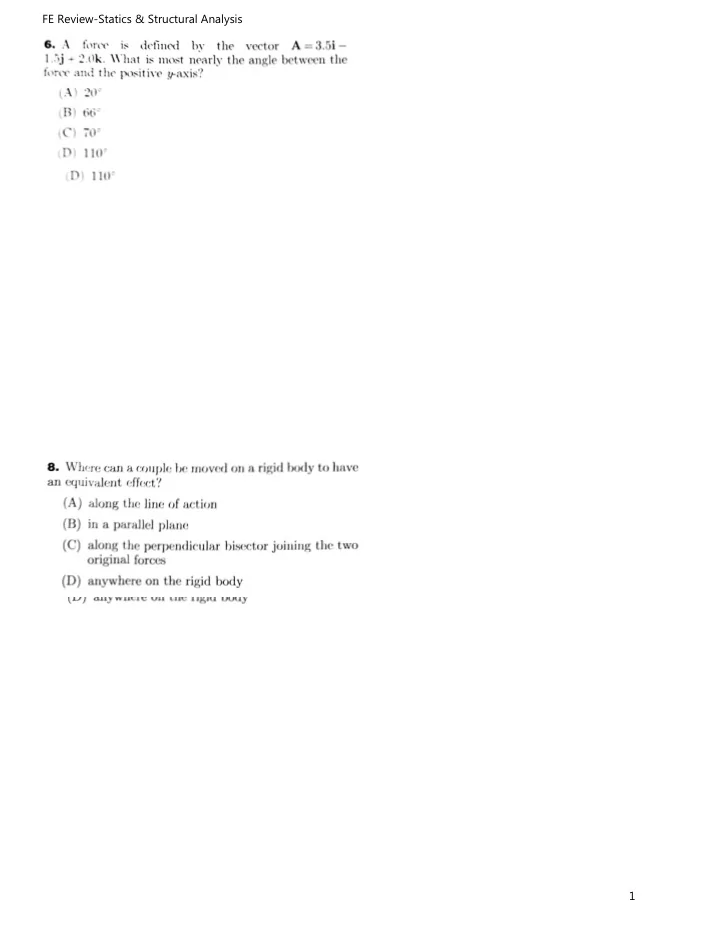
FE Review-Statics & Structural Analysis 6. A force is defined by the vector A 3.5i 1 \i - 2.0k. What is most nearly the angle between the 6. A force is defined by the vector A 3.5i force and the positive t/-axis? 1 \i - 2.0k.


slide-1
SLIDE 1

FE Review-Statics & Structural Analysis 1

  • 6. A

force is defined by the vector A — 3.5i —

1 \i - 2.0k. What is most nearly the angle between the

force and the positive t/-axis? (.At 20°

(B) 66

( C ) 70r

(D) 110c

  • 8. Where can a couple

be moved on a

rigid body to have an equivalent effect? (A) along the line of action (B) in a parallel plane (C) along the perpendicular bisector joining the two

  • riginal forces

(D) anywhere on the rigid body

  • 6. A

force is defined by the vector A — 3.5i —

1 \i - 2.0k. What is most nearly the angle between the

force and the positive t/-axis? (.At 20°

(B) 66

( C ) 70r

(D) 110c

  • 8. Where can a couple

be moved on a

rigid body to have an equivalent effect? (A) along the line of action (B) in a parallel plane (C) along the perpendicular bisector joining the two

  • riginal forces

(D) anywhere on the rigid body

slide-2
SLIDE 2

FE Review-Statics & Structural Analysis 2

The magnitude of the moment of the force F (see figure above) about the line OA is: a

.

200 in-lb.

b

.

165 in-lb. c

.

zero.

  • d. _ 1191 in-lb.
  • e. _ 128 in-lb.

The moment of the force F about the z-axis has a magnitude of: a

.

zero.

b

.

160 in-lb.

c

.

320 in-lb.

  • d. _ 800 in-lb.

e.

480 in-lb.

F*( 4 0 i - 1 2 0 j - 3 0 k ) l b s

( 3 . 0 . 4

T

2 - i

A - i

8 -1

slide-3
SLIDE 3

FE Review-Statics & Structural Analysis 3

250 kN 20 kN

In the analysis of rigid bodies the force system shown is: a

.

in static equilibrium. b

.

equivalent to a 1200 kN force acting vertically downward and intersecting the x-axis 1 m to the right of 'O'.

c

.

equivalent to a 1200 kN-m counterclockwise couple. d

.

equivalent to a 1200 kN-m clockwise couple.

e

.

equivalent to a single 240 kN force acting vertically downward 5 m to the right

  • f the origin 'O'.

50 kN 240 kN

slide-4
SLIDE 4

FE Review-Statics & Structural Analysis 4

The horizontal boom of negligible weight supports a 1000 pound load as shown. The boom is supported by cables and a ball and socket joint at '0'. The tensile load carried

by cable AB is:

a.

1500 lb.

  • b. _ 1800 lb.

c.

667 lb.

  • d. _ 1200 lb.

e. 10001b.

5

%

— Y

1000

slide-5
SLIDE 5

FE Review-Statics & Structural Analysis 5

Find resultant force and angle. Find Components.

slide-6
SLIDE 6

FE Review-Statics & Structural Analysis 6

  • 1. What is the resultant R of the system of forces

shown?

y

Ft = 15i + 25j-10k

F3 = —lOi + 40j + 50k

(3,6,4)^\_

F2 = 20i - 5j + 15k

/

X

/z

¥}(- Q^<3

  • io)(• - i f

Ty

+

<--

6o

slide-7
SLIDE 7

FE Review-Statics & Structural Analysis 7

R = 25i + 60j + 55k

(3,6,4)

slide-8
SLIDE 8

FE Review-Statics & Structural Analysis 8

slide-9
SLIDE 9

FE Review-Statics & Structural Analysis 9

Find resultant force Find FAC & FBC M=10 kg

slide-10
SLIDE 10

FE Review-Statics & Structural Analysis 10

slide-11
SLIDE 11

FE Review-Statics & Structural Analysis 11

  • 4. The two cables shown carry a 100 N vertical load.

100 N

Most nearly, what is the tension in cable AB?

(A) 40 N (B) 50 N (C) 60 N (D) 80 N

slide-12
SLIDE 12

FE Review-Statics & Structural Analysis 12

slide-13
SLIDE 13

FE Review-Statics & Structural Analysis 13

Find TAB. Wbar=300 N r=10 m Find L.

slide-14
SLIDE 14

FE Review-Statics & Structural Analysis 14

slide-15
SLIDE 15

FE Review-Statics & Structural Analysis 15

  • 2. A box has uniform density and a total weight of

GOO N. It is suspended by three equal-length cables,

  • AE. BE. and CE, as shown. Point E is 0.5 m directly

above the center of the box's top surface.

CE BE

0.4 m 0.6 m

Most nearly, what, is the tension in cable CE/

(A) 130 N (B) 200 N (C) 370 N (D) 400 N

slide-16
SLIDE 16

FE Review-Statics & Structural Analysis 16

A 156 pound homogeneous cylinder rests against

smooth surfaces as shown. The normal force at B is:

  • VERTICAL SURFACE

a.

b.

c. d. e.

156 lb. 144 lb. 169 lb. 60 lb. 405.6 lb.

156 lb.

The normal force at A (see figure above) is: a

.

zero.

  • b. _ 60 lb.
  • c. _ 144 lb.
  • d. _ 65 lb.

e.

156 lb.

slide-17
SLIDE 17

FE Review-Statics & Structural Analysis 17

slide-18
SLIDE 18

FE Review-Statics & Structural Analysis 18

slide-19
SLIDE 19

FE Review-Statics & Structural Analysis 19

slide-20
SLIDE 20

FE Review-Statics & Structural Analysis 20

Find the tension in the cable P=600 N

slide-21
SLIDE 21

FE Review-Statics & Structural Analysis 21

=? Find WB if P=80N. 80 N =

slide-22
SLIDE 22

FE Review-Statics & Structural Analysis 22

slide-23
SLIDE 23

FE Review-Statics & Structural Analysis 23

slide-24
SLIDE 24

FE Review-Statics & Structural Analysis 24

  • 3. A rope is wrapped over a 6 cm diameter pipe to

support a bucket of tools being lowered. The coefficient

  • f static friction between the rope and the pipe is 0.20.

The combined mass of the bucket and tools is 100 kg.

p, = 0.20 20°

pipe

r = 3 cm

bucket 100 kg

What is most nearly the range of force that can bo applied to the free end of the rope such that the bucket

remains stationary?

(A) 560 N to 1360 N (B) 670 N to 1440 N (C) 720 N to 1360 N (D) 720 N to 1510 N

slide-25
SLIDE 25

FE Review-Statics & Structural Analysis 25

The system shown is at rest and has values of coefficient of friction shown. A flexible cord connects the two weights. The maximum weight that can be supported without upsetting the equilibrium of the system is: a

.

25.6 pounds.

b

.

10.0 pounds c

.

16.0 pounds.

d

.

20.8 pounds. e

.

111.1 pounds.

80 LB

T T 7 7 7 7 T T 7 T 7 T T

u

  • 0 . 2
slide-26
SLIDE 26

FE Review-Statics & Structural Analysis 26

  • 10. A disk-shaped body with a 4 cm radius has a 320 N

force acting through the center at an unknown angle 9, and two 40 N loads acting as a couple, as shown. All of these forces are removed and replaced by a single 320 N force at point B, parallel to the original 320 N force.

40 N 320 N e

'b

4 cm

  • 40 N

Most nearly, what is the angle 9? (A) 0° (B) 7.6° (C) 15° (D) 29°

slide-27
SLIDE 27

FE Review-Statics & Structural Analysis 27

The 500 newton crate is initially at rest and the 200 newton force is then applied. The coefficient

  • f friction is 0.2 between the crate and the floor.

After the 200 N load is applied: (Assume the block can not tip). the crate will slide to the right. the frictional force will be 100 N.

a. b. c. d. e.

the frictional force will be 132 N. the frictional force will be 120 N. the frictional force will be 140 N.

200 N

5 0 0 N

r

0 . 2

iiummmMMMimmmnmm

slide-28
SLIDE 28

FE Review-Statics & Structural Analysis 28

W=50 kg us=0.2 uk=0.15

slide-29
SLIDE 29

FE Review-Statics & Structural Analysis 29

  • 1. A 2 kg block rests on a 34° incline.

(j.s = 0.2

kg

34°

If the coefficient of static friction is 0.2, approximately

how much additional force, F, must be applied to keep the block from sliding down the incline?

(A) i .7 N (B) 8.8 N

(C) 9.1 N (D) 14 N

slide-30
SLIDE 30

FE Review-Statics & Structural Analysis 30

slide-31
SLIDE 31

FE Review-Statics & Structural Analysis 31

slide-32
SLIDE 32

FE Review-Statics & Structural Analysis 32

Find the screw-jack moment. u=0.25 The thread moves up 2mm upon a 360 degree turn.

slide-33
SLIDE 33

FE Review-Statics & Structural Analysis 33

slide-34
SLIDE 34

FE Review-Statics & Structural Analysis 34

slide-35
SLIDE 35

FE Review-Statics & Structural Analysis 35

slide-36
SLIDE 36

FE Review-Statics & Structural Analysis 36

slide-37
SLIDE 37

FE Review-Statics & Structural Analysis 37

  • 3. Most nearly, what is the area moment of inertia

about the x-axis for the area shown?

7 cm E E 3.5 cm H

C

C

) 4.5 cm

A B

,

,

X

1.5 cm

(A) 89 cm4 (B) 170 cm4 (C) 510 cm4 (D) 1000 cm4

slide-38
SLIDE 38

FE Review-Statics & Structural Analysis 38

slide-39
SLIDE 39

FE Review-Statics & Structural Analysis 39

  • 5. Tho oontroidal moment of inertia ahont the .r-axis for

the area shown is 142.41 em1.

V i

8.2 cm F 3.8 cm H Q O 2.9 cm A B

  • X

4.1 cm

Most nearly, what is the centroidal polar moment of inertia?

(A 79 cm4 (B) 110 cm4 (CI 330 cm4 (D1 450 cm4

slide-40
SLIDE 40

FE Review-Statics & Structural Analysis 40

  • 7. Most nearly, what are the »

ami ./-eoor<li„ata „f centroid of the perimeter line for the area shown?

4.5 cm E

*

E 3.1 cm D

H

C

5.0 cm A

B

^

X 2.5 cm

(A) 1.0 cm; 3.8 cm (B) 1.0 cm; 4.0 cm (C) 2.3 cm; 4.4 cm (D) 2.3 cm; 4.8 cm

slide-41
SLIDE 41
  • 9. The ^-coordinate of (ho ccntroid of tlic area shown is

5.8125 cm.

10 cm

E

\ 3 cm H V

1 \

C D

6 cm A 1

B

X

3 cm

Most nearly, what is the centroidal moment of inertia

with respect to the x-axis?

I

A) 82 cm4

IB) 100 cm'

(C) 220 cm' tD) 270 cm

FE Review-Statics & Structural Analysis 41

slide-42
SLIDE 42

FE Review-Statics & Structural Analysis 42

  • 12. Most nearly, what are the x- and y-coordinates of

the centroid of the area shown?

4 cm 12 cm

E

4 cm H

C

C

)

8 cm A B

X

(A) 4.8 cm;

  • cm

(B) 6.0 cm; 7.2 cm (C) 6.0 cm; 7.6 cm (D) 6.0 cm;

  • cm
slide-43
SLIDE 43
  • 11. If w = 15 in., find the distance to the centroid from the bottom of the

beam.

  • a. 15.4 in.
  • b. 15.9 in.
  • c. 15.1 in.
  • d. 15.7 in.
  • e. 14.8 in.
  • 12. If w = 5 in., find the moment of inertia about

the z axis. The centroid of the section is located 2.583 in. from the bottom of the beam.

  • a. 8.71 in.4
  • b. 11.1 in.4
  • c. 9.46 in.4
  • d. 12.3 in.4
  • e. 10.7 in.4

FE Review-Statics & Structural Analysis 43

slide-44
SLIDE 44

FE Review-Statics & Structural Analysis 44

  • 9. The overhanging beam shown is supported by a

roller and a pinned support. The moment is removed and replaced by a couple consisting of forces applied at points A and C.

100 N 100 N/m 2.5 N m

fit

a

0.1 m 0.5 m 0.2 m 0.4 m

What is the magnitude of the forces that constitute the

couple?

(A) 2.1 N (B) 4.2 N (C) 6.3 N (D) 8.3 N

slide-45
SLIDE 45

FE Review-Statics & Structural Analysis 45

  • 1. What are the approximate vertical reactions at the

ends of the structure shown?

1000 N 30 m 10 m

  • '

J

r

i

(A) RA — 120 N; RB = 630 N B) RA = 160 N; RB = 840 N

C) RA = 630 N: RB = 120 N

D) RA = 840 N; ftB = 160 N

slide-46
SLIDE 46

FE Review-Statics & Structural Analysis 46

  • 2. What is most nearly the fixed-end moment at point

A when a 15 N load is applied?

L = 3 m 1 m

15 N

  • f

A

B fAj 3.3 N-rri

ff'j 33 N-rn

'B) 45 N' m

slide-47
SLIDE 47

FE Review-Statics & Structural Analysis 47

  • 11. The overhanging beam shown is supported by a

roller and a pinned support. The moment, is removed and replaced by a couple consisting of forces applied at points A and C.

210 N/m

I

I

500 N 8.3 N-m

AC I

B 0.2 m 0.7 m 0.4 m 0.5 m

What is most nearly the magnitude of the couple that exactly replaces the moment that is removed?

A1 0.080 N m

, B1 0.16 N m

(C) S.3 N m D1 15 Nm

  • 12. Which structure is statically determinate and

stable with the loadings shown?

r!

vV

1

rA r

ii

y/^y//,

r

HI

7

  • If

A IV

(A) I

  • nly

Hij I and III

(Cj J and IV IB) II and III

slide-48
SLIDE 48

FE Review-Statics & Structural Analysis 48

  • 3. For the beam shown, the fixed-end moment at point

A cannot exceed 2 N^m.

2 m

0.5 m

m r

I

'

r

lA

B

What is most nearly the maximum load that can be applied to the beam?

(A) 1.8 N (B) 2.0 N

(C) 3.6 N (D) 7.1 N

slide-49
SLIDE 49

FE Review-Statics & Structural Analysis 49

  • 3. The loading shown requires a clockwise resisting

moment of 20 N-in at the support.

1

15 N

I

r |76N

  • I -

I - 0.5 m

1 m 0.5 m

What is most nearly the value of force F? (A) 25 N (up) (B) 27 N (up) (C) 38 N (down) (D) 43 N (down)

slide-50
SLIDE 50

FE Review-Statics & Structural Analysis 50

  • 4. A bent beam is acted upon by a moment and several

concentrated forces, as shown.

60 N M = 20 Nm

i

.f

* 0.2 m

X

0.2 m I 10 N 20 N 10 N

Approximate the unknown force, F, and distance, x, that will maintain equilibrium on the beam. (A) F=5 N; x=0.8 m (B) F= 10 N; x=0.6 m (C) F= 20 N; £=0.2 im (D) F= 20 N; £=0.4 m

slide-51
SLIDE 51

FE Review-Statics & Structural Analysis 51

Find the reactions.

slide-52
SLIDE 52

FE Review-Statics & Structural Analysis 52

The distributed loading shown is statically equivalent

to a single downward load of:

a

.

1.2 kN at 4 m to the right of A.

b

.

3.6 kN at 3.4 m to the right of

A

A. c

.

3.6 kN at 3.8 m to the right of A.

d

.

3.0 kN at 3.6 m to the right of A. e

.

3.0 kN at 3.4 m to the right of A.

400 /

m

vuiMrvvvvvvvvvvtrfjrvvwvvvvvvvvvvvv

800 N/m

al

5m

5m

slide-53
SLIDE 53

FE Review-Statics & Structural Analysis 53

  • 5. For the cantilever truss shown, what is most nearly

tin1 force in member AF

5000 N 10000 N 5000 N 5 m

(A) 0 X (BI 5000 N

C

) 10 000 N

(D) 15 000 N

5 m

10000 N 5 m

slide-54
SLIDE 54

FE Review-Statics & Structural Analysis 54

Find internal force of members IJ and CD.

slide-55
SLIDE 55

FE Review-Statics & Structural Analysis 55

  • 1. Determine the approximate force in member BC for

the truss shown.

3000 N 3000 N 3000 N 7.5 m 3000 N 3000 N 5 m 5 m 5 m

(A) 0 N (B) 1000 N

(C) 1500 N (D) 2500 N

slide-56
SLIDE 56

FE Review-Statics & Structural Analysis 56

  • 2. Find the approximate force in member DE for the

truss shown.

25000 N 15 m

10 m

(A) 0 N (B) 6300 N (C) 8800 N (D) 10 000 N

10 m 10 m

slide-57
SLIDE 57

FE Review-Statics & Structural Analysis 57

slide-58
SLIDE 58

FE Review-Statics & Structural Analysis 58

  • 3. For the truss shown, what are most nearly the forces

in members AC and BD?

5000 N

A:

< :

Z 5 t m

"g^\H

jfm

I,

1-

  • I I

8 m

8 m

8 m

8 m

c-

(A) AC =

11000 N; BD

=

  • 7900 N

(B) AC =

0 N; BD

=

—2000 N

(C) AC =

1100 N; BD

=

2500 N

(D) AC =

0 N; BD

=

—7900 N

slide-59
SLIDE 59

FE Review-Statics & Structural Analysis 59

  • 4. The braced frame shown is constructed with pin-

connected members and supports. All applied forces are horizontal.

100 N 200 N 100 N 15 m 15 m 100 N 200 N 100 N 20 m

Most nearly, what is the force in the diagonal member BA?

(A) 0 N (B) 160 N (C) 200 N (D) 250 N

slide-60
SLIDE 60

FE Review-Statics & Structural Analysis 60

The pin connected 'A' frame carries a vertical load of 1000 pounds as shown. Member BD must carry a load of: a

.

400 lb. in tension.

b

.

400 lb. in compression. c

.

no load (it is a zero force member).

  • d. _ 500 lb. in tension.

e

.

500 lb. in compression.

000 LB

4

slide-61
SLIDE 61

FE Review-Statics & Structural Analysis 61

  • Q. 8

Analyze the truss shown.

2 h 2 h

The force in member AH is most nearly (A) 300 lbf (compression) (B) 600 lbf (compression) (C) 670 lbf (compression) (D) 670 lbf (tension)

Hint: Solve by using the method of joints.

slide-62
SLIDE 62

FE Review-Statics & Structural Analysis 62

slide-63
SLIDE 63

FE Review-Statics & Structural Analysis 63

slide-64
SLIDE 64

FE Review-Statics & Structural Analysis 64

The pin connected truss supports a mass of 100 kilograms as shown. The load carried by member BE is: a

.

1770 newtons compressive. b

.

1770 newtons tensile. c

.

180 newtons compressive. d

.

180 newtons tensile.

e

.

1.77 MN compressive.

k

  • o cm

75 150

cm

c m

100 kg—*

The load carried by member BD of the pin connected truss (see figure above) is: a

.

981 newtons compressive.

b

.

981 newtons tensile. c

.

zero. d

.

100 newtons compressive.

e

.

981 kN compressive.

slide-65
SLIDE 65

FE Review-Statics & Structural Analysis 65

slide-66
SLIDE 66

FE Review-Statics & Structural Analysis 66

  • 4. The truss shown is constructed of members having a

modulus of elasticity of 200 GPa. The cross-sectional area of each member is 5 cm2.

3 m 3 m 3 m 3 m 20 kN

What is most nearly the horizontal displacement of the roller at location 5 due to the applied load? (A) 0.1 cm (B) 4.2 cm (C) 6.0 cm (D) 8.5 cm

slide-67
SLIDE 67

FE Review-Statics & Structural Analysis 67

The hydrostatic force on the concrete dam per foot of width is:

  • a. _ 62.4 lb/ft.
  • b. _ 1872 lb/ft.
  • c. _ 936 lb/ft.
  • d. _ 28,080 lb/ft.
  • e. _ 56,160 lb/ft.

u_

I

C3

  • n

"WATER 7 =62.4LB/FT 3

r-

CONCRETE

(S)

^r

/777777777777777777777777T7

K 2 0 - f t H

slide-68
SLIDE 68

FE Review-Statics & Structural Analysis 68

slide-69
SLIDE 69

FE Review-Statics & Structural Analysis 69

slide-70
SLIDE 70

FE Review-Statics & Structural Analysis 70

slide-71
SLIDE 71

FE Review-Statics & Structural Analysis 71

slide-72
SLIDE 72

FE Review-Statics & Structural Analysis 72

slide-73
SLIDE 73
  • 3. Two solid cylindrical rods support a load of

P = 25 kN as shown. Determine the normal force in rod (2).

  • a. 22.5 kN
  • b. 18.9 kN
  • c. 25.3 kN
  • d. 11.2 kN
  • e. 14.0 kN

FE Review-Statics & Structural Analysis 73

slide-74
SLIDE 74
  • 1. Axial loads are applied with rigid bearing plates to the solid cylindrical rods
  • shown. Determine the axial load in rod (2) if forces F1 = 35 kips and F2 = 35

kips.

  • a. 15 kips
  • b. 10 kips
  • c. 20 kips
  • d. -30 kips
  • e. 25 kips
  • 2. A rigid bar ABCD is

supported by two bars as shown in the figure. If load P = 15 kN and the normal force in rod (1) is 5 kN (compression), determine the normal force in rod (2).

  • a. 12.3 kN
  • b. 14.2 kN
  • c. 16.5 kN
  • d. 13.7 kN
  • e. 17.1 kN

FE Review-Statics & Structural Analysis 74

slide-75
SLIDE 75

Determine the magnitude of the ground reactions at point A on the following beams.

  • 4. Vertical force Ay:
  • a. 9 kN
  • b. 13 kN
  • c. 10 kN
  • d. 11 kN
  • e. 12 kN
  • 5. Moment MA:
  • a. 32 kN-m
  • b. 23 kN-m
  • c. 28 kN-m
  • d. 25 kN-m
  • e. 19 kN-m
  • 6. Vertical force Ay:
  • a. 27.5 kN
  • b. 63.8 kN
  • c. 36.9 kN
  • d. 44.2 kN
  • e. 59.1 kN

FE Review-Statics & Structural Analysis 75

slide-76
SLIDE 76
  • 7. Use the graphical method to construct the

shear-force diagram and identify the magnitude

  • f the largest shear force (consider both positive

and negative). The ground reactions are shown.

  • a. 18 kN
  • b. 36 kN
  • c. 47 kN
  • d. 26 kN
  • e. 55 kN
  • 8. Use the graphical method to construct the

shear-force diagram and identify the magnitude of the largest shear force (consider both positive and negative). The ground reactions are shown.

  • a. 192 kN
  • b. 183 kN
  • c. 205 kN
  • d. 213 kN
  • e. 175 kN

FE Review-Statics & Structural Analysis 76

slide-77
SLIDE 77
  • 9. Use the graphical method to construct the

bending-moment diagram and identify the magnitude of the largest moment (consider both positive and negative). The ground reactions and shear-force diagram are shown.

  • a. 65 kN-m
  • b. 90 kN-m
  • c. 85 kN-m
  • d. 70 kN-m
  • e. 75 kN-m
  • 10. Use the graphical method to construct the

bending-moment diagram and identify the magnitude of the largest moment (consider both positive and negative). The ground reactions and shear-force diagram are shown.

  • a. 33.5 kN-m
  • b. 42.0 kN-m
  • c. 52.3 kN-m
  • d. 58.9 kN-m
  • e. 39.2 kN-m

FE Review-Statics & Structural Analysis 77

slide-78
SLIDE 78
  • 1. Rectangle
  • 6. Circle
  • 2. Right Triangle
  • 7. Hollow Circle
  • 3. Triangle
  • 8. Parabola
  • 4. Trapezoid
  • 9. Parabolic Spandrel
  • 5. Semicircle
  • 10. General Spandrel

C b h x x′ x − y y′ y − b h C x x′ x − y y′ y − b h C x x′ x − y y′ y − a b h C x y − a C x x′ y, y′ y − r d C x y r d D C r x y R Zero slope h C x b x′ x − y y′ y − b h y − C x x′ x − y y′ Zero slope b h y − C x x′ x − y y′ Zero slope

A bh y h I bh x b I hb I bh I hb

x y x y

= = = = = = =

′ ′

2 12 2 12 3 3

3 3 3 3

A bh y h I bh x b I hb I bh I hb

x y x y

= = = = = = =

′ ′

2 3 36 3 36 12 12

3 3 3 3

A bh y h I bh x a b I bh a ab b I b

x y x

= = = = + = − + ( ) =

2 3 36 3 36

3 2 2

( ) h3 12

A a b h y a b a b h I h a b a ab b

x

= + = + +

( )

= + + + ( ) ( ) ( ) 2 1 3 2 36 4

3 2 2

A r y r I r I I r

x x y

= = = −

( )

= =

′ ′

π π π π π

2 4 4

2 4 3 8 8 9 8 A r d I I r d

x y

= = = = = π π π π

2 2 4 4

4 4 64 A R r D d I I R r D d

x y

= − ( ) = − ( ) = = − ( ) = − ( ) π π π π

2 2 2 2 4 4 4 4

4 4 64 ′ = ′ = = = y h b x A bh x b y h

2 2

2 3 3 8 3 5 ′ = ′ = = = y h b x A bh x b y h

2 2

3 3 4 3 10

′ = ′ = + = + + = + + y h b x A bh n x n n b y n n h

n n

1 1 2 1 4 2

696

Table A.1 Properties of Plane Figures

x x A A y y A A

i i i i i i

= = Σ Σ Σ Σ I I d A

c

= + ( ) Σ

2

FE Review-Statics & Structural Analysis 78