Epsilon Noise Impact Studies Epsilon conducted noise modeling for - - PowerPoint PPT Presentation

epsilon noise impact studies
SMART_READER_LITE
LIVE PREVIEW

Epsilon Noise Impact Studies Epsilon conducted noise modeling for - - PowerPoint PPT Presentation

Epsilon Noise Impact Studies Epsilon conducted noise modeling for stationary (on-site equipment) and mobile (trucking) sources. Mitigation included in the project design includes: Use of an electric rail car pusher to move railway cars


slide-1
SLIDE 1

978-897-7100

Epsilon Noise Impact Studies

  • Epsilon conducted noise modeling for stationary (on-site equipment)

and mobile (trucking) sources. Mitigation included in the project design includes:

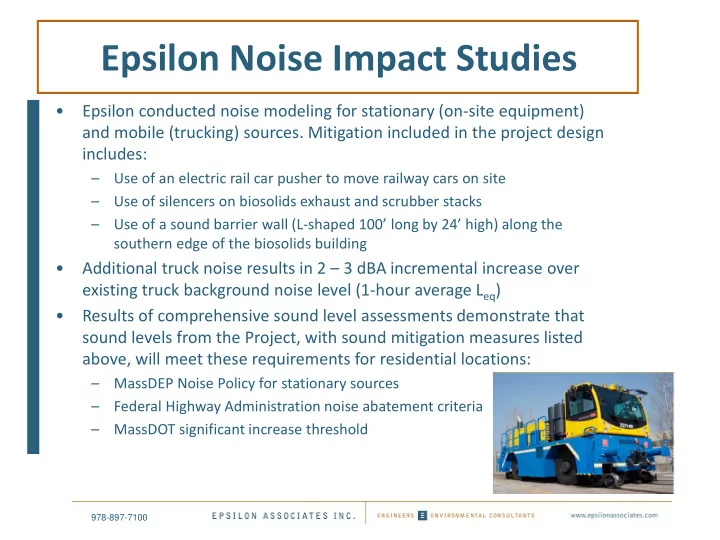
– Use of an electric rail car pusher to move railway cars on site – Use of silencers on biosolids exhaust and scrubber stacks – Use of a sound barrier wall (L-shaped 100’ long by 24’ high) along the southern edge of the biosolids building

  • Additional truck noise results in 2 – 3 dBA incremental increase over

existing truck background noise level (1-hour average Leq)

  • Results of comprehensive sound level assessments demonstrate that

sound levels from the Project, with sound mitigation measures listed above, will meet these requirements for residential locations:

– MassDEP Noise Policy for stationary sources – Federal Highway Administration noise abatement criteria – MassDOT significant increase threshold

slide-2
SLIDE 2

978-897-7100

Epsilon Odor Impact Studies

  • Massachusetts currently has no official odor policy or thresholds. Odor is regulated

under 310 CMR 7.09 in that operations that emit odors shall not permit their emissions to “cause a condition of air pollution.” A Draft Odor Policy for Composting Facilities was published by MassDEP in January 1996. This draft guidance document recommended a minimum design standard benchmark of 5 D/T.

  • The proposed project has been designed to avoid creating odor “nuisance”
  • conditions. Odor will be managed by use of odor control technologies (air pollution

controls), such as a biofilter with carbon adsorption and/or zeolite polishing (or equal), and ionization, and stacks designed with good dispersion characteristics.

  • An odor modeling study was prepared by Epsilon Associates. Results of the study

are presented in the air and odor report and the project was designed for odor concentration outcomes at the property lines adjacent to residential dwellings limited to 1 D/T or less (1-minute average).

slide-3
SLIDE 3

978-897-7100

Epsilon Air Quality Impact Studies

  • Epsilon Associates prepared an air quality study/analysis based on

maximum expected operating conditions and using conservative

  • assumptions. The Project’s impacts will comply with all applicable
  • standards. Specifically:

– The National Ambient Air Quality Standards (NAAQS) will not be exceeded. Per US EPA, these standards “provide public health protection, including protecting the health of ‘sensitive’ populations such as asthmatics, children, and the elderly.” – MassDEP has developed “health- and science-based air guidelines” – known as Ambient Air Limits (AALs) and Threshold Effect Exposure Limits (TELs) – to evaluate potential human health risks from exposures to chemicals in air. The Massachusetts AALs and TELs will not be exceeded. – The odor control system will be enhanced to also remove chemicals below AAL and TEL levels.

slide-4
SLIDE 4

978-897-7100

Epsilon Greenhouse Gas Studies

  • Epsilon conducted studies supporting and documenting Parallel

Products greenhouse gas (GHG) mitigation commitments. Parallel Products commits to the following:

– 3.5 MW of canopy and rooftop solar PV – A 20% reduction over Code in lighting installations electricity use in the new buildings and in the MSW processing area of the existing building – High-efficiency mechanical equipment – Variable frequency drives where appropriate – High-performance new building envelopes – Photovoltaic-ready new construction – Construction waste recycling

  • In addition, GHG will be reduced due to

transportation by rail rather than by over the road trucking