Environmental Sustainability in East & Southern Africa Verma - - PowerPoint PPT Presentation

environmental sustainability in east southern africa
SMART_READER_LITE
LIVE PREVIEW

Environmental Sustainability in East & Southern Africa Verma - - PowerPoint PPT Presentation

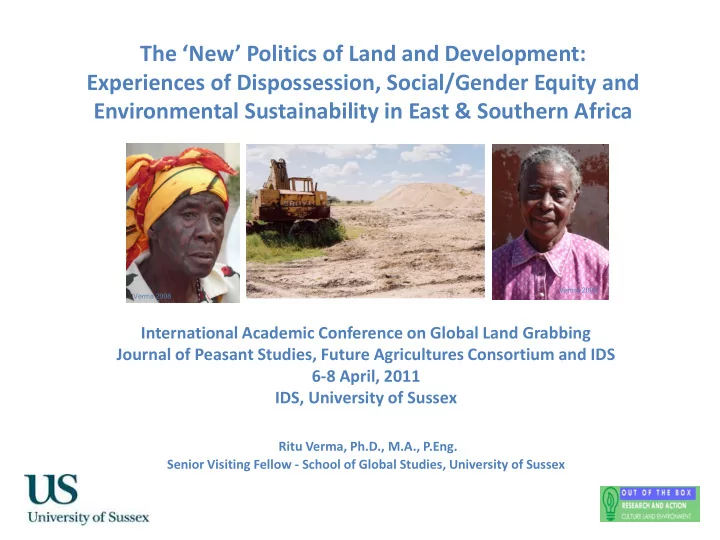
The New Politics of Land and Development: Experiences of Dispossession, Social/Gender Equity and Environmental Sustainability in East & Southern Africa Verma 2009 Verma 2008 International Academic Conference on Global Land Grabbing


slide-1
SLIDE 1

The ‘New’ Politics of Land and Development: Experiences of Dispossession, Social/Gender Equity and Environmental Sustainability in East & Southern Africa

International Academic Conference on Global Land Grabbing Journal of Peasant Studies, Future Agricultures Consortium and IDS 6-8 April, 2011 IDS, University of Sussex

Ritu Verma, Ph.D., M.A., P.Eng. Senior Visiting Fellow - School of Global Studies, University of Sussex

Verma 2009 Verma 2008

slide-2
SLIDE 2

Setting the Scene: Synthesis of Research

IDRC

(Kenya – Gender, Land, Livelihoods) (Madagascar, Malawi, Mozambique, Zimbabwe – Women’s Rights to Land)

NPA

(Mozambique – Land rights)

WISP-IUCN & FAO

(Kenya – Pastoral land rights)

SOAS

(Madagascar – Anthropological study of development interventions and actors)

Research: 1996- 2010

slide-3
SLIDE 3

Main Question: What’s ‘New’ about Land Grabs? What are its Effects and Implications?

Land Grabs in Africa: So, What’s ‘New’?

slide-4
SLIDE 4

Main Argument: Land Grabs

Echoes of the past, showing striking similarities with colonial interventions and dispossessions Contemporary political-economic changes and simultaneous crises, exacerbated by shifting geopolitics, corruption and elite-capture, have enabled widening inequities in power and land grabs When viewed from a political-ecological lens, land is experienced by farmers and pastoralists as having multiple values and meanings, linked to social relations, economic-welfare, material use, cultural identity/status, spirituality, well-being, etc. As powerful global forces and elite actors flex their muscles in terms of land deals, acquisitions and grabs, social justice, environmental sustainability and customary institutions are losing out to narrow economic framing narratives which focus on resource extraction, external food security and bio-fuel production based on the priorities of a few As these assumptions/notions gain traction, women and men are being increasingly dispossessed of their land and livelihoods, experiencing acute marginalization and food security

slide-5
SLIDE 5

Brief Overview of Land Grabs: Multiple Definitions

  • 1. Trans-national commercial land transactions and speculations driven by

LARGE-scale production, sale and export of food and bio-fuels (Borras and Franco, 2010)

  • 2. Resulting from contemporary LARGE-scale, cross-border land deals or

transactions carried out by TNCs or foreign governments, and resulting from multiple causes (Zoomer, 2010)

  • 3. * Land grabs, dispossessions, deals, investments and acquisitions resulting

from multiple causes and an inter-play of global and local forces in the contemporary context, but rooted in historical, geopolitical and patriarchal relations of power (varying size and scale)

slide-6
SLIDE 6

Brief Overview of Land Grabs: Driving Forces

Investment/expansion of off-shore/trans- national mono-cropped agriculture and food production (food crisis) Investment/expansion of non-food agricultural commodities (horticulture) bio-fuels and carbon sinks (energy crisis) Expansion/creation of protected areas, natural reserves, eco-tourism, conservancies, REDD, etc. Building of large-scale infrastructure, works and interventions Urban expansion, migration, housing projects, rural-urban linkages, etc. Extractive industries (mining and minerals, quarries, oil, WATER, etc.) Military operations and land as ‘strategic’ * Territorial expansion and wealth accumulation/concentration * Patriarchy and gendered power relations

slide-7
SLIDE 7

Key Learnings

Dominant Narratives

Land Grabs & Dispossessions in SSA

Disconnects

Land Grabs & Dispossessions in SSA

Pastoralist Lens

Land Grabs & Dispossessions in Kenya

Gender Lens

Land Grabs & Dispossessions in Madagascar, Malawi, Mozambique, Kenya and Zimbabwe

slide-8
SLIDE 8

Dominant Framing Narratives

Discourses

  • Neo-liberal policies: privatization, commoditization, enclosure, liberalization of land markets
  • Economic-reductionism, profit-seeking and resource extraction: neglect socio-cultural,

political, historical, identity and spiritual values of land (link to ancestors and afterlife)

Discourses

  • VOLUNTARY “Codes of Conduct (IFPRI)” and “Principals for Responsible Agricultural

Investment” (World Bank): LARGE scale land investments)

  • Benefits: Increase off-farm and smallholder incomes, transfer of technologies, increase in

food production, building of infrastructure, access to basic services, export opportunities, etc.

Pastoralists

  • Assumption is that land is ‘idle’ and ‘vacant’, and pastoral land management as ‘illogical’
  • Bias towards privatization/subdivision/enclosure of land
  • Agricultural-centric policies: view pastoral land use and mobility as ‘unsustainable’

Gender

  • Claims focus on “pro-poor”: gender blind and lack social differentiation (“the farmer”)
  • Focus on agriculture, without recognizing women’s critical role in farming and food security
  • Assume that “benefits” (if any) will be shared/captured equally (gender, class, ethnicity, etc.)
slide-9
SLIDE 9

Disconnects

Effects

  • Lack of participation, consultation, compensation and resettlement: harassment (Mozambique)
  • Not just global, bi-lateral, trans-national actors: negotiations, collusion with local elites
  • Focus on trans-national without attention to ‘local’ power, elite capture
  • Decentralization: unintended consequences/opportunities for elite capture and concentration

Effects

  • Subsistence land dispossessed for bio-fuel production (and carbon sinks, mono-cropped tree

plantations): negative effects of adaptation to climate change

  • ‘Efficient’ land governance/administration: technologies to document land (mapping, computerized

recording) also make dispossession more ‘efficient’ (knowledge/power)

Pastoral

  • Potential for and ongoing dispossession of pastoral and indigenous women and men from land and

resources (already happening in Kenya: Kitengela, Naivasha)

  • Loss of cultural identity, indigenous knowledge and sustainable NRM practices

Gender

  • Resettlement on marginal land: increase in women’s labour (water/fuelwood collection, farming, etc.),

and ignores/weakens their land and property rights (opportunity to title lost)

  • Decrease in food security, livelihoods/income options; exacerbates male out-migration
  • Lack of legal resources in the face of powerful actors and death threats (Mozambique)
slide-10
SLIDE 10

Are Land Grabs ‘New’?

  • MNCs seeking African resources for profit and to feed the needs and

demand for luxuries of more powerful nations and actors have been around since the 16th and 17th centuries (i.e. Dutch East India Co. and British East India Co.)

  • Resource extraction was a driving force for colonial intervention,

expansion and development (infrastructure, interventions, etc.)

Historical Connections

  • Colonial land grabbing and extraction of resources could not have

happened to the extent it did without collusion with local elites (Madagascar: caste and ethnicity differences) and already existing asymmetries in distribution of land, resources and power

  • Land grabbing by both customary and statutory leaders/actors, as well

as commercial/foreign actors

  • Ongoing processes of withdrawal of the state (SAPs, decentralization, etc

Africa

  • Colonial interventions entrenched men’s power and changed property

relations within patriarchal discourses

  • Customary laws re-interpreted in favour of men and erosion of women’s

land rights and access

  • Land grabbing by brothers, in-laws, etc. became common; statutory laws

interpreted/open to gender bias, corruption and discrimination

Gender

slide-11
SLIDE 11

So, What’s Really New?

  • Globalized nature of the grabs: same forces/new actors (South)
  • Critical mass and numbers of TNC’s - defy territorial boundaries and the

‘nation-state’ and accountability. ITCs

  • Rapidly changing climates and convergence of global crises: “Perfect

Storm” of financial, environment, energy, food crises

  • Speed and intensity of the dispossessions, volume of land markets

Globalization

  • Non-African nations seek long-term land leases and holdings beyond
  • wn borders in food insecure nations to supply food and energy to their
  • wn populations (ethics/hunger/food security)
  • Land deals destabilizing whole nation states (Madagascar; Daewoo

scandal, neglect of spiritual/cultural values, acute shifts in power and bilateral relations with changing governments)

Africa

  • Aggregation of everyday gender dispossessions are significant
  • Land and water interface, and implications for women (Mozambique)
  • Social movements: women’s movements on a large scale over the last

century

Gender

slide-12
SLIDE 12

Research, Action & Policy Recommendations

  • Regional/global analysis and synthesis is CRITICAL (IR/Geopolitics)
  • Urgent GAP: rigorous, credible research on impacts (alternative

narratives, experiences, life stories) beyond journalistic

  • Tailor/translate research for 3 target groups: researchers, policy

makers and marginalized groups

  • What are the implications /significance of high rates of male out-

migration and shifts in male identity/modernity for land grabs

Research

  • Dead research, not enough to be right, links to power, change

agents and social movements (Eric Holt)

  • Support dispossessed communities with legal support (cases,

compensation, resettlement, etc.) and basic services

  • Demonstrate difference between policy/discourses and impacts
  • Involve customary leaders and share/disseminate information

widely (information centres, drama, radio, etc.)

Action

  • Land is more than a ‘commodity’, this should be reflected
  • Class conscious, gender-sensitive, historical, cultural, human rights
  • Demand greater transparency, accountability, checks/balances,

democratization, ethics, and equity

  • Strengthen indigenous/pastoral women rights (policies,

strengthening of international instruments, etc.)

Policy
slide-13
SLIDE 13

Food for Thought: Voluntary ‘Codes of Conduct’ as Protection Against Land Grabs?

If constitutional, statutory laws, and policies that address land rights suffer from weak/lack/gender- bias in implementation, what are the chances that ‘voluntary’ codes of conduct and principals (meant to be “win-win” and to make “virtue out of necessity”) are effective, taken seriously and represent/defend the rights and needs of poor women and men?

slide-14
SLIDE 14

Food for Thought: Is it Helpful to View Land Grabs as an ‘African’ or ‘Southern’ Phenomenon?

Given examples from Latin American, Asia, North America, etc. of land grabbing, is there room for S-S and N-S dialogue, sharing of experiences and expansion of social and gender equity questions in key critical international instruments and movements (i.e. rights of indigenous peoples, climate change, etc.)?

slide-15
SLIDE 15

Food For Thought: How to We Deal with Complexity and Multiple Narratives?

Although some of the forces and actors responsible for land grabbing may be global, how do we analyze differences in reactions and resistances in local contexts and deal with complexity (i.e. differences between India and Madagascar: value/opting out of agriculture, modernizing discourses, meanings of land, links to ancestors, etc.)?

slide-16
SLIDE 16

Thank You!

www.outofboxorg.wordpress.com

Hall 2008 Verma 2009 Verma 2009 Verma 2009 Verma 2009 Verma 2008 Verma 2008 Verma 2008