1. JEWISH LIFE IN EAST RAND, MIDRAND, SOUTHERN GREAT ESCARPMENT & - - PDF document

1 jewish life in east rand midrand southern great
SMART_READER_LITE
LIVE PREVIEW

1. JEWISH LIFE IN EAST RAND, MIDRAND, SOUTHERN GREAT ESCARPMENT & - - PDF document

1. JEWISH LIFE IN EAST RAND, MIDRAND, SOUTHERN GREAT ESCARPMENT & SOUTHERN HIGHVELD. In the course of doing research into Jewish settlement in the rural areas of the East Rand, Midrand, Southern Great Escarpment & Southern Highveld, South


slide-1
SLIDE 1

1

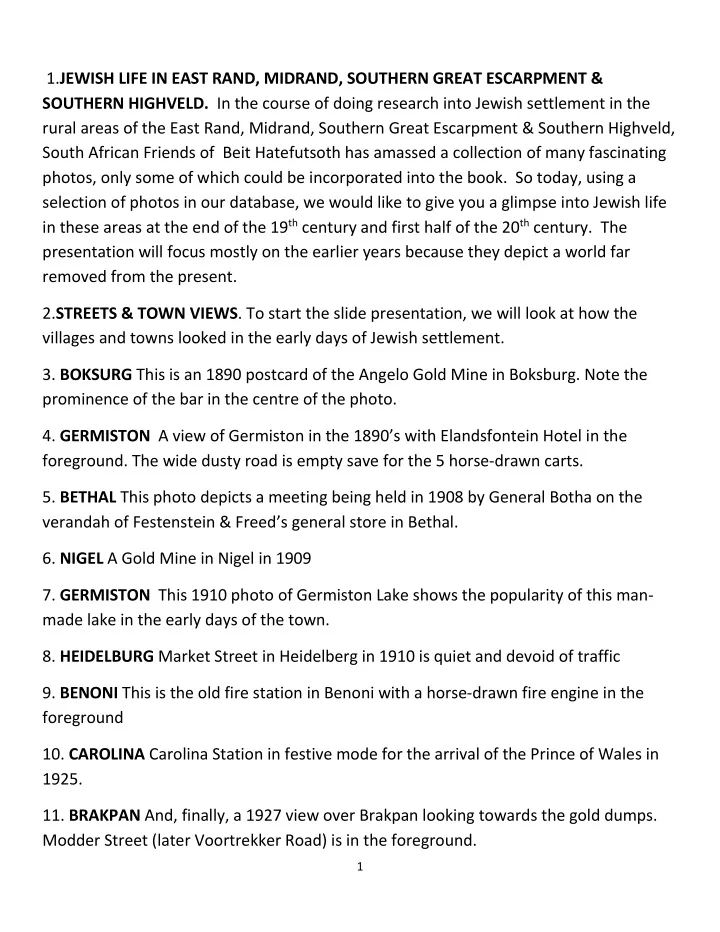
1.JEWISH LIFE IN EAST RAND, MIDRAND, SOUTHERN GREAT ESCARPMENT & SOUTHERN HIGHVELD. In the course of doing research into Jewish settlement in the rural areas of the East Rand, Midrand, Southern Great Escarpment & Southern Highveld, South African Friends of Beit Hatefutsoth has amassed a collection of many fascinating photos, only some of which could be incorporated into the book. So today, using a selection of photos in our database, we would like to give you a glimpse into Jewish life in these areas at the end of the 19th century and first half of the 20th century. The presentation will focus mostly on the earlier years because they depict a world far removed from the present. 2.STREETS & TOWN VIEWS. To start the slide presentation, we will look at how the villages and towns looked in the early days of Jewish settlement.

  • 3. BOKSURG This is an 1890 postcard of the Angelo Gold Mine in Boksburg. Note the

prominence of the bar in the centre of the photo.

  • 4. GERMISTON A view of Germiston in the 1890’s with Elandsfontein Hotel in the
  • foreground. The wide dusty road is empty save for the 5 horse-drawn carts.
  • 5. BETHAL This photo depicts a meeting being held in 1908 by General Botha on the

verandah of Festenstein & Freed’s general store in Bethal.

  • 6. NIGEL A Gold Mine in Nigel in 1909
  • 7. GERMISTON This 1910 photo of Germiston Lake shows the popularity of this man-

made lake in the early days of the town.

  • 8. HEIDELBURG Market Street in Heidelberg in 1910 is quiet and devoid of traffic
  • 9. BENONI This is the old fire station in Benoni with a horse-drawn fire engine in the

foreground

  • 10. CAROLINA Carolina Station in festive mode for the arrival of the Prince of Wales in

1925.

  • 11. BRAKPAN And, finally, a 1927 view over Brakpan looking towards the gold dumps.

Modder Street (later Voortrekker Road) is in the foreground.

slide-2
SLIDE 2

2

  • 12. SHULS As more and more Jews moved into the towns, congregations were formed.

As early as 1890 services were taking place in private homes, masonic halls or hotels. Once sufficient funds had been raised shuls were built.

  • 13. GERMISTON The earliest shul built in the areas covered by this book is the 1st shul of

the Germiston and Georgetown Hebrew Congregation, which was consecrated in 1903.

  • 14. Due to the rapid growth of the Jewish population of Germiston and movement away

from Georgetown, a larger, more elaborate, shul was opened in 1930 on the corner of President and George Streets.

  • 15. VOLKSRUST The Volksrust Hebrew Congregation was formed as early as 1901 and

the small, modest shul was built in 1904. It was the first building in Volksrust to receive electric lighting in 1912.

  • 16. BENONI Benoni’s first synagogue was built in 1908 in Woburn Ave. It was in use

until 1950 and was later proclaimed a national monument

  • 17. In 1929 it became apparent that a larger shul was required for the growing Jewish
  • population. The Park Street shul was consecrated in 1933. Its impressive interior

included fumed oak panels, coloured smoked glass windows imported from Europe and elaborate light fittings.

  • 18. SPRINGS The small Gates of Hope Shul in Springs was opened in 1908. It also

served the local farming communities and residents of Devon, Delmas, Bethal & Nigel.

  • 19. In 1951 the original Springs shul was demolished and a new one constructed on the

same site. At that time it was the second largest synagogue in the Transvaal. The choir room was screened off by a carved wooden screen made by famous South African sculptor, Herman Wald, which was placed above the Aron Kodesh.

  • 20. The modest Ermelo shul was consecrated in 1909. By 1976 the community had

dwindled and attended services in Bethal.

  • 21. BOKSBURG The Boksburg Hebrew Congregation, formed in 1896, split in 1912,

resulting in 2 congregations: Boksburg Hebrew Congregation and Boksburg North

slide-3
SLIDE 3

3

  • Congregation. Boksburg North Synagogue, seen here, was the first to be built in 1915

and was in use until 1965 when it was sold. It is now an automotive paint store. Boksburg Hebrew Congregation Shul was built in about 1920. A new Boksburg synagogue was consecrated in 1983 by Chief Rabbi Casper.

  • 22. BETHAL The foundation stone for the original Bethal shul was laid in 1915 by the

Prime Minister, General Louis Botha. In 1951 a new communal hall and synagogue were built.

  • 23. HEIDELBERG As early as 1893 Rosh Hashanah services were held at the Heidelberg

Town Hall. However the foundation stone for the synagogue was only laid in 1929.

  • 24. In the 1930’s shuls were built in BRAKPAN (1931) and
  • 25. NIGEL (1938).
  • 26. The 1940’s saw synagogues built in VOORTREKKERHOOGTE (1942) and
  • 27. DELMAS in 1944
  • 28. LEANDRA synagogue was built in 1963
  • 29. And the most recent synagogue is EDENVALE. In 1976 the building of the old

Dopper Church was renovated and converted into a synagogue and Edenvale Jewish

  • Centre. Here is an interior view of the shul

The vast majority of the synagogues in these areas no longer exist in their original form. This highlights the importance of documenting the past and is the motivation behind the series of books published by Beit Hatefutsoth.

  • 30. ECONOMIC In the economic sphere, country Jews made their mark in their

businesses, hotels and farming.

  • 31. ECONOMIC – BUSINESSES Many of the businesses were family affairs.
  • 32. The earliest businesses were general merchants selling a wide variety of items:

groceries, hardware, outfitting, drapery as seen in this 1890 photo of Ginsberg Brothers store in BENONI.

slide-4
SLIDE 4

4

  • 33. SPRINGS At the turn of the century Epstein’s General Merchant store in Springs was

situated right next to the railway line

  • 34. ERMELO Maurice Schwartz was a general dealer in the early days of Ermelo
  • 35. EDENVALE Harry Sneech’s general dealer store in Ninth Ave (now van Riebeeck Ave)

in Edenvale , founded in 1909, was on the old route taken by the dynamite wagons from Modderfontein to the Reef gold mines.

  • 36. VOLKSRUST Ethel and Harry Mayers stand proudly in the doorway of their grocery

store in Volksrust in about 1910.

  • 37. GINGER BEER Ginger beer was apparently a popular beverage in the early 1900’s,

being manufactured by Goldberg & Zefferts in Boksburg, M Finberg in Heidelburg and Isaac Bear in Benoni.

  • 38. BENONI General dealer stores soon gave way to more specialized outlets. In 1911

Harry Smaller opened a butchery in Benoni.

  • 39. BETHAL Here we see Robert Kark in front of his chemist shop in Bethal in 1920
  • 40. SPRINGS Isidore Gordimer was a watchmaker & jeweler in Springs in 1920.
  • 41. GERMISTON Most of the clothing factories in Germiston were started by Jewish
  • businessmen. In the 1920’s the Kalmeks owned Rand Trouser factory.
  • 42. ECONOMIC – HOTELS In the smaller towns many of the hotels and bottle stores had

Jewish owners.

  • 43. STANDERTON This is the hotel and store owned by Victor Simon in Standerton in

1910

  • 44. BETHAL In Bethal in 1913 the Commercial Hotel (above) was owned by the Blumberg

family and the Selborne Hotel (below) was owned by Fanny Jacobs

  • 45. PIET RETIEF The Werners owned the Imperial Hotel in Piet Retief. This photo shows

Rachel and Ethel Werner in front of the Imperial Hotel c1918

slide-5
SLIDE 5

5

  • 46. VOLKSRUST Here is a 1922 advertisement for The Grand Hotel in Volksrust, owned

by A. Friedlander, offering electric lighting and all mod cons!

  • 47. ECONOMIC – FARMING Farming in the fertile Southern Highveld was a prime

activity and the area became the “bread basket” of South Africa. Jewish farmers made a huge contribution to agriculture in South Africa. These farmers introduced innovative farming methods and equipment resulting in a modern, mechanized industry. In an area stretching east of Springs to Bethal, the so-called ‘Tel Aviv Strip’ was 80kms of uninterrupted Jewish farmland.

  • 48. BETHAL These photos show the old steam mealie threshing machine on the

Goldstein farm in Bethal the early 1900’s

  • 49. BALFOUR Balfour Milling was established by Israel Kaplan c1919
  • 50. KINROSS Seen here is a threshing machine on the Snipelisky farm in Kinross in c1930
  • 51. NIGEL Henry Plen invented a maize harvester in Nigel in the 1940's
  • 52. JEWISH FARMERS – OGIES TO LESLIE 1950’s-1970’s. This diagram shows the farms
  • wned by Jewish farmers in the 30 mile strip between Ogies and Leslie in the 1950’s,

60’s and 70’s

  • 53. DAILY LIFE What does our collection of photos tell us about daily life in the late 19th

and early 20th centuries?

  • 54. DAILY LIFE - HOUSES. Most of the earliest houses were simple corrugated iron

structures

  • 55. SPRINGS 'Old Nest’ was built by Samuel Epstein in Springs in 1898. The room on the

right was added in 1905

  • 56. BREYTEN Here is Hymie Peipert in front of his house in Breyten
  • 57. BETHAL This is Morris Friedland’s house in Bethal in the 1920’s
slide-6
SLIDE 6

6

  • 58. BENONI The use of bricks as building materials enabled more solid structures.

Houses were often semi-detached. Here is a typical semi-detached house in Benoni in about 1914

  • 59. This is the Salmenson family home which was a single family free standing house in

PIET RETIEF around 1920.

  • 60. And in the same period is the home of Robert & Sarah Kark in BETHAL
  • 61. AMERSFOORT Henry Treisman’s impressive house in Amersfoort had a verandah

(‘stoep’) around the house, as was the fashion of the day.

  • 62. GERMISTON And in many cases the family business was attached to the home, as in

this photo of the Rabinowitz family home and studio in Germiston in 1920.

  • 63. In the early days of the towns, horse-drawn carts were the means of transport
  • 64. AMERSFOORT In this very clear photo from about 1912 Mathilda & Annie Sawitz are

sitting on their horse and cart near the old bridge in Amersfoort.

  • 65. GERMISTON. Here Philip Saffer of Germiston is seen riding his motorbike and

sidecar with children Monty and Sylvia in 1926

  • 66. With improved financial circumstances motor cars were acquired. These were a

source of pride and joy as can be seen in the following photos. This is Ada Levy and friends posing with Louis Levy’s car in Kinross in 1920.

  • 67. BENONI In their 1930 photo album the Rutzkin family from Benoni proudly

announce “We have a motor car”!

  • 68. PIET RETIEF Rachel, Abel & Jacob Diamond from Piet Retief are seen here in 1933 on

a family outing in their motor car.

  • 69. BREYTEN In Breyten in 1934 Louis & Dora Abrams posed with their granddaughter

Ethne in front of their car.

  • 70. SPRINGS Looking dashing in his 8 cylinder sports car with a Springs number plate is

Louis Nestadt in 1937

slide-7
SLIDE 7

7

  • 71. WEDDINGS And, finally, everyone loves (or hates!) a wedding. So here are a

selection of wedding photos, spanning half a century, in which we can see changes in fashion, floral bouquets and formality.

  • 72. GERMISTON. In this turn of the century wedding, men are wearing top hats and all

the people in the photo, except the children, have serious expressions

  • 73. WAKKERSTROOM Note the elaborate women’s hats and children’s bonnets in this

Wakkerstroom wedding in 1910

  • 74. VOLKSRUST 1917. While most of the adults in this photo have blank expressions, the

children appear to be grimacing and one is looking up at the bride.

  • 75. AMERSFOORT By 1930 grouping is less formal, hats are simpler and there are slight

smiles on the faces.

  • 76. BALFOUR And to end this presentation, I chose this slide because of the variety of

expressions - happiness, uncertainty and stern Bobba in the middle keeping a beady eye

  • n proceedings!
  • 77. THE END We hope you have enjoyed this presentation of photos which is just a taste
  • f what is in the book being launched today.