SLIDE 1
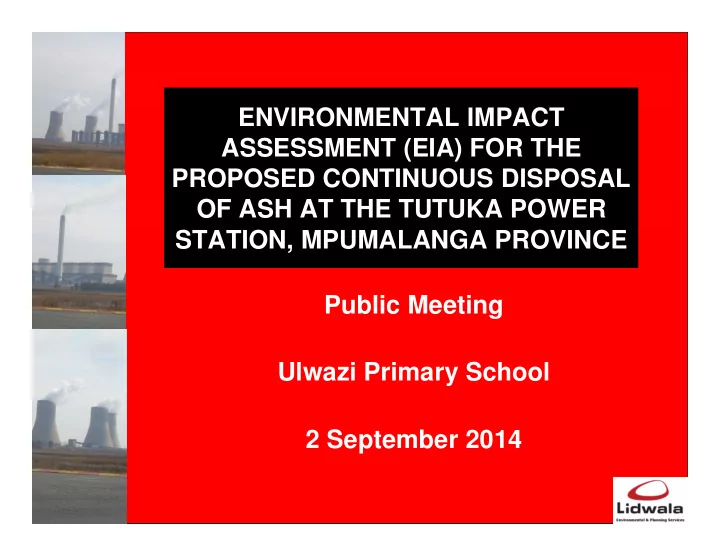
ENVIRONMENTAL IMPACT ASSESSMENT (EIA) FOR THE PROPOSED CONTINUOUS DISPOSAL OF ASH AT THE TUTUKA POWER STATION, MPUMALANGA PROVINCE Public Meeting Ulwazi Primary School 2 September 2014
SLIDE 2 Purpose of the Meeting
- Provide I&AP’s with information regarding:
- The proposed project
- The EIA process to date
- How to get involved in the project
- Findings
- f the EIA
and the proposed mitigation measures to reduce negative environmental Impacts and enhance positive Impacts
I&AP’s with the
to raise issues regarding impacts, significance and proposed mitigation
- Provide an opportunity for I&AP’s to interact with the
project team
SLIDE 3 Conduct of the Meeting
- Focus on issues at hand
- Equal opportunity
- Cell phones on silent
- Work through the facilitator
- Speak in language of choice
SLIDE 4 Role Players
Lidwala Consulting Engineers (SA) (Pty) Ltd
- Independent Environmental Assessment Practitioner
Imaginative Africa
- Public Participation Consultant
Eskom Holdings SOC Ltd – Generation Division Tutuka Power Station
Department of Environmental Affairs
- Lead Decision-maker for the Environmental Authorization
Application (Competent Authority) Interested and Affected Parties
- Raise comments and issues regarding the proposed
project for inclusion in the relevant documentation
- Review addressing of their comments
Commenting Authorities
- MDEDET,
- DWS
- SAHRA
- DAFF
- DMR, etc..
SLIDE 5 What is Public Participation?
A joint effort between:
I&APs Proponent Technical Specialists Decision Makers
To produce better decisions
SLIDE 6
Aim of Public Participation
To inform a wide range of I&APs
SLIDE 7
Tool of Public Participation
Allows the public to exchange information and express their views and concerns
SLIDE 8
Public Participation in Scoping – Impact Phase
Scoping
Facilitates the identification of issues & concerns early in EIA process
Impact
Ensure that issues raised have been assessed
SLIDE 9
My Contributions?
All contributions are fully documented, evaluated and responded to in the EIA
SLIDE 10 Public Participation Process (Scoping Phase)
Background Information Document
October 2012 E-mail/posted/public places
Advert – EIA Process
Cosmos News & Highveld Tribune September 2012
Site Notices
September 2012
Final Scoping Report
Submitted to DEA 12 December 2012
Meetings
FGM/KSW/PM 21 & 22 November 2012
Advertisement
Draft Scoping Report & Public Meeting November 2012
SLIDE 11
Public Participation Process (Impact Phase)
Advert DEIR & PM
Highveld Tribune & Cosmos News:15&16 July 2014: PM 31 July 2014
DEIR Review Period
Monday 21 July 2014 – Friday 19 September 2014
Advert & notification of PM Cancellation
Highveld Tribune & Cosmos News:15&16 July 2014: PM 31 July 2014
Advert new PM Date & Invitations
Highveld Tribune & Cosmos News:15&16 July 2014: PM 31 July 2014
Meetings: Tuesday 02 September 2014
Focus Group Meeting / Key Stakeholder Workshop / Public Meeting
SLIDE 12 Responsibilities
Lidwala Consulting Engineers (SA) (Pty) Ltd (EAP):
- Be independent with no vested interest
- Have the necessary qualifications & experience
- Responsible for EIA process, information & reports
- Provide relevant & objective information to the Authorities,
the I&APs & the Applicant
- Ensure Public Participation Process (PPP) is undertaken
- Ensure all issues raised are addressed or responded to
SLIDE 13 Responsibilities
Eskom Holdings SOC Limited (Applicant):
- Appoint suitable, independent consultants
- Ensure adequate resources are available to conduct an
effective, efficient & equitable EIA
- Ensure that the Consultants are provided with all relevant
information to undertake the EIA effectively
- Ensure that the Consultant provides all relevant information
to the Authorities
SLIDE 14 Responsibilities
Relevant Environmental Authority (National DEA):
- Efficient & expedient in evaluating proposals
- Compliance with regulatory requirements
- Inter-departmental co-operation & consultation
- Consultation with the Applicant & the Consultant
- Evaluation/review & decision-making
- Requiring sufficient detail to make informed decisions
SLIDE 15 Responsibilities
Interested & Affected Parties (I&APs)
- Provide input & comment during various stages of the EIA
process – Identify issues & alternatives – Review of reports
- Draft Scoping Report (DSR)
- Draft Environmental Impact Report (DEIR)
- Waste License Report
- Provide input & comment within specific timeframes
SLIDE 16
What does the Project Entail? Presented by: Mr R Lacock (PS Manager)
SLIDE 17 Tutuka Ash Dump Project Background
Date: 02 September 2014 Presented By: E van Rensburg
- n behalf of the Power Station Manager
Insert image here Insert image here
SLIDE 18 CONTENT
1. Overview and Site layout 2. Background 3. Problem statement 4. Project Need 5. Conclusion 6. Concession
2015-03-10 18
SLIDE 19
Construction started in 1980. The first unit became operational in March 1985. All six units were operational in June 1990. All six units are conventional wet-cooled units. Each unit can generate 609 MW. The power station coal consumption per 24 hour day is approximately 39 600 tons.
SLIDE 20
The daily ash production is about 12 870 tons. The current precipitator plant will be replaced with Fabric Filter Plant from the year 2017 which removes the dust particles from the smoke stacks. This new plant will improves the air quality from smoke stacks and hence more ash will be stacked on the ash dump. The New Denmark Colliery supply about 40% of the coal demand to the power
- station. The remaining 60% of the coal is
imported via rail and road transport.
SLIDE 21 BACKGROUND
- South Africa needs reliable electricity supply with enough capacity to support economic growth
and social development.
- Tutuka Power station is one the largest power stations in terms of electricity generation and
plays a major role in generating continuous and reliable electricity.
- Tutuka Power Station’s dry ash dump was originally designed and constructed in the early
1980’s for a 35 year station life, plus 5-year contingency.
- The expected station operating life has since been increased to 60 years, plus 5-year
contingency, which will result in an increased amount of ash that would need to be deposited.
- This renders the originally designed ash dump to be under capacity.
- 530Ha (capacity of 178mil m3) is required for ash disposal for the remaining life of the
power station.
- An ash disposal facility is unavoidable in a coal fired power station, since large amounts of ash
are generated from burning coal.
- Ash needs to be disposed in a manner that does not severely impact the environment.
2015-03-10 21
SLIDE 22 BACKGROUND CONT…
- The current emergency ashing area (TT02) in the power station
terrace area is used for temporary ash storage when the ash dump conveyor plant is out of operation.
- Currently, the amount of ash that is off loaded during emergency
- ffloading far exceeds the capacity of the existing footprint.
- The exceedance is because the ash quantity used to determine the
size of the emergency dump got worse than originally planned.
2015-03-10 22
SLIDE 23 Problem Statement
Tutuka Power Station is aligning its proposed ashing activities with the National Environmental Management Waste Act. Tutuka standby ash dump will reach capacity at the existing ash disposal footprint by 2018 and the main ash dump will reach capacity by 2025, resulting in major production risks if space is not available for ashing.
Figure 1: Current ash dump
2015-03-10 23
SLIDE 24 Problem Statement cont…
The current emergency ash off loading area is too small for the ash quantities. The current size of emergency ash off loading area is 1880 m2 and the proposed size is 20 785 m2.
Figure 2: Emergency ashing area. (TT02)
2015-03-10 24
SLIDE 25 PROJECT NEED
2015-03-10 25
- Obtain appropriate permission from the Competent Authority to continue with ash disposal
for the remaining life of the station. This will ensure that Tutuka will be able to provide sustainable electricity production to meet the needs of all South Africans.
- Project front end planning lead times within Eskom as well as external approvals will result
in lining only being provided in the first quarter of 2020.
- Tutuka will therefore request permission from the Authorities to continue the ash disposal
activity on the EIA recommended alternative until 2020 without a liner, up to the point where the liner can be provided.
- As mitigation in the transition period, the ground will be compacted after stripping the
topsoil in order to reduce the permeability of leachate to groundwater. Dirty and clean water drainage systems will be constructed. The dirty/seepage water will flow to the dirty water dam and the storm water will flow to the clean water dams.
- The emergency ash off loading area (TT02) needs to be increased to handle the higher
ash capacities from the station, incase if the ash dump conveyors are not available. This current area is 1880 m2 and this area needs to be increased to 20 785 m2.
SLIDE 26 PROJECT NEED CONT…
Proposed ash dump lay out
2015-03-10 26
SLIDE 27 CONCLUSION
No additional land would be required. The new ash dump foot print will still fits onto Eskom’s property. The ash disposal facility will be progressively rehabilitated using top soil covering and vegetation. Dust suppression system will be upgraded to cater for the bigger ash dump. The ash dump working/open ash surfaces will be bigger and hence more water sprayers will be required. Eskom values your input and suggestions during this EIA process regarding the proposed continuous ash disposal facility.
2015-03-10 27
SLIDE 28 CONCESSION
- The new ash dump concept design is based on plastic liners.
- Eskom need to use the Engineering Change Management system to
complete this ash dump design for all the disciplines. The project funding process also needs to be followed for the construction phase.
- The contract award completion would be in July 2017.
- The detail design completion should be the May 2018.
- The construction should start in January 2020, based on plastic liners.
- Eskom needs concession to use the existing ash dump operation from
now up to January 2020.
2015-03-10 28
SLIDE 29 THANK YOU
2015-03-10 29
SLIDE 30 Problem Statement
- The current main dump operation will run out of space by
September 2028
- The position three standby ash dump will run out of space
by December 2016.
- If standby dump positions 4,5 and 6 are used, then it will
run out of space by 2020.
- The main spreader requires outages for major repairs.
- The existing emergency ash handling area at the Power
Station is too small.
SLIDE 31 What does the Project Entail?
- Tutuka Power Station envisages the continuation of dry ash disposal over
Eskom owned land, purchased before the commencement of environmental laws, such as the Environment Conservation Act
would like to align its continued ashing activities, with the requirements of the NEMWA waste licensing processes
- The proposed continuous development is an ash disposal facility with the
following specifications: – Capacity of airspace of 353,1 million m3 (Existing and remaining); and – Ground footprint of 759 Ha (Proposed Continuous Ashing & pollution control canals)
- The project also includes the expansion of the emergency ashing area at
the power station from approximately 1900m2 to 21 000m2
SLIDE 32 Proposal
- Convert the existing main dump operation to radial operation.
- Expand the ash dump to the south side which becomes the
new standby ash dump.
- Construction of new channels, pipes, fences and roads.
- Construct new spreader system.
- Construct concrete slabs and channels at the emergency off
loading area.
SLIDE 33
Existing Ash Dump
SLIDE 34
Total Ash Dump
SLIDE 35
New spreader system
SLIDE 36
Environmental Studies Presented by: Danie Brummer
SLIDE 37 Why Environmental Studies?
tool used to ensure that potential impacts are identified, assessed and mitigated as required
– National Environmental Management Act, 1998 (Act No. 107 of 1998), as amended and the Environmental Impact Assessment Regulations, 2010; – National Environmental Management: Waste Act, 2008 (Act No. 59 of 2008) and Government Notice 921 of 2013
SLIDE 38 The EIA Process
r Prepare Draft Environmental Impact Report & EMPr Prepare Integrated EIA Report & WL Appl 40/60d Authority Comments 40/60d Authority Comments
SLIDE 39 Sensitivity Mapping
- To allow for a robust environmental process all land within a
radius of 8 km (secondary study area) was assessed in order to: – Identify potential alternatives sites – Identify no-go areas – Identify sensitive environmental aspects that may limit the suitability of all identified alternative sites
SLIDE 40
Sensitivity Mapping: No-Go Areas
SLIDE 41
Sensitivity Mapping:
Placement of sites within acceptable areas
SLIDE 42 Significant Impacts: (Construction)
– Impacts on fauna & flora species of conservation importance (including suitable habitat) A&C: The presence of plants of conservation importance was established during the survey period. Mitigation - Exclusion of red data habitat, possible relocation programme, minimise the impacted footprint. – Impacts on sensitive or protected flora & fauna habitat types (including loss and degradation)
- restricted presence in the larger region
- loss of habitat and biodiversity on a local and regional scale
Mitigation – Prevent impact on sensitive species, minimise footprint.
SLIDE 43
Significant Impacts: (Construction)
SLIDE 44 Significant Impacts: (Construction)
– Displacement
fauna species, human-animal conflicts & interactions: poaching, snaring, killing by accidental contact, capturing, effects of domestic cats and dogs, escalation in numbers of exotic and non-endemic species, road kills, etc. Mitigation – Training of personnel, Relocation. – Impacts on ecological connectivity & ecosystem functioning:
- transformed and fragmented grassland habitat
- animals migrate extensively across the region for various
reasons Mitigation – More pronounced on smaller slow moving species, monitoring & re-location, minimum area exposed, reduce edge.
SLIDE 45 Significant Impacts: (Construction)
– Indirect impacts on surrounding habitat
- Disruption of nutrient-flow dynamics;
- Introduction of chemicals into the ground- and surface water
through leaching;
- Impedance of movement of material or water;
- Habitat fragmentation;
- Changes to abiotic environmental conditions;
- Changes to disturbance regimes, e.g. increased or decreased
incidence of fire;
- Changes to successional processes;
- Effects on pollinators; and
- Increased invasion by plants and animals not endemic to the area.
Mitigation – Training of personnel, Relocation, Monitoring & Corrective action, installation of a barrier system, implementation of ZLED
SLIDE 46 Significant Impacts: (Operations)
– Impacts during operations are expected to be the same as for the construction phase. Impact on surrounding habitat A/H>H.
– Impacts on surface water quality & hydrology; Mitigation – Liner or barrier system, pollution control infrastructure, compliance to ZLED, monitoring programme.
- Agriculture (Construction/Operations)
– Loss of agricultural potential (All alternatives)
– Continued generation of electricity to the national grid (positive)
SLIDE 47 Significant Impacts: (De-commisoning)
– Displacement
fauna species, human-animal conflicts & interactions;
– Permanent transformation of the landscape. Mitigation – Rehabilitation of the disturbed areas, sloping & re- vegetation.
– Continued impact on the water quality in the area Mitigation – Liner, pollution control infrastructure, compliance with standards, Monitoring and corrective action.
SLIDE 48 Cumulative Impacts
– Cumulative impacts
conservation
& targets (including national and regional). This vegetation type (Soweto Highveld Grassland) is included in the ‘Endangered’ category. The current estimation of conservation level is likely to be an underrepresentation of the conservation requirements that need to be applied to these vegetation types. – Cumulative increase in local and regional fragmentation/ isolation of habitat; Uninterrupted habitat is a precious commodity for biological attributes in modern times, particularly in areas that are characterised by moderate and high levels of transformation. Mitigation: Migration corridors, minimized footprint.
SLIDE 49 No-go Alternative
If the new ash disposal facility is not established it would contribute negatively to the provision of reliable base load power to the national grid. It will result in the need to close down the power station due to the lack
- f ash disposal facilities, causing a long term
reduction in electricity supply. It is important to note that the additional power
- utput from Tutuka Power Station is still
required to meet the national demand irrespective of the newly-build infrastructure.
SLIDE 50
Site Preference
SPECIALIST WEIGHT SITE PREFERENCE P A B C S Air 2.26 3 2 4 N P Groundwater 2.35 3 3 3 Bats 2 3 3 4 Birds 2 3 3 4 Heritage 1.55 3 3 3 Social 1.61 3 3 3 Noise 1.32 3 3 4 Agriculture 1.74 4 3 3 Surface Water 2.29 4 2 3 Biodiversity 2.19 2 4 3 Visual 1.55 3 4 2 2.4 2.3 2.5Average 5.95 5.69 6.37Weighted Average
SLIDE 51 Financial/Technical Motivation
Eskom submits that, as much as all sites may be used, there are varying degrees of challenges in using Sites B and C, independently. Eskom submits its preference for Site A, for the following reasons:
- Site A fits in with the current ashing operations, in that it links with the radial movement
- f the stacker system, the plant would require minimum plant modifications;
- To optimise Site A, if the ash production cannot fit onto the site, then Eskom can use the
- ption to do “piggy-backing” stacker systems. Using “piggy-backing” would allow
reduction of ashing footprint as the ash facility would be contained within Site A;
- If “piggy-backing” is not feasible, the ashing operations would encroach into a small area
- f Site C. This would, however, be done towards the end of the life of the ashing facility;.
- Independent use of Sites B and C would require major plant modifications. New overland
conveyors would be required to feed the new spreader systems to build the ash dump on site B and C. The existing north dam drainage system also would be covered with ash if Site B is explored.
- Power generation at the station can be under risk when performing this tie-in, as the
ashing would have to be stopped. At the end the power station will have the existing stacker and spreader systems as redundant systems. This is because both of these sites are not in sync with current and ongoing operations.
SLIDE 52 Liner Concession
SLR Groundwater Consultants, were approached on their opinion on the proposed liner concession. According to the modelling conducted the mitigatory impact of the liner is not that significant that it would noticeably change the results of the model if a 3-4 year concession is granted on the implementation
- thereof. Existing control systems must remain.
SLIDE 53 Potential Impacts: Social
TB21
SLIDE 54 Slide 53 TB21 the facility can take 191 M m3 of ash...is that NOT adequate...this figure does NOT reflect any piggy-backing...should it?
Tobile Bokwe, 8/31/2014
SLIDE 55 Previous Comments
Should an EA be granted would it have negative impacts on farming activities?
- The area has been identified as an area with Medium – Low
Agricultural potential. The pollution of grazing crop and land has been investigated as part of the EIA process. Although the loss of Agricultural land is always a high impact, care has been taken to minimise this through this selection. The existing impact of dust emissions would remain but would be better regulated through a formal EA. It was asked if heavy metals are present in the ash and if the ash is toxic.
- The Type 3 waste classification was the result of the Leach
Concentration (LC) value
boron (B) and chromium VI concentrations exceeding their respective LC0 values, and the Total Concentration (TC) value of barium (Ba) and copper (Cu) exceeding their respective TC0 concentration values. Heavy metals do occur and therefor the classification. Toxicity is a function of the receptor.
SLIDE 56
Previous Comments
When Eskom rehabilitate ash disposal facilities, do they look at the land use? The land would not be directly available to the surrounding communities as per pre-disposal land-uses (grazing etc.) If all rehabilitation takes place in accordance to the EMPr however, the land could be available for certain low demand land uses (eg. Solar Farm). This could decrease the demand on High potential Agricultural soils in the surrounding area.
SLIDE 57 Conclusions and Recommendations
- Three Alternative Areas and the No-Go Alternative were
investigated in the EIA Phase.
- Detailed specialist studies were conducted to assess all
the identified impacts.
- Integrated Environmental Impact Assessment Report
with a waste licence section were compiled based on the specialist information. ALT C HAS BEEN IDENTIFIED WITH MARGINAL PREFFERENCE OVER ALT A (ENVIRONMENTAL), ALT A IS ROCEMMENDED BASED ON ALL CONSIDERATIONS (ENV, TECH, FINANCIAL, ENGINEERING)
SLIDE 58
Public Participation Presented by: Nicolene Venter
SLIDE 59 What is Public Participation?
- Public participation is a joint effort between:
- I&APs
- The proponent
- Technical Specialists
- Decision-makers
- Work together to produce better decisions
- Aim: To inform a wide range of I&APs
- Tool: Allows the public to exchange information and express
their views and concerns
- Scoping: Facilitates the identification of issues and concerns
early in the EIA process
- EIA: Assessing all of the issues
- All
contributions from I&APs will be fully documented, evaluated and responded to in the EIA
SLIDE 60 Public Participation Process (Scoping Phase)
Background Information Document October 2012 E-mail/posted/public places
Advert – EIA Process
Cosmos News & Highveld Tribune September 2012
Site Notices
September 2012
FINAL SCOPING REPORT
Submitted to DEA 12 December 2012
Meetings
FGM/KSW/PM 21 & 22 November 2012
Advertisement
Draft Scoping Report & Public Meeting November 2012
SLIDE 61
Public Participation Process (Impact Phase)
Meetings
FGM/KSW/PM 2 September 2014
DEIR Review Period
Monday 21 July 2014 – Friday 19 September 2014
Advert Postponement of PM
Highveld Tribune & Cosmos News 29 & 30 August 2014
Advert DEIR & PM
Highveld Tribune & Cosmos News 15 & 16 July 2014
Continuation of PM
Highveld Tribune & Cosmos News: 19 & 20 August 2014
SLIDE 62
Public Participation Process (Impact Phase - continued)
Appeal
I&AP Notice of Intent: 20 days; Applicant: 10 days
Advertise & Notify I&APs of DEA’s decision
Advertise & Notify I&APs within 12 days of EA issued
DEA Decision
Envisaged: 15 February 2015
Final Environmental Impact Assessment Report
Submission to DEA: Public Comment: 26 Sept to 27 Oct 2014
SLIDE 63
QUESTIONS & ANSWERS
SLIDE 64 QUESTIONS & ANSWERS
TB28
SLIDE 65 Slide 63 TB28 please replace the picture...don't show teh scientific work behind...there must be a picture of facilitator elsewhere
Tobile Bokwe, 8/31/2014
SLIDE 66 Way Forward
2014 2015 August September January February March Distribution of Minutes
☼
Submission of FEIR to DEA
☼
DEA Decision
☼
Appeal
☼ ☼
SLIDE 67
Contact Details
PUBLIC PARTICIPATION OFFICE CONTACT DETAILS Lidwala Consulting Engineers (SA) (Pty) Ltd Bongi Mhlanga / Nicolene Venter Post: PO Box 32497, Waverley, 0135 Tel: (0861) LIDWALA (0861 543 9252) Fax: 086 764 9282 E-mail: tutukaeia@lidwala.com