EIA Procedures and Decision Making 1
SOCIAL ASSESSMENT AND SOCIAL ASSESSMENT AND PUBLIC PARTICIPATION - - PowerPoint PPT Presentation
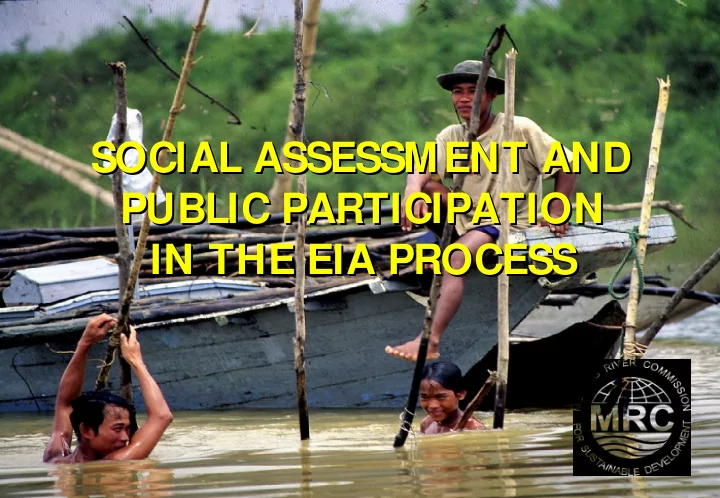
SOCIAL ASSESSMENT AND SOCIAL ASSESSMENT AND PUBLIC PARTICIPATION PUBLIC PARTICIPATION IN THE EIA EIA PROCESS PROCESS IN THE EIA Procedures and Decision Making 1 Lesson Learning Goals At the end of this lesson you should be able to: !
EIA Procedures and Decision Making 2
Lesson Learning Goals
At the end of this lesson you should be able to:
! Discuss the need to incorporate social
dimensions into assessment of development projects and activities
! Describe types of projects which require socio-
economic impact assessment (SIA)
! Detail the major steps in SIA and rapid rural
appraisal (RRA)
! Identify advantages of public participation in
environmental impact assessment (EIA)
EIA Procedures and Decision Making 3
Definition of Social Impacts
! Alteration of the ways in which people live,
work, play, relate to one another, organize to meet their needs, and generally cope as members of society
! Cultural impacts involving changes to the
norms, values, and beliefs that guide and rationalize people’s cognition of themselves and their society
EIA Procedures and Decision Making 4
To optimize the economic-cum- environmental potential of the project with respect to socio- economic parameters
Purpose of Socio-Economic Impact Assessment
EIA Procedures and Decision Making 5
SIA Principles
! Involve the diverse public: identify and involve
all potentially-affected groups and individuals
! Analyze impact equity: clearly identify who will
win and who will lose and emphasize vulnerability of under-represented groups
! Focus the assessment: deal with issues and
public concerns that ‘really count’, not those that are ‘easy to count’
EIA Procedures and Decision Making 6
SIA Principles (Cont’d)
! Identify methods and assumptions and define
significance in advance: define how the SIA was conducted, what assumptions were used, and how significance was determined
! Provide feedback on social impacts to project
planners: identify problems that could be solved with changes to the proposed action
- r alternatives
EIA Procedures and Decision Making 7
SIA Principles (Cont’d)
! Use SIA practitioners: trained scientists
employing accepted methods will provide the best results
! Establish monitoring and mitigation programs:
manage uncertainty by monitoring and mitigating adverse impacts
! Identify data sources: use published scientific
literature, secondary data, and primary data from the affected area
! Plan for gaps in data
EIA Procedures and Decision Making 8
SIA Objectives
Identify the Key Socio-economic Issues Identify and Design Environmental Protection Measures (EPMs) for Socio-economic Issues Formulate an Environmental Management Plan to Implement EPMs and Performance Monitoring Assess the Probability of Socio-economic Impacts and Risks
EIA Procedures and Decision Making 9
Projects Which Require SIA
!
Projects that have the potential to result in negative impacts to members of a community
» Potentially-affected community members must be involved in evaluating project desirability and designing mitigative measures
!
Projects that have a socio-economic benefit to members of a community
» SIA is required to ensure that the project’s desired effects will be realized by the target population
EIA Procedures and Decision Making 10
Relationship Between Bio-Physical and Socio-Economic Impacts
First Order Impacts Higher Order Impacts Project
Project 1 Project 2 Project 3 Socio-economic Physical/Biological Socio-economic Physical/Biological Socio-economic No Impact
EIA Procedures and Decision Making 11
Similarities Between EIA and SIA
! Desirability ! Scale ! Extent/duration of
impacts in time and space
! Intensity ! Cumulative ! Synergistic ! Uncertainty
EIA Procedures and Decision Making 12
Areas of Special Concern for SIA
! Socio-economic issues in ecologically
sensitive areas
» Forest areas » Coastal areas » Rangelands
! Indigenous peoples’ areas ! New land settlements
» Planned agricultural settlement » Spontaneous agricultural settlement » Induced developments
EIA Procedures and Decision Making 13
SIA Approaches and Methodologies
Two widely-applied approaches:
! The Social Design Study -
Asian Development Bank (ADB) approach
! Land Acquisition and Resettlement Plans -
World Bank approach
! Both approaches are generally similar in
scope and intent; more comprehensive ADB approach is profiled for illustrative purposes
Rapid Social Assessment
- 1. Identify subpopulations &
non-targeted populations
- 2. Rate level of development of
subpopulations
- 3. Assess target population’s need
for project
- 4. Assess absorptive capacity of
subpopulations
- 5. Interpret results of Rapid Social
Assessment
Social Design Study
- 1. Integrate target population priorities and preferences
- 2. Develop strategies to maximize absorptive capacity
- 3. Select appropriate technical options
- 4. Develop implementation strategies
- 5. Project assessment
Project Screening
Classify project by expected Social Impact
Social Design Flowchart
EIA Procedures and Decision Making 15
Project Screening
Category SI 1 SI 2 Classification
Projects whose primary objective is to have a positive impact in the form of poverty alleviation; almost always require active participation by project beneficiaries. Projects which are expected to have a direct positive social impact (e.g., rural and agricultural development, social infrastructure project); require active participation by project beneficiaries.
EIA Procedures and Decision Making 16
Project Screening (Cont’d)
Category SI 3 SI 4 Classification
Projects that rarely have immediate direct positive or negative social impacts (e.g., energy and industrial projects); can be executed and sustained without participation by project beneficiaries. Projects with the potential for direct negative impacts on the lives of a significant number of people, or any project with a resettlement component (e.g., dams, highways, airports).
Rapid Social Assessment
Identification of sub-populations affected by the project Rate level of development of each sub-population Assess each sub-populations’ need for project Assess absorptive capacity Interpret results of rapid social analysis
EIA Procedures and Decision Making 18
Rapid Rural Appraisal
A qualitative survey methodology using a multi-disciplinary team to formulate problems for rural research and development
EIA Procedures and Decision Making 19
RRA Principles and Practices
! Optimize trade-offs (e.g., optimal ignorance,
appropriate imprecision)
! Offsetting biases ! Triangulation ! Direct face-to-face learning from rural
people
! Adaptive learning process (i.e., flexible,
interactive, iterative, inventive)
EIA Procedures and Decision Making 20
RRA Methods
!
Secondary data review
!
Direct observation
!
Do-it-yourself
!
Key indicators
!
Semi-structured interviews
!
Key informants
!
Group interviews
!
Chain of interviews
!
Transects and group walks
EIA Procedures and Decision Making 21
RRA Methods (Cont’d)
!
Mapping and aerial photos
!
Diagrams
!
Ranking, stratifying and quantification
!
Ethno-histories
!
Stories, portraits, case studies
!
Team interactions
!
Key probes
!
Questionnaires
EIA Procedures and Decision Making 22
Rating Level for Sub-Populations
Level
High Medium Low
Classification
Those who own surplus-producing land; have spacious housing and access to institutional credit, primary and secondary education, health services; and may have political power Small farmers who produce negligible or small surpluses; they have modest housing and limited access to the services listed above Marginal farmers or the landless; their income is derived from low paid casual labor; they have no access to formal credit and little or no access to education and health services
EIA Procedures and Decision Making 23
Assessing Each Sub-Population’s Need for Project
Level
High Medium Low
Classification
Strong and spontaneous expressions of need related to the potential benefits of the project; willingness to be involved and to contribute Some expressed interest and need related to the potential benefits of the project, but not as a first priority; limited willingness to contribute Preoccupation with development problems
- ther than those addressed by the project; little
likelihood of contributing
EIA Procedures and Decision Making 24
Assessing Each Sub-Population’s Absorptive Capacity
Level
High Medium Low
Classification
Homogeneous society; positive loan record; active local organizations; positive links with government agencies; technically innovative Some social stratification; mixed success with past development programs; lifeless local
- rganizations; moderate links with
governmental agencies; technically static Social stratification and disunity; poor record with past development programs; no local
- rganizations; minimal links with government
agencies; technically backward
EIA Procedures and Decision Making 25
Interpreting Results
No social design study is required Where all of the following conditions prevail:
! No negative impact ! High level of need ! High absorptive capacity
EIA Procedures and Decision Making 26
Interpreting Results (Cont’d)
Social design study is required Where any of the following conditions prevail:
! Limitations in need ! Defects in absorptive capacity ! Potential negative impacts for some
sub-populations -
EIA Procedures and Decision Making 27
Interpreting Results (Cont’d)
Relocation, rethinking of project concept Where there are:
! High levels of potential negative impacts ! Significant opposition ! Major limitations to absorptive capacity
EIA Procedures and Decision Making 28
Social Design Study
Optimize Project Design
- 1. Integrate Target Population Priorities and Preferences
- 2. Develop Strategies to Maximize Absorptive Capacity
- 3. Select Appropriate Technical Options
Develop Implementation Strategies Project Assessment (including risks)
EIA Procedures and Decision Making 29
Optimizing Project Design
- 1. Examine project alternatives (e.g., design,
timing, size, technology, location) in terms of target population’s priorities and absorptive capacity
- 2. Integrate target population priorities and
preferences into the project:
» Rank project on target population priority list » Estimate number of people expected to participate in project » Calculate trade-offs between project alternatives in terms of sub-populations and number of beneficiaries
EIA Procedures and Decision Making 30
Optimizing Project Design (Cont’d)
- 3. Identify steps for maximizing absorptive
capacity
» Accommodate existing social infrastructure » Strengthen local community organizations » Establish linkages between executive agency and target populations
- 4. Select appropriate technical options
EIA Procedures and Decision Making 31
Developing Appropriate Implementation Strategies
- 1. Identify and recommend changes to
legislation that does not provide incentives to beneficiaries with regard to:
» Land tenure problems » Legal problems » Financial problems (e.g., access to credit)
EIA Procedures and Decision Making 32
Developing Appropriate Implementation Strategies (Cont’d)
- 2. Create appropriate management structure
» Select staff with awareness of socio-economic issues » Train key government personnel in socio-economic community development techniques » Involve NGOs in project execution
- 3. Ensure implementation schedule meets
beneficiaries needs
» Phase in technology, training programs, institutional strengthening, etc.
EIA Procedures and Decision Making 33
Social Design Study Benefits for Project Assessment
- 1. Economic Analysis
» Improve project cost effectiveness by facilitating efficient distribution of benefits » Increase project sustainability and long-term benefits » Project costs may be considered long-term community investments
- 2. Financial Analysis
» Improve project cost recovery by increasing community satisfaction and willingness to pay for project benefits
EIA Procedures and Decision Making 34
Social Design Study Benefits for Project Assessment (Cont’d)
- 3. Risk Assessment - reviews and minimizes
potential issues and problems
» Inadequate consideration of project’s social impacts » Lack of cooperation between executing agency and target group » Monopolization of benefits by non-target groups » Unintended negative impacts on target or non- target groups
EIA Procedures and Decision Making 35
Social Design Study Monitoring Program
- 1. Key Questions
» Are tangible project outputs reaching intended beneficiaries? » What are the impacts on intended beneficiaries? » Are project operations sustainable over the long term?
EIA Procedures and Decision Making 36
Social Design Study Monitoring Program (Cont’d)
- 2. Monitoring
» Executing government agencies » Community organizations » Population sub-groups
- 3. Actions
» Enforce agreements reached through social design study » Modify ETPs so they will attain their objectives
EIA Procedures and Decision Making 37
What is Public Involvement?
The process by which the views of all interested parties concerning a proposed project or activity are integrated into the decision- making process
EIA Procedures and Decision Making 38
Why is Public Involvement Needed?
! Inform stakeholders ! Present views, concerns and values ! Maximize benefits ! Influence project design ! Obtain local knowledge ! Increase public confidence ! Provide better transparency and
accountability in decision making
! Reduce conflict
EIA Procedures and Decision Making 39
When is Public Involvement Needed?
! A development-related decision requires
making choices between important social, environmental and economic values
! The results of a decision will significantly
affect the interests of some people or groups more than others
! The public perceives it has a lot to win or
lose by a decision
EIA Procedures and Decision Making 40
Who is the Public?
! The public consists of many different
segments (i.e., it is not just one collective entity)
! These publics change for each issue ! Person or groups being directly or
indirectly affected by a proposed project
- r activity or government development-
related decision, or have potential to be affected
EIA Procedures and Decision Making 41
Who is the Public? (Cont’d)
! Persons or groups who have an interest or
concern or stake in an issue or a project
! Typical stakeholders include:
» local communities » proponent and project beneficiaries » government agencies » non government organizations (NGOs) » others (e.g., donors, academics, the private sector)
EIA Procedures and Decision Making 42
Principles of Effective Public Participation
! The process must be credible
» support by all relevant governmental agencies; accepted as the ‘way of doing business’ » appropriate representation; venues and times are compatible with participant’s needs » open communication/adequate time is given to express views » concerns are acknowledged and effort devoted towards developing a workable solution » public is adequately informed (e.g., background information is understandable and timely)
EIA Procedures and Decision Making 43
Principles of Effective Public Participation (Cont’d)
! The process must be impartial
» neutral process management » consideration of all values » access to information is equally available to all participants
! The process is as important as the outcome ! The process should be planned
EIA Procedures and Decision Making 44
Public Involvement Approaches
Persuasion Education Information Feedback Consultation Joint Planning Delegated Authority Self Determination
Least Public Involvement Most Public Involvement
Public Involvement Techniques
Advertising Newspaper inserts Briefs Focus Groups Public Meetings/Public Hearings Conferences Workshops/Problem-Solving Meetings Advisory Groups/Task Forces Joint Working Groups Self-Directed Groups
EIA Procedures and Decision Making 46
Selecting Techniques
! No one single best technique; any one of a
number of techniques may be appropriate
! Technique selection depends on objectives ! Technique effectiveness depends on
assessor’s expertise and commitment
! Advisable to use several techniques;
different techniques will reach different groups or peoples and accomplish different
- bjectives
EIA Procedures and Decision Making 47
External Factors Affecting the Effectiveness of Public Involvement
! Poverty ! Rural settings ! Illiteracy ! Culture/local values ! Languages ! Legal systems ! Interest groups ! Confidentiality
EIA Procedures and Decision Making 48
Common Reasons for Avoiding Public Involvement
! It’s too early ! It will take too long and will cost too much ! It will stir up opposition ! We will only hear from the articulate ! We’ll raise expectations ! People won’t understand
EIA Procedures and Decision Making 49
Concluding Thoughts
Important points to remember are:
! Social assessment encompasses a variety
- f processes and procedures for
incorporating social dimensions into the decision-making process
! Effective social analysis and public