Environment and Natural Resources Trust Fund 2012-2013 Request for - - PDF document

environment and natural resources trust fund 2012 2013
SMART_READER_LITE
LIVE PREVIEW

Environment and Natural Resources Trust Fund 2012-2013 Request for - - PDF document

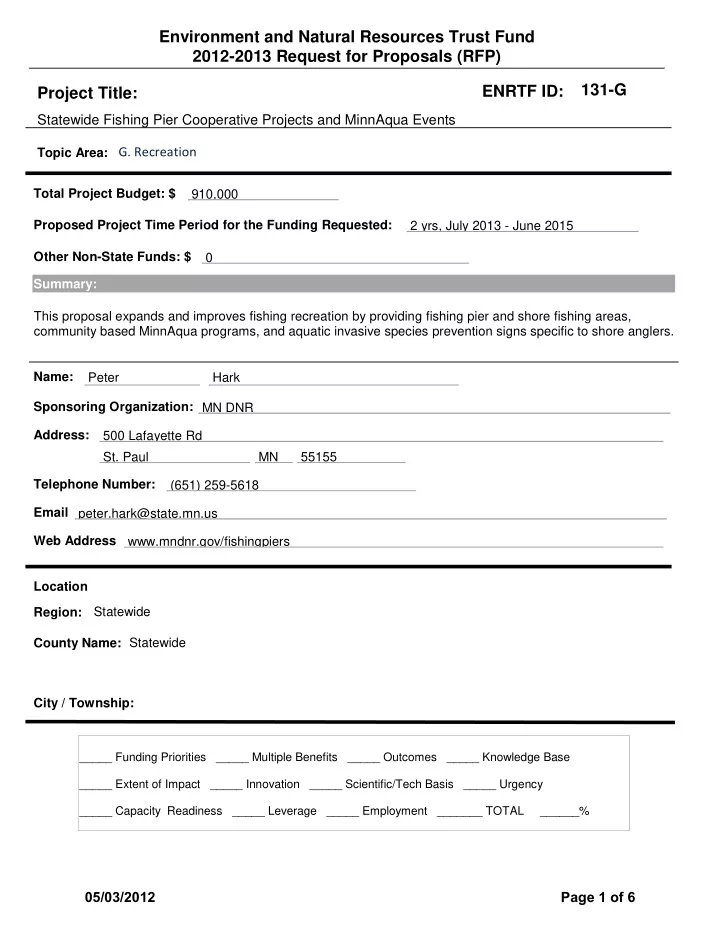
Environment and Natural Resources Trust Fund 2012-2013 Request for Proposals (RFP) 131-G ENRTF ID: Project Title: Statewide Fishing Pier Cooperative Projects and MinnAqua Events G. Recreation Topic Area: Total Project Budget: $ 910,000


slide-1
SLIDE 1

Environment and Natural Resources Trust Fund 2012-2013 Request for Proposals (RFP) Project Title:

Total Project Budget: $ Proposed Project Time Period for the Funding Requested: Other Non-State Funds: $ Name: Sponsoring Organization: Address: Telephone Number: Email Web Address County Name: City / Township: Region: Summary: Location

Statewide Fishing Pier Cooperative Projects and MinnAqua Events

910,000 2 yrs, July 2013 - June 2015 This proposal expands and improves fishing recreation by providing fishing pier and shore fishing areas, community based MinnAqua programs, and aquatic invasive species prevention signs specific to shore anglers. Peter MN DNR 500 Lafayette Rd

  • St. Paul

MN 55155 (651) 259-5618 peter.hark@state.mn.us www.mndnr.gov/fishingpiers Statewide Statewide Hark

_____ Funding Priorities _____ Multiple Benefits _____ Outcomes _____ Knowledge Base _____ Extent of Impact _____ Innovation _____ Scientific/Tech Basis _____ Urgency _____ Capacity Readiness _____ Leverage _____ Employment _______ TOTAL ______%

  • G. Recreation

ENRTF ID: 131-G

Topic Area:

05/03/2012 Page 1 of 6

slide-2
SLIDE 2

Environment and Natural Resources Trust Fund (ENRTF) 2012‐2013 Main Proposal

1 PROJECT TITLE: Statewide Fishing Pier Cooperative Projects and MinnAqua Events

  • I. PROJECT STATEMENT

The Department of Natural Resources (DNR) has been collaborating with local government units (LGUs) to provide fishing pier and shore fishing areas since 1984. Piers provide a safe and convenient place to fish, instead of from bridges, steep/rocky embankments, or fragile shorelines. Piers can eliminate shoreline erosion from foot traffic and allow native aquatic habitat and vegetation to thrive. Fishing piers can also help reduce the carbon footprint by providing an area for people to fish close to home or without a boat. They facilitate use by disabled anglers, elderly, and parents or grandparents with young

  • children. They also enhance the DNR’s outreach efforts by proving the “classroom” that easily facilitates

fishing clinics such as those offered through MinnAqua and their Fishing: Get in the Habitat! volunteers. The overall goal of the fishing pier program is to expand and improve statewide fishing opportunities, especially for families, elderly, people with disabilities and those without a boat. The desired outcome is for parks and communities to have fishing piers being used by people of all abilities to catch fish. Presently there are 307 fishing piers, 31 platforms, and 22 shore fishing sites statewide. Due to the age

  • f the program, fishing piers over 20 years old are in need of replacement.

MinnAqua is the statewide education program designed to teach angling skills, ecology, and conservation of aquatic habitats, natural resource stewardship, and Aquatic Invasive Species (AIS)

  • awareness. MinnAqua is ready to expand with a pilot program that will engage ten new communities to

host weekly fishing events. This will encourage more people to learn angling and assure that this family‐

  • rientated activity will continue to be one of Minnesota's most popular pastimes.

The goal of community‐sponsored angling classes and events is to increase the recruitment and retention of new and existing anglers. The desired outcome is to make fishing a life‐long activity for families and children that connects them with the outdoors. This connection encourages environmental stewardship and support of Minnesota’s natural resource conservation programs, including the prevention of the spread of AIS. To prevent the spread of AIS, a sign that explains the AIS laws to shore anglers will be developed. The new sign will be installed at all new and existing fishing piers and shore fishing areas. For those using smart phones, the development of a fishing pier mobile device internet application will allow them to find the closest pier and learn more about the facility, lake, and fish present.

  • II. DESCRIPTION OF PROJECT ACTIVITIES

Activity 1: Install 16 fishing piers (approximately 12 replacements and 4 new) Budget: $636,000 The DNR will select the highest priority new and replacement fishing pier projects by using established

  • criteria. Criteria for replacements are based on age, condition, and use. Criteria for new are based on

fisheries data and site features. Project sites will be distributed equally between the four DNR Regions.

Outcome Completion Date

  • 1. Order 16 fishing piers from MINNCOR Industries per state contract

October 31, 2013

  • 2. Complete cooperative agreements with local government units

April 30, 2014

  • 3. Install 10 fishing piers

December 31, 2014

  • 4. Install 6 fishing piers

June 30, 2015

Activity 2: Develop two (2) shore‐fishing areas Budget: $170,000 Shore fishing areas are typically developed along rivers where currents and/or steep banks do not lend well to floating fishing piers. Engineering and permits are required for these projects, which can be completed by DNR staff. Universal design principles for accessibility will be incorporated.

05/03/2012 Page 2 of 6

slide-3
SLIDE 3

2

Outcome Completion Date

  • 1. Request engineering and design for the shore‐fishing areas, apply for permits

October 31, 2013

  • 2. Request bids for development of shore‐fishing areas

June 30, 2014

  • 3. Develop shore‐fishing areas

June 30, 2015

Activity 3: Engage 10 communities to host weekly public fishing events Budget: $ 60,000 The DNR’s successful MinnAqua program will expand to more communities around the state. This pilot program will engage ten new communities to host weekly fishing programs and events.

Outcome Completion Date

  • 1. Hire staff, order equipment, and establish communities, partners and volunteers

April 30, 2014

  • 2. Organize successful weekly MinnAqua fishing event in those communities

June 30, 2015

Activity 4: Develop and install signs AIS prevention signs for shore anglers Budget: $ 24,000 For pier and shore anglers the highest risk of spreading Aquatic Invasive Species (AIS) is with their equipment and bait. Sign messages will focus on prevention methods specific to shore anglers.

Outcome Completion Date

  • 1. Design and order AIS signs for fishing pier and shore fishing areas

June 30, 2014

  • 2. Distribute and install AIS signs at fishing piers and shore‐fishing sites

June 30, 2015

Activity 5: Develop a fishing pier mobile device internet application Budget: $20,000 Instead of map, use your phone to take fishing pier information on the go with this app.

Outcome Completion Date

  • 1. Compile data and design the attributes of the fishing pier mobile device internet app

June 30, 2014

  • 2. Test and launch the fishing pier mobile device internet application

June 30, 2015

  • III. PROJECT STRATEGY
  • A. Project Team/Partners: For most fishing pier projects, the DNR enters into cooperative agreements

with the local government unit who provides the accessible walkway, parking area and 20+ years of

  • ngoing maintenance. The state constructs the shore‐fishing site or purchases the fishing pier. Often

the partner is able to donate money towards the purchase of the pier or provide additional in kind services such as plantings, picnic tables, benches, restrooms, and lighting. Communities agreeing to provide weekly fishing clinic opportunities will receive aquatic resource education training, staff support for two years as needed, and resource materials to reduce barriers to new anglers and families.

  • B. Timeline Requirements: Fishing Pier and shore fishing projects sites will be selected, cooperative

agreement with LGU’s s will be completed, and piers ordered by April 2014. Installation of the fishing piers and construction of the shore‐fishing sites will be done in the spring, summer, and fall of 2014 and the spring of 2015. MinnAqua guided fishing programs will take place for 10 weeks during the summer in 2014. The completion of the AIS sign and fishing pier mobile device internet application is expected by June 30, 2015.

  • C. Long‐Term Strategy and Future Funding Needs: To ensure the long‐term viability of the fishing pier

program, the DNR will continue to seek money from a variety of funding sources. The popularity of the program has been constant since 1984. Currently there are more than 70 requests for new and replacement projects statewide. MinnAqua staff will work with communities that receive training and supporting materials to establish a community‐based volunteer group. The goal is to have partners and/or volunteer groups maintain the equipment and continue to provide fishing programs for local residents after initial start‐up. MinnAqua will still be available to provide additional training and support to these communities in subsequent years as needed or resources allow, with the understanding that staff will be moving to support other communities around the state to establish these programs as well.

05/03/2012 Page 3 of 6

slide-4
SLIDE 4

BUDGET ITEM Personnel: 5 full time seasonal MinnAqua staff Additional Budget Item: DNR used a rate of 6.5% to calculate costs for direct support services, which are DNR's direct and necessary business services required to support this proposal TOTAL ENVIRONMENT AND NATURAL RESOURCES TRUST FUND $ REQUEST = SOURCE OF FUNDS AMOUNT Status Other Non-State $ Being Applied to Project During Project Period: Potential donations from LGU or local organizations for fishing piers 25,000 $ Pending Other State $ Being Applied to Project During Project Period: Game and Fish Fund pays for full time and seasonal Parks and Trails staff who will install the fishing piers. Game and Fish Fund also pays for 3 full time MinnAqua staff who oversee the angling education and skills program 50,000 $ Secured In-kind Services During Project Period: Local Government Units will provide the accessible path and parking area and other ammenities for fishing pier and shore fishing sites 100,000 $ Funding History: Fishing Pier Program $ 29,325 FY 2012 Donations from local organizations (2 piers) $ 35,000 FY 2011 Lake Superior Coastal Grant Program (1 pier) $595,000 FY 2010 Legacy (20 piers) $ 50,000 FY 2008 Bonding (3 piers) $ 24,000 FY 2008 Contributions from LUG's (1 pier) $ 19,000 FY 2008 Donations from local organizations $ 752,325

2012-2013 Detailed Project Budget

  • IV. TOTAL ENRTF REQUEST BUDGET 2 years

$ 10,000 AMOUNT Contracts: Development the mobile device internet application for fishing piers, contract with DNR MIS staff or competitve bid with an outside vendor Engineering for shore fishing area(s) site design, DNR staff 20,000 $

  • V. OTHER FUNDS

30,000 $ 910,000 $ 576,850 $ Equipment/Tools/Supplies: 16 Floating Fishing Piers built by MINNCOR Industries per state contract Construction of and materials for shore-fishing areas Fishing equipment including fishing poles, tackle, safety gear, Get in the Habitat! Leader guide lesson plans and learning kits 400 Signs (competitve bid with outside vendor) $ 160,000 $ 30,000 $ 59,150 $ 24,000

I:\ML2013\RFP\proposals_recevied\hark-peter_0412-2-194-Budget

05/03/2012 Page 4 of 6

slide-5
SLIDE 5

Environment Trust Fund 2012-2013 Project Proposal Project Title: Statewide Fishing Pier Cooperative Projects and MinnAqua Events Project Manager Qualifications Peter M. Hark has worked for the Minnesota DNR for over 20 years in various management and coordination positions. Currently, he is the Operations Manager for the Division of Parks and Trails. He directs and administers statewide field operations and a variety of program focused efforts. He also oversees professional program and operational staff. Organization Description The Department of Natural Resources, Division of Parks and Trails operates 67 state parks, 8 recreation areas, 575 miles of surfaced state trail, 1,610 water access sites, 30 water trails and 9 state waysides throughout Minnesota. The Division connects people to state’s natural resources by providing access to outdoor recreation, conservation education, and natural resource restoration and management.

05/03/2012 Page 5 of 6

slide-6
SLIDE 6

05/03/2012 Page 6 of 6