Environment and Natural Resources Trust Fund 2012-2013 Request for - - PDF document

environment and natural resources trust fund 2012 2013
SMART_READER_LITE
LIVE PREVIEW

Environment and Natural Resources Trust Fund 2012-2013 Request for - - PDF document

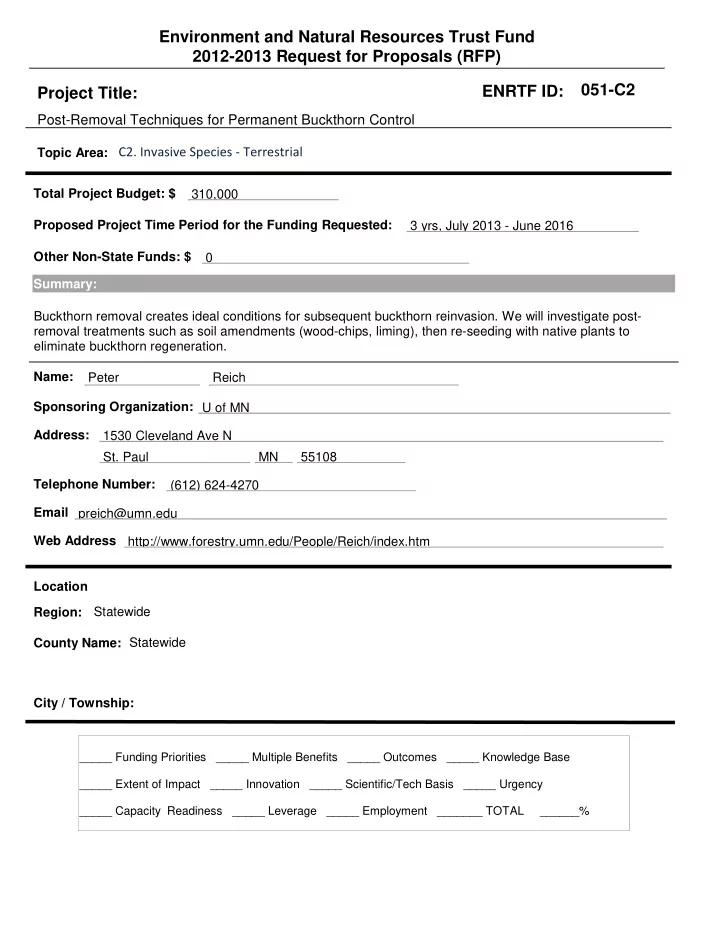
Environment and Natural Resources Trust Fund 2012-2013 Request for Proposals (RFP) 051-C2 ENRTF ID: Project Title: Post-Removal Techniques for Permanent Buckthorn Control C2. Invasive Species Terrestrial Topic Area: Total Project Budget:


slide-1
SLIDE 1

Environment and Natural Resources Trust Fund 2012-2013 Request for Proposals (RFP) Project Title:

Total Project Budget: $ Proposed Project Time Period for the Funding Requested: Other Non-State Funds: $ Name: Sponsoring Organization: Address: Telephone Number: Email Web Address County Name: City / Township: Region: Summary: Location

Post-Removal Techniques for Permanent Buckthorn Control

310,000 3 yrs, July 2013 - June 2016 Buckthorn removal creates ideal conditions for subsequent buckthorn reinvasion. We will investigate post- removal treatments such as soil amendments (wood-chips, liming), then re-seeding with native plants to eliminate buckthorn regeneration. Peter U of MN 1530 Cleveland Ave N

  • St. Paul

MN 55108 (612) 624-4270 preich@umn.edu http://www.forestry.umn.edu/People/Reich/index.htm Statewide Statewide Reich

_____ Funding Priorities _____ Multiple Benefits _____ Outcomes _____ Knowledge Base _____ Extent of Impact _____ Innovation _____ Scientific/Tech Basis _____ Urgency _____ Capacity Readiness _____ Leverage _____ Employment _______ TOTAL ______%

  • C2. Invasive Species ‐ Terrestrial

ENRTF ID: 051-C2

Topic Area:

slide-2
SLIDE 2

Permanent buckthorn control

1

MAIN PROPOSAL PROJECT TITLE: Post-removal techniques for permanent buckthorn control

  • I. PROJECT STATEMENT

Buckthorn control is a common management goal, and can cost up to $1,100 per acre. Over a two year period, Myre-Big Island State Park spent more than $30,000 to control buckthorn and other invasives. However, removing buckthorn creates ideal conditions for subsequent reinvasion and the long-term efficacy of these management activities is not clear. Buckthorn is a disturbance-adapted species, and buckthorn management itself disturbs the ecosystem by creating more soil and light resources. As a result, many of the current efforts to control buckthorn may have limited long-term benefit. If this is the case, use of funds for buckthorn management is of questionable value. Most research focuses on assessing the specific means of buckthorn removal, with little attempt to understand post-management treatments that keep buckthorn or other invasives from re-colonizing. We propose a plan to develop practical strategies for the long-term control of buckthorn. We incorporate removal and post-removal treatments including soil amendments, wood chips, or liming, followed by reseeding and/or planting of desired vegetation that will reduce buckthorn regeneration. This project will increase our capacity for effective, long-term management of buckthorn: (1) Experiments (new and ongoing) to develop effective buckthorn management. Test combinations of “traditional” removal with novel post-removal treatments (soil amendments, reseeding of native species) to deter buckthorn directly or promote other vegetation that deters buckthorn (2) Retrospective analyses of past buckthorn management efforts. Investigate the effectiveness of past buckthorn removal and control by state agencies and non-profit organizations. (3) Implement further experimental buckthorn control activities on a subset of the lands considered in #2. Test the impacts of post-removal treatment on sites with previous buckthorn management. (4) Integrate and synthesize findings from Activities 1-4 into a manual of buckthorn management.

  • II. DESCRIPTION OF PROJECT ACTIVITIES

Activity 1. Use new and ongoing experiments at four sites to test combinations of “traditional” buckthorn removal (weed-wrenching, basal bark herbicide application, cut-and-paint, and also burning) with novel post-removal treatments that we believe deter buckthorn re-growth and promote desired vegetation (soil amendments wood chips, or liming followed by reseeding of native vegetation). Budget $129,674 To develop effective management strategies, we will establish a large-scale experiment at four locations (50 x 50 meter plot at each location) with heavy buckthorn invasion, as well as continue a smaller-scale experiment begun in 2011. The experiment will include "traditional" removal techniques coupled with post management manipulations of soil conditions (nitrogen, pH) via soil amendments, wood chips, or liming, followed by reseeding and/or planting of desired vegetation that will reduce buckthorn

  • regeneration. Design of the new experiment (to be implemented in 2013-14) will be informed by an

established, small-scale study designed to investigate the outcome of different removal techniques. Few buckthorn removal efforts include a post-management component to reduce regeneration, resulting in expensive management with little long-term benefit. Outcome Completion date

  • 1. Establish experimental plots at four sites with heavy buckthorn invasion

6/30/2014

  • 2. Implement buckthorn removal and post-removal experimental treatments at

four locations, in 50 x 50 meter plots 12/15/2015

  • 3. Conduct statistical analysis, interpret results, draft publication

6/30/2016 Activity 2: Review past buckthorn removal success by compiling management history and conducting interviews with managers for approximately 50 sites across the state. Follow-up with field site visits to assess the effectiveness of this management. Budget: $77,243

slide-3
SLIDE 3

Permanent buckthorn control

2

Buckthorn management efforts tend to occur independently from one location to the next, and thus managers often develop strategies based on ad hoc results. By comprehensively searching management records and interviewing managers, we will reconstruct the history of buckthorn removal activities in Minnesota and make observations of current conditions to assess the outcome of these efforts. The goal is to generate a central depository of buckthorn removal activities to guide the success of future

  • management. We will work with agencies and non-profits such as the Minnesota DNR, Great River

Greening, and other organizations focused on land management to document invasive management history, and resulting outcomes, across the state. Outcome Completion date

  • 1. Develop retrospective depository on past buckthorn management and
  • utcomes

12/15/2015

  • 2. Conduct statistical analyses, interpret results, draft publication

06/30/2015 Activity 3: At three sites where buckthorn was previously removed between one and three years ago, we will remove regenerated buckthorn from two to three acres and implement post-removal treatments to suppress buckthorn regeneration. Budget: $58,841 To test the impact of specific post-management strategies on buckthorn reinvasion, we will investigate whether ongoing management, one to three years after buckthorn removal, can enhance re-establishment

  • f desired vegetation. Management activities tested will include planting seeds and seedlings of desired

species and manipulating site conditions using soil amendments, fire, or cutting. Outcome Completion date

  • 1. Implement experimental treatments on 2-3 acres at three sites with recent

buckthorn removal 12/15/2015

  • 2. Conduct statistical analyses, interpret results, draft publication

06/30/2016 Activity 4. Provide a manual that describes how to stop buckthorn regeneration. This will be a compilation of findings from activities 1-3. Budget: $44,242 We will develop guidelines for landowners and managers to successfully remove buckthorn and suppress its regeneration. These will be provided through a series of presentations, a written report, and also online. Outcome Completion date

  • 1. Final report, “Integrated buckthorn management: case studies and evidence

from Minnesota’s forests” 6/30/2016

  • 2. Outreach via presentations, workshops, written report, website

6/30/2016

  • III. PROJECT STRATEGY
  • A. Project Team/Partners. Peter Reich, project manager and Tim Whitfeld, project coordinator, U of M,

Department of Forest Resources. Additional project partners: Ann Pierce, Luke Skinner, Laura Van Riper, Division of Ecological and Water Resources, MN DNR, biodiversity conservation and invasive species expertise, access to DNR management records; Deborah Karasov, Executive Director, Great River Greening, access to management records for review of buckthorn control activities.

  • B. Timeline Requirements. 3 years with 2 years of funding (because funding starts mid-field season).
  • C. Long-Term Strategy. Our goal is to provide guidelines for the permanent removal of buckthorn.

Based on our results, land managers can develop cost effective buckthorn control strategies incorporating removal and suppression of regeneration. We will develop guidelines for long-term buckthorn control that make the initial investment in removal ecologically meaningful and economically viable.

slide-4
SLIDE 4

BUDGET ITEM Personnel: 1 U of M Research Associate, 100%, coordination of day to day project activities, lead on Activities 2 and 4 ($53,000 salary + $17,119 fringe) for 2 years Personnel: 1 U of M Graduate Student, 50%, dissertation research project from activities 1 and 3 ($21,000 salary + $3,536 health insurance + $ 11,170 tuition for 2 years Personnel: 1 U of M Project Assistant, 25% ($36,000 salary + $6,660 fringe) for 2 years Personnel: 2 U of M undergrad students (summer, 100%) 2000 hours @ $11/hour + $1,795 fringe) for 2 summers Personnel: 2 U of M undergrad students (academic year, 25%) 8 hrs/week, 640 hours @ $11/hour for 2 academic years Contracts: Great River Greening for assistance assembling mangement history, location of management, data on treatment, and maps ofr approximately 25 sites paid at an hourly rate to be determined Equipment/Tools/Supplies: Field supplies, tools, seed Travel: In-state travel to field sites and for interviews with land managers, includes lodging and mileage on personal vehicles Additional Budget Items: Chemical analyses of soils, cost based on 60 soil samples per site for four sites at a total cost of $11 per sample); printing of written report TOTAL ENVIRONMENT AND NATURAL RESOURCES TRUST FUND $ REQUEST = SOURCE OF FUNDS AMOUNT Status Other Non-State $ Being Applied to Project During Project Period:

  • $

N/A Other State $ Being Applied to Project During Project Period:

  • $

N/A In-kind Services During Project Period: Cost sharing of project manager salary Peter Reich 16,176 $ Secured Remaining $ from Current ENRTF Appropriation (if applicable): Total award was $359,000 (M.L. 2010, Chp. 362, Sec. 2, Subd. 6c "Healthy forests to resist invasion"). This balance will be spent by June 30, 2013. 186,680 $ Unspent Funding History: None 23,795 $ 14,080 $ 14,505 $ 8,640 $

2012-2013 Detailed Project Budget

  • IV. TOTAL ENRTF REQUEST BUDGET for 3 years (intended to complete most of the work in

AMOUNT 5,000 $

  • V. OTHER FUNDS

140,238 $ 310,000 $ 11,000 $ 71,412 $ 21,330 $

I:\ML2013\RFP\proposals_recevied\reich-peter_0412-2-136-Budget

slide-5
SLIDE 5

Tradi&onal ¡buckthorn ¡management ¡

Buckthorn ¡infested ¡forest ¡ Buckthorn ¡infested ¡forest ¡ 5 ¡years ¡later ¡ Buckthorn ¡free ¡forest ¡ Buckthorn ¡infested ¡forest ¡ Buckthorn ¡free ¡forest ¡ Buckthorn ¡free ¡forest ¡ 5 ¡years ¡later ¡

Buckthorn ¡management ¡with ¡post-­‑removal ¡treatments ¡

Na&ve ¡seeds ¡ Lime ¡ Wood ¡chips ¡

Post-­‑removal ¡techniques ¡for ¡permanent ¡buckthorn ¡control ¡ ¡

slide-6
SLIDE 6

Biographical Sketch of Project Manager Peter B. Reich, University of Minnesota, Department of Forest Resources Regents Professor and Distinguished McKnight University Professor, F.B. Hubachek, Sr., Professor E-mail: preich@umn.edu; Phone: 612-624-4270; FAX 612-625-5212 Professional Preparation Ph.D. (1983) Environmental Biology and Plant Ecology, Cornell University, Ithaca, NY M.S. (1977) Forest Ecology, University of Missouri, Columbia, MO B.A. (1974) Writing and Physics, Goddard College, Plainfield, VT Appointments F.B. Hubachek, Sr., Professor, Department of Forest Resources, University of Minnesota, St. Paul, MN, 1991- Assistant/Associate Professor, Department of Forestry, University of Wisconsin, Madison, WI, 1985-1991. University Course Taught Forest Ecology, Tree Physiology, Plant Physiological Ecology, Tropical Forest Ecology, Plant Responses to Air Pollution, Landscape Ecology, Science & Policy of Global Environmental Change Honors, Recognition, Service, Interdisciplinary Activities (Selected) American Academy of Arts and Sciences, Member (elected in 2011) BBVA Foundation Frontiers of Knowledge Award in Ecology and Conservation Biology (Madrid, 2010) Invited speaker at > 150 national/international symposium, research conferences, and university seminars Institute for Scientific Information (ISI) Science Citation Index: as of October 2011, total citations 19,856 from 334 articles, 2,380 in 2010. H-Index = 75. List of Most Cited 20 Ecologists and Environmental Scientists in the World (out of ≈ 500,000), every 10-yr period beginning 1991 to present Department of Energy, National Institute on Climate Change Research, Midwestern Regional Panel, 2006/2007 National Science Foundation, Biocomplexity and the Environment Program, Coupled Biogeochemical Cycles Panel member, 2004 Member or former member of the Editorial Review Board for the journals Oecologia, Tree Physiology, Trees, Canadian Journal of Forest Research and Ecology/Ecological Monographs Selected grants (current): National Science Foundation (USA), Ecosystem Studies Program, “The Complexity of Global Change - Interactive Effects of Warming, Water Availability, CO2 and N on Grassland Ecosystem Function ", 2011-2014 [P Reich, PI; R Montgomery, S Hobbie, co-PIs], $985,000 U.S. Department of Energy Program for Ecosystem Research. “Warming-induced biome change at the temperate- boreal ecotone: an experimental test of key regeneration processes”, 2011-2015 [P Reich, PI; R Montgomery, S Hobbie, R Rich, co-PIs], $2,520,000 National Science Foundation, Long-Term Ecological Research Program, "Biodiversity, Environmental Change and Ecosystem Functioning at the Prairie-Forest Border ", 2006-2012 (D Tilman, P Reich and other co-PIs), $4,920,000 Selected peer-reviewed publications (of >350 in total): Reich, PB, L Frelich, R Voldseth, P Bakken, C Adair. 2012. Understorey diversity in southern boreal forests is regulated by productivity and its indirect impacts on resource availability and heterogeneity. J Ecology doi: 10.1111/j.1365-2745.2011.01922.x Reich, PB, D Tilman, F Isbell, K Mueller, S Hobbie, D Flynn, N Eisenhauer. 2012. Impacts of biodiversity loss escalate as redundancy fades. Science (in press) Montgomery, R, B Palik, PB Reich. 2010. Untangling positive and negative biotic interactions: views from above and below ground in a forest ecosystem. Ecology 91:3641-3655. Knight, KS, J Oleksyn, AM Jagodzinski, PB Reich, M Kasprowicz. 2008. Overstory tree species regulate colonization by native and exotic plants: a source of positive relationships between understory diversity and invasibility. Diversity and Distributions 14:666-675 Knight KS, J Kurylo,T Endress, R Stewart, PB Reich. 2007. Ecology and Ecosystem Impacts of Rhamnus cathartica: A

  • Review. Biological Invasions 9:925-937.

Knight, K., PB Reich. 2005. Opposite relationships between invasibility and native species richness at patch versus landscape scales. Oikos 109:81-88.