Environment and Natural Resources Trust Fund 2012-2013 Request for - - PDF document

environment and natural resources trust fund 2012 2013
SMART_READER_LITE
LIVE PREVIEW

Environment and Natural Resources Trust Fund 2012-2013 Request for - - PDF document

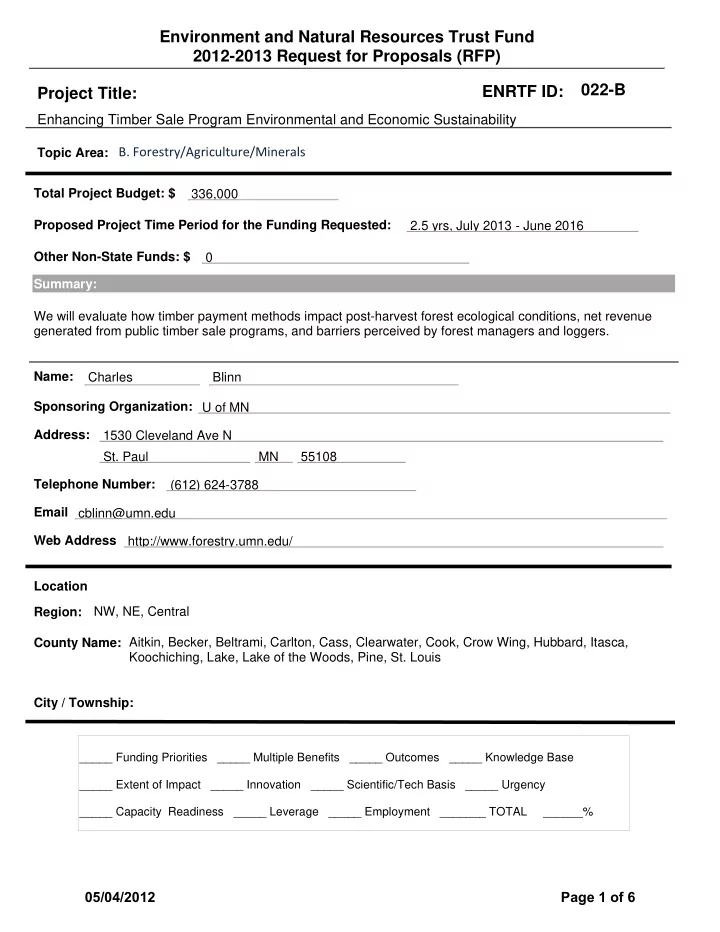
Environment and Natural Resources Trust Fund 2012-2013 Request for Proposals (RFP) 022-B ENRTF ID: Project Title: Enhancing Timber Sale Program Environmental and Economic Sustainability B. Forestry/Agriculture/Minerals Topic Area: Total


slide-1
SLIDE 1

Environment and Natural Resources Trust Fund 2012-2013 Request for Proposals (RFP) Project Title:

Total Project Budget: $ Proposed Project Time Period for the Funding Requested: Other Non-State Funds: $ Name: Sponsoring Organization: Address: Telephone Number: Email Web Address County Name: City / Township: Region: Summary: Location

Enhancing Timber Sale Program Environmental and Economic Sustainability

336,000 2.5 yrs, July 2013 - June 2016 We will evaluate how timber payment methods impact post-harvest forest ecological conditions, net revenue generated from public timber sale programs, and barriers perceived by forest managers and loggers. Charles U of MN 1530 Cleveland Ave N

  • St. Paul

MN 55108 (612) 624-3788 cblinn@umn.edu http://www.forestry.umn.edu/ NW, NE, Central Aitkin, Becker, Beltrami, Carlton, Cass, Clearwater, Cook, Crow Wing, Hubbard, Itasca, Koochiching, Lake, Lake of the Woods, Pine, St. Louis Blinn

_____ Funding Priorities _____ Multiple Benefits _____ Outcomes _____ Knowledge Base _____ Extent of Impact _____ Innovation _____ Scientific/Tech Basis _____ Urgency _____ Capacity Readiness _____ Leverage _____ Employment _______ TOTAL ______%

  • B. Forestry/Agriculture/Minerals

ENRTF ID: 022-B

Topic Area:

05/04/2012 Page 1 of 6

slide-2
SLIDE 2

1 PROJECT TITLE: Enhancing Timber Sale Program Environmental and Economic Sustainability

  • I. PROJECT STATEMENT

Minnesota’s 9.5 million acres of public forest land play an important role in sustaining our state’s environment and economy. The policies and programs used by public timber sale programs can impact post-harvest ecological conditions such as the types and amount of living and dead trees retained. These conditions can, in turn, have pronounced effects on the composition, structure, and productivity of the future forest (e.g., merchantable timber volume and products, wildlife habitat, species diversity). Timber harvesting on these lands also helps support the state’s forest products industry, which is an extremely important source of direct and indirect economic activity, employment, and tax revenue. The revenue generated from public timber sales also benefits state and local governments as well as K-12 education. The method used by a public timber sale program to collect payment for the timber sold can have a substantial impact on post-harvest ecological conditions and net timber sale revenue. Public land management agencies collect payment for timber sold at auction in one of two ways, pay-as-cut (consumer scale) or sold-on-appraised-volume (SOAV). Under the consumer scale approach, the buyer (typically a logging firm) pays for the scaled timber based on the amount harvested and scaled at a mill or

  • n a landing by a qualified scaler. For the SOAV approach, the buyer pays a fixed amount for the timber

sale based upon the appraised volumes of standing timber, regardless of the volume actually harvested. Payment method can affect the level of utilization from a given forest site, producing important differences in post-harvest ecological conditions. It can also impact gross timber sale receipts and agency timber sale administrative costs. In Minnesota, the Cass County Land Department and the USDA-Forest Service are the only public forestry agencies that almost exclusively use the SOAV approach; the St. Louis County Land Department (SLC) and MNDNR offer timber sales using each method. The goals of our study are to evaluate: (1) how the two timber payment methods impact post-harvest forest ecological conditions; (2) the cost-effectiveness of Minnesota’s public timber sale programs; and 3) how natural resource managers and loggers perceive each of these payment methods (strengths, weaknesses, opportunities, barriers). We will achieve our goals by reviewing the literature, collecting field data, and conducting focus groups with resource managers and loggers. The study will provide Minnesota’s public forest management agencies and policymakers with information that can help them identify economic and ecological tradeoffs associated with each payment method.

  • II. DESCRIPTION OF PROJECT ACTIVITIES

Activity 1: Assess ecological impacts of the two payment approaches Budget: $110,000 We will establish study plots in recently closed timber sales on state and county lands in Cass and St. Louis counties to assess the impact of timber payment method on post-harvest silvicultural and ecological

  • conditions. We will measure the distribution and abundance of living and dead trees and the amount of

coarse wood retained on the forest floor, allowing us to address questions related to how each payment method affects important habitats. The abundance and species of forest seedlings will also be measured to examine how each payment method affects future forest composition. Results concerning the impacts of timber sale payment method on forest habitat and composition will be summarized in project reports. Outcome Completion Date

  • 1. Post-harvest field sites identified through work with counties and MNDNR

March 2014

  • 2. Post-harvest sampling data collection completed

August 2014

  • 3. Final report of activity results submitted

June 2015

05/04/2012 Page 2 of 6

slide-3
SLIDE 3

2 Activity 2: Assess the cost-effectiveness of the two payment approaches Budget: $126,000 A national assessment of state and county timber sale program administrators will be conducted to understand their perceptions of the ecological, financial, administrative advantages and disadvantages of these two timber payment methods, including how each one affects forest certification and chain-of- custody efforts. Selected SLC timber sales will be set up and offered for sale under both payment options using a paired bidding methodology to determine how payment method affects gross timber sale revenue. Time card information from SLC field and office personnel responsible for setting up and administering timber sales will be assessed to identify administrative costs associated with each payment method. Outcome Completion Date

  • 1. Literature review completed

December 2013

  • 2. Survey of state and county land department timber sale administrators completed

September 2014

  • 3. Timber sales set-up and auctioned using paired bidding methodology

June 2015

  • 4. Timber sale administration time data collected and analyzed

June 2015

  • 5. Final report of activity results submitted

December 2015 Activity 3: Assess implementation barriers for the two payment approaches Budget: $100,000 Cass and St. Louis County Land Department staff will be interviewed to document the processes used to transition from a consumer scaling to a SOAV timber sale payment process, and the issues they encountered in doing so. Focus groups with MN loggers and natural resource managers will be conducted to assess ecological and economic opportunities and concerns associated with each timber payment

  • method. Recommendations will be provided for dealing with concerns identified.

Outcome Completion Date

  • 1. Interview and focus groups methods developed

March 2014

  • 2. Interview Cass and St. Louis County Land Department staff

June 2014

  • 3. Focus groups conducted

December 2014

  • 4. Final report of activity results submitted

June 2015

  • III. PROJECT STRATEGY
  • A. Project Team/Partners

The University of Minnesota will receive all of the funding and contribute time and effort to the project. Faculty involved are: Activity 1--Tony D’Amato (Assistant Professor); Activity 2--Charlie Blinn (Professor and project leader), Alan Ek (Professor) and Mike Kilgore (Professor); and Activity 3--Mae Davenport (Associate Professor). The University will partner at no cost to the project with the St. Louis County Land Department, Cass County Land Department, the Minnesota Logger Education Program (MLEP) and the MNDNR-Forestry. SLC will assist researchers with setting up and offering tracts for sale under both timber payment options, providing access to staff time card effort information, information about their recently completed timber sales and staff to participate in the focus groups. Cass County Land Department will provide information about their recently completed timber sales as well as staff to participate in the focus groups. MLEP will assist with identifying loggers for focus groups. MNDNR- Forestry will provide information about their recently completed timber sales.

  • B. Timeline Requirements

A 2.5-year project length is needed to be able to collect background information, develop and finalize study protocol, collect and analyze the data, and prepare project summary reports.

  • C. Long-Term Strategy and Future Funding Needs

It is anticipated that the project will be completed within a 2.5-year period beginning July 2013. Project study results will be presented to cooperators, others and submitted to peer review outlets after project completion.

05/04/2012 Page 3 of 6

slide-4
SLIDE 4

Overall Project Budget

BUDGET ITEM Personnel: One month of summer salary and fringe (0.36) for two years (University of Minnesota Co-PI faculty on 9-month appointments - D'Amato, Davenport, and Kilgore; 0.1 FTE each) Salary and fringe (0.8636) for University of Minnesota two graduate student at 2 years and one graduate student at 2.5 years, each at 50% time (20 hours/week). Graduate fringe is budgeted at 0.8636 of salary load and includes tuition for the academic year, health care for the fiscal year, and social security and Medicare for summer pay periods Salary and fringe (0.0743) for a University of Minnesota work-study undergraduate student for 1 year Travel: Travel within Minnesota to pay mileage (75%) and per diem costs (25%) for researchers, graduate students and undergraduate students to collect project data and meet with study collaborators. Additional Budget Items: Letterhead, envelopes, postage, and printing costs associated with administering the national survey of timber sale administrators. TOTAL ENVIRONMENT AND NATURAL RESOURCES TRUST FUND $ REQUEST = SOURCE OF FUNDS AMOUNT Status Other Non-State $ Being Applied to Project During Project Period: St. Louis and Cass County Land Department staff time to identify recently-closed timber sales to be evaluated during the field assessment ($2,000). St. Louis County Land Department staff time to set up and administer pair bid timber sales, to redesign and collect pertinent time card information, and to participate in assessment of timber sale administrators ($5,000). Cass County Land Department staff time to participate in assessment of timber sale administrators ($250). Minnesota Logger Education Program staff time to identify loggers for focus groups and provide incentives for them to attend ($500). Staff time for foresters to participate in focus groups ($1,000). 8,750 $ Secured Other State $ Being Applied to Project During Project Period: Minnesota DNR staff time to identify recently-closed timber sales to be evaluated during the field assessment ($1,000). 1,000 $ Secured In-kind Services During Project Period: Charlie Blinn and Alan Ek (University of Minnesota faculty with 11-month appointments) in support of

  • f working with project PIs and other project employees to provide input on

study protocol and interpretation of study results ($20,000). Tony D'Amato, Mike Kilgore and Mae Davenport (University of Minnesota faculty) in support of working with project PIs and other project employees to provide input on study protocol and interpretation of study results during 9-month appointment ($10,000 each). 50,000 $ Secured Remaining $ from Current ENRTF Appropriation (if applicable): NA

  • $

NA Funding History: Established and implemented paired bid methodology in two previous studies (MN Forest Resources Council, MN Department of Employment and Economic Development, MN DNR, St. Louis County Land Department) 195,000 $

  • V. OTHER FUNDS

336,000 $ 74,980 $ 6,714 $

2012-2013 Detailed Project Budget

  • IV. TOTAL ENRTF REQUEST BUDGET: 2.5 years

AMOUNT 14,416 $ 750 $ 239,140 $

C:\Users\dgriffit\Documents\proposals_recevied\blinn-charles_0412-2-057-Budget

05/04/2012 Page 4 of 6

slide-5
SLIDE 5

Comparison of activities and differences between the consumer scale (pay for what you harvest) and sold-on-appraised volume (pay for the estimated volume) payment methods. Consumer scale Sold-on-appraised volume (Pay for what you harvest) (Pay for estimated volume) Payment method could lead to differences in:

  • ecological outcomes
  • timber utilization
  • timber sale revenue
  • administrative costs

Forester walks through sale area to determine volume to be sold and prepares appropriate paperwork Forester walks through sale area to determine volume to be sold and prepares appropriate paperwork Agency sells timber and collects downpayment Full payment received and paperwork slips for tracking each truckload of wood are given to the buyer Buyer harvests timber Paperwork slips for tracking volume collected for each load

  • f wood received by

the purchasing mill Paperwork slips for tracking each truckload is sent to agency for verification A refund or invoice for remaining balance is issued by agency Agency sells timber and collects downpayment Full payment received Buyer harvests timber Agency verifies each slip of paperwork 05/04/2012 Page 5 of 6

slide-6
SLIDE 6

Enhancing Timber Sale Program Environmental and Economic Sustainability

Project Manager Qualifications Charles R. Blinn Qualifications Charlie is Professor and Extension Specialist in the Department of Forest Resources, University

  • f Minnesota. He has been with the University since 1984. He conducts teaching, research, and
  • utreach/Extension educational programs. His research interests are focused on a broad range of

forest management issues. Specific research areas include: assessing how public land management timber sale programs and policies impact environmental and economic outcomes, evaluating the effectiveness of forest management guidelines to moderate environmental impacts within forested riparian areas, and assessing how forest management guidelines impact environmental and economic outcomes. He also conducts Extension education programs for loggers and natural resource professionals which focus on a wide variety of forest management topics including presenting research results, demonstrating how to apply forest management guidelines, reviewing various aspects of timber harvesting and road planning, how to select and install stream and wetland crossing options, and using global positioning systems for work and recreational purposes. Charlie has published many peer reviewed and non-technical articles which report results and present management implications for the broad range or forest management issues he addresses through his research and outreach work. Responsibilities As Project Manager, Charlie would coordinate and manage the overall project. In the coordination and management role, he would convene meetings of project participants throughout the life of the project to facilitate collaborative efforts, share results, discuss future directions, and identify additional outreach opportunities that could be pursued. In addition, he would provide insight and assistance for all three project activities with a primary focus on Activity 2 where he would advice/co-advise a graduate student. Organization Description The Department of Forest Resources is part of the University of Minnesota. 05/04/2012 Page 6 of 6