Environment and Natural Resources Trust Fund 2012-2013 Request for - - PDF document

environment and natural resources trust fund 2012 2013
SMART_READER_LITE
LIVE PREVIEW

Environment and Natural Resources Trust Fund 2012-2013 Request for - - PDF document

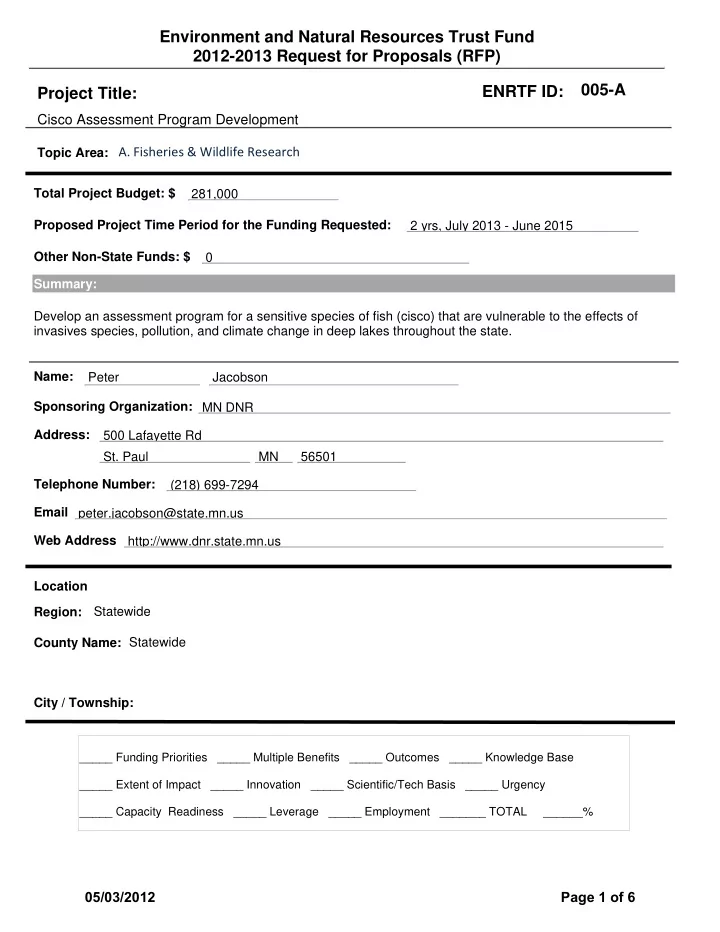
Environment and Natural Resources Trust Fund 2012-2013 Request for Proposals (RFP) 005-A ENRTF ID: Project Title: Cisco Assessment Program Development A. Fisheries & Wildlife Research Topic Area: Total Project Budget: $ 281,000 Proposed


slide-1
SLIDE 1

Environment and Natural Resources Trust Fund 2012-2013 Request for Proposals (RFP) Project Title:

Total Project Budget: $ Proposed Project Time Period for the Funding Requested: Other Non-State Funds: $ Name: Sponsoring Organization: Address: Telephone Number: Email Web Address County Name: City / Township: Region: Summary: Location

Cisco Assessment Program Development

281,000 2 yrs, July 2013 - June 2015 Develop an assessment program for a sensitive species of fish (cisco) that are vulnerable to the effects of invasives species, pollution, and climate change in deep lakes throughout the state. Peter MN DNR 500 Lafayette Rd

  • St. Paul

MN 56501 (218) 699-7294 peter.jacobson@state.mn.us http://www.dnr.state.mn.us Statewide Statewide Jacobson

_____ Funding Priorities _____ Multiple Benefits _____ Outcomes _____ Knowledge Base _____ Extent of Impact _____ Innovation _____ Scientific/Tech Basis _____ Urgency _____ Capacity Readiness _____ Leverage _____ Employment _______ TOTAL ______%

  • A. Fisheries & Wildlife Research

ENRTF ID: 005-A

Topic Area:

05/03/2012 Page 1 of 6

slide-2
SLIDE 2

Environment and Natural Resources Trust Fund (ENRTF) 2012‐2013 Main Proposal

1 PROJECT TITLE: Cisco Assessment Program Development

  • I. PROJECT STATEMENT

Cisco (also called tullibees or lake herring) are a sensitive species of fish that is vulnerable to the effects of invasives species, water pollution, and climate change. Invasive species such as smelt have already decimated native cisco populations in important lakes like Burntside near Ely and Trout Lake near Grand Marais. Fisheries managers are also concerned about the effects of other invasive species such as spiny water flea and zebra mussels. A requirement for cold, well‐oxygenated water also makes cisco especially vulnerable to nutrient impairment in lakes. In the summer, cisco are often found below the thermocline in the cold, deep waters of many Minnesota lakes. Deep, clear lakes that have high

  • xygen concentrations below the thermocline have the largest numbers of cisco. Walleye, northern

pike, muskellunge, and lake trout grow exceptionally well in lakes that have high densities of these important forage fish (cisco contain high amounts of lipids conducive for fast growth). Unfortunately,

  • xygen concentrations below the thermocline decline throughout the summer, especially in lakes with

high nutrient concentrations. Excessive nutrients from poor land use practices deplete oxygen levels and cisco can experience mortality (as was the case in the summer of 2006, when a large number of cisco died across the state). Climate change is expected to increase the thermal stress on cisco as well. Accurate assessments of these “canaries in a mineshaft” would provide an important biological measure of success for lake protection and restoration efforts in Minnesota. Unfortunately, standard DNR netting assessments do not adequately sample cisco. Most of the assessments target warm and coolwater fish such as walleye, northern pike, and yellow perch using gill nets set on the bottom near or above the thermocline. The DNR Fisheries Research Unit has been testing several new gears that specifically target cisco. Vertical gill nets appear to have potential to effectively sample cisco in the deep zones of a lake where cisco are suspended below the thermocline (many times well off the bottom). Hydroacoustic sampling is also a potentially important tool that can provide population estimates of suspended fish such as cisco. Both of these tools have been used successfully in other states, and the research is showing that they could provide excellent population data on cisco in Minnesota. Developing an program that uses these new and innovative cisco assessment tools for Minnesota lakes would be the primary goal of this funding. Specifically, a field crew would be assembled that would implement cisco sampling protocols developed by the DNR Fisheries Research Unit. The field crew would consist of a DNR Specialist and two summer student interns. The crew would sample cisco with vertical gill nets and hydroacoustic equipment in a number of lakes throughout the state (possibly coordinated with Minnesota PCA water quality sampling). The acoustics estimate would provide previously unavailable cisco population size and biomass estimates. The cisco assessment data would provide the basis for developing a sensitive, biological measure of impairment/quality for deep lakes throughout the state.

  • II. DESCRIPTION OF PROJECT ACTIVITIES

Activity 1: Finalize sampling protocol and assemble vertical gill nets and hydroacoustic gear. Budget: $85,000 A sampling protocol would be finalized based on recommendations from the DNR Fisheries Research unit that has been testing cisco assessment gear. A field sampling manual would be written that provides the protocol and detail necessary for field work to proceed in a standardized fashion. Then the vertical gill nets and hydroacoustics gear would be assembled and readied for field use.

05/03/2012 Page 2 of 6

slide-3
SLIDE 3

2 Outcome Completion Date

  • 1. Field sampling protocol manual

8/1/2013

  • 2. Assembled sampling gear prepared for field use.

8/1/2013 Activity 2: Conduct cisco assessments on lakes throughout the state. Budget: $196,000 Lakes throughout the state would have cisco populations assessed using the standard protocol developed in Activity 1. A schedule of lakes would be developed in consultation with DNR Area Fisheries

  • Supervisors. The lakes would be selected based on the importance of cisco populations, threat from

invasive species, and coordinated with PCA’s water quality sampling. Detailed assessment reports would be developed for each lake and distributed to DNR Fisheries Managers, Invasive Species Specialists, and PCA Water Quality Managers. Outcome Completion Date

  • 1. Lake survey schedule

8/1/2013

  • 2. Conduct field assessments of cisco populations

6/30/2015

  • 3. Distribute assessment reports

6/30/2015

  • III. PROJECT STRATEGY
  • A. Project Team/Partners

Project Manager: Peter Jacobson, DNR Fisheries Research Unit Habitat Group Supervisor would provide

  • versight for the development of the team and project. DNR Fisheries would support the Project

Manager (no LCCMR funds required). Fisheries Specialist Sr: A two year limited term position would be created within DNR Fisheries to implement the project. The Fisheries Specialist would complete the Field Sampling Manual and assemble the sampling gear. The Fisheries Specialist would also conduct the field assessments, write the assessment reports, and supervise the Summer Interns. Summer Interns: Two student interns would be hired for the summers of the project to assist with the field collection of assessment data. They would be supervised by the Fisheries Specialist.

  • B. Timeline Requirements

The timeline required to complete the project is two years: July 1, 2013 – June 30, 2015. That would allow for data to be collected from three summers of field seasons.

  • C. Long‐Term Strategy and Future Funding Needs

No future funding needs from LCCMR are expected. Once the sampling protocol and manual have been developed and the assessments standardized, it is possible that future assessments will be funded through existing DNR programs. This project is designed to develop an innovative assessment method and then allow the program to eventually become a standard component of the DNR lake survey program.

05/03/2012 Page 3 of 6

slide-4
SLIDE 4

BUDGET ITEM Personnel: (1) Fisheries Specialist Sr. 2 yrs 100% July 2013 - June 2015 Personnel:(2) Student Interns 6 total summer months from July 2013 - June 2015 Contracts: Equipment/Tools/Supplies: Hydroacoustic unit Equipment/Tools/Supplies:Vertical gill nets Equipment/Tools/Supplies: Boat, motor, trailer for field sampling Equipment/Tools/Supplies: Dissolved oxygen meter, computer, hydroacoustic software Additional Budget Items: Travel costs for field sampling crew Additional Budget Items: Direct Support Services - DNR used a rate of 6.5% to calculate costs for direct support services, which are DNR’s direct and necessary business services required to support this proposal. TOTAL ENVIRONMENT AND NATURAL RESOURCES TRUST FUND $ REQUEST = SOURCE OF FUNDS AMOUNT Status Other Non-State $ Being Applied to Project During Project Period:

  • $

Other State $ Being Applied to Project During Project Period:

  • $

In-kind Services During Project Period:

  • $

Remaining $ from Current ENRTF Appropriation (if applicable):

  • $

Funding History:

  • $

18,265 $

  • $
  • V. OTHER FUNDS

281,000 $ 30,000 $ 30,000 $ 114,000 $ 24,000 $

2012-2013 Detailed Project Budget

  • IV. TOTAL ENRTF REQUEST BUDGET 2 years

AMOUNT 9,735 $ 45,000 $ 10,000 $

I:\ML2013\RFP\proposals_recevied\jacobson-peter_0412-2-041-Budget

05/03/2012 Page 4 of 6

slide-5
SLIDE 5

Project Manager: Peter Jacobson is the Supervisor of the Minnesota DNR Fisheries Research Habitat Group. Peter directs the work of six biologists who conduct research into the effects of land use change, water quality, shoreline development, climate change, and invasives species on the habitat of fish throughout the state

  • f Minnesota. Peter has a Bachelor of Science degree from the University of Minnesota and a Master of

Science degree from Michigan State. He has been with the Minnesota Department of Natural Resources for 24 years. Organization Description: The mission of the Minnesota Department of Natural Resources is to work with citizens to conserve and manage the state's natural resources, to provide outdoor recreation opportunities, and to provide for commercial uses of natural resources in a way that creates a sustainable quality of life.

05/03/2012 Page 5 of 6

slide-6
SLIDE 6

05/03/2012 Page 6 of 6