Environment and Natural Resources Trust Fund 2012-2013 Request for - - PDF document

environment and natural resources trust fund 2012 2013
SMART_READER_LITE
LIVE PREVIEW

Environment and Natural Resources Trust Fund 2012-2013 Request for - - PDF document

Environment and Natural Resources Trust Fund 2012-2013 Request for Proposals (RFP) 052-C2 ENRTF ID: Project Title: Developing Economic Incentives for Eradicating Buckthorn C2. Invasive Species Terrestrial Topic Area: Total Project Budget:


slide-1
SLIDE 1

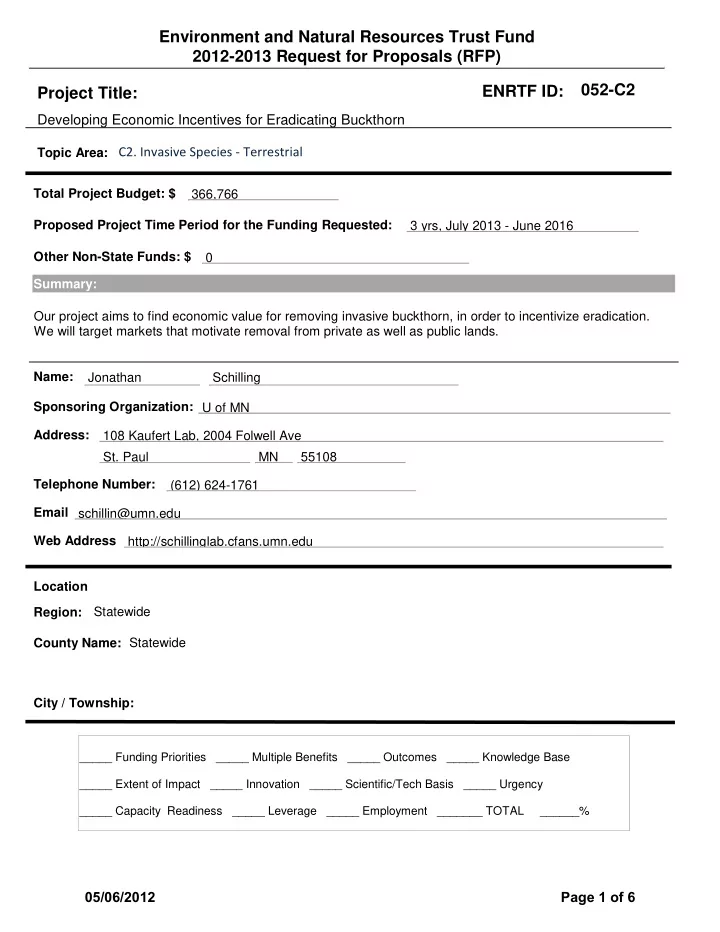
Environment and Natural Resources Trust Fund 2012-2013 Request for Proposals (RFP) Project Title:

Total Project Budget: $ Proposed Project Time Period for the Funding Requested: Other Non-State Funds: $ Name: Sponsoring Organization: Address: Telephone Number: Email Web Address County Name: City / Township: Region: Summary: Location

Developing Economic Incentives for Eradicating Buckthorn

366,766 3 yrs, July 2013 - June 2016 Our project aims to find economic value for removing invasive buckthorn, in order to incentivize eradication. We will target markets that motivate removal from private as well as public lands. Jonathan U of MN 108 Kaufert Lab, 2004 Folwell Ave

  • St. Paul

MN 55108 (612) 624-1761 schillin@umn.edu http://schillinglab.cfans.umn.edu Statewide Statewide Schilling

_____ Funding Priorities _____ Multiple Benefits _____ Outcomes _____ Knowledge Base _____ Extent of Impact _____ Innovation _____ Scientific/Tech Basis _____ Urgency _____ Capacity Readiness _____ Leverage _____ Employment _______ TOTAL ______%

  • C2. Invasive Species ‐ Terrestrial

ENRTF ID: 052-C2

Topic Area:

05/06/2012 Page 1 of 6

slide-2
SLIDE 2

PROJEC

  • I. PROJ

Buckthor species ( shade-tol suppress Buckthor berries p Buckthor

  • plants. C

buckthor from wet The goa rem ova pulling o the princ understa buckthor To do thi market o product following The tacti different Paul, inc District approach this dece value-add whose co propertie assessed. related t focus on thresho

  • II. DESC

Activity We will integrate buckthor qualities and extra O A B C

Environ 2012‐20

CT TITLE: JECT STAT rn is a non- (European a lerant hedgi ses weeds. T rn grows we provide food rn also exud Combined, bu rn thickets a tlands to sav al of our pr al on priva

  • r cutting bu

cipal remova and the ecolo rn as it is re is statewide

  • ptions of a

developmen g this logic, a ic we propos

  • markets. O

centivizing e Energy cog h that would entralized tac ded options

  • -investigato

es were cha . This is sim

  • solid woo

n all buck

  • lds in dem

CRIPTION y 1: Capture target two c e chipped (fla rn, which h (eg, anti-fu acts from all Outcom es (

  • A. Separation
  • B. Physical pr
  • C. Chemical c

nment and 013 Main

Developing TEMENT

  • native, inva

and glossy) ing with ber These attribu ell in shade u d to birds, des compoun uckthorn’s b and degrade vannahs, and roject is to te as well ckthorn, foll al method. T

  • gical value

emoved, in o without enc appropriate nt, not post and we are p se (a ‘carrot’ One example eradication w generation p d be less cen ctic, the Stat s when remo

  • rs included

racterized a milar to our p

  • d products

kthorn tissu m and, abov N OF PROJE e and chara components aked) or gro have some h ungal activity l plant tissue Com pletion n & varied ex roperty char characterizat

d Natural Proposal

economic in asive plant t were widely rries that att utes, howev under tree ca but harbor nds that are biology lends ed habitat. T d eradication identify ec as public lowed by app This has led t e of killing b

  • rder to mak

couraging cu

  • scale. This
  • hoc. Our pr

partnered wi not a ‘stick’ is a project within a 75-

  • plant. We a

tralized and te of Virginia

  • ving invasiv

d an investi and options proposal, bu not possible ues (bark, ve which th ECT ACTIV acterize ex s of bucktho

  • und bucktho

history in d y) that rema es, varying tr Dates) xtraction of b racterization tion of water

Resource

1 ncentives for that is an on y introduced ract birds, w ver, have all anopies, out r a laxative allelopathic, s an advanta This poses a n is a critical conomic use lands but plication of to massive e

  • uckthorn. W

ke removal m ultivation re would be roject and co th others de ’) has been u t focused on

  • mile radius

aim to buil d might bette a published ve Ailanthu gator on th for harvest ut many aspe e from an u , etc.) and here m ight VITIES xtractable c

  • rn: solid re
  • rn into a so

dyes and me ain poorly d ree age and e buckthorn (v n of bark, hea r/ organic ex

es Trust Fu

r eradicating ngoing prob d as ornam with persiste lowed buckt tcompeting n e that encou , meaning th age over nat a serious thr l challenge, p es for buckt also do not herbicides t efforts, largel We want to a more worthw equires defin most efficie

  • llective exp

eeply familia used before f n removal of s by burning ld a compl er target priv a landowne s, the ‘tree his proposal ting in tand ects will not understory s uses m ark be incentiv com ponen esidues and

  • lid product.

edicines, lik

  • defined. We

extraction to varied ages/ art- and sapw xtracts from

und (ENRT

g buckthorn blem in Min mentals in th ent leaves, a thorn to inv native plants urages local hey suppress ive plants, r reat to intac particularly thorn that promote cu to reduce stu ly volunteer attach econo while to priv ning flexible ent if done pertise have ar with eradi for woody in f woody inva g residues f lementary, vate lands. A er’s manual i

  • f heaven.’

, Dr. Omar dem with oth t translate, p

  • shrub. Ther

rket valuat ve to plant nts Bud extractives. . Extractive kely harbor will first ch

  • assess a ra

/ locations) wood all tissues

TF)

  • nnesota. Two

he late 1800 nd that natu vade our for s for sunligh l seed dispe s growth of resulting in d ct forests ran

  • n private la

incentivize

  • ultivation. H

ump-sprouti r, from those

  • m ic value t

vate landow , even temp in tandem e been assem cation issue nvasives but asives aroun for energy a not compet As an examp in 2009 targ For that pro Espinoza, w her species particularly t refore, we tion to iden t buckthorn dget: $130 Composites compounds

  • ther ‘bioa

haracterize s nge of optio (Jan. 31, 2 (Jan. 31, 2 (June 30, 2

  • key

0’s as urally rests.

  • ht. Its

ersal.

  • ther

dense nging ands. e its Hand- ng, is e who to the wners.

  • rary

with mbled s. t with nd St. at the titive, ple of geting

  • ject,

wood were those e will ntify n. ,9 22 s can from active’ solids ns. 2014) 2015) 2015)

05/06/2012 Page 2 of 6

slide-3
SLIDE 3

Developing economic incentives for eradicating buckthorn 2 Activity 2: Establish efficacy of target com ponents Budget: $168 ,28 5 For solid material, either chipped or ground into flour (sawdust), we will determine potential to pelletize or hot-press into a solid product, as well as test heating potential as btu’s from pellets, charcoal, etc. For extracts, biological activity will be tested against fungi, bacteria, and plants, targeting species relevant medically and that are pests in forests, fields, or building materials. Outcom es (Com pletion Dates)

  • A. Determination of best-use solid product options for buckthorn (June 30, 2015)
  • B. Standarized verification of biocidal efficacy of water/ organic extracts (June 30, 2015)
  • C. Identification of target bioactive compounds for purification

(Jan. 31, 2016) Activity 3: Identify realistic m arkets and aid in developm ent Budget: $67,559 We will target economically-viable supply chains that offer incentive without promoting cultivation, particularly those that are attractive for private landowners and that offer flexibility given unpredictable, even dwindling supply. Substitution schemes are an example, using ground buckthorn in production of fiberboard as a temporary stand-in for aspen or other species. Outcom es (Com pletion Dates)

  • A. Assessment of availability, concentration, and site operability (June 30, 2014)
  • B. Estimation of extraction, transport, and fixed/ variable process costs (June 30, 2016)
  • C. Determination of expected market values, viability, and perceptions (June 30, 2016)
  • III. PROJECT STRATEGY
  • A. Project Team / Partners

Jonathan Schilling (Project Lead) is Associate Professor in the Bioproducts and Biosystems Engineering (BBE) department at the University of Minnesota (UMN), and is an expert in wood microbiology and extractives as biocides. Christine Salom on is Assistant Director and Assistant Professor at the Center for Drug Design at UMN. Her expertise is extraction and characterization of biologically active compounds for targeting commodity compounds. Om ar Espinoza (Co-PI) is Chair of Forest Products Management Development Institute (FPMDI) and Assistant Professor in BBE at UMN. His has experience with Virginia’s invasive ‘tree of heaven’ eradication efforts and an established connection to the MN forest products industry. For this effort, we include non-ENRTF-funded partners Julie Blackburn and Dan Shaw from Minnesota Board of Water & Soil Resources (BWSR), who lead the Cooperative Weed Management Areas (CWMAs) in MN. Our partnership can guide collection, target dissemination

  • f findings, and build collaboration for future funding efforts using the CWMA framework.
  • B. Tim eline Requirem ents

This effort would span three years. Activity 1 will provide the building blocks for Activity 2, both providing core baseline data. Activity 3 will be active throughout the project period because it will both guide the characterization effort as well as the transition of the project into action.

  • C. Long-Term Strategy and Future Funding Needs

The strategies for this project are 1) to building a core knowledge that positions us to translate

  • ur work into real-world applications, and 2) to actively participate in this translational effort.

In addition to funding sources for fundamental invasive species research (eg, Plant Conservation Alliance and US Fish and Wildlife), we are also aligned with initiatives such as the USDA Pulling Together Initiative (PTI), which uses CWMA’s as a model system. By building on a baseline effort that has been guided by the CWMA program in Minnesota, and coupled with FPMDI, we feel strongly that we can align the project for continued success. This has the potential in Minnesota to offer value to local and rural economies as well as a template that might be utilized toward eradicating other invasive woody plants such as honeysuckles and Siberian elms.

05/06/2012 Page 3 of 6

slide-4
SLIDE 4

Title: Developing economic incentives for eradicating buckthorn

  • IV. TOTAL ENRTF REQUEST BUDGET (3 years)

BUDGET ITEM AMOUNT FTE Personnel: Omar Espinoza (Co-PI, 1 month summer salary, year 1 (June 2014) 84% salary, 16% fringe + benefits) $6,924 2% 1 Postdoctoral Research Associate (Center for Drug Design, Solomon advising, 2 years (January 2014-December 2015), Activities 1,2, 80% salary, 20% fringe + benefits) $103,776 100% 1 Postdoctoral Research Associate (BBE, Schilling advising, 2 years (July 2013-June 2015), Activities 1,2, 80% salary, 20% fringe + benefits) $104,068 100% 1 Graduate Research Assistant (BBE, Espinoza, 2 years (July 2014-June 2016), Activities 2,3, 48% salary, 52% fringe + benefits) $74,737 50% Equipment/Tools/Supplies: Activity 1 supplies: Wet-chemistry characterization supplies (eg, acids, filters, pipette tips, pipets, sundries); Extraction solvents and supplies (eg, organic solvents); Analytical supplies (eg, chromatography columns, autosampler tubes) $25,000 Activity 1 equipment: Agilent High-performance liquid chromatograph 1200 series fraction collector and heat exchanger unit, installed. Schilling lab. $15,261 Activity 2 supplies: Solids application supplies (eg, resins, hot-press molds); microbial culturing supplies (eg, petri dishes, media, cultures) $25,000 Activity 3 supplies: Dedicated computer and software for GIS and product life cycle assessments; $5,000 Travel: In-state travel for buckthorn collection and meetings with BWSR and industries $7,000 TOTAL ENVIRONMENT AND NATURAL RESOURCES TRUST FUND $ REQUEST = $366,766

  • V. OTHER FUNDS

SOURCE OF FUNDS

AMOUNT Status

Other Non-State $ Being Applied to Project During Project Period: none Other State $ Being Applied to Project During Project Period: none In-kind Services During Project Period: 1 month salary + fringe contributed by the PI and Co-PI's (2 investigators contributing 2 months each, total - Schilling contributing 3, total); use of existing chromatography supplies such as separation columns and guard columns $62,830 Remaining $ from Current ENRTF Appropriation (if applicable): none Funding History: Indicate funding secured prior to July 1, 2013, for activities directly relevant to this specific funding request. State specific source(s) of funds. none NOTE: Income generated from patents/royalties due to the proposed research would be shared with the ENRTF to the extent of their investment, although it is important to be clear that this is not the goal of our research plan.

2012-2013 Detailed Project Budget

05/06/2012 Page 4 of 6

slide-5
SLIDE 5

Developing economic incentives for eradicating buckthorn European buckthorn (Rhamnus Glossy buckthorn (Frangula European buckthorn wood; cathartica); distribution alnus); distribution ethanol extracts

PRELIMINARY TRIAL – Wood-decay fungi Buckthorn extracts suppress fungal growth.

Trametes versicolor Growth rate averages Extract-free medium (2.4 millimeters/day) FAST Buckthorn extracts (0.4 millimeters/day) SLOW Gloeophyllum trabeum Growth rate averages Extract-free medium (5.8 millimeters/day) FAST Buckthorn extracts (0.0 millimeters/day) NONE

plants.usda.gov

05/06/2012 Page 5 of 6

slide-6
SLIDE 6

Developing economic incentives for eradicating buckthorn Project Manager Qualifications/ Organization Description Project Manager: Jonathan S. Schilling 2011-present Associate Professor, UMN, Dept. Bioproducts & Biosystems Engineering 2006-2011 Assistant Professor, UMN, Dept. Bioproducts & Biosystems Engineering 2006 Ph.D. University of Maine, Wood Microbiology 2000 M.S. Longwood College, Environmental Studies 1995 B.A. Rhodes College, Biology

  • Dr. Schilling’s group at UMN is well-positioned to succeed in this buckthorn project, focusing

their research on wood science, m icrobiology and forest ecology. This team specializes in characterizing woody tissues and the attributes that affect decay by microbes. This has implications on wood product durability, tree health, and ecosystem-level processes in forests. To align with these areas, Dr. Schilling couples traditional characterization methods such as those of the American Society for Testing and Materials (ASTM) and American Wood Protection Association (AWPA) with microbial culturing and analyses, allowing exploration at an interface between biological organisms (trees and microbes). Supported by a research team of 9 members and in-house facilities for relevant culturing and analyses, Dr. Schilling is a good match for managing this project on buckthorn and the bioactive potential of extractives and solids.

  • Dr. Schilling brings experience managing multi-investigator projects and has successfully

managed 7 grants and many contracts since 2006 as lead project manager. In total, these grants exceed $2M and have included cost-share and in-kind in the budgets. From these projects, 16 peer-reviewed scientific articles have been published along with 6 outreach publications. Dr. Schilling has given 54 presentations in that time, 18 of which were invited talks. He is a Resident Fellow in the Institute on the Environment (IonE) and adjunct faculty in the Department of Plant Pathology at UMN. Among these achievements since 2006, Dr. Schilling was awarded 3 ‘early career’ grants totaling $1.3M, among them a prestigious, highly competitive Department

  • f Energy (DOE) Early Career award in the Biological and Ecological Research (BER) program.
  • Dr. Schilling also has the ability to integrate this buckthorn project into the classroom and to

disseminate the research to non-technical audiences. He teaches 2 courses annually at UMN: Biodegradation of Bioproducts (BBE 4/ 5302) and Bioremediation (ESPM 4/ 5608), both 3 credit courses targeting seniors and graduate students. Despite an appointment of 50% teaching and 50% research, he has dedicated significant time to outreach and service. This includes early detection case study publications, development of an online compendium for biodeterioration diagnostics (the ‘Rot Bot’), and many service lectures, including those given at annual Pesticide Applicator and Kild Drying workshops. Because this project strategy includes transition of the project and translation of the science, this is an important aspect for the future of the effort. This project would build a new and targeted collaboration with co-investigators Omar Espinoza (Ph.D. Virginia Tech) and Christine Salomon (Ph.D. Scripps Institution, UCSD), as well partners from the MN Board of Water and Soil Resources (BWSR). The University of Minnesota is an excellent home for this collaboration, providing the facilities and support needed to manage the research and to share the findings.

05/06/2012 Page 6 of 6