Enhanced Monitoring of the Moberly Lake Trout Rehabilitation Program - PowerPoint PPT Presentation
Enhanced Monitoring of the Moberly Lake Trout Rehabilitation Program Ministry of Forests, Lands, Natural Resource Operations and Rural Development Project Leads: Rick Elsner (Brendan Anderson, Lynn Avis, Kristen Peck) Brief History 2002
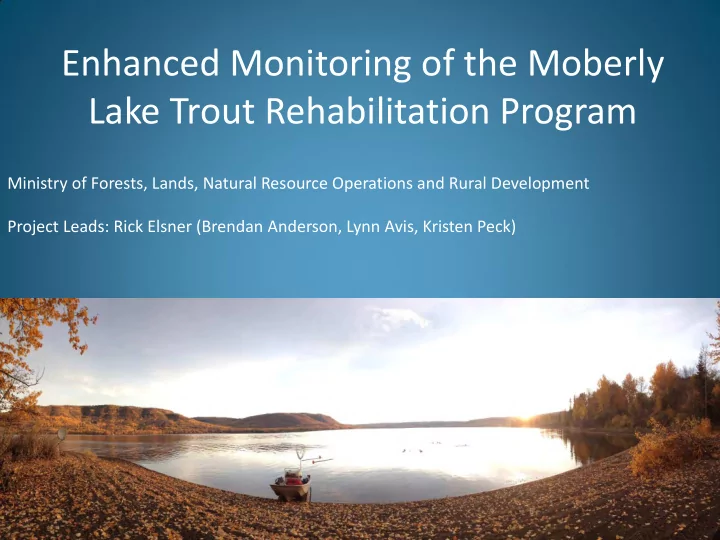
Enhanced Monitoring of the Moberly Lake Trout Rehabilitation Program Ministry of Forests, Lands, Natural Resource Operations and Rural Development Project Leads: Rick Elsner (Brendan Anderson, Lynn Avis, Kristen Peck)
Brief History • 2002 – low population abundance • 2005 – beginning of mark-recap program • 2005-2008 – evaluation of habitat suitability • 2010 – initiate stocking program • 2012-2016 – three cohorts of juveniles stocked
Objectives • 1. Track Lake trout abundance • 2. Monitor lake trout life history parameters • 3. Assess the success of rehabilitation cohorts • 4. Monitor the response of the Lake Whitefish population
Objective 1: Monitor Lake Trout Total Abundance and population trends • Mark-recapture – Marking: Annual spawning shoal targeted netting – Recapture: Spring Littoral Index Netting (SLIN)
Objective 1: Monitor Lake Trout Total Abundance and population trends • Recapture rates consistently >50% • Relatively high capture probability for mature males • Population growth rate 1.02 (95% CI 0.91-1.14) • Low but non-zero recruitment • Depressed state equilibrium • # Mature Upper Lower Total population Year SE Males 95% CI 95% CI ~360-570 2014 217 183 251 17 Mature fish 2015 224 185 263 20 based on a 1:1 2016 230 184 276 23 sex ratio 2017 235 180 289 28
Objective 1: Monitor Lake Trout Total Abundance and population trends
Objective 2: Monitor Lake Trout Life History Parameters
Objective 2: Monitor Lake Trout Life History Parameters • Survival is high ~90% (Pradel model) • Males spawn annually, females 1 out of every 2 years (Barker survival analysis) • Density dependant growth
Objective 2: Monitor Lake Trout Life History Parameters
Objective 3: Monitor survival, growth fitness and reproduction of stocked cohorts • SLIN • Opportunistic targeted netting • Incidental captures during targeted spawner netting
Objective 3: Monitor survival, growth fitness and reproduction of stocked cohorts
Objective 4: Monitor for changes in Lake Whitefish population • Hydroacoustic survey with gillnet validation • Initial years of sampling provide baseline • Monitoring for shifts in abundance
Objective 4: Monitoring cont’d Lake Whitefish a) 800,000 700,000 600,000 500,000 400,000 300,000 200,000 100,000 - 2013 2014 2015 2016 2017 Pygmy Whitefish b) 2,500,000 2,000,000 1,500,000 1,000,000 500,000 - 2013 2014 2015 2016 2017
Accomplishments and Implications for Conservation • Establishing indexing approach for whitefish species monitoring • New record of pygmy whitefish in BC
Accomplishments and Implications for Conservation • Development of sustainable long term core monitoring program – Population estimates based on male spawning population – Allows for robust population abundance estimates from single sampling session annually – Allows for evaluation of population parameters: survival, recruitment, mortality, population growth rate
Accomplishments and Implications for Conservation • Evaluate Success of Rehabilitation Program • Most rigorous absolute abundance lake trout estimates in BC • Potential future applications for Lake Trout Stock recovery in BC • Identification of other depressed LT populations at equilibrium?
Future Directions • Continue fall spawner • Next 3-5 years surveys implement another SLIN/Hydroacoustic – Monitor adult male population survey – Monitor stocked juvenile recruitment
Acknowledgements
Egg Take
Hatchery fish Release
Recommend
More recommend
Explore More Topics
Stay informed with curated content and fresh updates.