thinking outside the box A CHOCOLATEY OPTIMIZATION PROBLEM NCTM - - PDF document

thinking outside the box
SMART_READER_LITE
LIVE PREVIEW

thinking outside the box A CHOCOLATEY OPTIMIZATION PROBLEM NCTM - - PDF document

thinking outside the box A CHOCOLATEY OPTIMIZATION PROBLEM NCTM 2014 Annual Meeting & Exposition Taken from http://a.tgcdn.net/images/products/zoom/ New Orleans f158_chocolate_gaming_dice_set.jpg April 11, 2014 3-8 Gallery Workshop


slide-1
SLIDE 1

thinking outside the box

A CHOCOLATEY OPTIMIZATION PROBLEM

3-8 Gallery Workshop

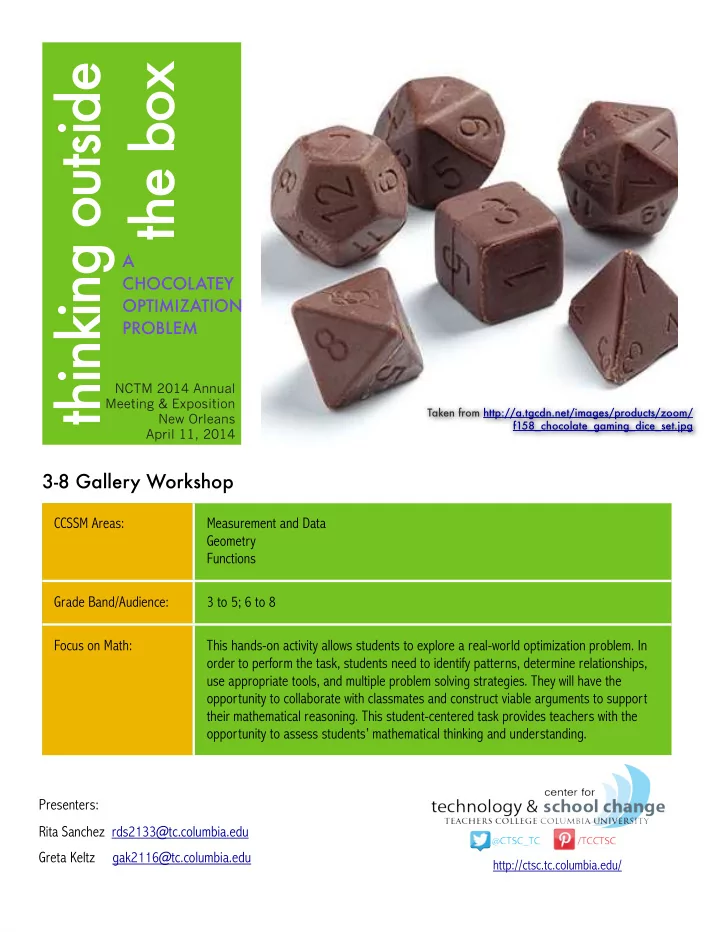
Taken from http://a.tgcdn.net/images/products/zoom/ f158_chocolate_gaming_dice_set.jpg

CCSSM Areas: Grade Band/Audience: Focus on Math: Measurement and Data Geometry Functions 3 to 5; 6 to 8 This hands-on activity allows students to explore a real-world optimization problem. In

  • rder to perform the task, students need to identify patterns, determine relationships,

use appropriate tools, and multiple problem solving strategies. They will have the

  • pportunity to collaborate with classmates and construct viable arguments to support

their mathematical reasoning. This student-centered task provides teachers with the

  • pportunity to assess students’ mathematical thinking and understanding.

NCTM 2014 Annual Meeting & Exposition New Orleans April 11, 2014

Presenters: Rita Sanchez rds2133@tc.columbia.edu Greta Keltz gak2116@tc.columbia.edu

http://ctsc.tc.columbia.edu/

slide-2
SLIDE 2

3rd & 4th Grade

How do packaging engineers use what they know about the properties of a product and the needs of the consumer to design packages?

Performance Task

It is almost Mother’s Day in the United States. Godiva, a manufacturer of premium chocolates and related products, needs to add a new gift box to their Mother’s Day Collection to launch their new kind of chocolate truffle, shaped like a cube. Since you are the packaging engineer at the Research and Development department at Godiva, it is your task to design and construct a prototype of the gift box. You have to take into consideration the requirements from the Board of Directors.

  • The base of each chocolate truffle is 1” x 1” square
  • The gift box has to have a rectangular shape.
  • Must hold 12 chocolate truffles.
  • A ribbon must be wrapped around the box.
  • You will have to use the least amount of ribbon.

Your task as the packaging engineer is to design a gift box, out of a rectangular sheet

  • f material, that meets the requirements from the Board of Directors.

For this task, you will have to come up with different designs that hold 12 chocolate

  • truffles. Think about all the different ways you could fit 12 chocolate truffles onto a

rectangle. You will record the dimensions of each design in a table. You can only use whole- number side lengths.

  • Fill in the chart for the length and width of each of your designs.
  • Find the area and perimeter of each of your rectangles.
  • Decide how many chocolate truffles would fit in the box.
  • Decide how long the ribbon needs to be.

Now, choose the design that uses the least amount of ribbon. Draw the net of the box and construct the prototype gift box. You will be able to use tape to bind the edges. You will have to present your prototype and a proposal to the Board of Directors. Make sure that the proposal includes the advantages of the design and why they should adopt and start producing it.

4th Grade Extension

The ribbon that goes around the middle of the box is very expensive, so your board of directors has told you that you can only use 18” of ribbon for each box. Think about all the possible designs you could use to create this box. Fill in the table to show all the possible combinations for a rectangle with a perimeter of 18”. Which design will hold the most candies? Choose a box that holds the most candies. This is the box you will construct as your prototype gift box. You will be able to use tape to bind the edges. You will have to present your prototype and a proposal to the Board of Directors. Make sure that the proposal includes the advantages of the design and why they should adopt and start producing it.

CCSS for Mathematics

Measurement and Data (MD) 3.MD.8 Solve real world and mathematical problems involving perimeters of polygons, including finding the perimeter given the side lengths, finding an unknown side length, and exhibiting rectangles with the same perimeter and different areas or with the same area and different perimeters. Measurement and Data (MD) 4.MD.3 Apply the area and perimeter formulas for rectangles in real world and mathematical problems.

NCTM 2014 Annual Meeting & Exposition New Orleans. April 11, 2014

Designed by the Center for Technology and School Change http://ctsc.tc.columbia.edu/ t h i n k i n g o u t s i d e t h e b o x

A CHOCOLATEY OPTIMIZATION PROBLEM
slide-3
SLIDE 3

3rd Grade Rubric

¡

4=Exceeds Standards 3=Meets Standards 2=Almost Meets Standards 1=Beginning to Meet Standards NCTM 2014 Annual Meeting & Exposition New Orleans. April 11, 2014

Designed by the Center for Technology and School Change http://ctsc.tc.columbia.edu/ ¡ Cri Criteri eria 4 3 2 1 Pr Proble lem So m Solving lving Uses the attributes of shapes in order to determine areas and perimeters to design, develop, and produce packages. Finds the area of a rectangle with whole-number sides by tiling it with unit squares and showing that the area is the same as would be found by multiplying the side lengths. Finds rectangles with the same perimeter and different areas and with the same area and different perimeters. Uses some of the attributes

  • f shapes in order to

determine areas and perimeters to design, develop, and produce packages. Finds the area of a rectangle with whole-number sides by either tiling it with unit squares, or multiplying the side lengths, but not both. Finds rectangles with either the same perimeter or different areas or with the same area and different perimeters, but not both. Is not able to use the attributes of shapes to design, develop, and produce packages. Is not able to find the area of a rectangle by tiling with unit squares or multiplying the lengths of the sides. Is not able to find rectangles with the same perimeter and different areas or with the same area and different perimeters. ¡ ¡

slide-4
SLIDE 4

3rd Grade Rubric

¡

4=Exceeds Standards 3=Meets Standards 2=Almost Meets Standards 1=Beginning to Meet Standards NCTM 2014 Annual Meeting & Exposition New Orleans. April 11, 2014

Designed by the Center for Technology and School Change http://ctsc.tc.columbia.edu/ ¡ Cri Criteri eria 4 3 2 1 Da Data ta C Colle llectio ction n Collects data and organizes it in a table. More than 4 sets

  • f dimensions are

represented in the table. Collects data and organizes it in a table. Between 2-3 sets

  • f dimensions are

represented in the table. Does not collect sufficient

  • data. Only 1 set of

dimensions is represented in the table. Gif Gift Box Prototype t Box Prototype Represents three- dimensional figures using nets made up of rectangles and uses the nets to construct the prototype box. Draws the net and labels the dimensions on the 12in x 18in sheet of paper. Constructs the prototype of the gift box by using the net. Represents three- dimensional figures using nets made up of rectangles and uses the nets to construct the prototype box. Draws the net but does not label the dimensions correctly. Constructs the prototype of the box. Does not represent three- dimensional figures using nets made up of rectangles. Constructs the prototype of the box without using a net. Is not able to construct a prototype of the box. Commu Communicat cation

  • n an

and d Reas Reason

  • ning

g & Proof roof Drafts a proposal in persuasive language that is addressed to the Board of

  • Directors. The proposal

includes: the advantages of the design, why it should be adopted and produced. Drafts a proposal. The proposal includes one of the following: the advantages of the design, why it should be adopted and produced. Does not draft a proposal or the proposal drafted includes none of the following: the advantages of the design, why it should be adopted and produced.

slide-5
SLIDE 5

Box Design No. Length Width Area of the Base Number of Chocolate Truffles Perimeter of the Base Length of Ribbon Used

NCTM 2014 Annual Meeting & Exposition New Orleans. April 11, 2014

Designed by the Center for Technology and School Change http://ctsc.tc.columbia.edu/

thinking outside the box

A CHOCOLATEY OPTIMIZATION PROBLEM

3rd Grade

slide-6
SLIDE 6

4th Grade Rubric

¡

4=Exceeds Standards 3=Meets Standards 2=Almost Meets Standards 1=Beginning to Meet Standards NCTM 2014 Annual Meeting & Exposition New Orleans. April 11, 2014

Designed by the Center for Technology and School Change http://ctsc.tc.columbia.edu/ ¡ Cri Criteri eria 4 3 2 1 Pr Proble lem So m Solving lving Uses the attributes of shapes in order to determine areas and perimeters to design, develop, and produce packages. Applies the area and perimeter formulas for rectangles in real world and mathematical problems. Expresses measurements in a larger unit in a smaller unit. Uses some of the attributes

  • f shapes in order to

determine areas and perimeters to design, develop, and produce packages. Applies the area and perimeter formulas for rectangles in real world and mathematical problems with some errors. Expresses measurements in a larger unit in a smaller unit with some errors. Is not able to use the attributes of shapes to design, develop, and produce packages. Is not able to apply the area and perimeter formulas for rectangles in real world and mathematical problems. Is not able to demonstrate how to express measurements in a larger unit in a smaller unit. Da Data ta C Colle llectio ction n Collects data and organizes it in a table. More than 4 sets

  • f dimensions are

represented in the table. Collects data and organizes it in a table. Between 2-3 sets

  • f dimensions are

represented in the table. Does not collect sufficient

  • data. Only 1 set of

dimensions is represented in the table. ¡ ¡

slide-7
SLIDE 7

4th Grade Rubric

¡

4=Exceeds Standards 3=Meets Standards 2=Almost Meets Standards 1=Beginning to Meet Standards NCTM 2014 Annual Meeting & Exposition New Orleans. April 11, 2014

Designed by the Center for Technology and School Change http://ctsc.tc.columbia.edu/ ¡ Cri Criteri eria 4 3 2 1 Gif Gift Box Prototype t Box Prototype Represents three- dimensional figures using nets made up of rectangles and uses the nets to construct the prototype box. Draws the net and labels the dimensions on the 12in x 18in sheet of paper. Constructs the prototype of the gift box by using the net. Represents three- dimensional figures using nets made up of rectangles and uses the nets to construct the prototype box. Draws the net but does not label the dimensions correctly. Constructs the prototype of the box. Does not represent three- dimensional figures using nets made up of rectangles. Constructs the prototype of the box without using a net. Is not able to construct a prototype of the box. Commu Communicat cation

  • n an

and d Reas Reason

  • ning

g & Proof roof Drafts a proposal in persuasive language that is addressed to the Board of

  • Directors. The proposal

includes: the advantages of the design, why it should be adopted and produced. Drafts a proposal. The proposal includes one of the following: the advantages of the design, why it should be adopted and produced. Does not draft a proposal or the proposal drafted includes none of the following: the advantages of the design, why it should be adopted and produced.

slide-8
SLIDE 8

Box Design No. Length Width Area of the Base Number of Chocolate Truffles Perimeter of the Base Length of Ribbon Used

NCTM 2014 Annual Meeting & Exposition New Orleans. April 11, 2014

Designed by the Center for Technology and School Change http://ctsc.tc.columbia.edu/

thinking outside the box

A CHOCOLATEY OPTIMIZATION PROBLEM

4th Grade

slide-9
SLIDE 9

5th & 6th Grade

How do packaging engineers use what they know about the properties of a product and the needs of the consumer to design packages? CCSS for Mathematics

Measurement and Data (MD) 5.MD.5 Relate volume to the

  • perations of multiplication and

addition and solve real world and mathematical problems involving volume.

  • a. Find the volume of a right

rectangular prism with whole- number side lengths by packing it with unit cubes, and show that the volume is the same as would be found by multiplying the edge lengths, equivalently by multiplying the height by the area of the base. Represent threefold whole-number products as volumes, e.g., to represent the associative property of multiplication.

  • b. Apply the formulas V = lxwxh

and V = bxh for rectangular prisms to find volumes of right rectangular prisms with whole number edge lengths in the context of solving real world and mathematical problems. Geometry (G) 6.G.2 Apply the formulas V=lwh and V=bh to find volumes of right rectangular prisms with fractional edge lengths in the context of solving real world and mathematical problems.

Performance Task

It is almost Mother’s Day in the United States. Godiva, a manufacturer or premium chocolates and related products, needs to add a new gift box to their Mother’s Day Collection to launch their new kind of chocolate truffle shaped like a cube. Since you are the packaging engineer at the Research and Development department at Godiva, it is your task to design and construct a prototype of the gift box. You have to take into consideration the requirements from the Board of Directors.

  • The dimensions of each cubed chocolate truffle are 1in x 1in x 1in.
  • The gift box has to have a rectangular shape.
  • The gift box must be constructed from a rectangular sheet of material with

dimensions 12in x 18in.

  • The net of the gift box must be drawn on the rectangular sheet of material.

The new machines will stamp out the net of the box and production line workers will assemble the box and carefully place the truffles inside it. Your task as the packaging engineer is to design and construct a packaging box made

  • ut of the rectangular sheet of material that will hold the most truffles.

As part of the engineering process, you will have to come up with different designs before you construct the final one. You will record the dimensions of each design in the following table. You can only use whole-number side lengths. After you analyze the data of the different dimensions and choose the final design, you will have to draw the net of the box and construct the prototype gift box. You will be able to use tape to bind the edges. You will have to present your prototype and a proposal to the Board of Directors. Make sure that the proposal includes the advantages of the design and why they should adopt and start producing it.

6th Grade Extension

As part of the engineering process, you will have to come up with lots of different designs before you construct the final one. You will record the dimensions of each design in the following table. You will have to use whole-number side lengths, as well as fractional side lengths. You will have to present your prototype and a proposal to the Board of Directors. Make sure that the proposal includes the advantages of the design and why they should adopt and start producing it.

NCTM 2014 Annual Meeting & Exposition New Orleans. April 11, 2014

Designed by the Center for Technology and School Change http://ctsc.tc.columbia.edu/ t h i n k i n g o u t s i d e t h e b o x

A CHOCOLATEY OPTIMIZATION PROBLEM

slide-10
SLIDE 10

5th Grade Rubric

4=Exceeds Standards 3=Meets Standards 2=Almost Meets Standards 1=Beginning to Meet Standards NCTM 2014 Annual Meeting & Exposition New Orleans. April 11, 2014

Designed by the Center for Technology and School Change http://ctsc.tc.columbia.edu/ ¡ Cri Criteri eria 4 3 2 1 Pr Proble lem So m Solving lving Uses the attributes of shapes in order to determine volumes to design, develop, and produce packages. Finds the volume of right rectangular prisms with whole-number side lengths by: packing it with unit cubes and applying the formulas V = l × w×h and V = b×h . Decomposes three- dimensional shapes and finds volumes of right rectangular prisms by viewing them as decomposed into layers of array of cubes. Uses some of the attributes

  • f shapes in order to

determine volumes to design, develop, and produce packages. Finds the volume of right rectangular prisms by either packing it with unit cubes or applying the formulas V = l × w×h and V = b×h , but not both. Is not able to use the attributes of shapes to design, develop, and produce packages. Is not able to apply the volume formulas correctly and does not determine the volume of a right rectangular prism by packing it with unit cubes. Da Data ta C Colle llectio ction n Collects data and organizes it in a table. More than 4 sets

  • f dimensions are

represented in the table. Collects data and organizes it in a table. Between 2-3 sets

  • f dimensions are

represented in the table. Does not collect sufficient

  • data. Only 1 set of

dimensions is represented in the table. ¡ ¡

slide-11
SLIDE 11

5th Grade Rubric

4=Exceeds Standards 3=Meets Standards 2=Almost Meets Standards 1=Beginning to Meet Standards NCTM 2014 Annual Meeting & Exposition New Orleans. April 11, 2014

Designed by the Center for Technology and School Change http://ctsc.tc.columbia.edu/ ¡ Cri Criteri eria 4 3 2 1 Gif Gift Box Prototype t Box Prototype Represents three- dimensional figures using nets made up of rectangles and uses the nets to construct the prototype box. Draws the net and labels the dimensions on the 12in x 18in sheet of paper. Constructs the prototype of the gift box by using the net. Represents three- dimensional figures using nets made up of rectangles and uses the nets to construct the prototype box. Draws the net but does not label the dimensions correctly. Constructs the prototype of the box. Does not represent three- dimensional figures using nets made up of rectangles. Constructs the prototype of the box without using a net. Commu Communicat cation

  • n an

and d Reas Reason

  • ning

g & Proof roof Drafts a proposal in persuasive language that is addressed to the Board of

  • Directors. The proposal

includes: the advantages of the design, why it should be adopted and produced. Drafts a proposal. The proposal includes one of the following: the advantages of the design, why it should be adopted and produced. Does not draft a proposal or the proposal drafted includes none of the following: the advantages of the design, why it should be adopted and produced.

slide-12
SLIDE 12

Box Design No. Length Width Height Volume Number of Chocolate Truffles

NCTM 2014 Annual Meeting & Exposition New Orleans. April 11, 2014

Designed by the Center for Technology and School Change http://ctsc.tc.columbia.edu/

thinking outside the box

A CHOCOLATEY OPTIMIZATION PROBLEM

5th Grade

slide-13
SLIDE 13

6th Grade Rubric

¡

4=Exceeds Standards 3=Meets Standards 2=Almost Meets Standards 1=Beginning to Meet Standards NCTM 2014 Annual Meeting & Exposition New Orleans. April 11, 2014

Designed by the Center for Technology and School Change http://ctsc.tc.columbia.edu/ ¡ Cri Criteri eria 4 3 2 1 Pr Proble lem So m Solving lving Uses the attributes of shapes in order to determine volumes to design, develop, and produce packages. Finds the volume of right rectangular prisms with whole-number side lengths and fractional side lengths by applying the formulas V = l × w×h and V = b×h . Uses some of the attributes

  • f shapes in order to

determine volumes to design, develop, and produce packages. Finds the volume of right rectangular prisms only using whole-number side lengths by applying the formulas V = l × w×h and V = b×h . Is not able to use the attributes of shapes to design, develop, and produce packages. Is not able to apply the volume formulas correctly. Da Data ta C Colle llectio ction n Collects data and organizes it in a table. More than 4 sets

  • f dimensions are

represented in the table. Collects data and organizes it in a table. Between 2-3 sets

  • f dimensions are

represented in the table. Does not collect sufficient

  • data. Only 1 set of

dimensions is represented in the table. ¡ ¡

slide-14
SLIDE 14

6th Grade Rubric

¡

4=Exceeds Standards 3=Meets Standards 2=Almost Meets Standards 1=Beginning to Meet Standards NCTM 2014 Annual Meeting & Exposition New Orleans. April 11, 2014

Designed by the Center for Technology and School Change http://ctsc.tc.columbia.edu/ ¡ Cri Criteri eria 4 3 2 1 Gif Gift Box Prototype t Box Prototype Represents three- dimensional figures using nets made up of rectangles and uses the nets to construct the prototype box. Draws the net and labels the dimensions on the 12in x 18in sheet of paper. Constructs the prototype of the gift box by using the net. Represents three- dimensional figures using nets made up of rectangles and uses the nets to construct the prototype box. Draws the net but does not label the dimensions correctly. Constructs the prototype of the box. Does not represent three- dimensional figures using nets made up of rectangles. Constructs the prototype of the box without using a net. Commu Communicat cation

  • n an

and d Reas Reason

  • ning

g & Proof roof Drafts a proposal in persuasive language that is addressed to the Board of

  • Directors. The proposal

includes: the advantages of the design, why it should be adopted and produced. Drafts a proposal. The proposal includes one of the following: the advantages of the design, why it should be adopted and produced. Does not draft a proposal or the proposal drafted includes none of the following: the advantages of the design, why it should be adopted and produced.

slide-15
SLIDE 15

Box Design No. Length Width Height Volume Number of Chocolate Truffles

NCTM 2014 Annual Meeting & Exposition New Orleans. April 11, 2014

Designed by the Center for Technology and School Change http://ctsc.tc.columbia.edu/

thinking outside the box

A CHOCOLATEY OPTIMIZATION PROBLEM

6th Grade

slide-16
SLIDE 16

Performance Task

It is almost Mother’s Day in the United States. Godiva, a manufacturer or premium chocolates and related products, needs to add a new gift box to their Mother’s Day Collection to launch their new kind of chocolate truffle shaped like a cube. Since you are the packaging engineer at the Research and Development department at Godiva, it is your task to design and construct a prototype of the gift box. You have to take into consideration the requirements from the Board of Directors.

  • The dimensions of each cubed chocolate truffle are 1in x 1in x 1in.
  • The gift box has to have a rectangular shape.
  • The gift box must be constructed from a rectangular sheet of material with

dimensions 12in x 18in.

  • The net of the gift box must be drawn on the rectangular sheet of material.

The new machines will stamp out the net of the box and production line workers will assemble the box and carefully place the truffles inside it.

  • The cost of a squared inch of packaging material is $0.21.
  • The cost of producing 1 chocolate truffle is $0.68.
  • The sale price of 1 chocolate truffle is $1.42.

Your task as the packaging engineer is to design and construct a packaging box made

  • ut of the rectangular sheet of material that will generate the most profit.

As part of the engineering process, you will have to come up with lots of different designs before you construct the final one. You will record your data in the following table. After you analyze the data of the different dimensions and choose the final design, you will have to draw the net of the box and construct the prototype gift box. You will be able to use tape to bind the edges. You will have to present your prototype and a proposal to the Board of Directors. Make sure that the proposal includes the advantages of the design and why they should adopt and start producing it.

8th Grade Extension

Analyze the data by analyzing the relationships between different quantities. Determine if the relation is a function. If it is a function, determine if it is increasing or decreasing, and linear or nonlinear.

  • Height vs Volume
  • Volume vs Profit
  • Surface Area vs Profit
  • Height vs Profit

After you analyze the data of the different dimensions and choose the final design, you will have to draw the net of the box and construct the prototype gift box. You will be able to use tape to bind the edges. You will have to present your prototype and a proposal to the Board of Directors. Make sure that the proposal includes the advantages of the design and why they should adopt and start producing it.

7th & 8th Grade

How do packaging engineers use what they know about the properties of a product and the needs of the consumer to design packages? CCSS for Mathematics

Geometry (G) 7.G.6 Solve real world and mathematical problems involving area, volume, and surface area of two- and three-dimensional objects composed of triangles, quadrilaterals, polygons and right prisms. Functions (F) 8.F.5 Describe quantitatively the functional relationship between two quantities by analyzing a graph (e.g., where the function is increasing or decreasing, linear or nonlinear).

NCTM 2014 Annual Meeting & Exposition New Orleans. April 11, 2014

Designed by the Center for Technology and School Change http://ctsc.tc.columbia.edu/ t h i n k i n g o u t s i d e t h e b o x

A CHOCOLATEY OPTIMIZATION PROBLEM

slide-17
SLIDE 17

7th Grade Rubric

¡

4=Exceeds Standards 3=Meets Standards 2=Almost Meets Standards 1=Beginning to Meet Standards NCTM 2014 Annual Meeting & Exposition New Orleans. April 11, 2014

Designed by the Center for Technology and School Change http://ctsc.tc.columbia.edu/ ¡ Cri Criteri eria 4 3 2 1 Pr Proble lem So m Solving lving Uses the attributes of shapes in order to determine volumes to design, develop, and produce packages. Finds the volume of right rectangular prisms with whole-number side lengths and fractional side lengths by applying the formulas V = l × w×h and V = b×h . Finds surface areas of prisms by decomposing them into pieces whose area they can determine or by using the net. Uses some of the attributes

  • f shapes in order to

determine volumes to design, develop, and produce packages. Finds the volume of right rectangular prisms only using whole-number side lengths by applying the formulas V = l × w×h and V = b×h . Does not find correctly the surface area of the prism. Is not able to use the attributes of shapes to design, develop, and produce packages. Is not able to apply the volume formulas correctly. Is not able to find the surface area of the prism. Da Data ta C Colle llectio ction n Collects data and organizes it in a table. More than 4 sets

  • f dimensions are

represented in the table. Collects data and organizes it in a table. Between 2-3 sets

  • f dimensions are

represented in the table. Does not collect sufficient

  • data. Only 1 set of

dimensions is represented in the table. ¡ ¡

slide-18
SLIDE 18

7th Grade Rubric

¡

4=Exceeds Standards 3=Meets Standards 2=Almost Meets Standards 1=Beginning to Meet Standards NCTM 2014 Annual Meeting & Exposition New Orleans. April 11, 2014

Designed by the Center for Technology and School Change http://ctsc.tc.columbia.edu/ ¡ Cri Criteri eria 4 3 2 1 Gif Gift Box Prototype t Box Prototype Represents three- dimensional figures using nets made up of rectangles and uses the nets to find the surface area and construct the prototype box. Draws the net and labels the dimensions on the 12in x 18in sheet of paper. Constructs the prototype of the gift box by using the net. Represents three- dimensional figures using nets made up of rectangles and uses the nets to construct the prototype box. Draws the net but does not label the dimensions correctly. Constructs the prototype of the box. Does not represent three- dimensional figures using nets made up of rectangles. Constructs the prototype of the box without using a net. Commu Communicat cation

  • n an

and d Reas Reason

  • ning

g & Proof roof Drafts a proposal in persuasive language that is addressed to the Board of

  • Directors. The proposal

includes: the advantages of the design, why it should be adopted and produced. Drafts a proposal. The proposal includes one of the following: the advantages of the design, why it should be adopted and produced. Does not draft a proposal or the proposal drafted includes none of the following: the advantages of the design, why it should be adopted and produced.

slide-19
SLIDE 19

Box Design Length Width Height Volume Area of F a of Faces s Surface Area Design No. F1 F2 F3 F4 F5 F6 Area

NCTM 2014 Annual Meeting & Exposition New Orleans. April 11, 2014

Designed by the Center for Technology and School Change http://ctsc.tc.columbia.edu/

thinking outside the box

A CHOCOLATEY OPTIMIZATION PROBLEM

7th Grade

slide-20
SLIDE 20

Box Design No. Volume Surface Area Cost of Packaging Material Cost of Producing Chocolate Truffles Sales Profit

NCTM 2014 Annual Meeting & Exposition New Orleans. April 11, 2014

Designed by the Center for Technology and School Change http://ctsc.tc.columbia.edu/

thinking outside the box

A CHOCOLATEY OPTIMIZATION PROBLEM

7th Grade

slide-21
SLIDE 21

8th Grade Rubric

¡

4=Exceeds Standards 3=Meets Standards 2=Almost Meets Standards 1=Beginning to Meet Standards NCTM 2014 Annual Meeting & Exposition New Orleans. April 11, 2014

Designed by the Center for Technology and School Change http://ctsc.tc.columbia.edu/ ¡ Cri Criteri eria 4 3 2 1 Pr Proble lem So m Solving lving Uses the attributes of shapes in order to determine volumes to design, develop, and produce packages. Finds the volume of right rectangular prisms with whole-number side lengths and fractional side lengths by applying the formulas V = l × w×h and V = b×h . Finds surface areas of prisms by decomposing them into pieces whose area they can determine. Analyzes the data by analyzing the relationships between different quantities. Determines if the relation is a

  • function. If it is a function,

determines if it is increasing

  • r decreasing, and linear or

nonlinear. Uses some of the attributes

  • f shapes in order to

determine volumes to design, develop, and produce packages. Finds the volume of right rectangular prisms only using whole-number side lengths by applying the formulas V = l × w×h and V = b×h . Does not find correctly the surface area of the prism. Analyzes some of the relationships between quantities. Is not able to use the attributes of shapes to design, develop, and produce packages. Is not able to apply the volume formulas correctly. Is not able to find the surface area of the prism. Is not able to determine the relationship between quantities. ¡ ¡

slide-22
SLIDE 22

8th Grade Rubric

¡

4=Exceeds Standards 3=Meets Standards 2=Almost Meets Standards 1=Beginning to Meet Standards NCTM 2014 Annual Meeting & Exposition New Orleans. April 11, 2014

Designed by the Center for Technology and School Change http://ctsc.tc.columbia.edu/ ¡ Cri Criteri eria 4 3 2 1 Da Data ta C Colle llectio ction n Collects data and organizes it in a table. More than 4 sets

  • f dimensions are

represented in the table. Collects data and organizes it in a table. Between 2-3 sets

  • f dimensions are

represented in the table. Does not collect sufficient

  • data. Only 1 set of

dimensions is represented in the table. Gif Gift Box Prototype t Box Prototype Represents three- dimensional figures using nets made up of rectangles and uses the nets to find the surface area and construct the prototype box. Draws the net and labels the dimensions on the 12in x 18in sheet of paper. Constructs the prototype of the gift box by using the net. Represents three- dimensional figures using nets made up of rectangles and uses the nets to construct the prototype box. Draws the net but does not label the dimensions correctly. Constructs the prototype of the box. Does not represent three- dimensional figures using nets made up of rectangles. Constructs the prototype of the box without using a net. Commu Communicat cation

  • n an

and d Reas eason

  • ning & P

g & Proof roof Drafts a proposal in persuasive language that is addressed to the Board of

  • Directors. The proposal

includes: the advantages of the design, why it should be adopted and produced. Drafts a proposal. The proposal includes one of the following: the advantages of the design, why it should be adopted and produced. Does not draft a proposal or the proposal drafted includes none of the following: the advantages of the design, why it should be adopted and produced.

slide-23
SLIDE 23

Box Design Length Width Height Volume Area of F a of Faces s Surface Area Design No. F1 F2 F3 F4 F5 F6 Area

NCTM 2014 Annual Meeting & Exposition New Orleans. April 11, 2014

Designed by the Center for Technology and School Change http://ctsc.tc.columbia.edu/

thinking outside the box

A CHOCOLATEY OPTIMIZATION PROBLEM

8th Grade

slide-24
SLIDE 24

Box Design No. Volume Surface Area Cost of Packaging Material Cost of Producing Chocolate Truffles Sales Profit

NCTM 2014 Annual Meeting & Exposition New Orleans. April 11, 2014

Designed by the Center for Technology and School Change http://ctsc.tc.columbia.edu/

thinking outside the box

A CHOCOLATEY OPTIMIZATION PROBLEM

8th Grade

slide-25
SLIDE 25

measurement

LINEAR MEASURE AREA, PERIMETER, AND VOLUME

Big Ideas

NCTM 2014 Annual Meeting & Exposition New Orleans. April 11, 2014

  • 1. Measurement involves a comparison of an attribute of an item or situation with a unit that

has the same attribute. Lengths are compared to units of length, areas to unit of area, volumes to unit of volume, and so on. Before anything can be measured meaningfully, it is necessary to understand the attribute to be measured.

  • 2. Meaningful measurement and estimation of measurements depend on a personal familiarity

with the unit of measure being used.

  • 3. Estimation of measures and the development of personal benchmarks for frequently used

units of measure help students increase their familiarity with units, prevent errors in measurements, and aid in the meaningful use of measurement.

  • 4. Measurement instruments are devices that replace the need for actual measurement units.

It is important to understand how measurement instruments work so that they can be used correctly and meaningfully.

  • 5. Area and volume formulas provide a method of measuring these attributes by using only

measures of length.

  • 6. Area, perimeter, and volume are related to each other, although not precisely or by formula.

For example, as the shapes of regions or three-dimensional objects change but maintain the same areas or volumes, there is a predictable effect on the perimeters and surface areas. (Van de Walle & Lovin, 2006, p. 252) Adapted by the Center for Technology and School Change http://ctsc.tc.columbia.edu/ The following big ideas and reasons for using non-standard and standard units were taken from Van de Walle & Lovin (2006), Teaching Student-Centered Mathematics Grades K-3 (pp. 252-257).

slide-26
SLIDE 26

To measure something, one must perform three steps:

  • 1. Decide on the

attribute to be measured.

  • 2. Select a unit that has

the attribute.

  • 3. Compare the units,

by filling, covering, matching, or some

  • ther method, with

the attribute of the

  • bject being

measured.

(Van de Walle & Lovin, 2006, p. 253)

Informal Units and Standard Units:

Reasons for Using Each

(Van de Walle & Lovin, 2006, p. 256) Use of Informal Units: Informal units make it easier to focus directly on the attribute being measured. For example, in a discussion of how to measure the are of an irregular shape, units such as lima beans, square tiles, or circular counters may be

  • suggested. Each unit covers area and each will give a

different result. The discussion focuses on what it means to measure area. By selecting units carefully, the size of the numbers in early measurement can be kept reasonable. The measures of length for 1st grade students can be kept less than 20 even when measuring long distances simply by using longer units. Informal units provide a good rationale for standard units. A discussion of the need for a standard unit can have more meaning after groups in your class have measured the same objects with their own units and arrived at different answers. Using informal units can be fun. Use of Standard Units: Knowledge of standard units is a valid objective of a measurement program and must be addressed. Students must not only develop a familiarity with standard units but must also learn appropriate relationships between them. Once a measuring concept is fairly well developed, it is frequently just as easy to use standard units. Adapted by the Center for Technology and School Change http://ctsc.tc.columbia.edu/

NCTM 2014 Annual Meeting & Exposition New Orleans. April 11, 2014

References: Van de Walle & Lovin (2006) Teaching Student-Centered MATHEMATICS Grades K-3. Pearson Education Ryan, J., & Williams, J. (2007). Children’s mathematics 4-15: Learning from errors and

  • misconceptions. Open

University Press.

slide-27
SLIDE 27

Common Errors and Misconceptions in Mathematics

Focus on Measurement

The following errors and misconceptions were derived from the National Mathematics Assessment for Learning and Teaching (MaLT), administered to sample students aged 5 to 14

  • years. The reporting has been adapted from Children’s Mathematics 4-15 (2007) by Julie Ryan

and Julian Williams (pp. 174 – 221). Children Aged 5 - 7

  • Misconception: “Longer” is “More.” (i.e., if there are 10 gummy worms in a row, and only

3 cars in a row, but the 3 cars are longer, children may identify the cars as “more”).

  • Common Error: When measuring in non-standard units, children will often not match the

end-points of the objects.

  • Misconception: A ruler must be longer than the item measured (i.e., children believe that

a ruler could not measure a door).

  • Common Error: Two-step complexity when reading clocks. (i.e., would write 2 hours later

than 11 o’clock is 2 o’clock). Children Aged 8 - 10

  • Misconception: There are 100 minutes in an hour.
  • Common Error: Children ignore scale (i.e., inches vs. centimeters)
  • Common Error: Converting units of measurement.
  • Common Error: Children confuse the hour and minute hand on a clock.
  • Common Error: Confuses clockwise and anti-clockwise; Only turns in half-turn prototypes

(i.e., cannot identify 90 degrees as a quarter-turn). Children Aged 11 - 12

  • Common Error: Confuse area and perimeter.
  • Misconception: Diagonal and side of square are equal (i.e., counts diagonal of a unit

square as 1).

  • Misconception: There are 10 or 1000 centimeters in a meter (i.e., converts 1 meter, 20

centimeters to 12 or 1020 meters).

  • Common Error: Counts each interval on scale as a unit (i.e., speedometer dial reads 20,

40, 60….200 – child reads each interval as one unit)

  • Common Error: Direction of turn (i.e., confuse clockwise and anti-clockwise).

Adapted by the Center for Technology and School Change http://ctsc.tc.columbia.edu/

NCTM 2014 Annual Meeting & Exposition New Orleans. April 11, 2014

slide-28
SLIDE 28

Gift Box Design

¡

NCTM 2014 Annual Meeting & Exposition New Orleans. April 11, 2014

Designed by the Center for Technology and School Change http://ctsc.tc.columbia.edu/ ¡

Image taken from Mathematics Assessment Resource Service (MARS) http://map.mathshell.org/materials/index.php

¡

The shaded areas are cut away and the rest is folded along the dashed lines.

The sides are folded up and stuck together using the four flaps marked F.

The lid has two flaps, marked L, which are not glued.

¡