English Learners (ELs) Who Are American Indian and/or Alaska Native - - PDF document

english learners els who are american indian and or
SMART_READER_LITE
LIVE PREVIEW

English Learners (ELs) Who Are American Indian and/or Alaska Native - - PDF document

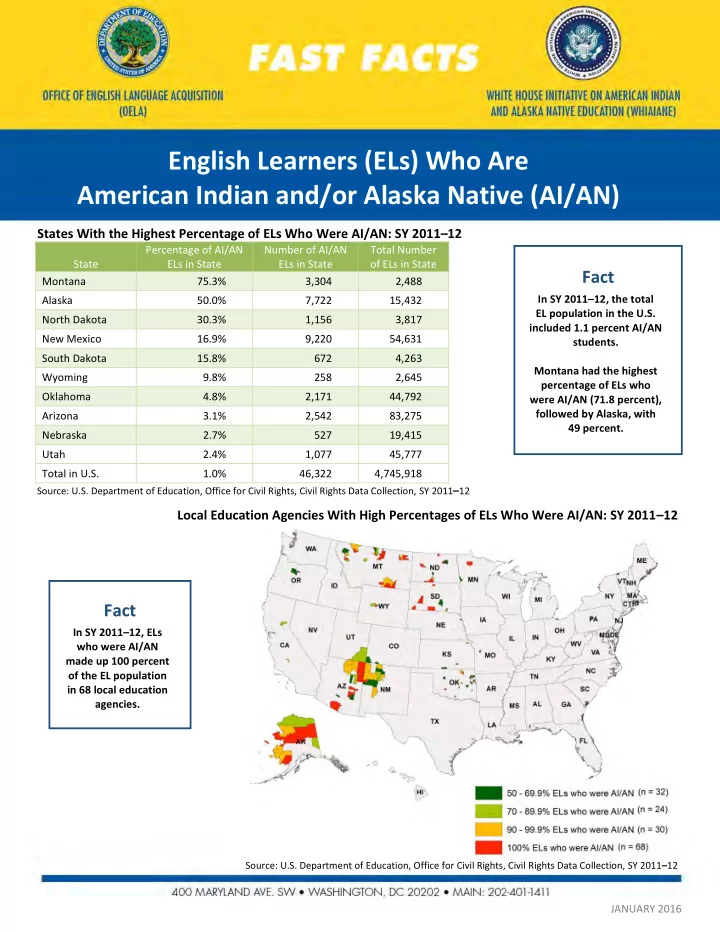
English Learners (ELs) Who Are American Indian and/or Alaska Native (AI/AN) States With the Highest Percentage of ELs Who Were AI/AN: SY 2011 12 Percentage of AI/AN Number of AI/AN Total Number State ELs in State ELs in State of ELs in


slide-1
SLIDE 1

English Learners (ELs) Who Are American Indian and/or Alaska Native (AI/AN)

JANUARY 2016

States With the Highest Percentage of ELs Who Were AI/AN: SY 2011–12

State Percentage of AI/AN ELs in State Number of AI/AN ELs in State Total Number

  • f ELs in State

Montana 75.3% 3,304 2,488 Alaska 50.0% 7,722 15,432 North Dakota 30.3% 1,156 3,817 New Mexico 16.9% 9,220 54,631 South Dakota 15.8% 672 4,263 Wyoming 9.8% 258 2,645 Oklahoma 4.8% 2,171 44,792 Arizona 3.1% 2,542 83,275 Nebraska 2.7% 527 19,415 Utah 2.4% 1,077 45,777 Total in U.S. 1.0% 46,322 4,745,918

Source: U.S. Department of Education, Office for Civil Rights, Civil Rights Data Collection, SY 2011–12

Local Education Agencies With High Percentages of ELs Who Were AI/AN: SY 2011–12

Source: U.S. Department of Education, Office for Civil Rights, Civil Rights Data Collection, SY 2011–12

Fact

In SY 2011–12, the total EL population in the U.S. included 1.1 percent AI/AN students. Montana had the highest percentage of ELs who were AI/AN (71.8 percent), followed by Alaska, with 49 percent.

Fact

In SY 2011–12, ELs who were AI/AN made up 100 percent

  • f the EL population

in 68 local education agencies.

slide-2
SLIDE 2

JANUARY 2016

AI/AN Languages Spoken by ELs as Reported by Seven States: SY 2013–14

Note: Alaska, Arizona, Montana, New Mexico, Oklahoma, South Dakota, and Utah reported AI/AN languages among the top five most commonly spoken languages for ELs, other than English. Montana reported “North American Indian” as one of the languages. Source: EDFacts/Consolidated State Performance Report, SY 2013–14

National Assessment of Educational Progress* Proficiency Level Distributions for ELs Who Are AI/AN: 2011, 2013, and 2015

* Also known as the Nation’s Report Card, NAEP is the largest nationally representative assessment of what students know about mathematics, reading, science, writing, the arts, civics, economics, geography, U.S. history, and technology and engineering literacy. Sources: U.S. Department of Education, Institute of Education Sciences, National Center for Education Statistics, National Assessment of Educational Progress (NAEP), 2011, 2013, and 2015 Reading and Mathematics Assessments. For more information, visit http://www.nationsreportcard.gov/. 91 368 497 911 1,376 6,629 8,914

2,000 4,000 6,000 8,000 10,000

North American Indian Siouian Languages Zuni Cherokee Inupiaq Yupik Navajo Number of EL Speakers 75 82 87 21 14 10 3 3 2 1 1

0% 10% 20% 30% 40% 50% 60% 70% 80% 90% 100%

2015 2013 2011

Fourth-Grade Reading Below Basic At Basic At Proficient At Advanced

54 67 67 38 29 29 8 4 4

0% 10% 20% 30% 40% 50% 60% 70% 80% 90% 100%

2015 2013 2011

Fourth-Grade Mathematics

Fact

ELs who were AI/AN scored higher in fourth-grade reading and mathematics in 2015 than in 2011

  • n the NAEP assessments.

Fact

In SY 2013–14, the seven AI/AN languages spoken by ELs, as reported by seven states, were Navajo, Yupik, Inupiaq, Cherokee, Zuni, Siouan languages, and North American Indian.

slide-3
SLIDE 3

English Learners (ELs) Who Are Asian or Pacific Islander

JANUARY 2016

Top 10 Asian and Pacific Islander Languages Spoken Among ELs: SY 2013–14

Note: “Chinese” includes Cantonese and Mandarin dialects. Source: Consolidated State Performance Report, SY 2013–14.

Numbers of Reported EL Speakers of Top Asian or Pacific Islander Languages: SY 2006–07 through 2013–14

Note: Figures reflect the combined number of speakers of a language in states where that language was one of the state’s five most common EL languages. “Chinese” includes Cantonese and Mandarin dialects. Source: Consolidated State Performance Reports, SYs 2006-07 through 2013-14. 99,943 80,283 26,136 23,473 9,371 8,438 5,195 5,011 4,327 3,633 20,000 40,000 60,000 80,000 100,000 120,000

Number of EL Speakers

33,788 39,566 65,337 68,743 68,563 88,798 95,486 99,943 85,683 85,645 82,233 85,252 76,857 79,021 82,682 80,283 54,416 51,536 49,451 46,311 41,480 40,445 24,295 23,473 29,040 30,890 30,937 29,805 21,089 24,463 28,633 26,136 20,000 40,000 60,000 80,000 100,000 120,000 2006-07 2007-08 2008-09 2009-10 2010-11 2011-12 2012-13 2013-14

Number of EL Speakers School year Chinese Vietnamese Hmong Tagalog/Filipino

Fact

Since SY 2006–07, the number of ELs speaking Chinese increased by over 65,000 speakers.

Fact

In SY 2013–14, states reported that 99,943 ELs spoke Chinese, the most common Asian or Pacific Islander language. Vietnamese was the second most common language spoken by ELs who are Asian or Pacific Islander.

slide-4
SLIDE 4

JANUARY 2016

Ten States With the Highest Number of ELs Who Are Asian and Pacific Islander

State Number of ELs Who Are Asian or Pacific Islander (Combined) Number of ELs Who Are Asian Number of ELs Who Are Native Hawaiian or Other Pacific Islander Total ELs in State Percentage of ELs Who Are Asian or Pacific Islander California 175,861 167,989 7,872 1,473,244 11.9% Texas 45,819 45,058 761 841,285 5.4% New York 43,934 43,155 779 213,279 20.6% Minnesota 21,775 21,682 93 64,840 33.6% Virginia 20,133 19,994 139 105,153 19.1% Hawaii 16,510 10,221 6,289 19,551 84.4% Illinois 15,316 15,072 244 187,056 8.2% Washington 15,172 13,266 1,906 93,734 16.2% Wisconsin 13,022 12,915 107 49,976 26.1% Massachusetts 12,351 12,259 92 72,547 17.0% Total in the U.S. 551,905 523,268 28,637 4,745,918 11.6%

Source: U.S. Department of Education, Office for Civil Rights, Civil Rights Data Collection, 2011–12.

Fifteen Local Education Agencies (LEAs) With the Highest Number of ELs Who Are Asian and Pacific Islander

LEA State Number of ELs Who Are Asian or Pacific Islander (Combined) Number of ELs Who Are Asian Number of ELs Who Are Native Hawaiian or Other Pacific Islander Total ELs in LEA Percentage

  • f ELs Who

Are Asian or Pacific Islander New York City Public Schools NY 33,851 32,937 914 147,198 23.0% Hawaii Department Of Education HI 16,613 10,263 6,350 19,978 83.2%

  • St. Paul Public School District

MN 9,097 9,079 18 14,402 63.2% Fairfax County Public Schools VA 9,009 8,953 56 37,519 24.0% San Francisco Unified CA 7,482 7,359 123 14,693 50.9% Fremont Unified CA 7,027 6,963 64 10,576 66.4% Los Angeles Unified CA 6,853 6,551 302 168,850 4.1% San Diego Unified CA 6,115 5,943 172 36,929 16.6% Elk Grove Unified CA 5,729 5,350 379 11,475 49.9% Sacramento City Unified CA 5,589 5,196 393 14,399 38.8% Clark County School District NV 3,934 3,631 303 55,348 7.1% Montgomery County Public Schools MD 3,868 3,834 34 22,519 17.2% Garden Grove Unified CA 3,854 3,766 88 20,959 18.4% Alhambra Unified CA 3,774 3,766 8 5,679 66.5% City Of Chicago SD 299 IL 3,706 3,568 138 64,551 5.7%

Source: U.S. Department of Education, Office for Civil Rights, Civil Rights Data Collection, 2011–12.

slide-5
SLIDE 5

Languages Spoken by English Learners (ELs)

OCTOBER 2015

Twenty Most Common EL Languages, as Reported in States’ Top Five Lists: SY 2013-14 Languages Reported Number of EL Speakers 1. Spanish 3,770,816 2. Arabic 100,461 3. Chinese 99,943 4. Vietnamese 80,283 5. Haitian/Haitian Creole 35,467 6. Somali 25,278 7. Tagalog 24,370 8. Hmong 23,473 9. Portuguese 10,102

  • 10. Bengali

9,371

  • 11. Russian

9,111

  • 12. Navajo

8,914

  • 13. Urdu

8,438

  • 14. Yupik languages

6,629

  • 15. Polish

5,347

  • 16. Karen languages

5,195

  • 17. Korean

5,011

  • 18. Marshallese

4,327

  • 19. Creoles and pidgins, Portuguese-based (Other)

3,893

  • 20. Nepali

3,633

Note: Figures reflect the combined number of reported speakers of a language in states where that language was one of the state’s five most common EL languages. This list includes only those languages for which specified data were listed. “Undetermined” and “not applicable” languages were not included in the list above. Source: U.S. Department of Education, Consolidated State Performance Reports, SY 2013-14.

Fact

States annually report the five most common languages spoken by ELs and the number of ELs who speak each

  • f those languages. Approximately 50 languages appear in one or more states’ top five lists. In SY 2013-14, the

most common languages included Spanish, Arabic, Chinese, Vietnamese, and Haitian/Haitian Creole.

slide-6
SLIDE 6

OCTOBER 2015

States, Including D.C., With 80 Percent or More Spanish-Speaking ELs: SY 2013-14

Source: U.S. Department of Education, Consolidated State Performance Reports, SY 2013-14.

Number of Spanish-Speaking ELs, by State, Including D.C.: SY 2013-14

Source: U.S. Department of Education, Consolidated State Performance Reports, SY 2013-14.

Fact

Nine states and the District of Columbia reported that 80 percent or more

  • f ELs in the

state spoke Spanish in SY 2013-14.

Fact

In SY 2013-14, Spanish-speaking ELs were concentrated in 11 states. Five of these states— California, Texas, Florida, New York, and Illinois—also reported the highest numbers of ELs

  • verall.
slide-7
SLIDE 7

Black Students Eligible for Free or Reduced‐Price Lunch (FRPL): 2013

70.0% 60.0% 50.0% 40.0% 30.0% 20.0% 10.0% 0.0% 58.5% Black EL Students Black English Proficient Students Percentage of Students Eligible for FRPL 62.2%

Fact

Sixty two percent

  • f EL students

who are Black are eligible for FRPL, compared with 59 percent of English proficient students who are Black. Note: The percentage of students eligible for free or reduced‐price lunch (FRPL) under the National School Lunch Program provides a proxy measure for the concentration of low‐income students within a school. Children from families with incomes at or below 130 percent of the poverty level are eligible for free meals. Those from families with incomes that are between 130 percent and 185 percent of the poverty level are eligible for reduced‐price meals. (http://www.fns.usda.gov/sites/default/files/NSLPFactSheet.pdf)

Immigration Status

  • f

Black Students: 2013

‐ ‐

100%

Not elsewhere classified

90% 80% 70%

Third generation or higher (U.S. born living with at

60%

least one U.S. born parent)

50%

Second generation

40%

(U.S. born living with at

30%

least one foreign‐born parent)

20%

First generation

10%

(Foreign born)

0% Black EL Students Black English Proficient Students 31.3% 1.9% 32.0% 10.0% 23.3% 73.2% 13.3% 14.9%

Fact

Thirty one percent of EL students who are Black are first generation immigrants. Source: U.S. Census Bureau, American Community Survey, 2013. Estimates are generated by NCELA using Census DataFerrett

Educational Attainment of Mothers of Black Students: 2013

No Schooling Completed Nursery School Through Grade 8 Some High School but No Diploma High School Graduate

7.5% 13.3% 11.7% 9.2% 1.1% .6% 5.5% 15.7% 8.1% 39.4% 11.5% 14.2% 5.6% 56.5%

Associate Degree Bachelor's Degree Graduate Degree 0.0% 10.0% 20.0% 30.0% 40.0% 50.0% 60.0%

Mothers of Black EL Students Mothers of Black English Proficient Students

400 MARYLAND AVE. SW • WASHINGTON, DC 20202 • MAIN: 202-401-1411 400 MARYLAND AVE. SW • WASHINGTON, DC 20202 • MAIN: 202-401-1411
Fact

Approximately 20 percent more mothers of English proficient students who are Black have a high school degree or higher than mothers of EL students who are Black. Source: U.S. Census Bureau, American Community Survey, 2013. Estimates are generated by NCELA using Census DataFerret

English Learner (EL) Students Who Are Black

According to the Elementary and Secondary Education Act (ESEA) section 9101(25), an EL (or “limited English proficient” child, per the ESEA) is “an individual (A) who is aged 3 through 21; (B) who is enrolled or preparing to enroll in an elementary school or secondary school; (C)(i) who was not born in the United States or whose native language is a language other than English; (ii)(I) who is a Native American or Alaska Native, or a native resident of the outlying areas; and (II) who comes from an environment where a language other than English has had a significant impact on the individual s level of English language proficiency; or (iii) who is migratory, whose native language is a language other than English, and who comes from an environment where a language other than English is dominant; and (D) whose difficulties in speaking, reading, writing, or understanding the English language may be sufficient to deny the individual (i) the ability to meet the State’s proficient level of achievement on State assessments described in section 1111(b)(3) [of the ESEA]; (ii) the ability to successfully achieve in classrooms where the language of instruction is English; or (iii) the opportunity to participate fully in society.”

States, Including D.C., With the Highest Concentration of ELs Who Are Black

State Percentage of ELs Who Are Black Total Number of ELs Who Are Black Total Number

  • f ELs
  • 1. Maine

48.6% 2,547 5,240

  • 2. Vermont

27.1% 497 1,835

  • 3. Mississippi

25.9% 2,700 10,431

  • 4. South Dakota

21.4% 967 4,511

  • 5. North Dakota

21.3% 862 4,047

  • 6. Minnesota

19.9% 13,220 66,296

  • 7. Ohio

18.0% 7,330 40,829

  • 8. Washington, D.C.

15.7% 952 6,063

  • 9. Massachusetts

14.5% 10,838 74,703

  • 10. New Hampshire

14.0% 808 5,769 Total in Top 10 States 18.5% 40,721 219,724 Total in All States 3.7% 180,467 4,834,433

Fact

Maine has the highest concentration of ELs who are Black enrolled in public schools (48.6 percent).

States, Including D.C., With the Largest Number of ELs Who Are Black

State Total Number of ELs Who Are Black Total Number of ELs Percentage of ELs Who Are Black

  • 1. Florida

33,742 248,697 13.6%

  • 2. New York

14,595 218,181 6.7%

  • 3. Minnesota

13,220 66,296 19.9%

  • 4. Massachusetts

10,838 74,703 14.5%

  • 5. Texas

10,749 848,875 1.3%

  • 6. California

8,629 1,485,222 0.6%

  • 7. Virginia

7,956 107,426 7.4%

  • 8. Ohio

7,330 40,829 18.0%

  • 9. Maryland

6,751 55,617 12.1%

  • 10. Washington

5,042 96,241 5.2% Total in Top 10 States 118,852 3,242,087 3.7% Total in All States 180,467 4,834,433 3.7%

Fact

Florida has the largest number of ELs who are Black enrolled in public schools. Source: U.S. Department of Education, Office for Civil Rights, Civil Rights Data Collection, 2011 – 12

400 MARYLAND AVE. SW • WASHINGTON, DC 20202 • MAIN: 202-401-1411

slide-8
SLIDE 8

Fact

Twenty five LEAs in the United States enroll 11.6 percent

  • f all ELs who are Black in public schools.

Local Education Agencies (LEAs) With the Largest Number of ELs Who Are Black

LEA State Total Number

  • f

ELs Who Are Black Total Number

  • f

ELs Percentage

  • f

ELs Who Are Black 1. New York City Public Schools NY 9,102 147,198 6.0% 2. Broward County Public Schools FL 8,104 25,311 32.0% 3. Dade County Public Schools FL 6,772 70,691 10.0% 4. School District

  • f

Palm Beach County FL 6,129 19,021 32.0% 5. Orange County Public Schools FL 5,082 27,830 18.0% 6. Boston Public Schools MA 3,941 19,157 21.0% 7. Fairfax County Public Schools VA 3,224 37,519 9.0% 8. Montgomery County Public Schools MD 3,090 22,519 14.0% 9. Leflore County School District MS 2,598 2,720 96.0% 10. Brockton Public Schools MA 2,361 3,274 72.0% 11. Columbus City School District OH 2,213 5,261 42.0% 12. Prince George's Schools County Public MD 1,994 16,341 12.0% 13. Seattle Public Schools WA 1,853 6,220 30.0% 14. San Diego Unified School District CA 1,807 36,929 5.0%

  • 15. Minneapolis

Public School District MN 1,751 7,390 24.0% 16. St. Paul Public School District MN 1,751 14,402 12.0% 17. Dekalb County School District GA 1,423 9,845 14.0% 18. Philadelphia City School District PA 1,352 12,241 11.0% 19. Denver Public Schools CO 1,314 27,558 5.0% 20. Prince William Schools County Public VA 1,284 18,144 7.0% 21. Jefferson County Schools KY 1,271 5,769 22.0% 22. Collier County Public Schools FL 1,249 6,169 20.0% 23. Portland Public Schools ME 1,136 1,758 65.0% 24. Hillsborough County Public Schools FL 1,128 23,696 5.0% 25. Houston District Independent School TX 1,114 60,924 2.0% Total in Top 25 LEAs 73,043 627,887 11.6% Total in all U.S. LEAs 180,467 4,834,433 3.7% ‐ ‐ ‐ Source: U.S. Department of Education, Office for Civil Rights, Civil Rights Data Collection, 2011 – 12

The data in the following tables and charts are from the 2013 American Community Survey (ACS) and apply the following definitions:  An “English learner” student  An “English proficient” student

  • is ages 5 to 18,
  • is ages 5 to 18,
  • attends school,
  • attends school,
  • lives in a home where English is not the

primary language spoken, and

  • lives in a home where English is spoken, or
  • reports speaking English “well,” “not

very well,” or “not at all.”

  • reports speaking English “very well.”

 The 2013 ACS defines individuals who are Black as those whose racial self‐identification included “Black, African‐American, negro, or mulatto, regardless of what additional race(s) the person reported, if any.” These individuals can be “Black alone or in combination” with other races, regardless of Hispanic origin. These definitions represent the respondent’s perceptions of his or her own English‐speaking ability (Gambino, et al., 2014). The definitions may not correspond with those used by state education agencies and local education agencies for reporting purposes.

Top 15 Languages Spoken At Home by EL Students Who Are Black: 2013

Language Number of Speakers Percentage Spanish 53,924 40.0% French Creole 24,445 18.1% French 10,175 7.5% Cushite 9,591 7.1% Kru, Ibo, Yoruba 8,332 6.2% Bantu 3,995 3.0% Amharic 3,756 2.8% Swahili 3,221 2.4% German 2,990 2.2% Portuguese 2,087 1.5% Fulani 2,070 1.5% Vietnamese 1,860 1.4% Arabic 1,467 1.1% Other specified African languages 1,180 0.9% Japanese 931 0.7%

Note: Data are for both ELs born in the US and those born in another country.

Fact

Forty percent of EL students who are Black speak Spanish at home. Approximately 18 percent of EL students who are Black speak French Creole at home.

Top 15 Birthplaces of Foreign‐Born EL Students Who Are Black: 2013

Fact

Over a quarter (26 percent)

  • f foreign

born EL students who are Black were born in Haiti.

Country Number

  • f ELs

Percentage Haiti 13,241 26.0% Dominican Republic 4,815 9.5% Kenya 3,489 6.9% Ethiopia 2,671 5.3% Africa, not specified 2,459 4.8% Somalia 2,074 4.1% Mexico 2,032 4.0% Congo 1,712 3.4% Tanzania 1,505 3.0% Western Africa, not specified 1,312 2.6% Togo 1,169 2.3% Ghana 1,133 2.2% El Salvador 1,057 2.1% Nigeria 1,019 2.0% Democratic Republic of Congo (Zaire) 973 1.9%

Source: U.S. Census Bureau, American Community Survey, 2013. Estimates generated by NCELA using Census DataFerrett

Percentage of EL Students Who Are Black, by State, Including DC: 2013

Fact

Eleven to 20 percent of the EL student population in New York and Florida are Black. Note: Data are for both ELs born in the US and born in another country.

Fact

Eighteen percent of foreign born Black students are ELs, compared with nearly 1 percent of those who were born in the U.S.

Percentage of EL Students Who Are Black, by Birthplace: 2013

18% 82%

Percentage of Foreign‐Born Black Students Who Are EL

1% 99%

Percentage of US‐Born Black Students Who Are EL Source: U.S. Census Bureau, American Community Survey, 2013. Estimates generated by NCELA using Census DataFerrett References cited: Gambino, Christine P., Yesenia D. Acosta, and Elizabeth M. Grieco. English‐ Speaking Ability of the Foreign‐Born Population in the United States: 2012. American Community Survey Reports, ACS‐26. U.S. Census Bureau, Washington, DC. 2014

400 MARYLAND AVE. SW • WASHINGTON, DC 20202 • MAIN: 202-401-1411 400 MARYLAND AVE. SW • WASHINGTON, DC 20202 • MAIN: 202-401-1411 400 MARYLAND AVE. SW • WASHINGTON, DC 20202 • MAIN: 202-401-1411