SLIDE 1 1
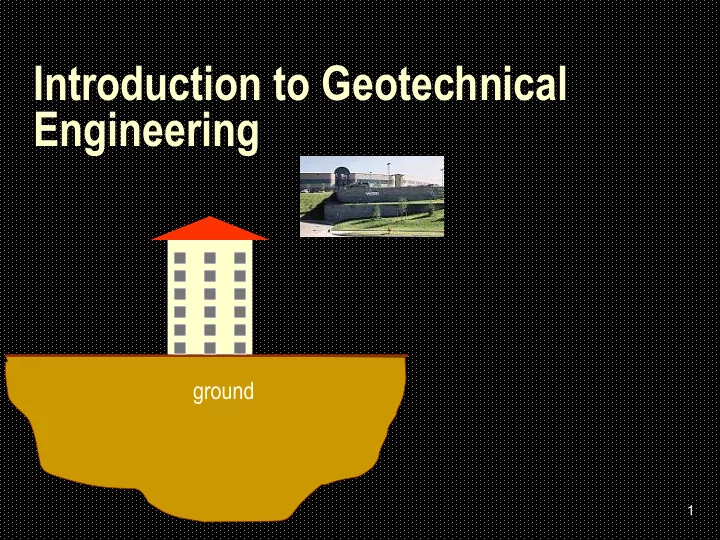
Introduction to Geotechnical Engineering
ground
SLIDE 2 2
Typical Geotechnical Project
construction site Geo-Laboratory ~ for testing Design Office ~ for design & analysis soil properties
SLIDE 3
SLIDE 4 4
bed rock firm ground
Shallow Foundations
~ for transferring building loads to underlying ground ~ mostly for firm soils or light loads
SLIDE 5
Shallow Foundations
SLIDE 6 6
bed rock weak soil
Deep Foundations
P I L E
~ for transferring building loads to underlying ground ~ mostly for weak soils or heavy loads
SLIDE 7 7
Deep Foundations
Driven timber piles, Pacific Highway
SLIDE 8 8
Pier Foundations for Bridges
Cable-stayed bridge Supported on 7 piers, 342 m apart Longest pier (336) in the world
Millau Viaduct in France (2005)
SLIDE 9 9
Pier Foundations for Bridges
Millau Viaduct in France (2005)
SLIDE 10 10
Retaining Walls
~ for retaining soils from spreading laterally
Road Train
retaining wall
SLIDE 11 11
Earth Dams
~ for impounding water
soil reservoir clay core shell
SLIDE 12 12
Concrete Dams
reservoir soil concrete dam
SLIDE 13 13
Concrete Dams
Three Gorges Dam, Hong Kong
SLIDE 14 14
Concrete Dams
SLIDE 15 15
Earthworks
Roadwork, Pacific Highway
~ preparing the ground prior to construction
SLIDE 16 16
Geofabrics
~ used for reinforcement, separation, filtration and drainage in roads, retaining walls, embankments…
Geofabrics used on Pacific Highway
SLIDE 17 17
Reinforced Earth Walls
~ using geofabrics to strengthen the soil
SLIDE 18 18
Tunneling
Chile (2006) MSE (Mechanically stabilized Earth) wall
SLIDE 20 20
Retaining Walls
Rock anchors to support the vertical walls
SLIDE 21 21
Sheet Piles
~ sheets of interlocking-steel or timber driven into the ground, forming a continuous sheet
ship
warehouse
sheet pile
SLIDE 22 22
Sheet Piles
~ resist lateral earth pressures ~ used in excavations, waterfront structures, ..
SLIDE 23 23
Sheet Piles
~ used in temporary works
SLIDE 24 24
Cofferdam
~ sheet pile walls enclosing an area, to prevent water seeping in
SLIDE 25 25
Cofferdam
~ sheet pile walls enclosing an area, to prevent water seeping in
SLIDE 27 27
Shoring
propping and supporting the exposed walls to resist lateral earth pressures
SLIDE 28 28
Excavations
Chile (2006)
SLIDE 29 29
Earthquake Engineering
Loma Preita Earthquake, San Francisco (1989)
SLIDE 30 30
Ground Improvement
Impact Roller to Compact the Ground
SLIDE 31 31
Ground Improvement
Big weights dropped from 25 m, compacting the ground. Craters formed in compaction
SLIDE 32 32
Environmental Geomechanics
Waste Disposal in Landfills
SLIDE 33 33
Instrumentation
~ to monitor the performances of earth and earth supported structures ~ to measure loads, pressures, deformations, strains,…
SLIDE 34 Soil Testing
More Field Tests Standard Penetration Test Vane Shear Test
SLIDE 35 35
Soil Testing
Triaxial Test on Soil Sample in Laboratory
SLIDE 36 36
Some Civil Engineering marvels ….
… buried right under your feet.
foundations soil exploration tunneling
SLIDE 37 37
Sea wall in Brisbane (2005)
Courtesy: Coffey Geosciences Pty Ltd.
SLIDE 38
Great Contributors to the Developments in Geotechnical Engineering
SLIDE 39 Karl Terzaghi 1883-1963 C.A.Coulomb 1736-1806
1820-1872
SLIDE 40
Geotechnical Engineering Landmarks
SLIDE 41 41
Leaning Tower of Pisa
Our blunders become monuments!
SLIDE 42 42
Hoover Dam, USA
Tallest (221 m) concrete dam
SLIDE 43 43
Burj Dubai (Khalifa Tower)
the tallest man-made structure ever built, at 818 m (2,684 ft).
SLIDE 44
SLIDE 45 45
Geo-engineering at HU
110401336 Introduction to Geotechnical Engineering 110401338 Geotechnical Engineering Laboratory 110401435 Foundation Engineering and Design
SLIDE 46 Course Description
- Index properties of soils, soil classification, soil-
water, one-dimensional and two dimensional flow, soil stresses, compaction, distribution of soil stresses due to surface loads, consolidation theory and effect of construction period, shear strength of soils and shear strength tests, stability
SLIDE 47 Course Objectives
- 1. To know and understand the formation and
mineralogy of soils especially the clay minerals
- 2. To understand the classification and index
properties of soils and the importance of soil classification on defining and integrating the engineering properties of soils, which in tern affect the engineering purpose
- 3. To know and understand the mechanical
stabilization of soil (compaction)
- 4. To evaluate soil stresses due to the weight of
- verburden soil and external stresses. Stress
evaluation is very important for soil shear strength and settlement calculations
SLIDE 48 Course Objectives
- 5. To understand the mechanism of water flow through the
soil mass and the effect of this flow on soil effective stresses.
- 6. To understand consolidation (compression), rate of
consolidation, and settlement of soils under the change in soil stresses.
- 7. To understand and evaluate the soil shear strength which
is a very important aspect in geotechnical engineering. Soil shear strength is very important in evaluating foundation bearing capacity, slope stability, earth retaining wall design, pavement design, and so on.
- 8. To understand and evaluate the slope stability problems.
Slopes could be natural, sloped formed by excavation, embankment slopes, and earth dam slopes.
SLIDE 49
Course Outline
(weeks-1&2) Introduction to Geotechnical Engineering Formation of Soils and Mineralogy of Soil Solids as Geotechnical Materials
Formation of Soils Soil Profile Mineralogy of Soil Solids Clay Minerals
SLIDE 50 Course Outline
(week-3&part of week-4) Index Properties and Classification of Soils
Basic Definitions and Phase Relations Solution of Phase Problems Role of Classification System in Geotechnical Engineering Soil Texture, Grain Size, and Grain Size Distribution Atterberg Limits and Consistency Indices Unified Soil Classification System
(Rest of week-4) Soil Compaction
Compaction Theory of Compaction Density-Water content (Compaction Curve) of Soils Field Compaction Control and Specification Relative Density of Cohesionless Soils
SLIDE 51 Course Outline
Stress(week-5) Soil Effective Stresses Effective Vertical Stress Capillarity and Stresses in Capillarity Zone Response of Effective Stress to a Change in Total Stress Relationship between Horizontal and Vertical (Weeks-6&7) Water in Soils (Permeability, Seepage, and Effective Stresses) Introduction Darcy’s Law for Flow Bernoulli Energy Equation for Steady Flow Total, Pressure, and Elevation Heads One Dimensional Flow and Measurement of Permeability Factors Affect the Permeability Permeability in Multi-layer Soil Profile Seepage Forces, Quicksand, and Liquifaction Seepage and Flow nets (Two-Dimensional Flow
SLIDE 52 Course Outline
(week-8) Stress Distribution in Soils Due to External Loading Point Loading Line Loading Uniform loading Distributed over Rectangular and Circular Areas Strip Loading (Weeks-9&10 and part of week-11) Soil Consolidation, Consolidation Settlement, and Rate of
Consolidation
Components of Settlements The Oedometer and Consolidation Testing (One-Dim. Cons.) Pre-consolidation Pressure Settlement Calculations Prediction of Field Consolidation Curves Consolidation Process Terzaghi’s One-Dim. Consolidation Theory Evaluation of Secondary Settlement Determination of Immediate Settlement
SLIDE 53 Course Outline
(Rest of week 11 and weeks-12&13) Shear Strength of Soils
Shearing Resistance
Granular Soils (Cohesionless Soils) Clay Soils (Cohesive Soils) Shear Strength Failure Mohr’s Theory of Failure Mohr-Coulomb Envelope in Terms of Principal Stress Drained Versus Undrained Shear Strength Measurement of Shear Strength in Laboratory (Triaxial Tests)
- CD-Tests
- CU-Tests
- UU-Tests
Shear Strength of Cohesionless (Granular Soils) Shear Induced Pore Water Pressures Stress Paths Soil Sensitivity
SLIDE 54
Course Outline
(week-14) Stability of Slopes
Type of slope failure Analysis of a plane translational slip Analysis of rotational, circular slips The method of slices
SLIDE 55 Course Outline
Course Requirements
- 1. Attending the lectures (no make up between lectures)
- 2. Late coming to lectures (-3 minute from start consider absentee)
- 3. Exams
- 4. No make up exams will be provided
Grade distribution
30.%
30%
40%
SLIDE 56
Office Hours
No office hours in the exams’ day
posted on office door
SLIDE 57 Dates of Exams
Dates of Exams:
- First exam: Thursday 29/10/2015
- Second Exam: Thursday 10/12/2015
- Final Exam: will be determined by the registrar
No make up exams whatsoever (Absent =0.0)
SLIDE 58
Text book
Text book
Graig, R. F., “ Soil Mechanics”, (7th edition) Spon
Press References
Budhu” Soil Mechanics and foundation”, John Wiley
(for slope stability part)
Terzaghi, Peck, and Mesri, " Soil Mechanics in
Engineering Practice", John Wiley
Holtz, R. D., and Kovacs W. D., ”An Introduction to
Geotechnical Engineering”, Prentice-Hall
SLIDE 59 Textbook(s):
You can download free book from here
http://eng4ever.en.funpic.de/civil.html
59
SLIDE 60 60
Recipe for Success
I like soils… I like soils….I like soils….
SLIDE 61 Civil Engineering challenges
61