
SLIDE 1
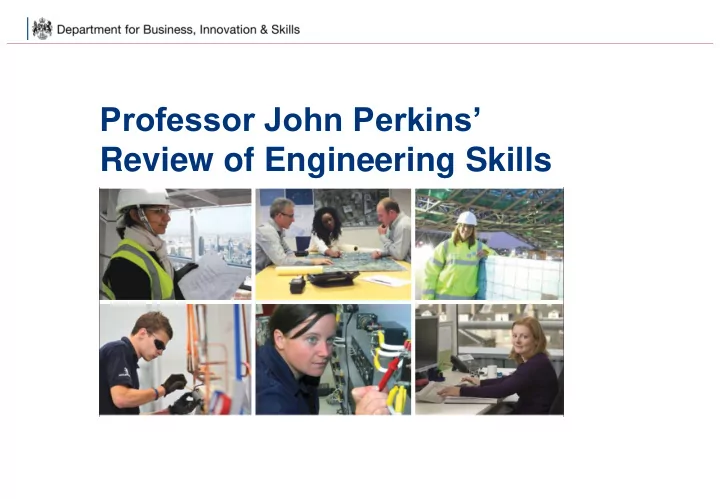
Review of Engineering Skills The challenge Engineering is pervasive - - PowerPoint PPT Presentation
Professor John Perkins Review of Engineering Skills The challenge Engineering is pervasive engineering drives technological progress engineering skills are in demand throughout the economy It would benefit the economy to substantially
The challenge
Engineering is pervasive …engineering drives technological progress …engineering skills are in demand throughout the economy It would benefit the economy to substantially increase the supply of engineers entering the labour market
by Government, the profession and industry across the engineering “supply system”
“It is time for concerted action by the profession, industry and Government, to achieve the goals for engineering which we all share.”
engineering skills in areas of shortage Immediate impact
for nationwide roll out Inspiration
Higher Education
plus High Speed Rail, Nuclear, … Vocational Education
Which career would parents most like their child to pursue?
The Engineering Profession
FEANI, SEFI 36 Engineering Institutions (IET, IMechE, ICE…) Engineering Council, Engineering UK Design and Technology Assoc (DATA) UKRC / WISE Assoc of Science Educators (ASE) NAACE (ICT subject assoc) National STEM Centre Science Learning Centres (regional) STEMNET Education and Employers Taskforce Royal Society Royal Soc Chemistry Soc of Biology Inst of Physics Science Council Gatsby Foundation Wellcome Trust Nuffield Foundation OFQUAL OFSTED Sector Skills Councils (SEMTA, COGENT, E-Skills…) Non licenced engineering institutions (IMI…)
DFE BIS
National Careers Service National Apprenticeship Service EBPs E4E ACME SCORE CASE NCUB UKCES
EMPLOYERS
SCHOOLS Higher Education CODING CLUBS NESTA Royal Institution Others… e.g Royal Astronomical, Royal Geological, etc. NextGen.Skills Computing at School EDT Smallpeice Young Engineers Primary Engineer Bloodhound STEM Directories Tomorrow’s Engineers TDA / TA AQA Edexcel OCR WJEC EAL City and Guilds BITC Sutton Trust Salters Institute AFBE - UK Generating Genius WES NCETM LMS JMC MEI IMA and others Big Bang Fair CBI EEF HEFCE / HEFCW ETF AoC UUK
STEM EDUCATION STAKEHOLDER MAP
This is an indicative landscape. rhys.morgan@raeng.org.uk (May 2014)
SSAT Baker-Dearing FE & Skills
Mathematics community Diversity organisations STEM Activities Education institutions STEM teacher support Prominent STEM funders Science community STEM policy bodies HE, FE & skills 5-19 education Awarding bodies
ERA Foundation 1851 Commission Arkwright Reece Foundation Industrial Cadets UKforCE Teach First Teaching Leaders Lloyds Register Others National Space Academy Ogden Trust Techniquest Science Museum
Science Discovery Centres
Royal Observatory Livery Companies EPC
Royal Academy of Engineering
highlight school engagement
activity
schools
are hard-to-reach
all stakeholders
7
Base: Children (1007 ) Base: Parents (1007 )
% female “Engineering Professionals” in EU countries
Your Life
A new government campaign to boost the numbers of young people, especially women, studying mathematics and physics was launched on 7 May by the Chancellor, George Osborne at the Science Museum. Your Life includes:
female participation in technology, engineering and physical science
number of girls choosing maths and physics A levels and to change young people’s perceptions of maths and science
schools and spread subject expertise. Thirteen companies so far have signed up including Barclays, Tata Consulting, Nationwide, BAE and GlaxoSmithKline
Over the last year, Government has worked in partnership with the engineering community Task and finish groups have facilitated concerted action between employers and educators to boost engineering skills supply across schools, colleges and universities Progress report written in partnership with the engineering community demonstrates the impact of collaborative action Going forward: we need to sustain partnerships &
its commitment to collaborate with industry and Government to undertake the long term work needed
Task and Finish Groups
Increasing employer engagement and impact with the education system
For more information contact Claire Donovan: claire.donovan@raeng.org.uk 12
Supply-side solutions designed to
Building demand by making the career more appealing
Public affairs: to lobby for structural change e.g. funding for career switchers; incentives to delay retirement Industry: Target talent not qualification; create more pathways including apprenticeships Advertising & Branding: Build awareness and appeal PR & Social Create fame and improve the image
engineers Tomorrow’s Engineers Give young people a positive experience
engineering
The challenge
Engineering is pervasive …engineering drives technological progress …engineering skills are in demand throughout the economy It would benefit the economy to substantially increase the supply of engineers entering the labour market
by Government, the profession and industry across the engineering “supply system”
“It is time for concerted action by the profession, industry and Government, to achieve the goals for engineering which we all share.”