6/11/2012 A proposal to address knowledge gaps in sustainability - - PDF document

6 11 2012 a proposal to address knowledge gaps in
SMART_READER_LITE
LIVE PREVIEW

6/11/2012 A proposal to address knowledge gaps in sustainability - - PDF document

6/11/2012 A proposal to address knowledge gaps in sustainability Credit : MPOC A project coordinated by the Royal Society SEARRP What is the SEnSOR Programme? The S ocially and En vironmentally S ustainabl e O il palm R esearch (SEnSOR) programme:


slide-1
SLIDE 1

6/11/2012 1

A project coordinated by the Royal Society SEARRP

A proposal to address knowledge gaps in sustainability

Credit : MPOC

What is the SEnSOR Programme?

A project coordinated by the Royal Society SEARRP

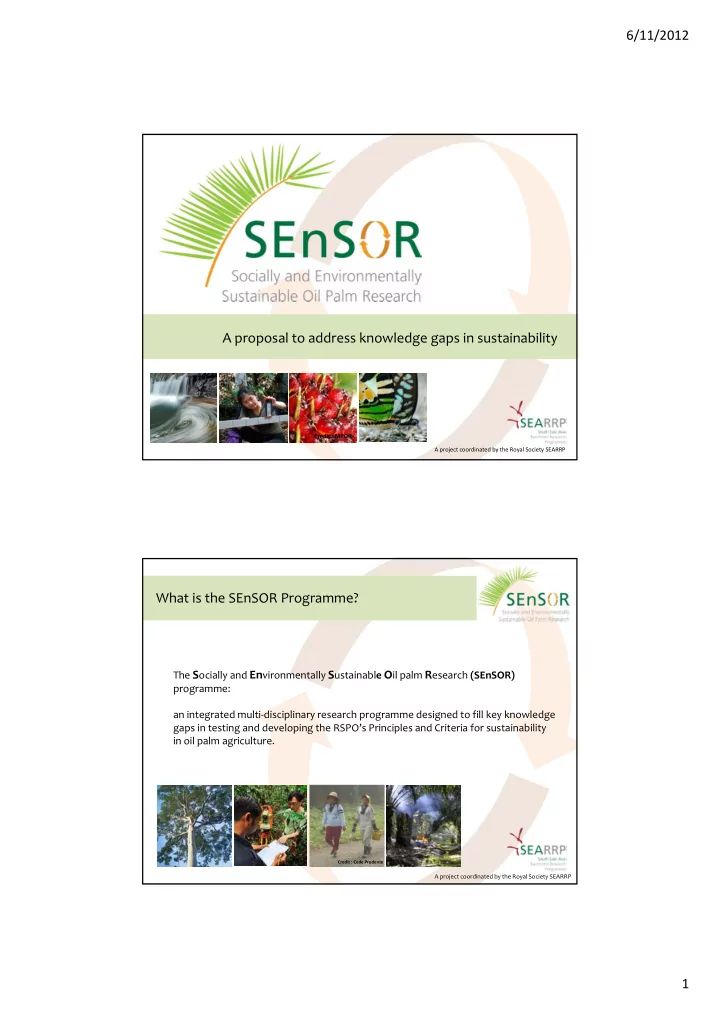
The Socially and Environmentally Sustainable Oil palm Research (SEnSOR) programme: an integrated multi‐disciplinary research programme designed to fill key knowledge gaps in testing and developing the RSPO’s Principles and Criteria for sustainability in oil palm agriculture.

Credit : Cede Prudente

slide-2
SLIDE 2

6/11/2012 2

...developed as a result of a scoping study commissioned by RSPO

A project coordinated by the Royal Society SEARRP

Scientific literature review Reports and policy papers Expert opinion

Why is more scientific research necessary?

A project coordinated by the Royal Society SEARRP

This requires rigorous and independent scientific research, and this research underpins the SEnSOR programme.

  • To develop an evidence‐based approach for testing

the effectiveness of the Principles and Criteria

  • To provide baseline information
  • To continue to advance the development of

sustainable practices.

  • To provide independent assessment of RSPO’s

approach to sustainability.

Credit : MPOC

slide-3
SLIDE 3

6/11/2012 3 Research structure

A project coordinated by the Royal Society SEARRP

Soil and water

A project coordinated by the Royal Society SEARRP

  • Coordinated by Prof Rory Walsh
  • Impacts and improvements of riparian buffers on sedimentation and chemical runoff
  • Effectiveness of existing and new erosion prevention and fertiliser regimes in

minimising negative environmental impacts

  • Economic costs and benefits of erosion and water quality control for smallholders and

large enterprises Research activities: Surveys, manipulation experiments, laboratory analysis and soil core techniques

slide-4
SLIDE 4

6/11/2012 4 Greenhouse gases and air quality

A project coordinated by the Royal Society SEARRP

  • Coordinated by Prof Nick Hewitt
  • Carbon storage capacity in HCVs
  • Impacts of management practices on Nitrogen and methane emissions
  • Quantifying ozone from plantations and costs to yields, human health and

environment Research activities: above and below canopy measurements using state‐of‐the art techniques, computer modelling

Biodiversity

A project coordinated by the Royal Society SEARRP

  • Coordinated by Dr Keith Hamer
  • How to quantify and improve biodiversity levels in HCV‐designed oil palm landscapes
  • Impacts of management practices on plantation biodiversity
  • Costs and benefits of implementing biodiversity‐friendly practices and monitoring

Research activities: biodiversity field surveys, GIS and computer modelling

slide-5
SLIDE 5

6/11/2012 5 Participatory Processes and Rights

A project coordinated by the Royal Society SEARRP

  • Coordinated by Dr Michiel Kohne
  • Ensuring that FPIC and the HCV process are effective in delivering benefits to communities
  • Effectiveness of approaches and incentives for community involvement by plantations
  • Effectiveness and improvement of mechanisms for labour organisation

Research activities: Inventories of current strategies, multi‐stakeholder surveys, in depth case‐studies.

Credit : Cede Prudente Credit : United Plantations Credit : Dr Asril Darussamin, RSPO

Livelihoods

A project coordinated by the Royal Society SEARRP

  • Coordinated by Dr Maja Slingerland and Jolanda van

den Berg

  • Use of natural resources and ecosystem services by smallholders and effectiveness of

HCVs in provision of these

  • Adoption of sustainable agricultural practices by smallholders through social
  • rganisation
  • Impacts of implementing ILO standards for employers, employees and profits

Research activities: participatory education and training approaches, inventory of livelihood strategies, bio‐economic modelling

Credit : Dr Asril Darussamin, RSPO Credit : Dr Asril Darussamin, RSPO
slide-6
SLIDE 6

6/11/2012 6 Integration

A project coordinated by the Royal Society SEARRP

How will the programme run?

  • Five year programme
  • Main sites in Malaysia and Indonesia
  • Capitalising on other ongoing research programmes
  • Capitalising on infrastructure, expertise and

facilities available via the Royal Society SEARRP

A project coordinated by the Royal Society SEARRP

  • Coordinated by the Royal Society’s SE Asia

Rainforest research programme

slide-7
SLIDE 7

6/11/2012 7

How will findings from the SEnSOR programme help stakeholders?

A project coordinated by the Royal Society SEARRP

  • Our findings will underpin confidence in the RSPO approach to sustainability and

provide a credible scientific evidence base.

  • Confidence in RSPO Principles and Criteria by markets and the public will encourage

demand for RSPO certified palm oil, thereby enhancing profits.

  • Findings will highlight which practices are effective and deliver alternative

recommendations where appropriate. This will help growers target resources effectively, and have confidence that compliance with RSPO Principles and Criteria delivers sustainability and produces long term benefits.

  • Palm oil users and investors can be confident that their commitment to RSPO

certified palm oil is fulfilling their obligations to sourcing and investing in sustainable products.

  • Findings from SEnSOR will enable the RSPO and its members to develop the best

methods for ensuring a sustainable palm oil industry, helping to safeguard the natural environment, local communities and society.

Credit : Dr Asril Darussamin, RSPO Credit : Dr Asril Darussamin, RSPO Credit : MPOC

Facilitating impact of SEnSOR findings through knowledge exchange

A project coordinated by the Royal Society SEARRP

We will create maximum impact through effective dissemination

  • f findings…

…so that research outputs can be translated into policy and practice by RSPO, NGOs, stakeholders, and governments. We will involve funders, stakeholders and RSPO at all stages

  • f programme delivery…

…working together to ensure that the programme’s findings are delivered to the most appropriate people and in the most useable way.

slide-8
SLIDE 8

6/11/2012 8

A project coordinated by the Royal Society SEARRP

Exit Strategy

A lasting legacy of established processes and collaboration with and between local institutions and organisations for effective implementation of programme findings and recommendations. This legacy will involve embedding long term monitoring and analysis of standardised information into RSPO Principles and Criteria beyond the timeframe of the SEnSOR programme.

Credit : Dr Asril Darussamin, RSPO

We will build scientific research capacity through local collaborations and graduate studentships in oil palm growing countries and equip key personnel with the knowledge needed to train others into the future.

A project coordinated by the Royal Society SEARRP

Conclusion

SEnSOR will deliver major, evidence‐based gains in sustainability… …and provide a robust, credible foundation for the continued development of RSPO Principles and Criteria. The economic importance and potential environmental and social impacts of palm oil production necessitate rigorous assessment and testing of RSPO guidelines for sustainability‐ this is SEnSOR’s mission. We are now seeking funding for the implementation of the full programme.

slide-9
SLIDE 9

6/11/2012 9

A project coordinated by the Royal Society SEARRP

Thank you for listening

Please come and find us at the SEnSOR exhibition booth