Energy sector overview South Africa Lydie Menouer Oct 2019 Maryll - - PowerPoint PPT Presentation

energy sector overview
SMART_READER_LITE
LIVE PREVIEW

Energy sector overview South Africa Lydie Menouer Oct 2019 Maryll - - PowerPoint PPT Presentation

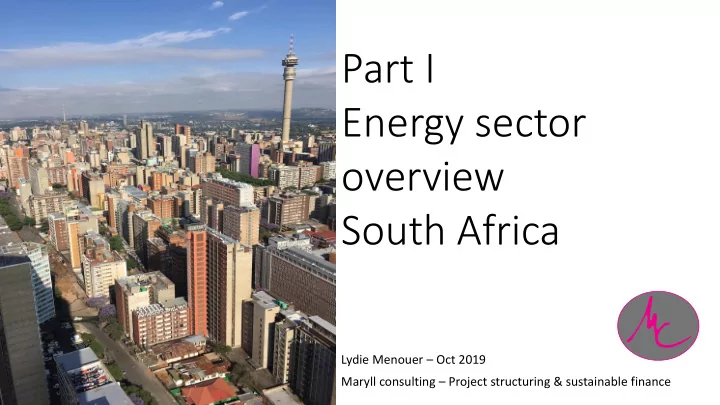
Part I Energy sector overview South Africa Lydie Menouer Oct 2019 Maryll consulting Project structuring & sustainable finance Market size 58 M habitants (65% urban) Middle income country: 2 nd largest economy SSA


slide-1
SLIDE 1

Part I Energy sector

  • verview

South Africa

Lydie Menouer – Oct 2019 Maryll consulting – Project structuring & sustainable finance
slide-2
SLIDE 2

Interesting facts to know before…

  • Market size – 58 M habitants (65% urban)
  • Middle income country: 2nd largest economy SSA –

advanced & diversified economy – Rating BBB-/BB+. Emerging middle class – consumption supported by high debt level.

  • Social – 90/10. high expectation on ‘transformation

agenda’ – need to upskill people

  • Transparency and regulations – consultation

process

  • Very open for FDI - President Cyril Ramaphosa aims

to attract $100 billion in FDI by 2023. Much more confidence than with Jacob Zuma.

  • Europeans - primary partner
slide-3
SLIDE 3

Energy sources – 85% Coal (total of 51 GW cap.)

  • Mainly coal. South Africa is the biggest coal producer

in Africa. coal-fired power generation (for electricity generation) and coal-to liquid (CTL for transport – synthetic fuel – because no crude oil locally sourced)

  • South Africa, integral part of the South African Power

Pool (SAPP) is furthermore trading electricity with Botswana, Lesotho, Mozambique, Namibia Swaziland, Zambia and Zimbabwe.

  • Other fossil fuels. Natural Gas (Mossel bay – game

changer?)

  • Nuclear (Koeberg – lifespan to be expanded)
slide-4
SLIDE 4

Energy’s ownership – Monopoly situation

  • Generates, transmits and distributes electricity to about 5 M

customers in the industrial, mining, commercial, agricultural and residential sectors

  • Eskom holds 90% of the country’s effective/nominal

generation capacity. Remaining generation capacity is held by municipalities (2%) as well as Independent Power Producers that sell power to Eskom (8%).

  • Eskom’s electricity is mostly sold to municipalities (42%) that

further distribute electricity to end-users, followed by industrial consumers (23%) and mining (14%).

slide-5
SLIDE 5

Eskom under fire

  • Due to a massive failure of strategic and financial management over

many years, the utility is burdened with huge debt, inflated operating costs and power plants which, on average, have reached at least 70% of their originally intended lifespan.

  • Governance issue - State capture (vote of no confidence)
  • Since 2007, the cost of power has risen dramatically as Eskom has

struggled to remain profitable and grow its investments in new power capacity, most notably the Medupi and Kusile coal power plants. With an increase in the price of electricity of around 520% over the 15 years from 2004 to 2019, it has far outstripped consumer price inflation of 136%

  • ver the same period.
slide-6
SLIDE 6

load shedding (since 2008)

slide-7
SLIDE 7

Load-shedding impact on Economy

  • Hard to estimate but some experts tried…
  • Cost estimation = 62 M EUR per stage, per day
  • Rating agencies downgrades based on huge ESKOM liquidity risk (systemic

risk – too big to fail)

  • Rescue Plan by The South African Department of Finance - almost 4 billion

USD Total cost of load shedding just for T1 2019 ….

Rands 30 billion (1.8 Bn EUR) in 3 months

slide-8
SLIDE 8

Unbundling of ESKOM has been announced:

  • From too big to fail – rescue plan from NT (Capital/ cash injection)
  • Management of risk more efficient (especially for private sector

funding - reorganization should also crowd in private finance and enable lenders to more accurately assess and reflect the risks of the underlying businesses when funding them)

  • Presidential Task team should deliver conclusions with pressure from

Unions.

  • Higher role for embedded generation market to close the gap –

decentralization of energy ownership.

slide-9
SLIDE 9

WHAT ROADMAP FOR ENERGY … CLEARLY TOWARDS RE

slide-10
SLIDE 10

The role of the NDP – National Development Plan 2010-2030

  • a guideline/vision for the country (backed up by strategic medium

and short-term plans). The strategic objectives of the NDP is to eradicate poverty, reduce inequality and address unemployment (triple challenge).

  • in Energy:
  • Access to electricity (objective – 95% versus 85% now)
  • Diversification power sources and ownership in the electricity sector
  • Coal exit + green energies - South Africa committed to its Nationally

Determined Contribution (NDC) as part of the Paris Agreement at COP21 in

  • 2015. Coal exit also driven by lower global demand
  • Reliability
  • Affordability – Price ESKOM has been ramping up. 2009/2019 – x 2!!!
slide-11
SLIDE 11

In EUROPE 18 cents EUR/kwh but not comparable as the purchase power is much higher and RELIABLE

In SOUTH AFRICA 7/8 cents EUR/kwh). Still affordable comparatively (+

Free Basic Electricity)

slide-12
SLIDE 12

MOVE TO ENERGY TRANSITION – The RE potential

  • 2003 White paper on RE
  • Economic – Coal-based energy price too high + declining global

Demand + divestment (Word Bank and Medupi)

  • Price parity is being reached (even with storage…)
  • Environmental – Externalities (social costs of emissions of air

pollutants)

  • Cleaner coal technologies are being explored (2 plants – operational

in 2022) but more expensive…

  • Transition will have to be managed carefully (triple challenge)
slide-13
SLIDE 13

REIP IPPP (2 (2011) – The Renewable Energy In Independent Power Producer Programme

  • The REIPPP is a public-procurement program that allows Independent

Power Producers (IPPs) to submit competitive bids to design, develop and operate large-scale renewable energy power plants across South Africa.

  • All the IPPs from REIPPPP projects sell their electricity to Eskom.

(PPAs) – back up by National Treasury (guarantee).

  • Process – Bid Windows (capacity per technology)
slide-14
SLIDE 14
slide-15
SLIDE 15

REIPPP results (2011 to date)

  • To date, more than 100 IPP projects have been procured from 4

bidding round windows.

  • Total = 6,377 MW capacity added
  • 8 years REIPPP has attracted approx. USD 14.2 billion in committed

private sector investment into South Africa.

  • 60% owned by foreigners – major EU players (developers, EOMs,

EPC…)

  • Some of the main contributing countries are Germany, France, Italy,

Spain, and the USA.

  • Mobilization of local funding (Pension Funds, banks, Life Insurers…)
slide-16
SLIDE 16

Technology Capacity (MW) Biomass 52 Solar CSP 600 Landfill Gas 18 Wind

  • nshore

3,366 Solar PV 2,322 Small Hydro 19 Total 6,377

Growing interest – Municipalities – gas-to electricity Support from EU – on developing feedstock market (economy of scale) – Durban and CPT

slide-17
SLIDE 17

Source: Energy Intelligence

slide-18
SLIDE 18

Source – Greencape Utility-scale renewable energy 2019 - Market Intelligence Report

slide-19
SLIDE 19

Price parity is reached

slide-20
SLIDE 20
  • Solar Capital De Aar Project – 175MW
  • Phelan Energy Group (IRISH)
  • Largest solar farm in the country
  • power up to 100,000 South African homes
  • Year 2011 and 2014 (Window 1 and 2)
  • EPCs - Moncada Energy Group (ITALIAN)
slide-21
SLIDE 21

KaX aXu Sola lar One - 10 100MW concentrated so sola lar power (C (CSP) pla lant

1st one in SA (2011) – Window 1 Developped by Aben engoa (shareholder 51% – IDC/BEE 49%) Abener and Teyma, two subsidiaries of Abengoa, as EPC Riog iogla lass manufactured the mirrors and Siem iemens supplied the steam turbine for the solar thermal power plant.

slide-22
SLIDE 22

Kathu Solar Park –100MW CSP plant (2019) Developed and co-owned by EN ENGIE (with local Trust/Funds/Investors) SEN ENER and and ACCIONA was awarded EPC

slide-23
SLIDE 23

Jasp sper er Sola

  • lar Power

er Proj

  • ject – 96M

96MW 2014 2014 Sola

  • larReserve (U

(USA) ) an and its its con

  • nsor
  • rtium

pa partner ers Kens ensani an and In Intikon Ene Energy.

slide-24
SLIDE 24

Khobab windfarm

Eastern Cape – 100 MW - 2017 Lekela, a Dutch renewable energy leading the development

slide-25
SLIDE 25

Part II Dynamic around the RE market South Africa

slide-26
SLIDE 26

RE to support the transformation objectives

  • Energy transition has been engaged – beginning of a major market
  • pportunity in the RE space.
  • But comes with high pressure to be transformative for the local economy:
  • Transition to be managed (coal exit )
  • Transformation objective (REIPPP criteria: This is reflected in the evaluation which

ensures each bid is assessed according to price (70% weighting) and other development factors (30%). job creation, local content and black economic

  • empowerment. This encourages joint ventures with local renewable energy

companies, as well as a number of foreign firms to set up local factories which cater for export.

  • Role of the Integrated Resource Plan (IRP) 2010-2030 currently being

revised

slide-27
SLIDE 27
slide-28
SLIDE 28

The IRP long awaited 2019 version is CRUCIAL

slide-29
SLIDE 29

The role of the battery/storage

  • The role for storage/batterie solutions to ensure the Energy Transition:
  • Hydro-pumped storage – large scale projects for load balancing (especially for peak-

usage hours).

  • Storage that would be used to attenuate the impact of renewable energy generation
  • n the grid – Eskom contracted with UK Red T (Solar plus storage system) for the

Eskom Distributed Battery Storage Programme (in rural areas).

  • Research Programme on Hydrogen Fuel cells energy storage system (ambitious

programme HySA - 25% share of the global Hydrogen and Fuel Cell market based on platinum resource – good catalyst for speeding up the chemical reactions)

slide-30
SLIDE 30

Opportunities on REIPPP – (wait & see IRP)

  • High opportunities for international players (+ 20,000 MW over the

next 10 years) but with high entry barriers:

  • High competition (lower returns)
  • Delays in the rollout of the REIPPPP and statements made by Eskom and Coal

unions about the future of RE have created doubt in the market – IRP should put an end to debates.

  • Local content (development ratio – from 20 to 30% criteria assessment)
  • Launch of Atlantis SEZ for Green Technologies, with national Department of

Trade and Industry (the dti) encouraging Greentech investment through incentives.

slide-31
SLIDE 31

Source – Greencape Utility-scale renewable energy 2019 - Market Intelligence Report

slide-32
SLIDE 32

Company Status Jinko Solar CHINESE 100 MW/year facility – decreased capacity due to delay in REIPPPP Sun Power US 160 MW/year facility – currently dormant ART Solar SA 75 MW/year facility – decreased capacity due to delay in REIPPPP ILB Helios SWISS 300 MW/year facility – recently upgraded to tier 1 manufacturer in partnership with Seraphim Company Status DCD wind towers Capacity of 200 towers per year. Currently dormant due to delay in REIPPPP. GRI towers SPANISH Capacity of 150 towers per year. Not running at full capacity due to slowdown in REIPPPP. Concrete towers At least 5/12 projects of BW 4 making use of concrete towers. Competitive pricing and improved design driving the movement.

Some OEMs local presence

slide-33
SLIDE 33

Opportunities in Embedded generation– the Small- Scale Embedded Mark rket to revive local market production

  • Ring-fenced (and not linked to the grid) or connected to the grid.
  • Until now:
  • SSEG is for < 1MW
  • License exemption (or authorisation from MoE for deviation from IRP if > 1 MW)
  • Mostly PV
  • But registration process unclear (fees + limited capacity NERSA)
  • NEW - Announcement (President + IRP)
  • SSEG annual capacity 500 MW
  • SSEG definition – 1MW to 10MW
  • Process to be clarified (registration and licensing)
  • No limit for projects < 1MW
slide-34
SLIDE 34

SSEG – potential with Residential Commercial/Industries/Mining

  • Market driven by the high Demand (Municipalities, residential,

commercial/industries/mining)

  • Market highly organized: SAPVIA – SAWEA – SSEG - SALGA…with

standards/trainings/advisory

  • Connection to the grid (and reverse flow) – ESKOM or Municipalities

(on a willingness basis)

  • Potential:
  • Municipalities (IPPs) – still constrained;
  • Rural areas (mini grids) – with support of DFIs;
  • Commercial/Industries/Mining - +++++
slide-35
SLIDE 35

Conclusion

  • SA at crossway
  • Ensuring new market will not exacerbate the existing 90/10 –

inclusive

  • Foreign Investment welcomed
  • EU-SA Partners for Growth Programme to support Business
  • pportunities and investment between EU and South Africa.
  • REIPPP – lobbying to demonstrate social impact of EU investment
  • REIPPP what lessons learnt – bottleneck (benchmark with other developing

countries - India)

  • SSEG – market potential assessment + study tour for feed-in tariffs
slide-36
SLIDE 36

Q&A

Thank you for your attention!

Lydie Menouer Project Development/Structuring Johannesburg, South Africa Maryll consulting – (+27) 76 431 3696 Lydie@maryllconsulting.com