Energy gy S Storage a and S Syntheti tic M Methane SCCER HaE, - - PowerPoint PPT Presentation

energy gy s storage a and s syntheti tic m methane
SMART_READER_LITE
LIVE PREVIEW

Energy gy S Storage a and S Syntheti tic M Methane SCCER HaE, - - PowerPoint PPT Presentation

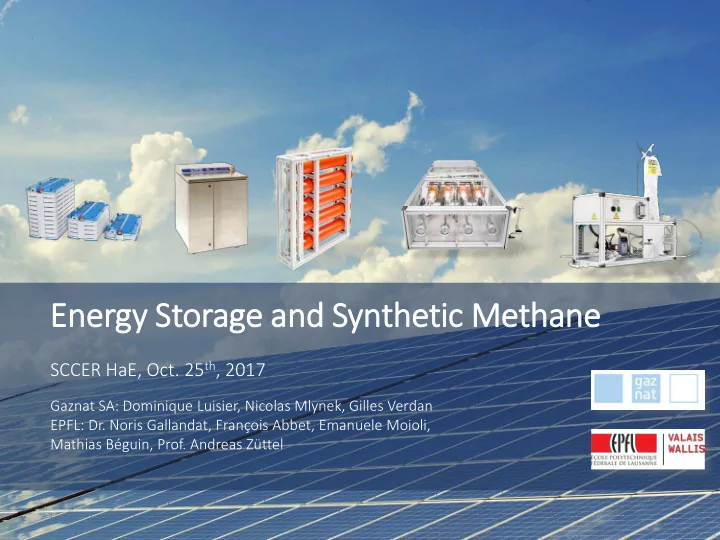
Energy gy S Storage a and S Syntheti tic M Methane SCCER HaE, Oct. 25 th , 2017 Gaznat SA: Dominique Luisier, Nicolas Mlynek, Gilles Verdan EPFL: Dr. Noris Gallandat, Franois Abbet, Emanuele Moioli, Mathias Bguin, Prof. Andreas Zttel


slide-1
SLIDE 1

25/10/17 1

Energy gy S Storage a and S Syntheti tic M Methane

SCCER HaE, Oct. 25th, 2017

Gaznat SA: Dominique Luisier, Nicolas Mlynek, Gilles Verdan EPFL: Dr. Noris Gallandat, François Abbet, Emanuele Moioli, Mathias Béguin, Prof. Andreas Züttel

slide-2
SLIDE 2

The U Unhab habitabl able E Earth

25/10/17 2

slide-3
SLIDE 3

Clos

  • sin

ing th the C Carbon C Cycle cle

ELECTROLYSIS CO CO2 O2 O2

ENERGY ENERGY

n CO CO2 + (3n+1) +1) H H2 → CH CH3-(C (CH2)n-2- CH CH3

3 + 2n

2n H H2O

H2O

  • (CH

CH2)n-

COMBUSTION

H2 CO CO2 H2O H2O

H2O O → H2 + ½ + ½O2

SYNTHESIS

[1] A. Züttel et al., “Storage of Renewable Energy by Reduction of CO2 with Hydrogen,” Chim. Int. J. Chem., May 2015

25/10/17 3

slide-4
SLIDE 4

The H e Hype C Cycle cle

VISIBIL ILIT ITY TIME ME Peak of Inflated Expectations Technology Trigger Trough of Disillusionment Plateau of Productivity Fail

25/10/17 4

slide-5
SLIDE 5

Outline

  • Small Scale Demonstrator Sion (SSDS, EPFL

Valais/Wallis)

  • Synthesis of Methane and Waste Heat Recovery

(SOMAHR, EPFL Valais/Wallis & Gaznat SA)

25/10/17 5

slide-6
SLIDE 6

Small S ll Scale le D Dem emonstrator S Sion ( (SSDS)

  • Full Solar to Synthetic Hydrocarbons conversion

displayed in a single installation

  • Many components developed in-house gives a high

flexibility and modularity of the installation

  • Intermediate size allowing testing of new materials and

components under real conditions at moderate costs

5 – 50 bar 20o – 100oC CO2 + 3H2 ➞ CH3OH + H2O Si cryst Si amorph CIGS Perovskite cells 21kWpeak, 2 kWav 48 kWh/day 30° 10° PbO/PbSO4 72 kWh Ni/MH 72 kWh

EMS

Electrolyzer MH Storage 80.8 kWh 2.05 kg H2 H2, 4 bar CO2 + 4H2 ➞ CH4 + 2H2O 0.1 kg/h 1.54 kW

Methanation Methanol

CH4 CH3OH

MH Compressor 3.55 kW 3 Phase: 400 V, 30 A 3 Phase 400 V, 30 A 48V

H2 50 g/h, 50 bar

0.26 kg/h 1.63 kW CO2 275 g/h H2 50 g/h, 13 bar Heat 0.46 kW Heat 0.23 kW 2 kW CO2 366 g/h CO2

BMS NI DAQ

25/10/17 6

slide-7
SLIDE 7

PV I Installation

Si crys yst Si amorph CIGS Pe Pero rovskite cells

Type Manufacturer Inclination Orientation Area [m2] Efficiency [%] Peak Power [W]

  • Est. Ann.

Production [kWh] Cost [CHF] Payback Time [Years] Si cryst. ET Solar 10° South 24.1 16.29 3975 3975 3120 5.23 Si cryst. 30° 24.1 3975 3975 3120 5.23 Si amorph ET Solar 10° 24.1 15.98 3900 3900 3120 5.33 Si amorph 30° 24.1 3900 3900 3120 5.33 CIGS Solar Frontier 10° 14.7 13.84 2040 2040 2497 8.16 CIGS 30° 14.7 2040 2040 2497 8.16 Perovskite Solaronix SA 10° 8 8.5 490 490 16’756 227.9 Perovskite 30° 8 490 490 16’756 227.9

  • 4 different types of panels are installed at

two inclinations (10° and 30°)

  • The total peak power PPeak is about 21 kW
  • The average power Pav is about 2.1 kW

25/10/17 7

slide-8
SLIDE 8

Batter eries es

[3] www.nilar.com

Nilar Metal Hydrides Batteries 10E-120-10-PTAIL 60 Units, 120V, 10Ah = 1.2kWh Total Capacity: 72 kWh Dimensions: 212 x 347 x 325 mm Weight: 29 kg per unit (0.041 kWh/kg) Hopecke Pb Batteries 12 sun power VRL1500 1695 24 Units, 2V, 1500 Ah = 3kWh Total Capacity: 72 kWh Dimensions: 215 X 277 x 710 mm Weight: 100 kg per unit (0.03 kWh/kg)

[2] www.hoppecke.com

25/10/17 8

slide-9
SLIDE 9

Electr ectrolyser er

Pr Prot

  • ton
  • n OnSite S20

S20 H2 Flow: 47.5 g/hr (530 Nl/hr) Delivery Pressure: 13.8 barg Electrical Power: 3.55 kW Power Consumption: 6.7 kWh/Nm3

H2

[4] An Analytical Model for the Electrolyser Performance Derived from Materials Parameters, N. Gallandat et al., JPEE, 2017

25/10/17 9

slide-10
SLIDE 10

Metal al Hy Hydride de S Storag age

96 cm

  • 5 cylinders (10L each)
  • 50 liter (System: 206L)
  • 2.05 kg Hydrogen
  • 80.8 kWh
  • Total weight 255 kg
  • 0.282 kWh/kg

∆H = -29.1 kJ/mol ∆S = 109 J/mol K

25/10/17 10

slide-11
SLIDE 11

Energy De y Density o y of Metal al Hy Hydrides

  • Highly reduced

volume (Fa Factor 25 25)

  • 100% safe inside

building Conventional H2 storage:

  • Unsafe: placement
  • utside house
  • Large volume

increases cost

25/10/17 11

slide-12
SLIDE 12

Metal H l Hydrid ide C Com

  • mpressor (

(I)

5 – 50 bar 20 – 110°C

  • Max. Flow at 50 bar: 50 gH2/h

Batch Operation: 4 steps process: Isothermal Absorption – Heating – Isothermal Desorption – Cooling

25/10/17 12

slide-13
SLIDE 13

Metal H l Hydrid ide C Com

  • mpressor (

(II)

GRZ HyCo, Product launch November 2017

25/10/17 13

slide-14
SLIDE 14

Methanati tion

  • n R

React ctor

  • r

25/10/17 14

  • Reactor Volume: 700 cm3
  • Maximal temperature: 400°C
  • Maximal pressure: 15 bar
  • Maximal space velocity: 0.55 s-1 (1980 h-1)
  • Liquid cooling
slide-15
SLIDE 15

Outcome me

  • Display of the full conversion of solar energy to synthetic hydrocarbons

with many components designed and built in-house

  • Several student projects performed on the topic
  • Publications
  • Small-scale demonstration of the conversion of renewable energy to synthetic

hydrocarbons, N. Gallandat et al., RSC Sustainable Energy and Fuels, 2017

  • An Analytical Model for the Electrolyser Performance Derived from Materials

Parameters, N. Gallandat et al., JPEE, 2017

  • Experimental Performance Investigation of a 2kW Methanation Reactor, N.

Gallandat et al., RSC Sustainable Energy and Fuels, 2017 (Submitted)

  • Startup created (GRZ Technologies Ltd.)

25/10/17 15

slide-16
SLIDE 16

Ou Outl tlook

  • ok
  • Commissioning (Q4 2017)
  • Q1 2018 – Q4 2019 Operation and Scientific

Evaluation

  • Generation of an open-source database
  • Project in collaboration with industry: upscaling of

the methanation reactor (x10) and waste heat recovery

25/10/17 16

slide-17
SLIDE 17

Synthes esis s of Met ethane a e and W nd Waste H e Hea eat Recovery ( (SOMA MAHR)

SCCER HaE, Oct. 25th, 2017

Gaznat SA: Dominique Luisier, Nicolas Mlynek, Gilles Verdan EPFL: Dr. Noris Gallandat, Emanuele Moioli, Mathias Béguin, Prof. Andreas Züttel

25/10/17 17

slide-18
SLIDE 18
  • Supplier of natural gas for Western Switzerland
  • HQ in Vevey, control room in Aigle (VD)
  • Turnover: CHF 484 mio
  • 12’800 GWh of energy sold per year (around 4% of

the global energy consumed in Switzerland)

  • Operates 600 km of gazoducts and 50 gas metering

and regulating stations

Gaznat S SA

18 25/10/17

slide-19
SLIDE 19

Natural al G Gas Grid

19 25/10/17

slide-20
SLIDE 20

Metering a and R Regulating S Station ( n (I)

20 25/10/17

slide-21
SLIDE 21
  • Conventional layout

Metering a and R Regulating S Station ( n (II)

MRS CO CO2 CH CH4 5 bar, r, 5 5°C CH CH4 50 50 - 80 80 bar, 5 5°C Q1 Burner 1 Q3 Burner 2 Burner 3 Q2 CO CO2 CO CO2 CH CH4 CH CH4 CH CH4

21 25/10/17

slide-22
SLIDE 22
  • Optimized configuration

Metering a and R Regulating S Station ( n (III)

MRS Chemical Reactor CO2 + 4H2 ➝ CH4 + 2H2O ∆HR = -252 kJ/mol CO CO2 (Exter ernal al S Source) e) H2 H2O Elec ectricity O2 H2O CH CH4 CH CH4 5 bar, r, 5 5°C CH CH4 50 50 - 80 80 bar, r, 5°C Conventional Burner Q3 Q1 Q2 Electrolyser Efficiency: 50%

22 25/10/17

slide-23
SLIDE 23

Methanati tion

  • n R

React ctor

  • r P

Perfor

  • rmance

ce

23 25/10/17

slide-24
SLIDE 24
  • First reported by Paul Sabatier (1854-1941) in 1902
  • Discovered the first catalyst for hydrogenation (nickel based)
  • The catalyst used in the reactor is a 0.5%wt Ru on alumina

Sabatie ier R Rea eact ctio ion

24 25/10/17

slide-25
SLIDE 25
  • Investigate and optimize the pressure p, the

temperature T and the space velocity vS of a methanation reactor in order to obtain a maximal CO2 conversion into methane

Goals ls & & Challe llenges

25 25/10/17

slide-26
SLIDE 26
  • The thermodynamic equilibrium determines the theoretical

maximal conversion

  • Set the pressure of the reactor constant and calculate the

maximal conversion as a function of the pressure and the temperature

Thermodyn ynam amic E Equilibrium

26 25/10/17

slide-27
SLIDE 27
  • Temperature set to 300°C
  • Conversion calculated as

a function of the pressure

Conversio ion a as Funct ctio ion o

  • f P

Pres essure

27 25/10/17

slide-28
SLIDE 28
  • The pressure is kept

constant

  • The conversion is

calculated as a function

  • f the temperature

Conversio ion a as Funct ctio ion o

  • f T

Tem emperatu ture

28 25/10/17

slide-29
SLIDE 29
  • The thermodynamic equilibrium
  • nly describes the maximal

conversion after an infinite period of time

  • Practically, the notion of kinetics

has to be considered

  • Typically, higher temperatures

favor fast kinetics

  • There is a tradeoff to be found

between fast kinetics and high equilibrium conversion

Reacti tion

  • n K

Kineti tics cs a and S Space V ce Veloci city

29 25/10/17

slide-30
SLIDE 30
  • The domain of experiments was defined

based on the following three parameters:

  • Numerical modeling
  • Literature
  • Reactor limitations

Des esign of

  • f Experiments

SV = [0.14-0.55 s-1] T = [200-400oC] p = [1-5 bar]

30 25/10/17

slide-31
SLIDE 31
  • Three main parameters are used to determine the efficiency of

the reaction

  • CO2 conversion:
  • Methane yield:
  • The Selectivity:

Reaction E Efficiency

31 25/10/17

slide-32
SLIDE 32
  • CO2 conversion very close

thermodynamic equilibrium

  • High thermal gradients within the

reactor

  • Optimal temperature ranges from

220°C to 260°C

  • No degradation of the catalyst over

> 200 hours of operation

  • High methane selectivity

Res esult lts

32 25/10/17

slide-33
SLIDE 33
  • CO2 conversion very close thermodynamic equilibrium
  • High methane selectivity
  • High thermal gradients within the reactor
  • Optimal temperature ranges from 220°C to 260°C
  • No degradation of the catalyst over > 200 hours of
  • peration
  • Design of 15 kW chemical reactor with waste heat

recovery system

  • Integration in gas metering and regulating station

Conclusion & & Outlook

33 25/10/17

slide-34
SLIDE 34

Thank y you for your a r attention

25/10/17 34

slide-35
SLIDE 35

Refer eren ences

[1] A. Züttel et al., “Storage of Renewable Energy by Reduction of CO2 with

Hydrogen,” Chim. Int. J. Chem., May 2015 [2] www.hoppecke.com [3] www.nilar.com [4] An Analytical Model for the Electrolyser Performance Derived from Materials Parameters, N. Gallandat et al., JPEE, 2017

25/10/17 35

slide-36
SLIDE 36

Ob Object ectives es

1. 1. De Demons nstrate a working conversion from solar energy to synthetic hydrocarbons 2. Investigate the energy flows from renewable sources to synthetic hydrocarbons under real c condi nditions ns and build a dat atabas ase for system modeling 3. Compare the perform rmanc nce of different components such as different types of photovoltaic cells, different batteries etc. under working conditions 4. Develop new produc ducts and support the creation of startup c up compa pani nies 5. Offer a platform for services and R&D with industry and foster colla laboratio ion with partners worldwide 6. Offer a platform for stude udents’ projects and thesis

25/10/17 36

slide-37
SLIDE 37

Per erovskit ite C Cel ells ls

  • Experimental Perovskite cells will be installed (16m2). The cells are manufactured

by an EPFL spinoff (Solaronix SA)

  • No need for complex, expensive multi-step manufacturing process occurring at

high temperatures.

  • Main challenges:
  • Only small cells (up to 200 x 200 mm) have been produced thus far
  • Stability over time under real working conditions (organic constituent is

soluble in water)

257 mm 208 mm

Monolithic Perovskite Module 25x20 cm with 24 cells at 1000 W/m2 artificial sunlight Perovskite Module Efficiency v. Temperature PCE = 8.1% 25/10/17 37

slide-38
SLIDE 38
  • Three main parameters are used to determine the efficiency of

the reaction

  • CO2 conversion:
  • Methane yield:
  • The Selectivity:

Reaction E Efficiency

38 25/10/17

slide-39
SLIDE 39
  • Use an FT-IR Spectrometer
  • Follow the C-atom

Outfl tflow G Gas Analy lysis is

39 25/10/17

slide-40
SLIDE 40

Reacti tion

  • n E

Efficiency cy: E Example

  • CO2 conversion:

40 25/10/17

slide-41
SLIDE 41
  • Thermal gradients in the reactor

Res esult lts ( (III)

41 25/10/17

slide-42
SLIDE 42
  • The CO2 conversion

increases with pressure

  • Difference with the

theoretical model due to:

  • Temperature gradient in

the reactor

  • Variation in the heat

transfer with change in pressure

  • The maximal conversion

is reached at 10 bar

Res esult lts ( (I)

42 25/10/17

slide-43
SLIDE 43
  • A reactor for the Sabatier reaction with a power of 2 kW

2 kW was successfully designed, built and tested

  • The catalyst allows for very high CO2 conversion of up to 99%

99%

  • The temperature maximizing the CO2 conversion ranges from 220

220°C to 260 260°C

  • No degradation of the catalyst (0.5%wt Ru on Alumina) was
  • bserved during > 200 h

200 hours of operation

  • The catalyst exhibited a high methane selectivity. No other

byproducts were detected in the outlet gas stream

  • The presence of large thermal gradients in the reactor allows

balancing equilibrium and kinetic effects

Concl clusion

  • ns

43 25/10/17

slide-44
SLIDE 44
  • Considérant les valeurs suivantes:
  • pin = 65 bar, Tin = 5°C
  • pout = 5 bar, Tout = 5°C
  • cP = 2226 J/kg-K
  • Chaleur nécessaire: 11.5 kW per kNm3/h

Prel elimin inary De Design M MRS

44 25/10/17

slide-45
SLIDE 45
  • PDC Sion, 2015
  • Considérer un flux minimal de 1000 Nm3/hr pour un

taux d’utilisation de 80% (à définir de façon détaillée)

Dimen ension

  • nnement p

t prél élim iminaire ( e (II)

Sel elon d n données es de e Gazna nat, Année 2015 2015

45 25/10/17

slide-46
SLIDE 46
  • Configuration possible:
  • Capacité de réchauffage: 1000 Nm3/h
  • Chaleur nécessaire: 11.5 kW
  • Rendement électrolyseur: 50%
  • Production de chaleur électrolyseur: 141.8 MJ/kgH2
  • Production de chaleur réacteur: 31.6 MJ/kgH2
  • Production de chaleur totale: 173.4 MJ/kgH2
  • Production d’hydrogène: 0.24 kg/h
  • Puissance électrique électrolyseur: 18.9 kW
  • Production de méthane: 0.48 kg/h
  • Consommation de CO2: 1.32 kg/h

Dimensionnement p préliminaire ( (III) I)

46 25/10/17

slide-47
SLIDE 47

Co Coût ûts

  • Electricité (CHF 0.15 / kWh): 8760 x

0.8 x 18.9 x 0.15 = CHF F 19 19’86 867 7 / a anné nnée

  • CO2: 8760 x 365 x 1.32 = 11’563 kg /

année, correspondant à 25 cadre à CHF 600 / pièce, pour un total de CHF F 15 15’000 00 / anné nnée

  • Réduction des coûts opérationnels:
  • Utilisation CO2 de source

industrielle

  • Installation PV

Coûts / / bén énéfic fices o

  • pératio

ionnels ls

Bénéf éfices es

  • Production gaz naturel: 8760 x 0.48 =

4204 kg / année

  • Consommation gaz naturel évitée:

6534 kg / année

  • CO2 compensation (myclimate, 41t):

CHF CHF 14 14’380 80

47 25/10/17

slide-48
SLIDE 48

Need eed f for E Ener ergy S Stor

  • rage

[1] The Independent, May 11th, 2016. [2] www.energytransition.de, October 7th, 2014.

25/10/17 48

slide-49
SLIDE 49

Issues es E Encountered

  • Risk analysis & Safety Concerns
  • ATEX Requirements: minimal ventilation required (volume of the

room exchanged 10 times per hour), ATEX installation such as safety lights, A/C unit

  • Structural analysis of the building (e.g. batteries have to be mounted
  • n the walls)
  • Thermal management in the room to avoid overheating of the

components

  • Safety requirements are time-consuming and lead to significant

additional costs

  • Sourcing of Components
  • Manufacturers specifications not always true at this intermediate

size (cost & performance)

  • Lead time hardly met for emerging commercial products

25/10/17 49

slide-50
SLIDE 50

Small S ll Scale le D Dem emonstrator S Sion ( (SSDS)

  • Full Solar to Synthetic Hydrocarbons conversion

displayed in a single installation

  • Many components developed in-house gives a high

flexibility and modularity of the installation

  • Intermediate size allowing testing of new materials and

components under real conditions at moderate costs

5 – 50 bar 20o – 100oC CO2 + 3H2 ➞ CH3OH + H2O Si cryst Si amorph CIGS Perovskite cells 21kWpeak, 2 kWav 48 kWh/day 30° 10° PbO/PbSO4 72 kWh Ni/MH 72 kWh

EMS

Electrolyzer MH Storage 80.8 kWh 2.05 kg H2 H2, 4 bar CO2 + 4H2 ➞ CH4 + 2H2O 0.1 kg/h 1.54 kW

Methanation Methanol

CH4 CH3OH

MH Compressor 3.55 kW 3 Phase: 400 V, 30 A 3 Phase 400 V, 30 A 48V

H2 50 g/h, 50 bar

0.26 kg/h 1.63 kW CO2 275 g/h H2 50 g/h, 13 bar Heat 0.46 kW Heat 0.23 kW 2 kW CO2 366 g/h CO2 50 bar

BMS NI DAQ

25/10/17 50
slide-51
SLIDE 51

Small S ll Scale le D Dem emonstrator S Sion ( (SSDS)

  • Full Solar to Synthetic Hydrocarbons conversion

displayed in a single installation

  • Many components developed in-house gives a high

flexibility and modularity of the installation

  • Intermediate size allowing testing of new materials and

components under real conditions at moderate costs

5 – 50 bar 20o – 100oC CO2 + 3H2 ➞ CH3OH + H2O Si cryst Si amorph CIGS Perovskite cells 21kWpeak, 2 kWav 48 kWh/day 30° 10° PbO/PbSO4 72 kWh Ni/MH 72 kWh

EMS

Electrolyzer MH Storage 80.8 kWh 2.05 kg H2 H2, 4 bar CO2 + 4H2 ➞ CH4 + 2H2O 0.1 kg/h 1.54 kW

Methanation Methanol

CH4 CH3OH

MH Compressor 3.55 kW 3 Phase: 400 V, 30 A 3 Phase 400 V, 30 A 48V

H2 50 g/h, 50 bar

0.26 kg/h 1.63 kW CO2 275 g/h H2 50 g/h, 13 bar Heat 0.46 kW Heat 0.23 kW 2 kW CO2 366 g/h CO2 50 bar

BMS NI DAQ

25/10/17 51