
SLIDE 1
AWLC May 15, 2014 Denis Perret-Gallix@in2p3.fr LAPP/IN2P3-KEK 1
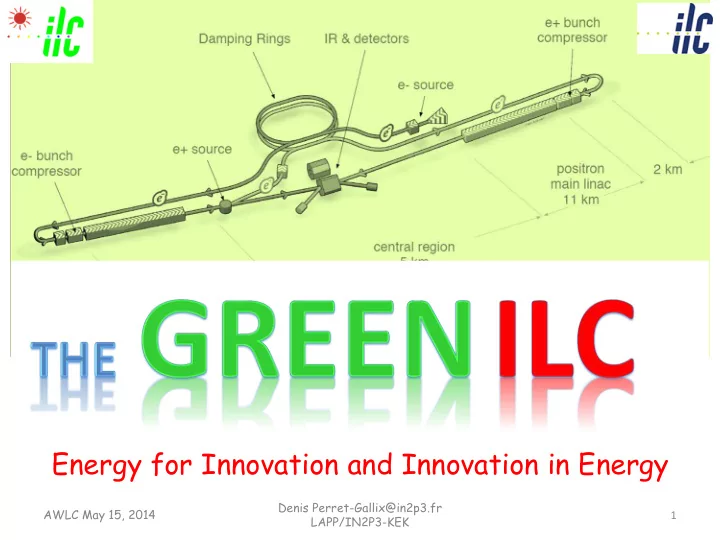
Energy for Innovation and Innovation in Energy Denis - - PowerPoint PPT Presentation
Energy for Innovation and Innovation in Energy Denis Perret-Gallix@in2p3.fr AWLC May 15, 2014 1 LAPP/IN2P3-KEK AWLC May 15, 2014 2 High-Energy is Energy Other things being equal: Beam Intensity } Beam Energy scales up with the wall-plug
AWLC May 15, 2014 Denis Perret-Gallix@in2p3.fr LAPP/IN2P3-KEK 1
AWLC May 15, 2014 2
AWLC May 15, 2014 Denis Perret-Gallix@in2p3.fr LAPP/IN2P3-KEK 3
Other things being equal:
And construction/running cost also depend on Energy …
AWLC May 15, 2014 Denis Perret-Gallix@in2p3.fr LAPP/IN2P3-KEK 4
Accelerator architectures evolved from:
Denis Perret-Gallix@in2p3.fr LAPP/IN2P3-KEK 5
TDR takes an even larger margin: 300 MW 500 MW
AWLC May 15, 2014
ILC 500 GeV 18% of Iwate prefecture electricity consumption, Morioka (300,000) ILC 1 TeV 32%
Yearly electricity running cost: 500 GeV ~ 210 M$
1 TeV ~ 380 M$
FCC-ee : 354 MW @350 GeV FCC-hh : 468 MW @ 100 TeV (Paul Collier, CERN)
AWLC May 15, 2014 Denis Perret-Gallix@in2p3.fr LAPP/IN2P3-KEK 6
AWLC May 15, 2014 Denis Perret-Gallix@in2p3.fr LAPP/IN2P3-KEK 7
ILC is a good place to start:
– The first world-wide fundamental science project: a unique showroom for physics and technology innovation with researchers/experts on many disciplines. – Interdisciplinary – Technology transfer: a “Global Science City”. Many other research labs and a strong industrial environment.
A greenfield project
– First time since ~ 50 years a new HEP site is built. – Unleash creativity and plan with the future and expansion in mind.
Time has come: Energy was not a concern “before”, now it is:
– 1.2 TWh (500 GeV) 20% of a nuclear reactor – Energy/Global warming/Financial crisis in the world and in Japan – For fundamental science …
in Research Facilities
AWLC May 15, 2014 Denis Perret-Gallix@in2p3.fr LAPP/IN2P3-KEK 8
23-25 October 2013 CERN
Linear Collider WS
Tokyo Nov. 15 2013
9
AWLC May 15, 2014 Denis Perret-Gallix@in2p3.fr LAPP/IN2P3-KEK 10
Wind Power: 100 MW Machine: 278 GWh/y Cooling: 265 GWh/y
Reliable
stable electricity and cooling supplies
Future Circular Collider Study Kick-Off Meeting, Geneva 2014 Erk Jensen 100 MW RF System Future Circular Collider Study Kick-Off Meeting, Geneva 2014 Erk Jensen 100 MW RF System
generation is needed for many future accelerator projects (proton drivers for several applications, linear colliders, material test facilities) and certainly has impact beyond the accelerator community.
ergy E Efficiency” has started to pick up momentum inside the European Project EuCARD2, see
http://eucard2.web.cern.ch/activities/wp3- energy-efficiency-enefficient
this network!
13-Feb-2014 11
AWLC May 15, 2014 Denis Perret-Gallix@in2p3.fr LAPP/IN2P3-KEK 12
1. Energy Saving: improving efficiency 2. Energy Recovery and Recycling 3. Operational saving
Revisiting all ILC components with a focus on: 1. Renewable energies production and use 2. Energy Storage and conversion 3. Energy Distribution and Management: Smart Grid Study of Alternative energies in the ILC framework:
AWLC May 15, 2014 Denis Perret-Gallix@in2p3.fr LAPP/IN2P3-KEK 13
Rank: 1 6 3 2 4 5 % : 42 3 15 23 13 5
MW
AWLC May 15, 2014 Denis Perret-Gallix@in2p3.fr LAPP/IN2P3-KEK 14
– Power reduction during idle periods:
– Increase reliability (to avoid down time)
– RF high efficiency (power converter/modulator(90%), klystron (65%),
waveguides, power couplers)
– Wall-plug to beam power efficiency: 9.6 %. – Cryogenics: High efficiency cryocooler and system optimization
– NC magnets – ILC Lattice optimization
CPD is an energy-saving scheme that recovers the kinetic energy of the spent electrons after generating rf power. Conventional collector Schematic diagram of CPD collector
Linear Collider WS
Tokyo Nov. 15 2013
15
AWLC May 15, 2014 Denis Perret-Gallix@in2p3.fr LAPP/IN2P3-KEK 16
110 GHz, 1 MW Multi-stages Depressed Collector Efficiency increased from: 30-35% to 60%
Amarjit Singh et al. IEEE TRANSACTIONS ON PLASMA SCIENCE, VOL. 27, NO. 2, APRIL 1999
From 6 beams 30 beams …. ??
AWLC May 15, 2014 Denis Perret-Gallix@in2p3.fr LAPP/IN2P3-KEK 17
Heat waste from the water cooling systems:
– Increase output temperature: Carnot cycle more efficient with higher temperature gradient
– Recycling efficiency ? Cooling efficiency ? Saving/investment ratio ? – Many industrial applications
Beam dumps energy recovery
– 2 main full power beam dumps, 5.3 (@500 GeV) - 13.6(@1 TeV) MW, pressurized water (155 °C) + activation – 1 BD photons 0.3 MW, water at 190 °C – How to recover, store and recycle this energy ?, stirling engines, heat pumps, molten salts, – Other ideas: Plasma deceleration dumping, Energy Recovering Linac
smaller than the stopping in condensed matter.
10 cm for 100 GeV
Use Collective Fields of Plasmas for Deceleration
Linear Collider WS
Tokyo Nov. 15 2013
AWLC May 15, 2014 18
AWLC May 15, 2014 Denis Perret-Gallix@in2p3.fr LAPP/IN2P3-KEK 19
AWLC May 15, 2014 Denis Perret-Gallix@in2p3.fr LAPP/IN2P3-KEK 20
Energy Production:
– Study the (dis)-advantages of the various sources: solar, wind, geothermal, sea, …)
– Find the best mix to cover ILC specific needs ? 24/7, long shutdowns, … – Accommodate the ILC component power requirements to the various energy sources distinctive features:
mechanical compressor (no electricity)
Energy Storage: HEP: experts in some of these technologies
– Liquid Helium, Nitrogen, Hydrogen, SMES(Sc Magnetic Energy Storage), Flywheel, Hydro (Dam), Compressed air, Batteries, …
Distribution: Smart (Local) GRID:
Full scale multi-sourced, AC/DC, GRID management and control
– Smooth and rapid switching between energy sources, including conventional supply – Energy Monitoring, Management and forecast: production, storage and backup
AWLC May 15, 2014 Denis Perret-Gallix@in2p3.fr LAPP/IN2P3-KEK 21 2 MW Goto island prototype
2.3 GW installed, none failed after 3/11
Wind Projects 6 floating 2MW wind turbines off Fukushima up to 80 in 2020
Tidal and marine stream Sea temperature gradient
AWLC May 15, 2014 Denis Perret-Gallix@in2p3.fr LAPP/IN2P3-KEK 22
Many sources including: Rice, fishery and agricultural wastes Algae Other cattle and human wastes Co-generations heat and electricity
Idemitsu Kosan Co. 5 MW
Miyasaki, Nishinippon Env. Energy co. 11.7 MW
Installed 2.3 GW (2011) very little progress since 2011
AWLC May 15, 2014 Denis Perret-Gallix@in2p3.fr LAPP/IN2P3-KEK 23
9.5MW 1967 Matsukawa
Installed 2011 : 0.5 GW. Geothermal potential sources : ~ 20 GW No substantial progress since 2011
But:
AWLC May 15, 2014 Denis Perret-Gallix@in2p3.fr LAPP/IN2P3-KEK 24
10 MW Komekurayama 30 km Fuji-san (TEPCO) Installed: 8.5 GW Projects: 341 MW in Hokaido 100 MW Minami Soma 2009 Target Japanese gov. 28 GW of solar PV capacity by 2020 53 GW of solar PV capacity by 2030 10% of total domestic primary energy demand met with solar PV by 2050
Solar thermal Energy
CERN Physicist
70 MW in Kagoshima started Nov. 7 2013
AWLC May 15, 2014 Denis Perret-Gallix@in2p3.fr LAPP/IN2P3-KEK 25
– The cryogenics is consuming ~ ¼ ~ 40 MW of ILC Wall-plug power
efficiency by a factor 2.
– LN2 produced by sustainable energies
system, bypassing electricity production and improving efficiency. Byproducts liquid
– LN2 as Energy storage
AWLC May 15, 2014 Denis Perret-Gallix@in2p3.fr LAPP/IN2P3-KEK 26
AWLC May 15, 2014 Denis Perret-Gallix@in2p3.fr LAPP/IN2P3-KEK 27
ILC Sustainable Energy Research Center ILC High-Energy Research Center
Basic Research Technology R&D
Electrons, photons, neutrons factories HPC/GRID Computing
Fundamental Research Pilot Power plants for ILC HEP Applications
AWLC May 15, 2014 Denis Perret-Gallix@in2p3.fr LAPP/IN2P3-KEK 28
Biomass Off-shore wind Solar Power Plant Geothermal Plant Wind turbine Hydro storage Wave/stream energy
Courtesy of:
Photovoltaic Photovoltaic and thermal He, H2 storage Smart GRID Forecast and data management
AWLC May 15, 2014 Denis Perret-Gallix@in2p3.fr LAPP/IN2P3-KEK 29
components.
Base-line and Advanced-line on more innovative technologies. – ILC Design modifications:
– Implementation timeline (minimum impact of the ILC planning) – Budget assessment: additional spending and saving
Green-ILC project report by 2015
– Get the “Energy research” community and organization and the “Industry leaders” involved in a network. – Propose a global governance scheme for the “ILC Energy Center” – Form an additional budget for the “Sustainable Energy Center” (no ILC money) – Identify short term renewable energy pilot plants with build-in upgradability – Identify basic energy researches in line with the ILC project
AWLC May 15, 2014 Denis Perret-Gallix@in2p3.fr LAPP/IN2P3-KEK 30
1. As a backup to the conventional power supply (diesel engines) 2. To cover buildings energy through recycling and storage (electricity and heating) (zero energy ) 3. To cover some parts of the ILC: computers (fuel cells), water cooling, part of the cryo plants 4. To power more of the previous components 5. To power some of the klystrons 6. All 500 GeV ILC electrical supply
– Conventional power supply is now in backup mode
7. Get ready for the 1 TeV
Gradual and Multi-Staged e.g.
7 MW 10 MW 10-20 MW 30-40 MW 100 MW 170 MW +150 MW
AWLC May 15, 2014 Denis Perret-Gallix@in2p3.fr LAPP/IN2P3-KEK 31
Energy consumption: a major limiting factor to higher beam energies and intensity The Green-ILC project precisely addresses this issue.
ILC consumption being similar to a city, it is a full scale workbench:
– To study and implement: energy saving, recycling and storing – To develop, maintain and manage a mix of sustainable energy sources.
Green-ILC links High-Energy physics and Energy R&D :
– Substantial running cost saving and better flexibility in ILC operations. – A disruptive approach but an exciting challenge toward ”Sustainable Colliders” – Energy R&D, a Societal Issue: the green-ILC project would:
Research collaboration.
AWLC May 15, 2014 Denis Perret-Gallix@in2p3.fr LAPP/IN2P3-KEK 32