Energy Facility Siting Council Solar PV Facilities Rulemaking - - PowerPoint PPT Presentation

energy facility
SMART_READER_LITE
LIVE PREVIEW

Energy Facility Siting Council Solar PV Facilities Rulemaking - - PowerPoint PPT Presentation

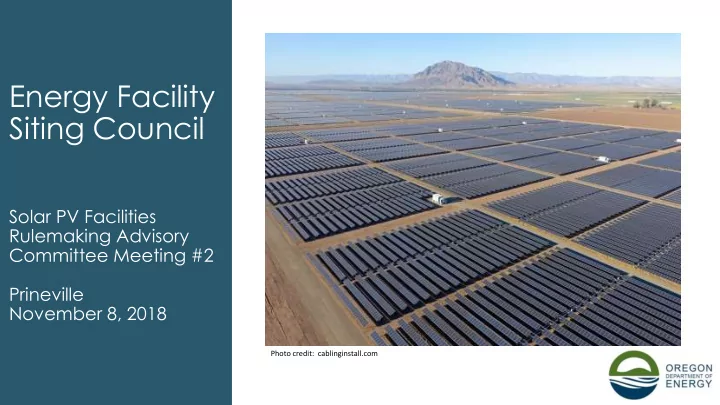
Energy Facility Siting Council Solar PV Facilities Rulemaking Advisory Committee Meeting #2 Prineville November 8, 2018 Photo credit: cablinginstall.com AGENDA 1. Introductions 2. Overview of Meeting 3. Issues / Potential Standards

slide-1
SLIDE 1

Energy Facility Siting Council

Solar PV Facilities Rulemaking Advisory Committee Meeting #2 Prineville November 8, 2018

Photo credit: cablinginstall.com

slide-2
SLIDE 2

AGENDA

  • 1. Introductions
  • 2. Overview of Meeting
  • 3. Issues / Potential Standards Specific to Solar PV Facilities
  • 4. Follow Up to Questions Raised During Meeting #1
  • 5. Public Comment
  • 6. Wrap Up and Next Meeting
slide-3
SLIDE 3

INTRODUCTIONS & OVERVIEW

  • 1. Introductions
  • In Room
  • On Phone
  • 2. Overview
  • Seeking input, not consensus or majority consensus
  • Calling on each RAC member on every issue
  • Notes and recording
slide-4
SLIDE 4
  • 1. General Standard of Review
  • 2. Organizational Expertise
  • 3. Structural Standard
  • 4. Soil Protection
  • 5. Land Use
  • 6. Protected Areas
  • 7. Retirement and Financial

Assurance

SHOULD SPECIFIC STANDARDS APPLY TO SOLAR PV FACILITIES? 14 General Council Standards

  • 8. Fish and Wildlife Habitat
  • 9. Threatened and Endangered

Species

  • 10. Scenic Resources
  • 11. Historic, Cultural and

Archaeological Resources

  • 12. Recreation
  • 13. Public Services
  • 14. Waste Minimization
slide-5
SLIDE 5

Need Standard for Non-generating Facilities Specific Standards for Wind Facilities

  • Public health and safety standards for wind energy facilities
  • Cumulative effects standards for wind energy facilities

Specific Standards for Surface Facilities Related to Underground Gas Storage Reservoirs Specific Standards for Transmission Lines Standards for Energy Facilities the Emit Carbon Dioxide

Existing Project Specific Standards

slide-6
SLIDE 6

Topics selected for initial discussion

  • Toxicity and Safe Disposal
  • Glare and Glint
  • Heat Island Effect
  • Wildlife

Reasons for evaluation

  • Prior displays of public interest
  • Department’s knowledge of risks

Literature review includes

  • Local, state, federal, and international statutes & regulatory codes
  • Model ordinances
  • Peer reviewed journals
  • News articles

Research Into Potential Solar PV Specific Standards

slide-7
SLIDE 7

Solar PV panels may be hazardous waste

  • Not listed under RCRA
  • Must be evaluated on a case-by-case basis

Washington

  • Interim policy classifies solar PV as electrical waste, thereby lessening handling and

transportation requirements

  • RCW 70.355.0101 requires a “stewardship plan”:
  • Financing
  • Recycling (85% by weight)
  • Acceptance of all panels in Washington a

California

  • Rulemaking to classify solar PV as “universal” hazardous waste
  • Legislative Counsel’s Digest of Senate Bill notes that intent is to “ensure the recovery

and recycling” of solar PV panels and to reduce the likelihood of disposal in landfills.

Toxicity and Safe Disposal

slide-8
SLIDE 8
  • FAA indicates that an average solar PV panel may cause glare or glint
  • Relevant factors:
  • Percent of sunlight reflected
  • Specular or diffuse reflection
  • Angle of sun
  • FAA SGHAT tool
  • Few jurisdictions impose regulations relating to glare
  • At least one model ordinance advises against regulating glare
  • Literature suggest that greatest concern relates to solar thermal

technology, not solar PV

Glare and Glint

slide-9
SLIDE 9
  • Issue raised by public in relation to alfalfa farming
  • Few studies examine solar PV heat island effect
  • One empirical study noted that ambient temperature increased

by 3-4 degrees Celsius at night

  • Study conducted in Arizona, in desert environment
  • Literature suggests that heat dissipates at approximately 100

feet

Heat Island Effect

slide-10
SLIDE 10

Solar Development Impacts to Wildlife & Habitat:

Considerations for the Solar PV Rulemaking Advisory Committee

Sarah Reif, Oregon Department of Fish and Wildlife November 8, 2018

slide-11
SLIDE 11

ODFW Mission: To protect and enhance Oregon’s fish and wildlife and their habitats for use and enjoyment by present and future generations ODFW Fish and Wildlife Habitat Mitigation Policy (OAR 635-415-0000 through 0025) EFSC Fish and Wildlife Habitat Standard (OAR 345-022-0060) T&E Species Standard OAR 345-022-0070 Oregon Statewide Planning Goal 5

Oregon’s Commitment to Wildlife, in Context

slide-12
SLIDE 12

Climate Change – Role of Solar Development

  • Facilitates Oregon’s reduction of greenhouse gas emissions
  • Helps address impacts of climate change
  • Oregon’s natural resources at risk from climate change:
  • Water resources affected by decreased snowpack and precipitation
  • Ocean acidification, changes in ocean current
  • Expected sea level rise
  • Increased fire frequency and intensity
  • Recreation/Tourism affected by declining resources, fire, invasive species
slide-13
SLIDE 13

Wildlife and Wildlife Habitat – Impacts of Solar

  • Direct impact of solar
  • Vegetation removal, trenching/blading, fencing, panels
  • Crushing/trampling of wildlife, entrapment/entanglement with fencing
  • Collision with PV panels
  • Indirect impact of solar
  • Construction activity noise/disturbance
  • Net loss of habitat for breeding, wintering
  • Loss of habitat connectivity for wide-ranging species
slide-14
SLIDE 14

Fort Rock Valley Case Study Lake County

  • 6 permitted facilities

2009-2018 EFSC

  • 1 proposed facility

~ 8,500 acres

slide-15
SLIDE 15
slide-16
SLIDE 16
slide-17
SLIDE 17

EFSC Siting Standards Fish and Wildlife Protection Standard OAR 345-022-0060 T&E Species Standard OAR 345-022-0070

slide-18
SLIDE 18

Mule Deer Migration 2007-2008 Wintering in Fort Rock Valley Summering in Fremont Mtns and Cascades

slide-19
SLIDE 19

Wildlife Habitat Issues/Standards

  • Do the existing standards

related to wildlife provide adequate protections or mitigation related to individual projects?

  • What is the best way to

address cumulative impacts of multiple projects in the same area on the sustainability of wildlife habitat?

slide-20
SLIDE 20

Follow Up to Questions Raised During Meeting #1

  • “Fifteen Questions” Related to Wind Facilities
  • Oregon Public Utility Commission PURPA Project Aggregation
  • Examples to Solar PV Project Aggregation
  • Oregon Natural Desert Association Petition For Rulemaking Related

to Wind Project Aggregation

  • Infrastructure Information
slide-21
SLIDE 21

PUBLIC COMMENT

  • In the room
  • On the phone

This time is reserved for the public to address the RAC.

slide-22
SLIDE 22

WRAP UP AND NEXT MEETING

  • Location: Boardman
  • Date: TBD
  • Agenda: TBD