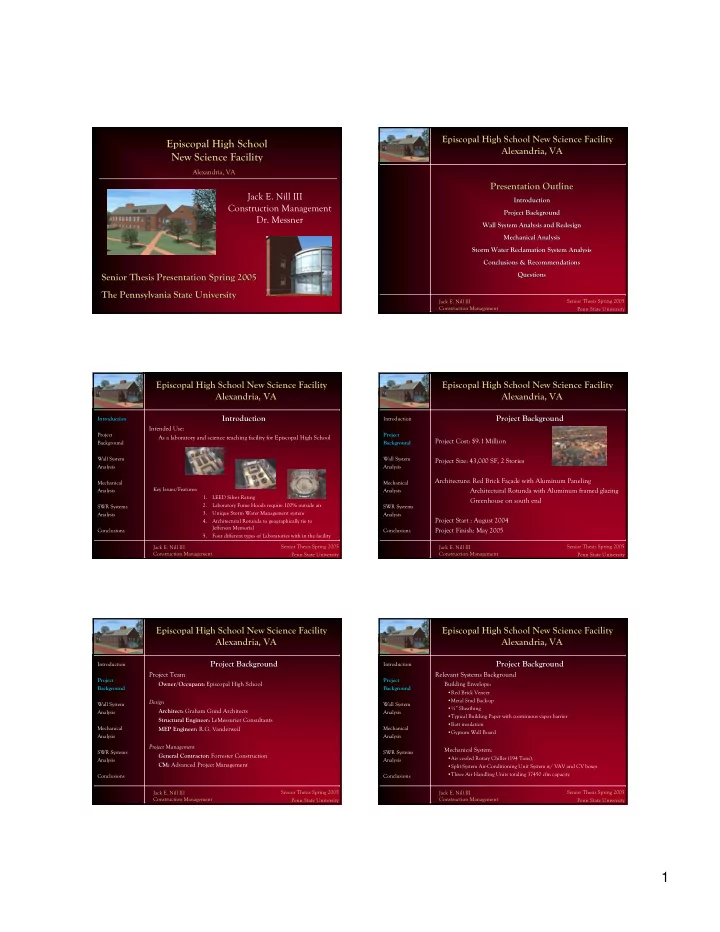
1 Episcopal High School New Science Facility Episcopal High School - - PDF document

1
SMART_READER_LITE
LIVE PREVIEW

1 Episcopal High School New Science Facility Episcopal High School - - PDF document

Episcopal High School New Science Facility Episcopal High School New Science Facility Episcopal High School Episcopal High School Alexandria, VA Alexandria, VA New Science Facility New Science Facility Alexandria, VA Presentation Outline


slide-1
SLIDE 1

1

Alexandria, VA

Jack E. Nill III Construction Management

  • Dr. Messner

Senior Thesis Presentation Spring 2005 Senior Thesis Presentation Spring 2005 The Pennsylvania State University The Pennsylvania State University

Episcopal High School Episcopal High School New Science Facility New Science Facility

Jack E. Nill III Construction Management

Episcopal High School New Science Facility Episcopal High School New Science Facility Alexandria, VA Alexandria, VA

Senior Thesis Spring 2005 Penn State University

Presentation Outline Presentation Outline

Introduction Introduction Project Background Project Background Wall System Analysis and Redesign Wall System Analysis and Redesign Mechanical Analysis Mechanical Analysis Storm Water Reclamation System Analysis Storm Water Reclamation System Analysis Conclusions & Recommendations Conclusions & Recommendations Questions Questions

Jack E. Nill III Construction Management

Episcopal High School New Science Facility Episcopal High School New Science Facility Alexandria, VA Alexandria, VA

Senior Thesis Spring 2005 Penn State University Introduction Introduction Project Background Wall System Analysis Mechanical Analysis SWR Systems Analysis Conclusions

Introduction Introduction

Intended Use: As a laboratory and science teaching facility for Episcopal High School

Key Issues/Features: 1. LEED Silver Rating 2. Laboratory Fume Hoods require 100% outside air 3. Unique Storm Water Management system 4. Architectural Rotunda to geographically tie to Jefferson Memorial 5. Four different types of Laboratories with in the facility Jack E. Nill III Construction Management

Episcopal High School New Science Facility Episcopal High School New Science Facility Alexandria, VA Alexandria, VA

Senior Thesis Spring 2005 Penn State University Introduction Project Project Background Background Wall System Analysis Mechanical Analysis SWR Systems Analysis Conclusions

Project Background Project Background

Project Cost: $9.1 Million Project Size: 43,000 SF, 2 Stories Architecture: Red Brick Façade with Aluminum Paneling Architectural Rotunda with Aluminum framed glazing Greenhouse on south end Project Start : August 2004 Project Finish: May 2005

Jack E. Nill III Construction Management

Episcopal High School New Science Facility Episcopal High School New Science Facility Alexandria, VA Alexandria, VA

Senior Thesis Spring 2005 Penn State University Introduction Project Project Background Background Wall System Analysis Mechanical Analysis SWR Systems Analysis Conclusions

Project Background Project Background

Project Team

Owner/Occupant: Episcopal High School Design Architect: Graham Gund Architects Structural Engineer: LeMessurier Consultants MEP Engineer: R.G. Vanderweil Project Management General Contractor: Forrester Construction CM: Advanced Project Management

Jack E. Nill III Construction Management

Episcopal High School New Science Facility Episcopal High School New Science Facility Alexandria, VA Alexandria, VA

Senior Thesis Spring 2005 Penn State University Introduction Project Project Background Background Wall System Analysis Mechanical Analysis SWR Systems Analysis Conclusions

Project Background Project Background

Relevant Systems Background

Building Envelope:

  • Red Brick Veneer
  • Metal Stud Back-up
  • ½” Sheathing
  • Typical Building Paper with continuous vapor barrier
  • Batt insulation
  • Gypsum Wall Board

Mechanical System:

  • Air cooled Rotary Chiller (194 Tons),
  • Split-System Air-Conditioning Unit System w/ VAV and CV boxes
  • Three Air Handling Units totaling 37450 cfm capacity
slide-2
SLIDE 2

2

Jack E. Nill III Construction Management

Episcopal High School New Science Facility Episcopal High School New Science Facility Alexandria, VA Alexandria, VA

Senior Thesis Spring 2005 Penn State University Introduction Project Project Background Background Wall System Analysis Mechanical Analysis SWR Systems Analysis Conclusions

Project Background Project Background

Jack E. Nill III Construction Management

Episcopal High School New Science Facility Episcopal High School New Science Facility Alexandria, VA Alexandria, VA

Senior Thesis Spring 2005 Penn State University Introduction Project Project Background Background Wall System Analysis Mechanical Analysis SWR Systems Analysis Conclusions

LEED Summary LEED Summary

LEED LEED-

  • NC Silver Rating (33

NC Silver Rating (33-

  • 38 point)

38 point)

  • EHS New Science Facility scheduled to obtain 33 points

EHS New Science Facility scheduled to obtain 33 points Focus Areas: Focus Areas: 1.

  • 1. EA

EA – – Energy and Atmosphere Energy and Atmosphere (3 of 17 possible points and all Prerequisites met) (3 of 17 possible points and all Prerequisites met) 2.

  • 2. WE

WE – – Water Efficiency Water Efficiency (5 of 5 possible points and all Prerequisites met) (5 of 5 possible points and all Prerequisites met) 3.

  • 3. ID

ID -

  • Innovation and Design Process

Innovation and Design Process (3 of 5 possible points) (3 of 5 possible points)

Jack E. Nill III Construction Management

Episcopal High School New Science Facility Episcopal High School New Science Facility Alexandria, VA Alexandria, VA

Senior Thesis Spring 2005 Penn State University Introduction Project Background Wall System Wall System Analysis Analysis Mechanical Analysis SWR Systems Analysis Conclusions

Analysis I: Wall System Analysis and Redesign Analysis I: Wall System Analysis and Redesign

Background Background:

:

  • Up to 40% of energy consumed to heat or cool a building is due to

Air infiltration.

Goals Goals:

:

  • Implement a Zero Percent Air Infiltration System in order to lower the

infiltration values of the wall system significantly, analyze the impacts of the new system, and determine the feasibility of the new system in green construction practices.

Jack E. Nill III Construction Management

Episcopal High School New Science Facility Episcopal High School New Science Facility Alexandria, VA Alexandria, VA

Senior Thesis Spring 2005 Penn State University Introduction Project Background Wall System Wall System Analysis Analysis Mechanical Analysis SWR Systems Analysis Conclusions

Analysis I: Wall System Analysis and Analysis I: Wall System Analysis and Redesign Redesign

Causes of Infiltration

  • 1. The Stack Effect
  • 2. Chimney’s
  • 3. Wind
  • 4. Forced Hot-Air Heating Systems

Jack E. Nill III Construction Management

Episcopal High School New Science Facility Episcopal High School New Science Facility Alexandria, VA Alexandria, VA

Senior Thesis Spring 2005 Penn State University Introduction Project Background Wall System Wall System Analysis Analysis Mechanical Analysis SWR Systems Analysis Conclusions

Advantages of Using an Air Barrier Advantages of Using an Air Barrier

  • Prevent premature deterioration of the building envelope
  • Enhance thermal performance of the structure and save energy

costs

  • Improve comfort for the building occupants
  • Decreased moisture infiltration into wall cavity, lowering

probability of mold issues within the building envelope

Jack E. Nill III Construction Management

Episcopal High School New Science Facility Episcopal High School New Science Facility Alexandria, VA Alexandria, VA

Senior Thesis Spring 2005 Penn State University Introduction Project Background Wall System Wall System Analysis Analysis Mechanical Analysis SWR Systems Analysis Conclusions

Analysis I: Wall System Analysis and Redesign Analysis I: Wall System Analysis and Redesign

Design Criteria Design Criteria

  • Air Barrier Product: Grace Perm

Air Barrier Product: Grace Perm-

  • A

A-

  • Barrier membrane in place of

Barrier membrane in place of Building Paper and Continuous Vapor Barrier Building Paper and Continuous Vapor Barrier

  • Grace Perm

Grace Perm-

  • A

A-

  • Barrier Wall conditioner applied prior to self adhesive

Barrier Wall conditioner applied prior to self adhesive membrane membrane

  • Membrane wrapped into window frames and sealed by glazer

Membrane wrapped into window frames and sealed by glazer

  • Bituthene mastic used to seal all penetrations

Bituthene mastic used to seal all penetrations

  • Perm

Perm-

  • A

A-

  • Barrier Wall Flashing used and sealed to membrane

Barrier Wall Flashing used and sealed to membrane

slide-3
SLIDE 3

3

Jack E. Nill III Construction Management

Episcopal High School New Science Facility Episcopal High School New Science Facility Alexandria, VA Alexandria, VA

Senior Thesis Spring 2005 Penn State University Introduction Project Background Wall System Wall System Analysis Analysis Mechanical Analysis SWR Systems Analysis Conclusions

Perm-A-Barrier Membrane Bituthene Mastic PAB Wall Flashing

Jack E. Nill III Construction Management

Episcopal High School New Science Facility Episcopal High School New Science Facility Alexandria, VA Alexandria, VA

Senior Thesis Spring 2005 Penn State University Introduction Project Background Wall System Wall System Analysis Analysis Mechanical Analysis SWR Systems Analysis Conclusions

CM Concerns and Issues CM Concerns and Issues

  • Quality of Construction!!!

Quality of Construction!!!

  • Coordination with other trades for the building envelope

Coordination with other trades for the building envelope

  • Integration with the Roof and Foundation wall

Integration with the Roof and Foundation wall

  • Availability of Materials

Availability of Materials

  • Cost

Cost

  • Schedule impacts

Schedule impacts

Jack E. Nill III Construction Management

Episcopal High School New Science Facility Episcopal High School New Science Facility Alexandria, VA Alexandria, VA

Senior Thesis Spring 2005 Penn State University Introduction Project Background Wall System Wall System Analysis Analysis Mechanical Analysis SWR Systems Analysis Conclusions

Cost and Schedule Impacts of Perm Cost and Schedule Impacts of Perm-

  • A

A-

  • Barrier

Barrier

  • Initially $33,558 more expensive ($1.41/SF more)

Initially $33,558 more expensive ($1.41/SF more)

  • Adds 7 days to the schedule but not on the critical path

Adds 7 days to the schedule but not on the critical path

Jack E. Nill III Construction Management

Episcopal High School New Science Facility Episcopal High School New Science Facility Alexandria, VA Alexandria, VA

Senior Thesis Spring 2005 Penn State University Introduction Project Background Wall System Wall System Analysis Analysis Mechanical Analysis SWR Systems Analysis Conclusions

Infiltration Impacts Infiltration Impacts

1% $1,180/year

Energy Cost Savings

30 + years

8% Heating 6% Cooling .3716 W/SF 4 e-6 cfm/sf

Return on Investment Energy Savings Reduction

  • n Demand

Infiltration Value

Jack E. Nill III Construction Management

Episcopal High School New Science Facility Episcopal High School New Science Facility Alexandria, VA Alexandria, VA

Senior Thesis Spring 2005 Penn State University Introduction Project Background Wall System Wall System Analysis Analysis Mechanical Analysis SWR Systems Analysis Conclusions

Conclusions and Recommendations Conclusions and Recommendations

EHS New Science Facility

  • For this particular project an Air Barrier Wall System is not a feasible

solution to a more efficient building envelope.

Industry

  • In more extreme climates such as Canada, however, this type of system

has proven to significantly reduce energy costs associated with heating the building.

  • Annual cost savings of up to $6,000 have been seen by using similar Air

Barrier systems to reduce air leakage.

  • Could prove useful on other high performance/green projects in the

future.

Jack E. Nill III Construction Management

Episcopal High School New Science Facility Episcopal High School New Science Facility Alexandria, VA Alexandria, VA

Senior Thesis Spring 2005 Penn State University Introduction Project Background Wall System Analysis Mechanical Mechanical Analysis Analysis SWR Systems Analysis Conclusions

Analysis II: Mechanical Analysis Analysis II: Mechanical Analysis

Background:

  • Fume Hoods in the laboratories and the recent adoption of the 2000

International Energy Conservation Code (ICC) by the state of VA were driving factors in this analysis

  • High performance Mechanical Systems can result in long term energy

savings as well as cost savings to the owner

Goals:

  • To maximize energy efficiency of the mechanical system by adding

sustainable upgrades

  • Determine the feasibility of such upgrades using DOE 2.2 cost

modeling and based on ROI to the owner and CM issues encountered

slide-4
SLIDE 4

4

Jack E. Nill III Construction Management

Episcopal High School New Science Facility Episcopal High School New Science Facility Alexandria, VA Alexandria, VA

Senior Thesis Spring 2005 Penn State University Introduction Project Background Wall System Analysis Mechanical Mechanical Analysis Analysis SWR Systems Analysis Conclusions

Sustainable Upgrades Sustainable Upgrades

  • Variable air volume with variable frequency drives
  • Heat Recovery on AHU 3
  • Water Cooled Chiller vs. Air Cooled Chiller
  • CO2 monitors

Jack E. Nill III Construction Management

Episcopal High School New Science Facility Episcopal High School New Science Facility Alexandria, VA Alexandria, VA

Senior Thesis Spring 2005 Penn State University Introduction Project Background Wall System Analysis Mechanical Mechanical Analysis Analysis SWR Systems Analysis Conclusions

DOE 2.2 Energy Cost Modeling DOE 2.2 Energy Cost Modeling

What is DOE 2.2?

  • Energy cost modeling software used in the industry to determine

the energy costs of a building based on its components and location (Department Of Energy) Assumptions:

1) Electric Costs based on Virginia Electric and Power Company Schedules GS-3 with fuel charges of $0.01613/kWh 2) Gas costs based on Washington Gas 3) Two position hood control in both cases 4) Chiller performance based on performance info provided from Trane 5) Weather data averaged over 25 year records Jack E. Nill III Construction Management

Episcopal High School New Science Facility Episcopal High School New Science Facility Alexandria, VA Alexandria, VA

Senior Thesis Spring 2005 Penn State University Introduction Project Background Wall System Analysis Mechanical Mechanical Analysis Analysis SWR Systems Analysis Conclusions

DOE 2.2 Energy Cost Modeling DOE 2.2 Energy Cost Modeling

  • Net Cost Savings of $.77/SF/Year
  • A 16% Energy Savings seen (1 LEED Point)

Jack E. Nill III Construction Management

Episcopal High School New Science Facility Episcopal High School New Science Facility Alexandria, VA Alexandria, VA

Senior Thesis Spring 2005 Penn State University Introduction Project Background Wall System Analysis Mechanical Mechanical Analysis Analysis SWR Systems Analysis Conclusions

DOE 2.2 Energy Cost Modeling DOE 2.2 Energy Cost Modeling

Jack E. Nill III Construction Management

Episcopal High School New Science Facility Episcopal High School New Science Facility Alexandria, VA Alexandria, VA

Senior Thesis Spring 2005 Penn State University Introduction Project Background Wall System Analysis Mechanical Mechanical Analysis Analysis SWR Systems Analysis Conclusions

CM Concerns CM Concerns

1) Long lead time 2) Special controls and wiring requiring specialty tradesmen 3) Testing and Balancing 4) User/Operator Training CO2 Monitors 1) Increased coordination amongst trades due to increased components 2) More space required 3) More installation time required 4) Proper sealant of connections 5) Delivery coordination with building enclosures to ensure it fits into the building Water Cooled Chiller 1) Longer lead time on equipment 2) Slightly more space needed: both for the unit as well as extra piping Heat Recovery on AHU3 1) Long lead time 2) Special controls and wiring requiring specialty tradesmen 3) Testing and Balancing 4) User/Operator Training VAV w/ VFD’s

CM Issue or Concern CM Issue or Concern Upgrade Upgrade Jack E. Nill III Construction Management

Episcopal High School New Science Facility Episcopal High School New Science Facility Alexandria, VA Alexandria, VA

Senior Thesis Spring 2005 Penn State University Introduction Project Background Wall System Analysis Mechanical Mechanical Analysis Analysis SWR Systems Analysis Conclusions

Conclusions & Recommendations Conclusions & Recommendations

  • The Sustainable Upgrades result in a $19,900/year savings which

will pay for itself in <5 years

  • Cost Savings to the owner will be seen after 5 years of operation
  • Early Coordination and quality of construction is the key to

mitigating CM concerns

slide-5
SLIDE 5

5

Jack E. Nill III Construction Management

Episcopal High School New Science Facility Episcopal High School New Science Facility Alexandria, VA Alexandria, VA

Senior Thesis Spring 2005 Penn State University Introduction Project Background Wall System Analysis Mechanical Analysis SWR Systems SWR Systems Analysis Analysis Conclusions

Analysis III: Storm Water Reclamation System Analysis III: Storm Water Reclamation System

Background:

  • In the United States approximately 340 billion gallons of water are

withdrawn from the sources available per day.

  • SWR Systems can reduce potable water usage on a project by up to

60% just by reusing rain water

  • A recent survey indicated that 69% of industry members have not

worked on a project with a SWR system.

Goals:

  • To study Existing SWR systems and their issues impacting

construction to better understand how to utilize such systems without incurring cost negating the benefits gained.

Jack E. Nill III Construction Management

Episcopal High School New Science Facility Episcopal High School New Science Facility Alexandria, VA Alexandria, VA

Senior Thesis Spring 2005 Penn State University Introduction Project Background Wall System Analysis Mechanical Analysis SWR Systems SWR Systems Analysis Analysis Conclusions

Analysis III: Storm Water Reclamation System Analysis III: Storm Water Reclamation System

What is a SWR system?

  • A system that catches rain water runoff and stores it in a storage

tank to be treated and reused in the building or irrigation system to reduce the amount of potable water required from the source

Case Studies

  • 1. EHS New Science Facility
  • 2. Chesapeake Bay Foundation Philip Merill Environmental Center
  • 3. The PSU SALA Building

Jack E. Nill III Construction Management

Episcopal High School New Science Facility Episcopal High School New Science Facility Alexandria, VA Alexandria, VA

Senior Thesis Spring 2005 Penn State University Introduction Project Background Wall System Analysis Mechanical Analysis SWR Systems SWR Systems Analysis Analysis Conclusions

EHS New Science Facility SWR Schematic EHS New Science Facility SWR Schematic

Jack E. Nill III Construction Management

Episcopal High School New Science Facility Episcopal High School New Science Facility Alexandria, VA Alexandria, VA

Senior Thesis Spring 2005 Penn State University Introduction Project Background Wall System Analysis Mechanical Analysis SWR Systems SWR Systems Analysis Analysis Conclusions

  • 1. Tanks are not in the way of construction
  • 2. Rough-ins are completed and tested prior to tank installation and backfill
  • 3. Gravity lines have necessary drop to maintain flow
  • 4. Significant lead time for tanks
PSU SALA Building
  • 1. Tanks are not in the way of construction
  • 2. Aesthetics of tanks is not compromised during installation
  • 3. Crane is onsite for placement of tanks
  • 4. Rough-ins are completed prior to installation of tanks
  • 5. Gravity lines have necessary drop to maintain flow
  • 6. Long lead times for tanks
CBFPMEC Building
  • 1. Extensive coordination with other trades to ensure rough-ins and connections
are correct before backfilling.
  • 2. Coordination with foundations systems to ensure pump vault is not in the way
and is complete before slab on grade is poured.
  • 3. Warranties from manufacturers are not compromised (for pumps and tanks). Is
the pump submersible or does it require a conditioned space?
  • 4. Surface above the tank is protected against heavy machinery (especially if close to
the building footprint)
  • 5. Delays will result in large schedule impacts since it is on the critical path.
EHS NSF Building

CM Concerns and Issues

Project/System Type

Jack E. Nill III Construction Management

Episcopal High School New Science Facility Episcopal High School New Science Facility Alexandria, VA Alexandria, VA

Senior Thesis Spring 2005 Penn State University Introduction Project Background Wall System Analysis Mechanical Analysis SWR Systems SWR Systems Analysis Analysis Conclusions

  • 1. Critical to coordination of trades (piping
rough-in and control systems)
  • 2. More Space Required
  • 3. Site Congestion
  • 4. Gravity lines take precedence
  • 1. Pumps to allocate water eliminated
(gravity)
  • 2. Aesthetically pleasing
  • 3. Sequencing not critical (can install and
just hook into rough-in)
  • 4. Easy to detect leaks
PSU SALA Building (partially above grade)
  • 1. Aesthetic concerns
  • 2. Exposed to the elements
  • 3. More space required
  • 4. Site Congestion
  • 5. Gravity lines take precedence
  • 1. Pumps to allocate water eliminated
(gravity)
  • 2. Sequencing not critical (can install
and just hook into rough-in)
  • 3. Coordination with other trades is less
critical due to easy access to tanks
  • 4. Easy to detect leaks
CBFPMEC Building (above grade)
  • 1. Pumps required to allocate water into
the building
  • 2. Intense sequencing and coordination
issues for installation
  • 3. Critical to the schedule of the project
due to sub-grade components
  • 4. Difficult to detect leaks
  • 1. No site space required
  • 2. Aesthetically pleasing
  • 3. Freeze protected (if below the frost
line)
  • 4. Cheaper non aesthetic tanks allowed
EHS NSF Building (Sub grade)

Disadvantages Advantages System Jack E. Nill III Construction Management

Episcopal High School New Science Facility Episcopal High School New Science Facility Alexandria, VA Alexandria, VA

Senior Thesis Spring 2005 Penn State University Introduction Project Background Wall System Analysis Mechanical Analysis SWR Systems SWR Systems Analysis Analysis Conclusions

Analysis III: Storm Water Reclamation Systems Analysis III: Storm Water Reclamation Systems

EHS New Science Facility

  • 2. Cover area over tank

with supports to transfer heavy loads to soil with proper bearing capacity.

  • 2. Early coordination of

scheduling trades with heavy machinery prior to installation and backfill

  • f tank
  • 2. The soil above the tank

could not have any heavy machinery or load on it after the tank was

  • installed. The tank is

located right in the construction path next to the building footprint

  • 1. Prior to purchasing

look into submersible pumps that would save money vs. moving the entire pump vault.

  • 1. Relocate the pump vault to

a conditioned space inside the building footprint

  • 1. The pump warranty was

voided due to the pump vault not located in a conditioned space. Other Possible Actions

Action Taken Concern/Issue

slide-6
SLIDE 6

6

Jack E. Nill III Construction Management

Episcopal High School New Science Facility Episcopal High School New Science Facility Alexandria, VA Alexandria, VA

Senior Thesis Spring 2005 Penn State University Introduction Project Background Wall System Analysis Mechanical Analysis SWR Systems SWR Systems Analysis Analysis Conclusions

Analysis III: Storm Water Reclamation Systems Analysis III: Storm Water Reclamation Systems

Chesapeake Bay Foundation Philip Merill Center

  • 2. Early sequencing
coordination with the crane to ensure another crane will not need to be brought back on site. This can only be done by earlier purchasing of the tanks to coordinate delivery with availability
  • f the crane on site.
  • 2. Brought in another crane

with capacity to lift tanks into place. This was costly and time consuming compared to earlier coordination of lifting

  • capabilities. Primarily

caused by unexpected long lead time.

  • 2. A crane with significant

capacity was required to place the tanks on the roof significantly after the crane had left from the earlier phases.

  • 1. Earlier involvement of

the CM/GC with the design to realize this would be an issue

  • 1. Tank connections and

plumbing rough-in to point of quick connection when the tanks were delivered

  • 1. The long lead time for the

tanks to be manufactured

Other Possible Actions Other Possible Actions Action Taken Action Taken Concern/Issue Concern/Issue Jack E. Nill III Construction Management

Episcopal High School New Science Facility Episcopal High School New Science Facility Alexandria, VA Alexandria, VA

Senior Thesis Spring 2005 Penn State University Introduction Project Background Wall System Analysis Mechanical Analysis SWR Systems SWR Systems Analysis Analysis Conclusions

Analysis III: Storm Water Reclamation Systems Analysis III: Storm Water Reclamation Systems

PSU SALA Building

  • 1. Use a more passive

system that does not require pumps for the irrigation system.

  • 2. Better research on Penn

States maintenance and irrigation procedures

  • 1. One tank and the irrigation

system were eliminated and the other was left to still obtain one LEED credit for storm water

  • management. One credit

was lost however

  • 1. Utility cost savings

analysis did not warrant the implementation of this system for irrigation control

Other Possible Actions Action Taken Concern/Issue Jack E. Nill III Construction Management

Episcopal High School New Science Facility Episcopal High School New Science Facility Alexandria, VA Alexandria, VA

Senior Thesis Spring 2005 Penn State University Introduction Project Background Wall System Analysis Mechanical Analysis SWR Systems Analysis Conclusions Conclusions

Conclusions & Recommendations Conclusions & Recommendations

  • The Air Barrier Wall system does not work well for this project

but may be explored for future uses with high performance/green buildings

  • The upgraded mechanical system is an excellent way to cut energy

usage and save energy costs in the long run

  • The SWR systems are an extremely useful tool to reduce the use
  • f potable water and protect out natural resources. They are still

extremely new but with proper planning and coordination they can be implemented with minimal conflicts on projects.

Jack E. Nill III Construction Management

Episcopal High School New Science Facility Episcopal High School New Science Facility Alexandria, VA Alexandria, VA

Senior Thesis Spring 2005 Penn State University Introduction Project Background Wall System Analysis Mechanical Analysis SWR Systems Analysis Conclusions Conclusions

Acknowledgements Acknowledgements Thank you to:

  • Penn State AE Faculty and Advisors
  • Forrester Construction Company
  • Graham Gund Architects
  • R.G. Vanderweil Engineers (Mechanical Engineer)
  • My Friends and Family

Jack E. Nill III Construction Management

Episcopal High School New Science Facility Episcopal High School New Science Facility Alexandria, VA Alexandria, VA

Senior Thesis Spring 2005 Penn State University Introduction Project Background Wall System Analysis Mechanical Analysis SWR Systems Analysis Conclusions Conclusions

? Questions ? ? Questions ?