
SLIDE 1
Energy Facility Siting Council
Solar PV Facilities Rulemaking Advisory Committee Meeting #4 Salem March 6, 2019
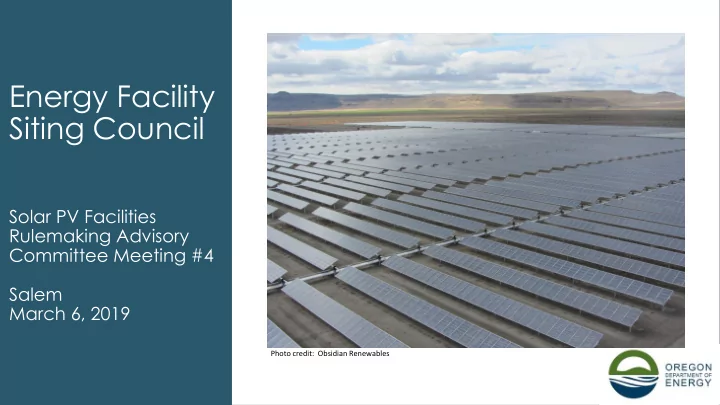
Photo credit: Obsidian Renewables
Energy Facility Siting Council Solar PV Facilities Rulemaking - - PowerPoint PPT Presentation
Energy Facility Siting Council Solar PV Facilities Rulemaking Advisory Committee Meeting #4 Salem March 6, 2019 Photo credit: Obsidian Renewables Agenda 10:30 Introductions & overview 10:40 Updates from Feb. 22 Council meeting
Solar PV Facilities Rulemaking Advisory Committee Meeting #4 Salem March 6, 2019
Photo credit: Obsidian Renewables
10:30 Introductions & overview 10:40 Updates from Feb. 22 Council meeting 10:45 Issues discussion This meeting will be focused on what is constitutes a “solar photovoltaic power generation facility” as that term is used in the definition of “energy facility” under ORS 469.300(11). 12:00 Lunch (provided for RAC members) 12:30 Continuation of issues discussion 2:00 Public comment 2:25 Wrap up and next steps
EFSC Rulemaking Project – Initial Scope:
aggregate in a way that the aggregate is functionally the size of an EFSC jurisdictional solar PV facility;
functionally aggregate to the size of an EFSC jurisdictional solar PV facility, to develop new rules that identify objective criteria for determining the circumstances of when multiple non-EFSC jurisdictional solar PV facilities functionally aggregate to the size of an EFSC jurisdictional solar PV facility; and
solar PV facilities, and if so, to develop such standards.
Question: Can multiple non-jurisdictional solar PV facilities aggregate in a way that is functionally the size of an jurisdictional solar PV facility? Answer: No, a “non-jurisdictional” solar PV facility can not be made subject to Council jurisdiction by rule; however, Council may clarify what constitutes a solar photovoltaic power generation facility if statute is not clear.
Two primary questions:
“solar photovoltaic power generation facility” as that term is used in the definition of “energy facility” under ORS 469.300(11)?
power generation facility,” improve the clarity, consistency, and predictability of solar facility permitting jurisdiction?
This area is divided into several lots and parcels.
Scenario 1: A solar array is developed on parcel A.
Later, an additional array is developed on the same parcel.
Question: Are these two arrays parts of the same facility? Why or why not?
A solar array is developed
single owner.
An additional array is developed on an adjacent tract.
Question: Are these two arrays parts of the same facility? Why or why not?
A solar array is developed
single owner.
An additional array is developed on a tract that is not adjacent.
Question: Are these two arrays parts of the same facility? Why or why not?
project? Is that company related to the owner of the nearby wind energy project? For example, are the companies related through a parent corporation?
included within the site of another wind project?
infrastructure with the nearby wind project?
supporting facilities with the nearby wind energy project?
separate control room? Would the control equipment for the proposed project be located in the same building as the control equipment for the nearby wind energy project?
proposed project be made independent of such decisions for the nearby wind energy project? Would these decisions be made by separate personnel?
routine inspections, fire protection agreements with local authorities, weed control, etc.) for the proposed project be made independent of such
project? Would separate personnel be responsible for making those decisions?
and maintenance staff be shared with the nearby wind energy project?
be sold into the same market as the power output from the nearby wind energy project? In what way would the markets differ?
proposed project be done independent of marketing for the nearby wind energy project?
from the proposed project be separate from the contracts for sale of power output from the nearby wind energy project? Would there be any aggregated sales of power output from the proposed project with power output from the nearby project?
separate from the financing for the nearby project?
the proposed project be separate from contracts for transmission of the output from the nearby wind energy project?
that the proposed project would be a separate wind energy project and not an expansion of a nearby wind energy project? In what other ways would the projects be operated or otherwise treated as separate projects?
(f) “* * * For purposes of applying the acreage standards [Goal 3 exception standards] of this section, a photovoltaic solar power generation facility includes all existing and proposed facilities on a single tract, as well as any existing and proposed facilities determined to be under common ownership on lands with fewer than 1320 feet of separation from the tract on which the new facility is proposed to be sited. Projects connected to the same parent company or individuals shall be considered to be in common ownership, regardless of the
“(2) “Co-location” means two or more projects that exhibit characteristics of a single development, such as common ownership structure, an umbrella sale arrangement, revenue-sharing arrangements, or common debt or equity financing. Projects are not considered co located solely because the same person provides tax equity financing for the projects. Co location of projects is not permitted within a five-mile radius unless: (a) The aggregate nameplate capacity of the co-located projects is three megawatts or less; or (b) The co-located projects are all sited within a single municipality or urban area as defined in the Program Implementation Manual.”
“solar photovoltaic power generation facility” as that term is used in the definition of “energy facility” under ORS 469.300(11)?
power generation facility,” improve the clarity, consistency, and predictability of solar facility permitting jurisdiction?