Energy dissipated by a resistor P IV V IR 2 P I R 2 V - - PowerPoint PPT Presentation
energy dissipated by a resistor
SMART_READER_LITE
LIVE PREVIEW

Energy dissipated by a resistor P IV V IR 2 P I R 2 V - - PowerPoint PPT Presentation

Energy dissipated by a resistor P IV V IR 2 P I R 2 V P R Effective Resistance 1 1 1 Parallel: R R R eff 1 2 Series: R R R eff 1 2 Four identical light bulbs


slide-1
SLIDE 1

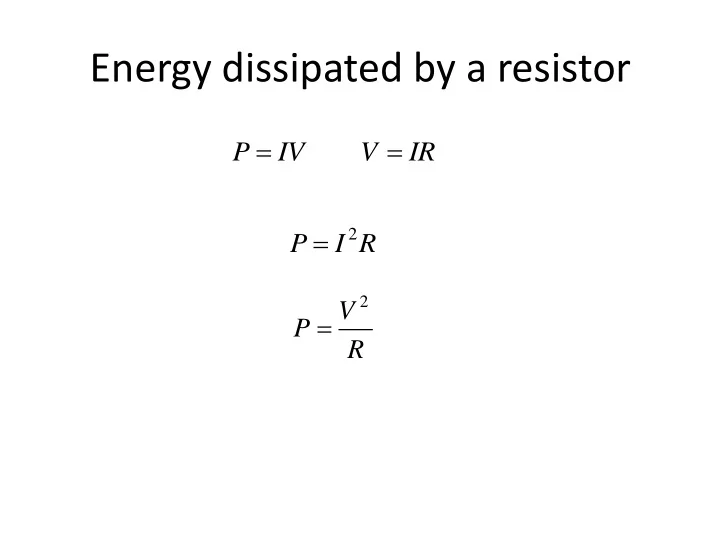
Energy dissipated by a resistor

P IV V IR  

2

P I R 

2

V P R 

slide-2
SLIDE 2

Effective Resistance

  • Parallel:
  • Series:

1 2 eff

R R R   

1 2

1 1 1

eff

R R R   

slide-3
SLIDE 3

V   B1 B2 B3 B4

Four identical light bulbs are connected to a power supply as shown. Which light bulb consumes the most power?

1) B1 2) B2 3) B3 4) B4 5) They all consume the same amount of power.

slide-4
SLIDE 4

Electrostatic Equilibrium and Steady State

  • Equilibrium – the charges in a conductor in

equilibrium have stopped moving.

– Potential is constant throughout a conductor in equilibrium.

  • Steady state – the currents in a circuit are

constant in time.

– A wire carrying a steady-state current is not in equilibrium (unless the current is zero).

slide-5
SLIDE 5
  • Current:
  • Capacitance:

dQ I dt  Q CV 

slide-6
SLIDE 6

Figure 26.59

Discharging a Capacitor

slide-7
SLIDE 7

Figure 26.17a

Charging a Capacitor

slide-8
SLIDE 8

Which curve best represents the charge on the capacitor in a charging RC circuit as a function

  • f time?
slide-9
SLIDE 9

Figure 26.17b

slide-10
SLIDE 10

The switch S is initially at position a for a long time. It is then switched to position b. Describe what happens to the light bulb as a function of time after the switch is flipped from a to b. 1) The light bulb goes on but goes off immediately. 2) The light bulb goes off and stays off. 3) The light bulb goes on but its brightness decreases with time and eventually goes off. 4) The light bulb goes on and stays on at a constant brightness. 5) The light bulb goes on but its brightness increases with time.

bulb C a b S V  

slide-11
SLIDE 11

Figure 26.17c