
SLIDE 1
Warmup
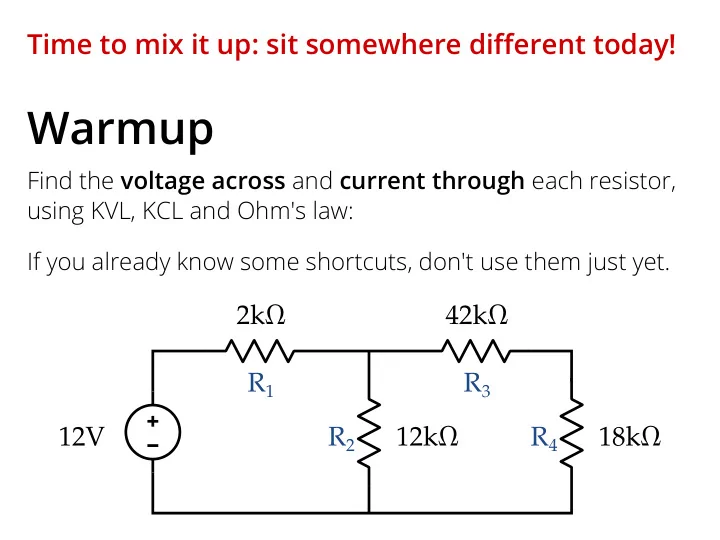
Find the voltage across and current through each resistor, using KVL, KCL and Ohm's law:
12kΩ 18kΩ 42kΩ 2kΩ 12V R1 R3 R2 R4
If you already know some shortcuts, don't use them just yet.
Warmup Find the voltage across and current through each resistor, - - PowerPoint PPT Presentation
Time to mix it up: sit somewhere di ff erent today! Warmup Find the voltage across and current through each resistor, using KVL, KCL and Ohm's law: If you already know some shortcuts, don't use them just yet. 2k 42k R 1 R 3 12V R 2 12k
Find the voltage across and current through each resistor, using KVL, KCL and Ohm's law:
12kΩ 18kΩ 42kΩ 2kΩ 12V R1 R3 R2 R4
If you already know some shortcuts, don't use them just yet.
5 July 2016
Voltages are always relative, so it's meaningless to talk about the voltage "at" a point. But if we define a reference point in our circuit, we can talk about the voltage relative to that. This point is called "ground". There's also "earth ground", which is literally a wire going into the ground somewhere.
Drawing sources sometimes gets annoying when we have several of them. In some cases, we'll simplify the drawing by using one of these symbols for the top of a voltage souce: It's implied that the bottom of the source is connected to ground.
Current sources are still drawn explicitly.
5V 3V 5V
30Ω 30Ω 30Ω
Vdd
Submit your answer on menti.com with code 92 21 3
Find the voltage across and current through each resistor, using what you know about series/parallel simplification:
12kΩ 18kΩ 42kΩ 2kΩ 12V R1 R3 R2 R4
5V
Vout 4kΩ 1kΩ
Find the voltage across each of the vertical resistors.
2kΩ 1kΩ 1kΩ 1kΩ 1V 1kΩ 1kΩ 1kΩ 2kΩ 2kΩ 2kΩ
Challenge: what is something like this good for? (other than annoying students studying circuits)
Find the current through the 4kΩ resistor:
Suppose you had a device that could measure voltages between -200mV and +200mV... But you needed to measure voltages between -2 and +2
Magic measuring boxTM
Magic measuring boxTM
?V
Challenge: What would change if you used larger or smaller resistors?
Now you want to measure current too, using the same voltage-measuring box. Design a circuit that will let you measure current between
Magic measuring boxTM
?A
We're on a roll. Design a circuit that will let you measure resistance, too. Hint: you might need a power source, so that you can get some voltages somewhere.
Magic measuring boxTM
?Ω
3kΩ 12kΩ 6kΩ 21V 14V 8.4V Vcenter