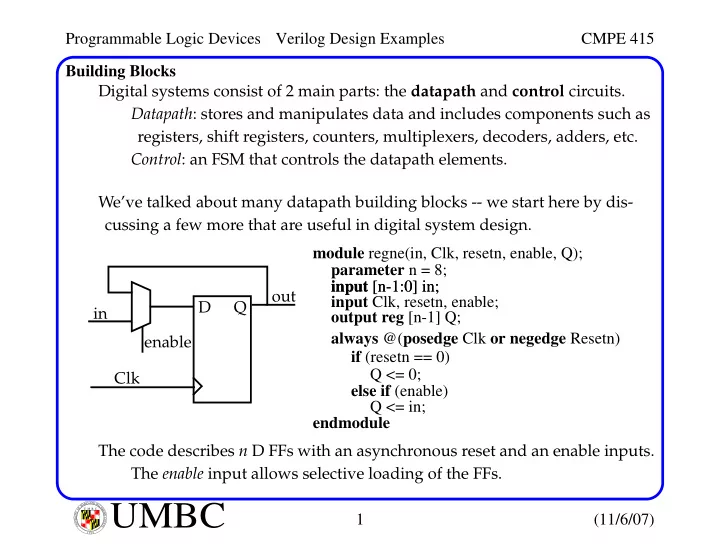
Programmable Logic Devices Verilog Design Examples CMPE 415 Building Blocks Digital systems consist of 2 main parts: the datapath and control circuits. Datapath : stores and manipulates data and includes components such as registers, shift registers, counters, multiplexers, decoders, adders, etc. Control : an FSM that controls the datapath elements. We’ve talked about many datapath building blocks -- we start here by dis- cussing a few more that are useful in digital system design. module regne(in, Clk, resetn, enable, Q); parameter n = 8; input [n-1:0] in; input [n-1:0] in; out input Clk, resetn, enable; D Q in output reg [n-1] Q; always @( posedge Clk or negedge Resetn) enable if (resetn == 0) Q <= 0; Clk else if (enable) Q <= in; endmodule The code describes n D FFs with an asynchronous reset and an enable inputs. The enable input allows selective loading of the FFs. L A N R Y D UMBC A B M A L T F O U M B C I M Y O R T 1 (11/6/07) I E S R C E O V U I N N U T Y 1 6 9 6
Programmable Logic Devices Verilog Design Examples CMPE 415 Building Blocks Left shift register with parallel load and enable inputs. par_load enable in 0 in 1 0 0 0 0 w 1 1 D Q D Q 1 1 Clk Clk out 0 out 1 module shiftlne(in, par_load, enable, w, Clk, Q); parameter n = 4; input [n-1:0] in; input par_load, enable, w, Clk; output reg [n-1] Q; integer k; L A N R Y D UMBC A B M A L T F O U M B C I M Y O R T 2 (11/6/07) I E S R C E O V U I N N U T Y 1 6 9 6
Programmable Logic Devices Verilog Design Examples CMPE 415 Building Blocks always @( posedge Clk) begin if (par_load) Q <= in; else if (enable) begin // non-blocking -- all RHS sampled FIRST. Q[0] <= w; for (k = 1; k < n; k = k+1) Q[k] <= Q[k-1]; end end endmodule SRAM: data 1 data 0 select L A N R Y D UMBC A B M A L T F O U M B C I M Y O R T 3 (11/6/07) I E S R C E O V U I N N U T Y 1 6 9 6
Programmable Logic Devices Verilog Design Examples CMPE 415 Bit Counting Count the number of bits in a register that have the value 1. reset B = 0; S1 while A /= 0 do B <- 0 if a 0 = 1 then B = B + 1; Load A 0 endif 1 0 s s Right-shift A; end while; 1 S2 S3 shift right A done B <- B + 1 1 When S2 is entered, A == 0 A is NOT shifted While s == 0, external until the following 0 operations are loading clock cycle -- we will 0 register A set an enable signal a 0 to allow this. 1 L A N R Y D UMBC A B M A L T F O U M B C I M Y O R T 4 (11/6/07) I E S R C E O V U I N N U T Y 1 6 9 6
Programmable Logic Devices Verilog Design Examples CMPE 415 Bit Counting module bitcount (Clk, resetn, load_A, A_ready, data, cnt, done); input Clk, resetn, load_A, A_ready; input [7:0] data; output reg [3:0] B; output reg done; wire [7:0] A; wire A_zero; reg [1:0] cur_state, next_state; reg en_shift, inc_B, init_B; parameter S1 = 2’b00, S2 = 2’b01, S3 = 2’b10; always @(A_ready, cur_state, A_zero) // Next state logic begin: State_table case (cur_state) S1: if (!A_ready) next_state = S1; else next_state = S2; S2: if (A_zero == 0) next_state = S2; else next_state = S3; S3: if (A_ready) next_state = S3; else next_state = S1; default: next_state = 2’bxx; endcase end L A N R Y D UMBC A B M A L T F O U M B C I M Y O R T 5 (11/6/07) I E S R C E O V U I N N U T Y 1 6 9 6
Programmable Logic Devices Verilog Design Examples CMPE 415 Bit Counting always @( posedge Clk or negedge resetn) // Sequential logic begin: State_flipflops if (resetn == 0) cur_state <= S1; else cur_state <= next_state; end // Combo logic for output signals always @(cur_state or A[0]) begin: FSM_outputs en_shift = 0; inc_B = 0; init_B = 0; done = 0; case (y) S1: init_B = 1; S2: begin // Enabling the shift control signal en_shift = 1; // is asserted on entering state S2 -- if (A[0]) inc_B = 1; // so it’s not available until next Clk else inc_B = 0; end S3: done = 1; endcase end Same is true for inc_B signal -- they are not set/unset until state S2 is active so actions taken by asserting signals in this state don’t take place until next Clk. L A N R Y D UMBC A B M A L T F O U M B C I M Y O R T 6 (11/6/07) I E S R C E O V U I N N U T Y 1 6 9 6
Programmable Logic Devices Verilog Design Examples CMPE 415 Bit Counting always @( posedge Clk or negedge resetn) // Seq. logic for cnter B if (resetn) B <= 0; else if (init_B) B <= 0; else if (inc_B) B <= B + 1; shiftrne shift_A(data, load_A, en_shift, 1’b0, Clk, A) // RIGHT shifter assign A_zero = ~|A; endmodule Note that resetn is NOT used to initialize B after the initial reset of the machine during ’power up’. A separate signal init_B is used to do this when the FSM transitions from state S3 to S1. L A N R Y D UMBC A B M A L T F O U M B C I M Y O R T 7 (11/6/07) I E S R C E O V U I N N U T Y 1 6 9 6
Programmable Logic Devices Verilog Design Examples CMPE 415 Divider The example illustrates division using a the traditional long-hand approach. R = 0; 00001111 Q 15 for i = 0 to n-1 do 9 140 1001 10001100 B A left-shift R|| A; 9 1001 if R >= B then 2n-bit shift 50 10001 q i = 1; 45 register with 1001 R concat with A R = R - B; 5 10000 else 1001 q i = 0; 1110 1001 endif; 101 R endfor; Pseudo-code illustrates operation where A is left shifted, one bit at a time, into R and then R ( not R || A) is compared with B. Q is computed by left shifting a 1 or 0 into the least significant digit based on the comparison of R with B, i.e., if R >= B, shift a 1, else a 0. The remainder, R, is what remains after n clks. L A N R Y D UMBC A B M A L T F O U M B C I M Y O R T 8 (11/6/07) I E S R C E O V U I N N U T Y 1 6 9 6
Programmable Logic Devices Verilog Design Examples CMPE 415 Divider We use a left-shift register with parallel load for R to handle two cases. • If R becomes greater than B (remember, A is shifted into R one bit at a time), then the new value of R is R - B. • If R is less than B, than we shift the MSB bit of A into R. In either case, the R inputs to the subtractor must be driven with the low order n-1 bits of the register R concatenated with the MSB of A. R inputs of adder = R[n-2:0] || MSB(A) However, R itself is R[n-1:0] when the division is completed. To accomplish this, we keep the MSB(A) in a separate 1-bit register: n - 1 n 1 c out c in + n MSB(A) R L A N R Y D UMBC A B M A L T F O U M B C I M Y O R T 9 (11/6/07) I E S R C E O V U I N N U T Y 1 6 9 6
Programmable Logic Devices Verilog Design Examples CMPE 415 Divider Register A is used to store the quotient by left shifting as A is shifted out: Clk cycle R rr 0 A/Q Load A, B 0 0 0 0 0 0 0 0 0 1 0 0 0 1 1 0 0 0 Shift left 0 0 0 0 0 0 0 0 1 0 0 0 1 1 0 0 0 1 Shift left, Q 0 <-0 0 0 1 1 0 0 0 0 0 0 0 0 0 0 0 1 0 2 Shift left, Q 0 <-0 0 1 1 0 0 0 0 0 0 0 0 0 0 0 1 0 0 3 Shift left, Q 0 <-0 1 1 0 0 0 0 0 0 0 0 0 0 0 1 0 0 0 4 Shift left, Q 0 <-0 1 0 0 0 0 0 0 0 0 0 0 0 1 0 0 0 1 5 Subtract, Q 0 <-1 0 0 0 0 0 0 0 1 0 0 0 0 1 0 0 0 1 0 0 0 0 0 0 1 1 6 Subtract, Q 0 <-1 0 0 0 0 1 0 0 0 0 0 0 0 0 0 1 1 1 7 Subtract, Q 0 <-1 0 0 0 0 0 1 1 1 0 0 0 0 0 1 1 1 1 8 Subtract, Q 0 <-1 0 0 0 0 0 1 0 1 0 At clk cycle 0, A’s MSB is left shifted into rr 0 , yielding R || rr 0 = 0_0000_0001, which is smaller than B (1001). At clk cycle 1, rr 0 is left shifted into R while A’s MSB moves into rr 0 . Also, a 0 is shifted into the LSB of A to indicate a 0 in the quotient. At clk cycle 4, R || rr 0 = 0_0001_0001, which is > B , so in clk cycle 5, the result of subtraction 0001_0001 - 1001 = 0000_1000 is loaded into R . L A N R Y D UMBC A B M A L T F O U M B C I M Y O R T 10 (11/6/07) I E S R C E O V U I N N U T Y 1 6 9 6
Programmable Logic Devices Verilog Design Examples CMPE 415 Divider reset S1 Rmux = 0 en_shift_A, rr 0 mux load_R load_cnt en_shift_R S2 en_shift_R, rr 0 mux Also load en_shift_A, Rmux A&B 0 1 s 0 1 s 0 c out S3 1 done en_cnt load_R cnt 1 0 == 0 ? L A N R Y D UMBC A B M A L T F O U M B C I M Y O R T 11 (11/6/07) I E S R C E O V U I N N U T Y 1 6 9 6
Programmable Logic Devices Verilog Design Examples CMPE 415 Divider Hardware requirements: • Register for B. • Two shift registers for A and R. • A subtractor for R-B (implemented as an adder with carry = 1 and B com- plemented). The c out of this module is 1 if R >= B. c out connected to the serial input of the shift reg that stores Q. • A multiplexer feeding the input to R because it is loaded with 0 in state S1 and from the output of the adder in S3. • A down counter to implement cnt . • A NOR gate to determine when C == 0. L A N R Y D UMBC A B M A L T F O U M B C I M Y O R T 12 (11/6/07) I E S R C E O V U I N N U T Y 1 6 9 6
Recommend
More recommend