
SLIDE 1
Callixte KAMBANDA Manager - Energy Policy, Regulation & Statistics African Development Bank c.kambanda@afdb.org
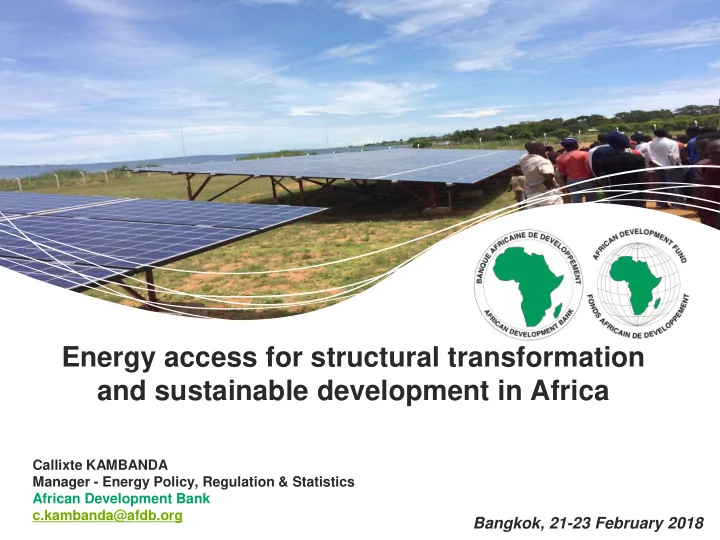
Energy access for structural transformation and sustainable development in Africa
Bangkok, 21-23 February 2018
Energy access for structural transformation and sustainable - - PowerPoint PPT Presentation
Energy access for structural transformation and sustainable development in Africa Callixte KAMBANDA Manager - Energy Policy, Regulation & Statistics African Development Bank c.kambanda@afdb.org Bangkok, 21-23 February 2018 Energy access
Callixte KAMBANDA Manager - Energy Policy, Regulation & Statistics African Development Bank c.kambanda@afdb.org
Bangkok, 21-23 February 2018
1
c
2
Source: AfDB, 2016
1 Association of Southeast Asian Nations. 2 Bangladesh, DPR Korea, India, Mongolia, Nepal, Pakistan, Sri Lanka, Other Asia.
3
c
18 8 14 13 2 4 6 8 10 12 14 16 18 20 "Less than 5%" "Between 5-10%" "Between 10-40%" "Above 40%"
African countries grouped by level of their population percentage with primary reliance on clean fuels and technology (2014)
0,0 20,0 40,0 60,0 80,0 100,0 Central Africa East Africa North Africa Africa Sub-Saharan Africa Southern Africa West Africa
Africa - % of population with access to electricity
2014 2016 Source: AfDB, 2017
positive trend but significant efforts needed to achieve the SDG7 by 2030
4
c
areas; and
areas.
connections
One billion Africans have access to modern energy services NDEA is partnership driven effort
Source: AfDB, 2015
5
Universal access by 2025 means: 200 millions HH connected and nearly doubling the current grid generation capacity.
≈ 80 GW of new capacity currently under construction ≈ 160 GW of new Capacity to be added. ≈ 130 M new
connections ≈ 75 M new off- grid connections
Source: AfDB, 2015
6
c
Source: AfDB, 2017
INVESTMENT NEEDS TO ACHIEVE NDEA TARGETS
≈ USD 30 bn : Total average annual investment needed (new estimates). ≈ USD 230 bn : Total investment needs by 2030 ≈ USD 420 bn : Total investment needs by 2040
≈ USD 75 bn of currently under construction (80 GW)
7
c
Household access to electricity (Million) and Connection rate (%) projections
Source: AfDB Statistics Department and Muticonsult
8
c
Universal access by year of realization
Source: AfDB Statistics Department and Muticonsult
9
East Africa
capacity by 2030.
integration
demand and utilize comparative resources advantages
Southern Africa
dampens forecasted demand growth and new investment requirements
continues to dominate the generation mix
significant benefits from the integration
Source: Atlas of Africa Energy Resources, ICA 2017
10
African Regional Power Pool (RPP) Installed Capacity in the RPP (MW) Total Consumption in the RPP (GWh) Projected Demand by 2030 (TWh) Projected Investment Needs by 2030 (USD bn)
Southern Africa Power Pool (SAPP)
61,859 (2015) 269,375 (2015) 570 270
West Africa Power Pool (WAPP)
19,648 (2015) 50,634 (2015) 250 170
Eastern Africa Power Pool (EAPP)
54,311 (2013) 232,505 (2013) 500 400
Central Africa Power Pool (WAPP)
6,299 (2013) 24,744 (2013) 90 60
Comité Maghrebin d'Electricité (COMELEC)
36,367 (2013) 120,200 (2013) 980 450
PIDA1 estimated that Regional Integration would save USD 33 billion p.a.
1PIDA: Program for Infrastructure Development in Africa
Source: Regional Power Pool Report, ICA 2015
are already at or near full access
therefore primarily driven by the forecasted economic growth
11
c
12
Call llixt ixte KAMBA BANDA | Division ion Mana nager ger | P Poli licy cy, Regul gulatio tion n and d Statis tistic ics| Energy gy Solut utions, ions, Poli licy cy and d Regul ulatio tion Departme ment nt | Afri rica can n Deve velopmen ent Bank nk | 01 B.P . 1387 387 Abidjan idjan 01- Ave venu nue e Jean n Paul ul II Côte d'Ivoire e | T Tel : (225) 25) 2026 26 2649 49 | E-mail il: c.kamb mbanda da@afd @afdb.or b.org