Emergenta system C-kurs, 5 pong, HT-05 Jonny Pettersson - - PDF document

emergenta system
SMART_READER_LITE
LIVE PREVIEW

Emergenta system C-kurs, 5 pong, HT-05 Jonny Pettersson - - PDF document

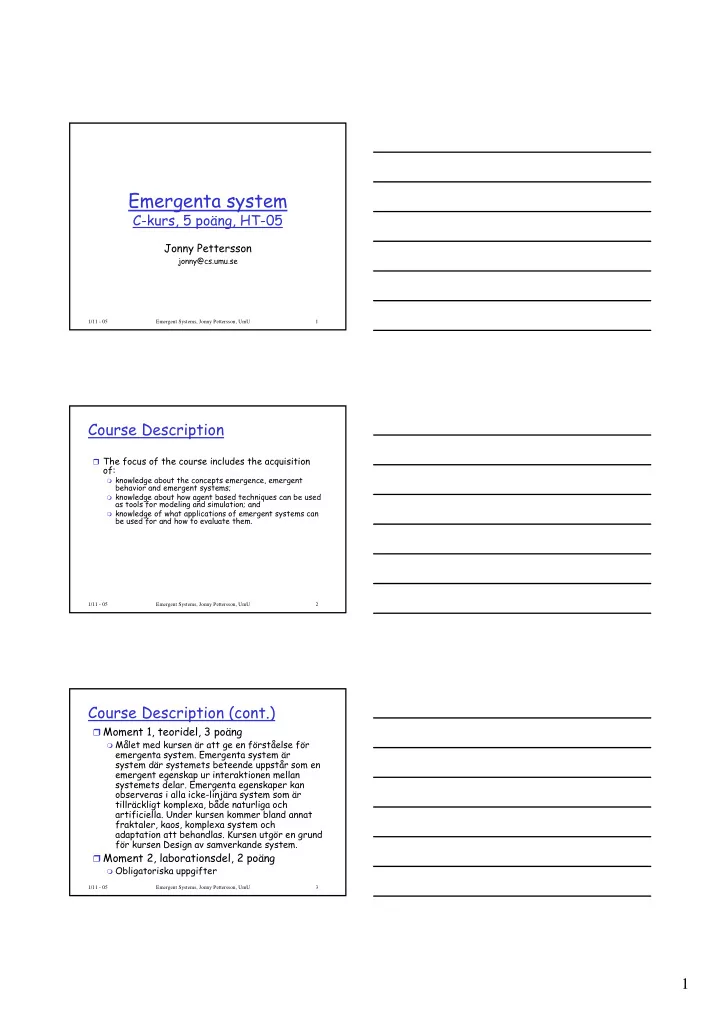
Emergenta system C-kurs, 5 pong, HT-05 Jonny Pettersson jonny@cs.umu.se 1/11 - 05 Emergent Systems, Jonny Pettersson, UmU 1 Course Description The focus of the course includes the acquisition of: knowledge about the concepts


slide-1
SLIDE 1

1

1/11 - 05 1 Emergent Systems, Jonny Pettersson, UmU

Emergenta system

C-kurs, 5 poäng, HT-05

Jonny Pettersson

jonny@cs.umu.se

1/11 - 05 2 Emergent Systems, Jonny Pettersson, UmU

Course Description

The focus of the course includes the acquisition

  • f:

knowledge about the concepts emergence, emergent

behavior and emergent systems;

knowledge about how agent based techniques can be used

as tools for modeling and simulation; and

knowledge of what applications of emergent systems can

be used for and how to evaluate them.

1/11 - 05 3 Emergent Systems, Jonny Pettersson, UmU

Course Description (cont.)

Moment 1, teoridel, 3 poäng

Målet med kursen är att ge en förståelse för

emergenta system. Emergenta system är system där systemets beteende uppstår som en emergent egenskap ur interaktionen mellan systemets delar. Emergenta egenskaper kan

  • bserveras i alla icke-linjära system som är

tillräckligt komplexa, både naturliga och

  • artificiella. Under kursen kommer bland annat

fraktaler, kaos, komplexa system och adaptation att behandlas. Kursen utgör en grund för kursen Design av samverkande system. Moment 2, laborationsdel, 2 poäng

Obligatoriska uppgifter

slide-2
SLIDE 2

2

1/11 - 05 4 Emergent Systems, Jonny Pettersson, UmU

Last year

First time An interesting course with good result Average workload Literature

Good and not so difficult to read

Assignments and project

Interesting

1/11 - 05 5 Emergent Systems, Jonny Pettersson, UmU

This Course

Text book + papers

Computer programs

Focus on

Fractals Chaos Complex Systems Adaptation

Contents

Lectures Guest lectures Assignments Project 1/11 - 05 6 Emergent Systems, Jonny Pettersson, UmU

Assignments and Project

Assignments

L-systems NetLogo and termites

  • First (?) contact with NetLogo
  • Termites – a simple system with emergent behavior

Boids Genetic Algorithms 2 and 2 in the assignments

Project

1 to 4 in the project

slide-3
SLIDE 3

3

1/11 - 05 7 Emergent Systems, Jonny Pettersson, UmU

Teaching

Pedagogical thoughts Slides

Source Contents Language

What should you learn?

1/11 - 05 8 Emergent Systems, Jonny Pettersson, UmU

The rest of today

Concepts

Emergence, emergent systems, …

Life

Real life Artificial life

Topics

1/11 - 05 9 Emergent Systems, Jonny Pettersson, UmU

Emergence

Definitions

The whole is more then a sum of parts The global behavior could not be predicted

from lower levels

Something that emerges in the interactions

between simple(?) parts and the environment, and that is not described in the parts Emergent properties Emergent systems Example: Ants

slide-4
SLIDE 4

4

1/11 - 05 10 Emergent Systems, Jonny Pettersson, UmU

Emergent Behavior

Bottom-up Distributed Local determination of behavior On all levels Example: The human body

1/11 - 05 11 Emergent Systems, Jonny Pettersson, UmU

Properties of Emergent Systems

Many interacting parts Decentralized Non-linear Dynamic Competition and cooperation Emergent properties

1/11 - 05 12 Emergent Systems, Jonny Pettersson, UmU

Many interacting parts

Societies made of many people, people

made of many organs, organs made of many cells

A system of parts because of interactions Number of parts may differ Massive parallelism

Often many simple parts doing the same thing Complexity comes from interaction

Example: Weather

slide-5
SLIDE 5

5

1/11 - 05 13 Emergent Systems, Jonny Pettersson, UmU

Decentralised

Self-organization

The order emerges from the system itself

Advantages of decentralization

Easier to adapt to changes A system does not need to have a smart leader

Examples:

WWW Peer-to-peer architectural models

1/11 - 05 14 Emergent Systems, Jonny Pettersson, UmU

Non-linear

Do not obey the superposition principle

Output is not proportional to input

Interactions between parts Example: Phase transitions

Solid – liquid - gas

1/11 - 05 15 Emergent Systems, Jonny Pettersson, UmU

Dynamic

Often the interactions continues on and on

Does not always come to a ”fixed” state Can be better to handle changing environments

Dynamic systems can have different amounts of

complexity

Example:

Society

slide-6
SLIDE 6

6

1/11 - 05 16 Emergent Systems, Jonny Pettersson, UmU

Competition and Cooperation

Some agents may cooperate Some agents may fight for the same

resource

Some agents may destroy what others

tries to do

Example: Producer-consumer systems

1/11 - 05 17 Emergent Systems, Jonny Pettersson, UmU

Discussion

Questions to consider:

What is the emergent property? What is the goal of the system? Does each agent know the goal? How was the system created?

Emergent systems in the society Emergent systems in the nature

1/11 - 05 18 Emergent Systems, Jonny Pettersson, UmU

Complex Systems

(Almost) like emergent systems

Many parts Interdependent parts

Difficult to understand

The behavior of the whole system understood

from behavior of the parts

The behavior of the parts depends of the

behavior of the whole system Example: Family

slide-7
SLIDE 7

7

1/11 - 05 19 Emergent Systems, Jonny Pettersson, UmU

Adaptation

Can lead to improved fitness and

performance, or just to be able to survive

Adaptation can happen in three ways

Improved handling of an event by the agent Learning – in the lifetime of the agent Evolution – across generations

1/11 - 05 20 Emergent Systems, Jonny Pettersson, UmU

Complex Adaptive Systems

An complex adaptive system is a system

consisting of many interacting parts. The behavior of the system emerges out of the parallel interactions between the parts and the environment without any global plan. The parts adapt and evolve over time.

Example: Ecosystems

1/11 - 05 21 Emergent Systems, Jonny Pettersson, UmU

Life – What is Life?

Vitalism

Life is ”something” extra over and above the detailed

  • rganization of a material organism

Langton, 1988

”…living organisms are nothing more than complex

biochemical machines. … A living organism … must be viewed as a large population of relatively simple machines.”

”Life is a property of form, not matter”

Flake, 1998

”Nature appears to be a hierarchy of computational

systems that are forever on the edge between computability and incomputability.”

slide-8
SLIDE 8

8

1/11 - 05 22 Emergent Systems, Jonny Pettersson, UmU

Life - Biology

Does it have to be the study of carbon-

based life?

The Concise Oxford Dictionary, 1990

Biology – The study of living organisms

Merriam-Webster´s Collegiate Dictionary

Biology - A branch of knowledge that deals with

living organisms and vital processes From Greek

bios – life logus - discourse

1/11 - 05 23 Emergent Systems, Jonny Pettersson, UmU

Life – Artificial Life

Langton, 1988

”Artificial Life is the study of man-made

systems that exhibit behaviors characteristic

  • f natural living systems.”

”… Artificial Life can contribute to theoretical

biology by locating life-as-we-know-it within the larger picture of life-as-it-could-be.”

”The artificial in Artificial Life refers to the

component parts, not the emergent processes.”

1/11 - 05 24 Emergent Systems, Jonny Pettersson, UmU

From Chaos to Life

Living organisms are nonlinear systems! Living organisms are complex systems! How has nature achieved this?

slide-9
SLIDE 9

9

1/11 - 05 25 Emergent Systems, Jonny Pettersson, UmU

From Chaos to Life - Naturally

Evolution through natural selection

Darwin, The Origin of Species, November 24,

1859

Genotype – phenotype Criteria for evolution

  • Heredity
  • Variability
  • Fecundity

The role of environment Co-evolution

A necessary condition?

Self-similarity Self-organization

1/11 - 05 26 Emergent Systems, Jonny Pettersson, UmU

From Chaos to Life - Artificially

How to do this artificially?

Can not predict the global behavior of simple

interacting subparts

Can not decide which subparts to use to get a

predetermined global behavior You must ”run” the system to see what kind

  • f global behavior it generate

You need methods to search through the

solution space of a nonlinear system

1/11 - 05 27 Emergent Systems, Jonny Pettersson, UmU

From Chaos to Life - Artificially

Methods in Artificial Life

Lindenmayer systems Cellular Automata Boids, herds and flocks Ant Algorithms Genetic Algorithms And more…

slide-10
SLIDE 10

10

1/11 - 05 28 Emergent Systems, Jonny Pettersson, UmU

Fractals

Lindenmayer systems

Consist of sets of rules

for rewriting strings of symbols

“Random processes in

nature are often self- similar on varying temporal and spatial scales” (Flake, 1998)

Example: Flake

1/11 - 05 29 Emergent Systems, Jonny Pettersson, UmU

Chaos – Dynamic Systems

Examples of dynamic

systems

Computability -

Incomputability

Fractals Cellular Automata 1/11 - 05 30 Emergent Systems, Jonny Pettersson, UmU

Chaos - Characteristics

Deterministic

Not random

Sensitive

Extremely sensitive to initial conditions

Ergodic

A chaotic system will return to the ”same” place

slide-11
SLIDE 11

11

1/11 - 05 31 Emergent Systems, Jonny Pettersson, UmU

Cellular Automata

John Von Neumann,

Stanislaw Ulam, 1940s

One-dimensional

A linear grid with cells

  • f finite-state-

machines

At each time step, the

next step of a cell is computed as a function

  • f its neighbors states

Four complexity

classes

1/11 - 05 32 Emergent Systems, Jonny Pettersson, UmU

Cellular Automata

Two-dimensional

Example: Conway´s Game of Life

  • Loneliness: Less than two neighbors, die
  • Overcrowding: More than three neighbors, die
  • Reproduction: Empty cell with three neighbors, live
  • Stasis: Exact two or three neighbors, stay the same

1/11 - 05 33 Emergent Systems, Jonny Pettersson, UmU

Autonomous Agents

Ant Algorithms

Ants deposits

pheromones when they move

They dynamically find

the ”shortest” way

slide-12
SLIDE 12

12

1/11 - 05 34 Emergent Systems, Jonny Pettersson, UmU

Autonomous Agents

Boids, herds and flocks

Craig Reynolds, 1986 Simple behaviors Separation Cohesion Alignment Neighborhood

1/11 - 05 35 Emergent Systems, Jonny Pettersson, UmU

Genetics and Evolution

Genetic Algorithms

Holland, 1960s A simple algorithm:

  • 1. Start with a randomly generated population of

candidate solutions to a problem

  • 2. Calculate the fitness of each solution in the

population

  • 3. Apply selection and genetic operators to the

population to create a new population

  • 4. Go to step 2

Example: Breve, Jon Klein

1/11 - 05 36 Emergent Systems, Jonny Pettersson, UmU

Competition and Cooperation

Game theory The evolution of cooperation The Prisoner’s Dilemma

Iterated Spatial

slide-13
SLIDE 13

13

1/11 - 05 37 Emergent Systems, Jonny Pettersson, UmU

Simulation and Modelling

Emergence is explained Want the simplest system that produce

the emergent behavior

Ockham’s razor (1285 – 1347/49)

Not complete models of reality

Focus on the essence of the system Not clones

1/11 - 05 38 Emergent Systems, Jonny Pettersson, UmU

Why Study Emergent Systems?

Fundamental to theory and implementation

  • f massively parallel, distributed

computation systems

Goals/challenges

Efficiency Self-optimizing Adaptive Robust to failures Security

Nature as a source

Try to understand nature Use nature as an inspiration

1/11 - 05 39 Emergent Systems, Jonny Pettersson, UmU

Summary

Concepts

Emergence, emergent systems, …

Life

Real life Artificial life

Topics

slide-14
SLIDE 14

14

1/11 - 05 40 Emergent Systems, Jonny Pettersson, UmU

Next Time

Fractals NetLogo Assignment 1