Email: mirelatase@hotmail.com The aim is to study what is happening - - PowerPoint PPT Presentation

email mirelatase hotmail com
SMART_READER_LITE
LIVE PREVIEW

Email: mirelatase@hotmail.com The aim is to study what is happening - - PowerPoint PPT Presentation

Dr. Mirela Tase Department of Tourism Alkesander Moisiu University Albania Email: mirelatase@hotmail.com The aim is to study what is happening with this heritage in one of the countries in Europe where this heritage have been


slide-1
SLIDE 1
  • Dr. Mirela Tase

Department of Tourism Alkesander Moisiu University Albania Email: mirelatase@hotmail.com

slide-2
SLIDE 2

 The aim is to study what is happening with this

heritage in one of the countries in Europe where this heritage

 have been discussed and emphasized the least and

also to contribute to the discussion

 about heritage from difficult periods and events

and show what different meanings it may have instead of labeling it “unwanted heritage”

slide-3
SLIDE 3

 The

interviews with professionals had two purposes.

 The

interviews were

  • rganized as conversations,

without fixed questions

 The main purpose was

to explore who works

 with communist

heritage, which communist heritage, how and why and also to capture the current

 debate and the

informant's role and her or his opinions.

slide-4
SLIDE 4
slide-5
SLIDE 5

 Albania was the strongest communist

regime in Europe, isolated from the rest

  • f the world between 1944 and 1990.

 The communist ideology was reflected

in the physical environment, which was changed in a harsh way during this period

 Religious buildings were demolished or

turned into profane buildings since Albania in theory was an atheistic state

 Construction

and architecture in Albania after the Second World War until 1990, exactly for 45 years, were guided by the principles of socialist realism

 There were radical changes in social

and economic structure, as well as in the urban structure and the Albanian urban heritage because of the socialist realism ideas

 One of the most obvious examples of

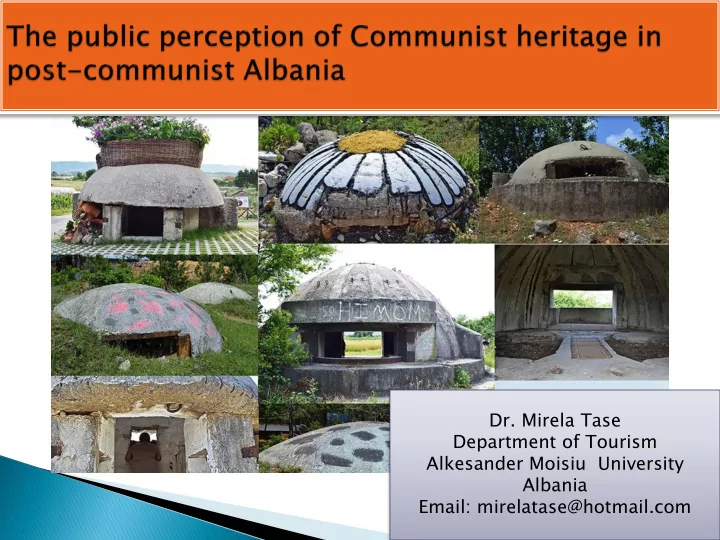
the built communist heritage is between 300 000 and 800 000 concrete bunkers which Enver Hoxha let build all over the country.

slide-6
SLIDE 6

 Among the first buildings that reflected

the socialist style in Albania was the industrial building of “Stalin” Textiles Factory

 It was constructed in the early 1950s in

the suburbs of Tirana.

slide-7
SLIDE 7

 In the 1960s religion was prohibited in

Albania which in theory became the world's first atheist state. More than 2000 religious buildings were either transformed into profane buildings or demolished

 Palace is a type of building that is very

typical for communist countries, because culture was controlled and created by the government

 To return to traditional architecture

was also prohibited

slide-8
SLIDE 8

 Buildings were sometimes decorated

with mosaics or reliefs with socialist realist motives

 The artworks were realistic, optimistic

heroic and glorified the lives of peasants and workers and their struggle towards socialist progress

slide-9
SLIDE 9

 At the end of the 70s, Albania entered

the path of isolation

 the state began investing in setting up

a tourist hotel chain in major city centers as a clear attempt to convey the image of triumph and avoid from developments

 These hotels as a result of isolation

were frequented mostly by the native tourists than foreign tourists

slide-10
SLIDE 10

 The "Enver Hoxha" Museum, which

itself was summed up as a culmination

  • f the myth of the extinct dictator.

 The building was named Pyramid by

most people so the majority opinion is taken into consideration, but in fact the building looks so only if you are below it.

slide-11
SLIDE 11

 The

urban development was characterized by chaos and irregularity with no development plans or policies during the first years after the fall of communism.

 In Tirana a great number of buildings

were built legally but with no respect to the most elementary rules of urban planning

 The colorful facades have been known

  • utside Albania which has been

important for the city and the nation which do not want to be connected with their communist past, poverty and other problems.

slide-12
SLIDE 12

 Physical reminders of communism are everywhere in the capital  The military communist heritage is still present in the centre of Tirana  The Pyramid has since the fall of communism functioned as a conference centre, a

night club, offices for a TV company and a cultural centre

 Nowdays pyramid is abandoned and declined . In front of the Pyramid the Peace

Bell installation was raised in 1999. The bell is made of metal from bullet cartridges from the turbulent 1990s in Albania

slide-13
SLIDE 13

 The recent debate in Albania has concerned what heritage from the communist

period is, how it is part of shaping the contemporary society and if and how it should be protected for the future.

 Some people argues that it is important to preserve this heritage for the younger

and future generations to give them the possibility to understand the older generations, themselves and their society better

 I thought that the memory gap between generations is especially big in Albania

compared to other countries and that young people today lack knowledge about how their parents lived during communism

 The communist past is present in places and names, but they might be present

without people putting any value to them or even knowing about their origin. Former names and concepts may have been given new meanings.

slide-14
SLIDE 14

 The Pyramid could be preserved and symbolize Hoxha and the former regime with

the purpose to remind people of the past without honoring it.

 We have two contradictors between the government and society. Mostly of target

people which range from over 60 years wanted to safe and show the other generation the pyramid which symbolize the communism system

 On the other hand during 2010 the government where the prime minister was Sali

Berisha decided to demolish the pyramid but they do not realized

 The solution to demolish difficult heritage as a way to move on from the difficult

past and to build a cityscape of their own is practiced by the government in the case with the Pyramid.

slide-15
SLIDE 15

 1. How is tangible heritage of communism regarded and

valued by heritage professionals in Albania today? Which are the reasons to preserve or not preserve communist heritage, according to heritage professionals?

 2. Is the communist heritage an unwanted heritage in

Albania today?

slide-16
SLIDE 16

 Communism affected the landscape and cityscape in almost every aspect. The

common viewpoint among the people is however that different kind of communist heritage should be preserved.

 The Pyramid and other communist heritage sites and buildings are also storehouses

for personal memories, both positive and negative, from the communist period and after 1991

 To remember is also commonly seen as a way to prevent the same mistake to be

done again.

 Citizens of Tirana have had few opportunities to discuss the recent past and express

their opinions about heritage protection. This makes it difficult to know whether communist heritage is unwanted or not in Albania today

slide-17
SLIDE 17

 All of the interviews would like to see more buildings from the communist period,

including the Pyramid, to be recognized as heritage, preserved and protected.

 Heritage from the period is seen as one way to keep memories alive. Heritage from

the communist past have been lost and will be lost, but because of the rising debate and because of the Pyramid case which has intensified the debate and engaged many Tirana citizens, much of it might be protected and preserved for the future.

slide-18
SLIDE 18