
2012-08-26 1
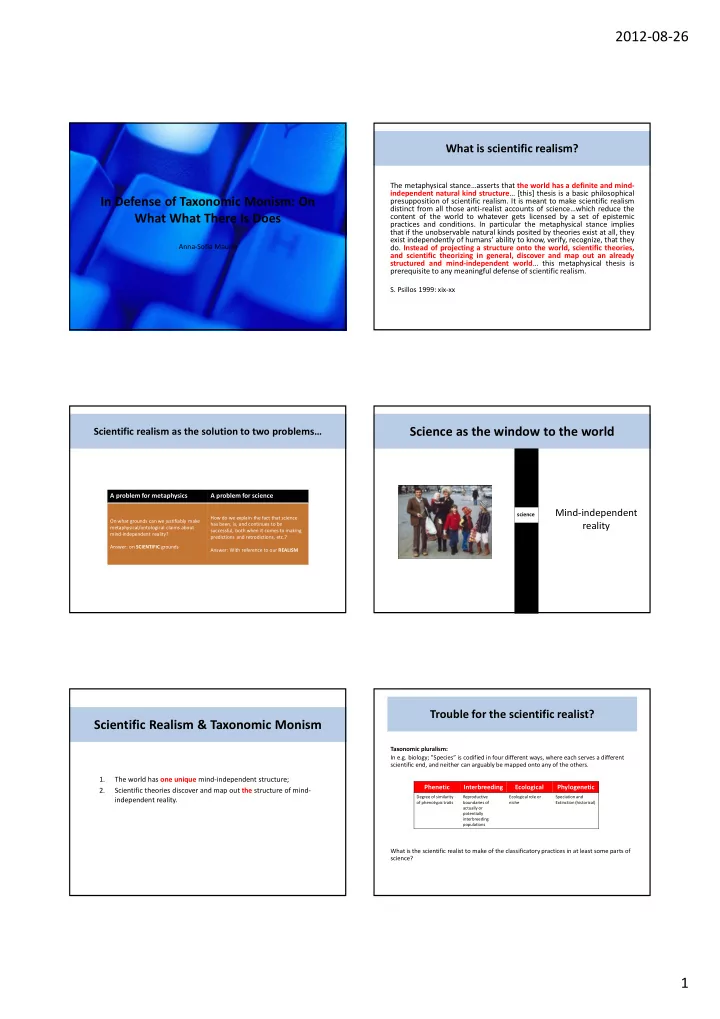
In Defense of Taxonomic Monism: On What What There Is Does
Anna-Sofia Maurin
What is scientific realism?
The metaphysical stance…asserts that the world has a definite and mind- independent natural kind structure… [this] thesis is a basic philosophical presupposition of scientific realism. It is meant to make scientific realism distinct from all those anti-realist accounts of science…which reduce the content of the world to whatever gets licensed by a set of epistemic practices and conditions. In particular the metaphysical stance implies that if the unobservable natural kinds posited by theories exist at all, they exist independently of humans’ ability to know, verify, recognize, that they
- do. Instead of projecting a structure onto the world, scientific theories,
and scientific theorizing in general, discover and map out an already structured and mind-independent world… this metaphysical thesis is prerequisite to any meaningful defense of scientific realism.
- S. Psillos 1999: xix-xx
Scientific realism as the solution to two problems…
A problem for metaphysics A problem for science
On what grounds can we justifiably make metaphysical/ontological claims about mind-independent reality? Answer: on SCIENTIFIC grounds How do we explain the fact that science has been, is, and continues to be successful, both when it comes to making predictions and retrodictions, etc.? Answer: With reference to our REALISM
Science as the window to the world
science
Mind-independent reality
Scientific Realism & Taxonomic Monism
1. The world has one unique mind-independent structure; 2. Scientific theories discover and map out the structure of mind- independent reality.
Trouble for the scientific realist?
Taxonomic pluralism: In e.g. biology; ”Species” is codified in four different ways, where each serves a different scientific end, and neither can arguably be mapped onto any of the others. What is the scientific realist to make of the classificatory practices in at least some parts of science? Phenetic Interbreeding Ecological Phylogenetic
Degree of similarity
- f phenotypic traits
Reproductive boundaries of actually or potentially interbreeding populations Ecological role or niche Speciation and Extinction (historical)