
SLIDE 1
1
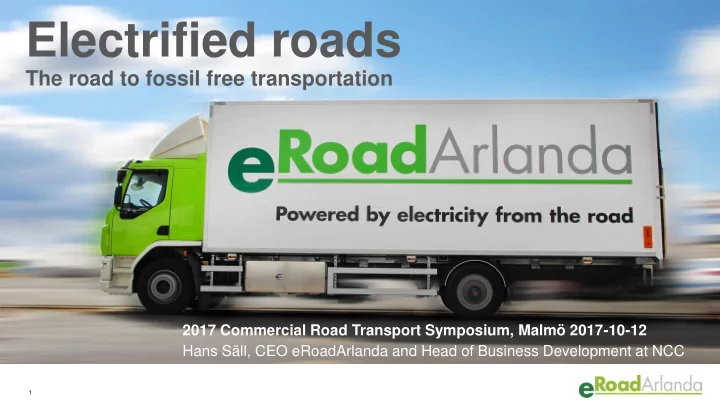
Electrified roads
The road to fossil free transportation
2017 Commercial Road Transport Symposium, Malmö 2017-10-12 Hans Säll, CEO eRoadArlanda and Head of Business Development at NCC
Electrified roads The road to fossil free transportation 2017 - - PowerPoint PPT Presentation
Electrified roads The road to fossil free transportation 2017 Commercial Road Transport Symposium, Malm 2017-10-12 Hans Sll, CEO eRoadArlanda and Head of Business Development at NCC 1 eRoadArlanda A pre-commercial procurement In
1
The road to fossil free transportation
2017 Commercial Road Transport Symposium, Malmö 2017-10-12 Hans Säll, CEO eRoadArlanda and Head of Business Development at NCC
process was initiated in June 2013 – the largest yet in Europe – by the Swedish Transport Administration, VINNOVA and the Swedish Energy Agency.
two of the eleven consortiums will electrify existing public roads: eRoadArlanda and Gävle Electric Road.
3
Källa: Ny Teknik
1/3 from heavy vehicles 2/3 from cars
– Gasoline = 30% – Electricity = 85%
– Gasoline = 6 SEK = 100 % – Electricity = 25 % – Difference = 75 %
2015-12-11 eRoadArlanda
1 2 3
battery powered
leasing and battery replacement was introduced.
2015-12-11 eRoadArlanda
and manufactured by Siemens
more than 350 different trolley-bus systems in the world
If all cars in Sweden were a Tesla: = 2 miljoner m3 batteries If all heavy vehicles is equipped with 4 h electrical driving power = 0,2 miljoner m3 batteries
11
Significant cost and environmental savings! If passenger cars can use the technique for electrified roads. 325 m 472m 47 m
12
0,05 400
Example Germany
Millions of electric vehicles km of electrified roads
0,8 0,2 0,5
0,2 0,3 0,4 0,5 0,6 0,7 0,8 0,9 COST IN GEUR Non elecric roads- cost of batteries Electric roads- Cost of batteries Cost of electrified roads
13
50 33100
Example Germany
Millions of electric vehicles km of electrified roads
768 17 49
200,0 300,0 400,0 500,0 600,0 700,0 800,0 900,0 COST IN GEUR Non elecric roads- cost of batteries Electric roads- Cost of batteries Cost of electrified roads
45 km Direct feed Battery In Sweden it would be sufficient to electrify 20 000 km of totally almost 500 000 km roadways at a cost of about 10 - 15 BnEUR
Sweden are importing fossil fuel amounting to 6 BnEUR every year
Conductive technology – feeding from above
Inductive technology – feeding from the road
Conductive feeding from the road- Our choice
while driving
50 km range.
than one MEUR/km
20
2 200 vehicles per day
45 11 33
Cost in thousand EUR per km and year
Cost of truck and car fuel Cost of electricity for trucks and cars Cost of electric road
21
20 000 vehicles per day
409 103 33
Cost in thousand EUR per km and year
Cost of truck and car fuel Cost of electricity for trucks and cars Cost of electric road
22
100 000 vehicles per day
2 047 516 33
Cost in thousand EUR per km and year
Cost of truck and car fuel Cost of electricity for trucks and cars Cost of electric road
25
Target in full production: 1 km per hour
removed.
power of 226 kilowatts (300 hp).
acceleration and stable with low center of gravity
May 2012.
2014.
version 3 in August 2016.
installed in March 2017.
28
during the project.
starting from scratch.
lot of anxiety and tough demands.
rails.
standards.
been a long and bureaucratic process.
29
Rosersberg Freight Terminal
been finalized in September 2017.
the road.
30