SLIDE 1
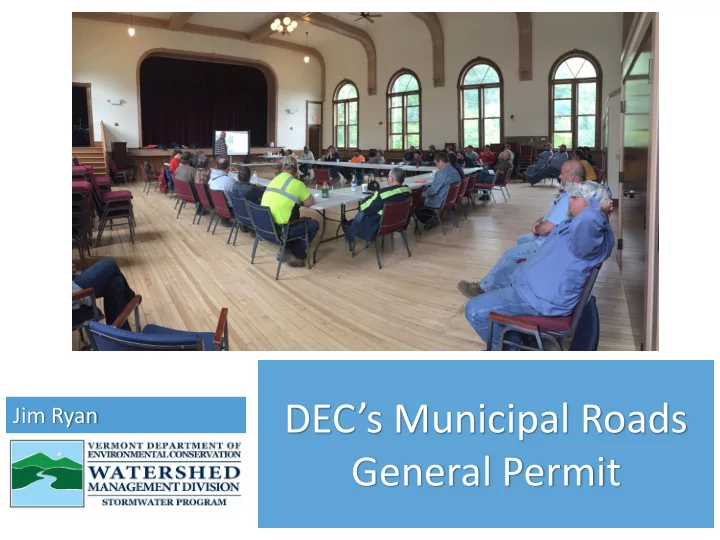
DEC’s Municipal Roads General Permit
Jim Ryan
SLIDE 2 Today’s Presentation
- Roads and water quality
- MRGP Timelines and coverage
- Hydrologic connectivity
- Road Erosion Inventories
- Very High Priority roads and prioritization
- Implementation Table and Annual Reporting
- MRGP Standards
- MRGP Fees
- Available assistance and summary for
municipalities
SLIDE 3 Vermont Road Mileage
- 18,777 total road miles
- 155 miles of federal roads-
1%
highway- 14%
roads- 15%
highway (Classes 1-4)- 70%
Road Miles
State Highway Municipal roads Private roads Federal roads
SLIDE 4 Municipal Road Classes
Road Classes
Class 1 Class 2 Class 3 Class 4
Road Class Distribution (annually reported to Vtrans)
- Class 1: 139 miles or 1.1%
(VTrans and municipally- maintained)
- Class 2: 2,790 miles or 21.2%
- Class 3: 8,535 miles or 65.2%
- Class 4: 1,627 miles or 12.5%
SLIDE 5 Potential Road Pollutants
- Nutrients – Phosphorus
- Sediment
- Trace heavy metals
- Hydrocarbons
- Road salt
SLIDE 6 Modeled phosphorus loading to Lake Memphremagog
(Municipal roads approximately 6.6% of total P)
SLIDE 7 Secondary benefits: Flood resilience and reducing town road maintenance and costs
Photo Credits: Beverley Wemple Wemple Bryan Pfeiffer
SLIDE 8 Draft municipal roads general permit Summer-Fall 2017
Municipalities apply for MRGP coverage (NOI) and pay fees
July 31, 2018
MRGP Timeline of Deliverables (Near-Term)
2020 2017
MRGP public hearings and comments
2018 2019
MRGP Issued January 2018
Required implementation of priority road projects. A minimum of 15% of non-compliant segments upgraded to meet standards in 2021 and 2022
2021
2021 and 2022 Starting in 2019- Annual Reports due April 1st
2022
Initial Road Erosion Inventory and Implementation Table Due December 31, 2020
SLIDE 9 December 31, 2025
MRGP Timeline of Deliverables (Longer-Term)
On-going MRGP practice implementation and maintenance throughout
2023
All Very High Priority segments (except Class 4) upgraded
2025
All connected roads meet MRGP
- Standard. On-going practice
maintenance forward
2036
December 31, 2036
Annual MRGP schedule updates- due April 1st
2028
All Class 4 Very High Priority segments upgraded
December 31, 2028
SLIDE 10 MRGP Coverage
Discharges of Stormwater (SW) from municipal roads including:
- Town highways, Classes 1-4
- SW infrastructure associated with town highways under the
- perational control of the municipality
Exemptions:
- Unorganized towns and gores exempt from MRGP permit
- MS4 towns- exempt from MRGP fee and permit application but
MRGP standards implementation will be required in future SW Management Plans
SLIDE 11 What is not covered by the MRGP
- Perennial stream crossing replacements or
retrofits
- Road embankment streambank or lakeshore
stabilization-related to stream or wave erosion
- Standard implementation considered infeasible if
the implementation of that practice will trigger another state or federal permit (except non- reporting permits such as ACOE Self-Verified)
SLIDE 12
Hydrologically-Connected Road Segments
SLIDE 13 Hydrologically-Connected Roads
Connected Criteria:
- Municipal roads within 100’ of a
water resource
- Municipal road that bisects (crosses)
and drains to a water resource
- Municipal road located within the
DEC river corridor
- Segments can be re-classified as
connected, or not connected, during the inventories
- Catch basin outfalls within 500’ of a
water resource and those segments associated with those outfalls Water Resources:
- Perennial streams
- Intermittent streams
- Wetlands
- Lakes and Ponds
SLIDE 14
Road Stormwater Management Plan Components
Inventory Prioritize – Implementation Table Implement
SLIDE 15
SLIDE 16
Road Erosion Inventories (REI)
Determine if MRGP standards are met by evaluating individual practices within the road cross section.
SLIDE 17 Road Erosion Inventories (REIs)
Separate REIs and standards for:
- Paved and gravel roads with ditches
- Paved roads with catch basins
- Class 4 roads
REI “scores” for each 328 foot segment:
- Fully Meets
- Partially Meets or
- Does Not Meet
SLIDE 18
Approximately half of connected roads already meet the MRGP Standards
SLIDE 19 Implementation Prioritization
results and Implementation Tables by 12/31/2020
brought up to MRGP standards no later than 12/31/2036
SLIDE 20 Very High Priority (VHP) Segments Criteria
Gravel and Paved Roads with Drainage Ditches:
- Does Not Meet MRGP on slopes
>10%
Paved Roads with Catch Basins:
- Does Not Meet with outfall erosion of
3 cubic yards or more cubic yards= (length x width x depth)/27
Class 4 Roads:
- Does Not Meet MRGP (gully erosion)
- n slopes >10%
SLIDE 21 Very High Priority Segments Implementation Schedule
VHP Paved and Gravel Roads with Ditches:
12/31/2025 VHP Class 4 roads:
12/31/2028 VHP Paved Roads with Catch Basins:
12/31/2025
(Gully erosion)
SLIDE 22
Implementation Table
SLIDE 23 Implementation Table Components
- Road Erosion Inventory (REI) results
- Connected segments Fully Meeting, Partially
Meeting, and Not Meeting MRGP Standards- report any segment status changes
- Lists all segments upgraded to meet MRGP
Standards in previous calendar year
SLIDE 24 MRGP Implementation Example
Town A. has 52 total road miles (VT average)
- 26 road miles are hydrologically-connected road segments
- 26 miles not considered connected (no BMP work needed)
- 13 connected road miles currently fully meet MRGP standards
(maintenance of BMPs only)
- 13 remaining connected miles – required to be brought up to MRGP
Standards before 2036
- 15% of 13 miles = 1.95 miles or 31.2 segments will be brought up to
standards over a 2 year period 2021 and 2022
SLIDE 25 Annual Reports due April 1st – starting in 2019
segment upgrades during the previous calendar year
compliance status
SLIDE 26 MRGP Principles
First – Disconnect road Stormwater whenever possible, starting at the top
Second – Infiltrate stormwater Third – Stabilize conveyances and turn out ditches
SLIDE 27 Implementation “Triggers”
Required baseline standards- no matter what existing conditions are:
- Road grading/crowning
- Grass and stone-lined ditching (based
- n slope) or distributed flow
- Removal of grader berm
- Lowering of shoulders
- Stable turnouts
Practices are required when moderate (rill) to severe (gully) erosion present and for new construction:
- 18” drainage culvert minimum-
(Culvert sizing information for intermittent streams available)
- 15” drive culvert
- Culvert headwalls/headers
- Culvert outlet stabilization
- Class 4 roads- gully erosion present
- Catch basin outfall erosion
SLIDE 28
Types of Erosion
Rill erosion 1” to <12” deep Gully erosion 12” plus
SLIDE 29 Seed and mulch or stone stabilization required for any work
- n connected roads within 5 days of disturbance
(starting this field season)
SLIDE 30
Required Baseline Standard
Road crowning
SLIDE 31
Required Baseline Standard – Grass and stone- lined drainage ditches/distributed flow
SLIDE 32 Drainage Ditch MRGP Standards
Road Drainages
Paved Paved/Ditched Gravel (not Class IV) Class IV
Sheet flow (no drainage ditch) Can be substituted for grass or stone-lined ditch. Road embankment lower than road surface (no back slope)
N/A
- Distributed flow from roadway/travel
lane to grass or forested area Distributed flow from roadway/travel lane to grass or forested area
- Drainage ditch: 0% ≤ Slope < 5%
N/A
- Grass-lined ditch
- Grass-lined ditch
- Drainage ditch: 5% ≤ Slope < 8%
N/A
- Stone-lined ditch 6-8” minus
minimum stone recommended and/or
- Stone-check dams and/or
- BMPs that disconnect water out of
road drainage network (2 cross culverts or 2 turnouts per segment)
- Stone-lined ditch 6-8” minus minimum
stone recommended and/or
- Stone-check dams and/or
- BMPs that disconnect water out of road
drainage network (2 cross culverts or 2 turnouts per segment minimum )
- Drainage ditches: Slope ≥ 8%
N/A
- Stone-lined ditch 6-8” minus stone
- required. 12” minus recommended
for slopes >10%
- Stone-lined ditch 6-8” minus required.
12” minus recommended for slopes >10%
SLIDE 33
Required Baseline Standard – Stable Turnouts
SLIDE 34
Required Baseline Standard – Removal of shoulder/grader berm
SLIDE 35
Distributed flow instead of a ditch
SLIDE 36
Driveway culvert erosion and remediation (within right-of-way)
SLIDE 37
Erosion from lack of culvert headwall/header
SLIDE 38
Culvert outlet erosion
SLIDE 39
Catch basin outlet erosion
SLIDE 40 New MRGP Fees?
Fees established through the 2015 Legislative Fee Bill
fee
(once every permit cycle)
processing fee
(twice every permit cycle – major permit amendments)
SLIDE 41 MRGP Summary for Municipalities:
- July 31, 2018: MRGP application coverage – Notice of Intent and annual fees begin
- April 1, 2019: Annual Reporting begins
- December 31, 2020: Road Erosion Inventories and Implementation Plans due
- 2021 Field Season (or sooner): Road upgrades begin
- December 31, 2025 (or sooner): All Very High Priority segments brought up to
standards, except Class 4’s
- December 31, 2028 (or sooner): All Very High Priority Class 4 roads brought up to
standards
- December 31, 2036 (or sooner): all connected roads meet MRGP standards
SLIDE 42 Assistance to Towns
Municipal Grant-in-Aid
Assistance
SLIDE 43 Grant in Aid – FY18 Results and FY19 Funding
FY 18 GIA – Actual Funding:
- 186 participating towns –
70% participation
- $2.6 million
- Approximately 42 road
miles will be brought up to the new MRGP standards by July 1, 2018.
FY 19 GIA – $2.9 million (anticipated)
SLIDE 44 For Additional Information:
http://dec.vermont.gov/watershed/stormwater/permit-information-applications-fees/municipal-roads-program#Development of Permit
Jim Ryan jim.ryan@vermont.gov (802) 490-6140