
SLIDE 1
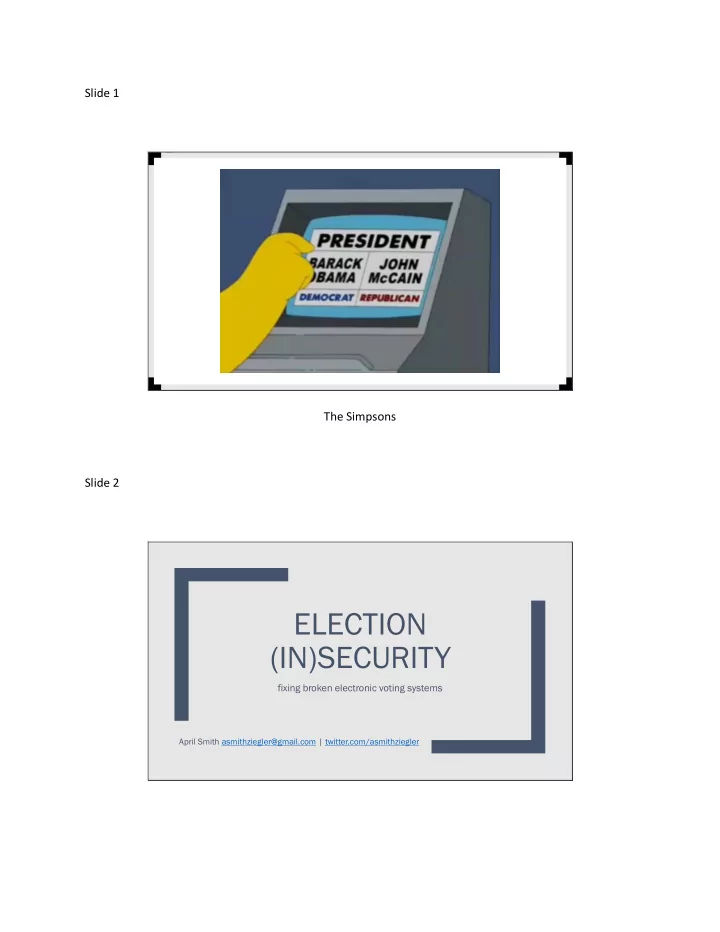
Slide 1 The Simpsons Slide 2
ELECTION (IN)SECURITY
fixing broken electronic voting systems
April Smith asmithziegler@gmail.com | twitter.com/asmithziegler
ELECTION (IN)SECURITY fixing broken electronic voting systems - - PDF document
Slide 1 The Simpsons Slide 2 ELECTION (IN)SECURITY fixing broken electronic voting systems April Smith asmithziegler@gmail.com | twitter.com/asmithziegler Slide 3 PROBLEMS Slide 4 www.electionsatrisk.org www.ivotedmovie.com Jason Grant
Slide 1 The Simpsons Slide 2
fixing broken electronic voting systems
April Smith asmithziegler@gmail.com | twitter.com/asmithziegler
Slide 3
Slide 4
www.ivotedmovie.com Jason Grant Smith www.electionsatrisk.org
Slide 5
■ faith-based vs evidence-based ■ hackable equipment, secret systems ■ audits (it depends) ■ corruption: vendors, lobbyists, electeds ■ regulations (what regulations?)
candidate & the voters should feel confident that the winner was elected fairly.
Slide 6
Rich DeMillo, is a cybersecurity expert who has studied elections and security extensively.
Slide 7
…once again…participants were able to find new ways, or replicate previously published methods, of compromising every
could alter stored vote tallies, change ballots displayed to voters, or alter the internal software that controls the machines.
DEF CON 27 Voting Machine Hacking Village August 2019
DEF CON is a hacking conference, conducted every year in Las Vegas. For the last 3 years they’ve hacked voting machines. From this year’s report: …… The report goes on to say the hackers:
Slide 8
DEF CON ■ e-pollbooks ■ vote-capture touchscreens ■ optical scanners ■ reporting sites Not at DEF CON (known wn issu sues) s) ■ voter registration database ■ EMS / central tabulators
Takeaway: a lot, all hackable electronics in our elections
Slide 9
wisconsinelectionintegrity.org
This is a typical jurisdiction. Elections are run by jurisdiction. There are 10,000 jurisdictions across US; 10,000 separate elections Varies in size from a few 100 voters in the smallest ones, to LA county, which is the largest (4.7 million voters) ncsl.org This picture shows how election hardware & software is distributed across a jurisdiction for each election: Vendor updates the Election Mgt System at county office, including updated memory cards to the county. County delivers memory cards to the city center where machines are stored Machines and updated memory cards delivered to voting locations. So corrupted memory cards can be distributed around in this fashion.
Slide 10
▪ Polling place ce ▪ County y office ce ▪ “Paper trail” ▪ “attack vector”
countedascast.org election day procedures
REPORT
This picture shows what happens at a polling location & county office election management system (EMS) & central tabulator Programmed/maintained by vendor touchscreen & scanners receive their programming from EMS via memory cards prior to
voter database; check-in (e-poll books or paper); Central tabulator to reporting site.
Slide 11
■ PC programmed by vendor ■ counts in secret ■ most vulnerable ■ 2015: Memphis--lost votes ■ 2018: Reporting systems left connected to internet in 10 states
More about the central tabulator/election mgt system: A PC & software supplied & maintained as a black box system by vendor. It counts in secret. Many experts feel it’s the most vulnerable part of this system because it touches everything else. A few security examples: 2015 Memphis: 40% of votes were lost from only predominantly African American
“feature” that counts a fraction of a vote. So the feature was activated for only those neighborhoods, counting only 60% of all votes cast. The same thing happened 8 years earlier in the OH primary, discovered when OH SOS sued the vendor for losing votes. Bear in mind, we don’t know how many of our 10,000 jurisdictions have this “feature.” 2018 Researchers discovered reporting systems in 10 states left connected to internet for months/years after election. (Including MI, WI, FL). https://www.vice.com/en_us/article/3kxzk9/exclusive-critical-us-election-systems-have-been- left-exposed-online-despite-official-denials
Slide 12
Comic relief! In the video documentary “I Voted?” veteran news reporter Dan Rather is being interviewed by the documentarian, Jason Smith
Slide 13
■ Electronic pollbooks ➢ 27+ states use* ➢ voters missing ➢ wrong precinct ➢ not working ■ Election reporting websites ➢ 11-yr old hacked at DEF CON
*Pew research
Epollbooks – electronic copies of voter databases. Instead of a paper book, like in MA. In one of the GA lawsuits around 2018 election, judge said enough, you must have paper backups. *https://www.pewtrusts.org/en/research-and-analysis/data-visualizations/2017/a-look- at-how-and-how-many-states-adopt-electronic-poll-books Election night reporting https://collaborate.nist.gov/voting/bin/view/Voting/ElectionNightReportingUseCase
Slide 14
■ hand-marked paper ballot
DRE summar ary card BMD
■ touchscreen (old): direct recording electronic (DRE) machine ■ touchscreen (new): ballot marking device (BMD)
3 basic vote-capture methods HMPB DRE—old touchscreens from early 2000s, communities replacing. They record the votes on a memory card. BMD—designed to assist people who cannot mark by hand. Summary card becomes ballot of record.
Slide 15 ■ hand-marked
paper ballot
summary card
Optical Scanner
cal scanner
■ machine marked printout (from BMD)
After your vote is captured, it has to be recorded. Scanners are used by almost all polling locations. A scanner keeps a running tally as each ballot is scanned, and then the ballots are collected in the box underneath. Very few jurisdictions hand count. Scanners receive their programming via memory card prior to election day. Ballots (hand- marked or machine marked) are fed into the scanner, and totals are saved to the memory card to be aggregated up into the central tabulator. Known vulnerabilities: memory cards can transmit malware. modems in scanners transmit tallies to central tabulations over the internet to hasten election results (as in RI https://www.providencejournal.com/news/20190808/report-prompts-ri- elections-officials-to-examine-security-of-voting-systems)
Slide 16
■ old old old ■ hackable ■ no paper record of selections ■ looooooooong lines ■ needs electricity ■ 14 states used in 2018 *
*Center for American Progress 2018
DRE
A bit more detail on the old touchscreens: They receive their programming on memory card from EMS. And totals from the device are returned to the central tabular.
2018 GA: (120K missing votes for Lt. Gov. – all from African American neighborhoods) DEF CON: All 3 models hacked.
ballot system: can vote just scan later.
Slide 17
A side bar about lines on election day. You don’t see lines like this when you vote on paper. 2012 in OH 2019 in Philadelphia (new touchscreens) 2018 in GA
Slide 18
■ “$5,000 pencil” ■ paper printout—”summary card” ■ hackable ■ looooooooong lines ■ needs electricity
summar ary card
ballot marking device BMD
New type of touchscreens. Like the old ones, they receive programming on memory card from
ballot marking devices (or BMDs) are also known as: $5,000 pencil. Only job is to mark a paper ballot. Designed as an assistive device for people who are unable to mark by hand. But some communities buying for universal use. They print a a paper summary of selections on touchscreen, called a summary card hackable—in the same manner as old touchscreens, plus they can be rigged to print different candidates than those selected on the touchscreen. long lines, needs electricity (same as the older touchscreens) DEF CON: All models hacked.
Slide 19
■ barcodes—voters can’t read ■ voters don’t read ■ recourse for error? ■ election accuracy depends
Most new BMDs print barcodes (or QR codes) that encode voter’s touchscreen selections; and the barcodes are what is read by the scanners. As a voter, it’s impossible to know whether what’s hidden in the barcodes is what was selected on the touchscreen. Even if configured without barcodes, voters could theoretically verify the summary card, but many studies show they don’t check. They’re in a hurry or they’ve already waited 3 hours to
the names of the candidates. And if they do check, find an error, AND want to correct it, what do they do if they do find an error? What’s their recourse? Destroy the ballot and vote again on a faulty touchscreen again? So the accuracy of elections depends on every voter checking, finding, and correcting errors. Every voter has to be a quality assurance analyst. All this as opposed to a regular paper ballot that you mark with a pen.
Slide 20
All-in-one (Hybrid) combines BMD + scanner in one machine. So it marks a ballot and tabulates. You make your selections, it prints a summary that you view & approve, and then the machine sucks it back in for scanning and storage. But with this all-in-one, the printer & scanner share same paper path. If voter leaves a race blank, machine could fill in blank, thus changing your ballot after you’ve approved it. Communities are buying these to replace their old touchscreens. Just last month: PA use them in 2 counties: candidates were receiving 0 votes or too few, touchscreens were flipping votes. GA used them in 5 (or 6?) counties (different make hybrid—the Dominion ImageCast): 4 counties had problems DEF CON: Hacked Dominion model. Expensive! Univ of Pittsburg & OSET---twice cost of HMPBs
Slide 21
■ Hand-ma marked paper r ballo lot ■ Voter verifiable paper ballot ■ Voter marked paper ballot ■ Backup paper ballot ■ Paper ballot
An important point about naming. What do we mean by “paper ballot.” Traditionally when we hear the term “paper ballot” we think of a standard paper ballot that you mark by hand. Vendors have coopted the term “paper ballot” to mean the printed summary card from a ballot marking device. So when an election administrator asks for a paper ballot system, the vendor sells them a BMD assuring them that it’s secure because it has paper. So all these terms are vendor-speak for a machine-marked ballot. So there’s a false equivalency being made between the traditional hand-marked ballot and a machine marked summary card. So when we refer to a traditional paper ballot that you mark with a pen, we have to add the prefix “hand-marked”
Slide 22
(eg risk limiting audit RLA)
Recounts a portion of ballots DOES verify count nt CAN’T verify print ntout uts
Audit: An audit takes a sampling of ballots and recounts them. It’s very important to understand what an audit does and doesn’t do. It does check counting or tabulation. Does not: check whether the printouts were accurately printed with the voter’s touchscreen selections. A risk limiting audit (or RLA) is the gold standard. (Statistically significant sample based on margin of victory. Small margin of victory means larger sample size. You keep sampling until your results reflect the same percentages as the election results.)
Slide 23
Optical Scanner
hand-ma marked paper ball llot
Bugs Bunny
ballo lot marki rking device ce (BMD) summa mary y card
Here’s what I mean when I say an audit can’t check the touchscreen printouts. Suppose you choose Bugs Bunny on your BMD. But someone installed malware that flips your vote to Elmer Fudd. Elmer is printed on your summary card, which is then scanned and tabulated. An audit looks at the paper, and recounts Elmer Fudd. An audit cannot look back to see what was selected on the touchscreen. In fact, that vote is lost. An audit begins with the paper, and counts what’s there. It can verify every part of the process after that point. But it can’t verify that what’s on the paper is what the voter selected. To be effective, an audit relies on a trustworthy paper record of the voter’s choices. Why is this important? Because vendors are promoting BMDs as safe because there’s paper and the paper can be audited to verify elections. This is false.
Slide 24
An audit can’t catch a BMD hack, so it can’t verify an election. It can only verify the tabulation of what’s printed on the paper. This is a HUGE issue because vendors (and anyone else who stands to gain) are messaging BMDs as verifiable. But they’re not.
Slide 25
■ State audit laws vary – before/after certification – within certain margins – only certain races ■ You have to DO them I don’t know whether the Russians or anyone else tampered with the voting machines in 2016 and 2018. No one does. We don’t know because Wisconsin election officials didn’t check. [They] just seal our paper ballots on Election Night and leave them sealed until it’s time to destroy them two years later. Karen McKim, Wisconsin Election Integrity
https://wisconsinelectionintegrity.org/
State laws: RI just starting using risk limiting audits. Trying to get passed in MA.
Slide 26
Slide 27
■ 80% of voting machine market ➢ Elections Systems & Software (ES&S) ➢ Dominion Voting ■ Both owned by private equity firms (undisclosed investors) ■ Recent examples ➢ 2015 ByteGrid purchased by Russian oligarch ByteGrid hosts Maryland elections ➢ 2019 North Carolina demanded ES&S reveal investor— an intermediary owned by private equity
80% of the market for voting machines is dominated by two vendors: ES&S & Dominion They are owned by private equity; so we don’t know who invests in them or who controls them. Recent examples relating to ownership. In 2015 ByteGrid, a company that hosts all of MD’s election systems, was purchased by a Russian oligarch w close ties to Putin. We know this because DHS told the MD elections board after Russia penetrated voter registration systems in FL & IL during the 2016 election. ByteGrid hosts voter registration systems, EMS & election night results website (AP) That prompted NC in 2019 to demand ES&S reveal its ownership before the state purchases new voting machines. The vendor stated that it is owned by an intermediary that is owned by a private equity. AP filed a public records request to get only that much info because the vendors asked NC not to make even that info public. https://apnews.com/cbc30e6a059a41ff8ba4d4da2f120f79
Slide 28
▪ 1970s: ES&S &S started by Bob & Todd Urosevich (initial funding from religious right billionaires) ▪ 1995 Bob started Global Election Systems (later renamed Diebold) ▪ 2000 EMS “lost” 16,000 votes for Al Gore in FL ▪ 2003 CEO & top Bush fundraiser: help OH “deliver its electoral votes to the president.” ▪ 2004 VP (convicted embezzler) programmed machines in 37 states ▪ 2004 OH lost votes for John Kerry causing Bush to win the state. ▪ 2009-10 Diebold split its assets between ES&S and Dominion ▪ 2010 Dominion: Canadian ▪ Programs systems in Serbia (Russia?) ▪ Senior VP is a former client of Paul Manafort ▪ Manafort’s lobby partners rerouted OH 2004 election results to a backup server in TN
A brief history showing the inter connectedness of top 2 vendors, ES&S and Dominion, and their ties with the Republican party.
Slide 29
■ 2000-06: sold EMS computers with: ➢ remote access software (300 jurisdictions) ➢ modems ■ 2017: exposed pwds to its servers ■ 2018: GA election programmed from a contractor’s garage
Examples of security breaches with vendor ES&S 2000-06: the vendor sold EMS computers w remote access software & modems to 300
regular updates. Motherboard, July 2018, Kim Zetter. NPR, Sept 2018, Miles Parks IL 2017: Vendor left Chicago’s voter registration data exposed for months on amazon cloud
https://apnews.com/f6876669cb6b4e4c9850844f8e015b4c GA 2018: contractors working for ES&S programmed all of GA’s election from their garage (unsecured)
Slide 30
■ Proprietary systems: – no vulnerability testing – threaten to sue – only through litigation ■ business model – no innovation – sell long maintenance contracts – sue competitors over patents – sue states seeking contracts w competitors
Proprietary: Testing: They prohibit testing by independent ethical hackers (standard practice for Pentagon & major banks). Claim they do outside testing, but won't say by whom or share results. AP Oct 2018 Threats : Threaten to sue researchers studying their systems (Guardian, April 2019, Jordan Wilkie) Litigation: The only way to know what’s going on with their systems is when there’s a problem, then you have to sue, and the judge has to allow discovery. Business model:
Slide 31
■ Lobbyists--often former state elections officials ■ State officials—former lobbyists ■ Campaign donations to state
exchange for awarding contracts
Lobbyists cozy w State officials: Brian Kemp, now Georgia’s governor after overseeing his own election while secretary of state, appointed an ES&S lobbyist as his deputy chief of staff. The state is in the process of purchasing more than $150m in new voting machines. https://www.ajc.com/news/state--regional-govt--politics/firm-close-ties-georgia-stir-concerns- about-voting-system-purchase/HVK4wcNsEAKO0Xa0ptLLKM/ Campaign donations: lobbyists will donate to campaigns of state officials & lo and behold the state grants them a contract. (Maybe the lobbyist does offers more? Offers to swing an election?)
Slide 32
…there are no mandatory federal cybersecurity standards for elections. It is perfectly legal for the biggest voting machine company in America … to sell a small county equipment that every cyber-security expert in America knows is insecure.
July 2019
What are the rules governing elections? Very little. Https://www.congress.gov/116/crec/2019/07/15/modified/CREC-2019-07-15-pt1-PgS4815- 2.htm https://thehill.com/opinion/technology/464065-voting-machines-pose-a-greater-threat-to-our- elections-than-foreign-agents
Slide 33
▪ purchases & certifies voting equipment ▪ runs & certifies elections ▪ underfunded ▪ undersupported Elections are state controlled Each state purchases & certifies its own voting equipment, develops its own protocols, runs & certifies its own elections. So each state BOE/SOS must have cybersecurity expertise & know the many vulnerabilities. They don’t get a lot of help with this and often have vendors in their ears. States have been shouting at Congress that they are underfunded and don’t have the support they need esp for increased cybersecurity.
Slide 34
■ HAVA / $4b / advise / oversee testing & certification ■ GOP undermines ■ Vendor influence ■ Guidelines for states optional ■ Guidelines weak ➢ version 1 from 2005; version 2 delayed. ➢ ban internet (50K comments)? ➢ exclude voter reg. databases & e- pollbooks
What about the Election Assistance Commission? The EAC is a very small agency, that has been troubled & toothless from the start. It started when Congress passed the Help America Vote Act (HAVA) in the wake of the FL 2000 election. HAVA granted nearly $4 billion to be distributed to states. EAC was formed to distribute the funds, advise states & certify equipment. The certification requirements were weak, the tech wasn’t ready, but Congress just wanted to throw money at the problem. House GOP has introduced bills every other year since 2011 to shut down / Senate won’t confirm commissioners There are vendors on the board of the EAC, former EAC officials have gone to work for vendors The EAC offers states guidelines for best practices but they’re optional: https://www.newyorker.com/tech/annals-of-technology/mitch-mcconnell-is-making-the-2020- election-open-season-for-hackers Guidelines are weak: They haven’t been updated since 2005, version 2 has been delayed for over 2 years. Ignored the 50K comments asking for a ban on internet connections to be included in
excludes voter reg systems--VR Systems hacked by Russians same time it remotely accessed NC election computer.
Slide 35
Slide 36
■ hand-ma marked paper r ballo lots s as prima mary y vo vote-capt capture re method ■ touchsc screens (BMDs) only for assistive needs (no “all-in in-one” hyprids, , no barcod rcodes) s). ■ secure chain of custody ■ robust st manual audits s (eg eg RLAs) s) to check k tabulation ■ no remote access software ■ no modems ■ vendor oversight! (not in time for 2020)
Some of the key solutions. There are others…
Slide 37
Slide 38
■ Jenni nifer er Cohn: n: follow https://twitter.com/jennycohn1 and read medium.com/@jennycohn1 ■ Brad Friedm dman: n: Bradcast podcast & The Bradblog.com (website slow to load) ■ Journalists: Kim Zetter (NYT+), Jordan Wilkie (Guardian), Sue Halpern (New Yorker), Lulu Friesdat (The Hill, Now This), Steven Rosenfeld (Independent Media Institute) ■ Jonatha han n Simon:
Democracy codered2014.com updated for 2018. ■ Nat’l Voting Rights Task Force (NVRTF): nvrtf.org info & conference videos ■ Coalition
for Good d Gov
erna nance coalitionforgoodgovernance.org suing GA SOS over 2016 election undervotes for Lt. Gov. DREs unconstitutional!
Jen Cohn: must follow, my go-to Brad Friedman: at this for 2 decades. Coalition for Good Governance has sued GA secy of state. There was a landmark ruling declaring old DRE touchscreens unconstitutional
Slide 39
■ Lobby y lobby lobby at commu munity y leve vel ■ Example ple in We West stch chest ster Cty NY: Stopped purchase of 300 hybrid BMDs for general use. ■ Count the Vote initiative: train volunteers to advocate for secure protocols & monitor vote counts. www.smartelections.us. Launch? ■ Scrutineers initiative: train volunteers about issues. Launch in Jan. www.scrutineers.org text SECURITY to 773-770-4377 to get on interest list.
State/Community level activism: since congress is handicapped & elections are state controlled. Example: Westchester Cty NY: Hybrid BMD (Dominion Ice) about to spend $6m for 300 units for general use. ES advocates and experts wrote to BOE & testified. Stopped the purchase (for 300); still purchased 30 for ADA. Count the vote: SMART elections, in collaboration w other groups, train volunteers to advocate for secure protocols & counting vote totals. Scrutineers: Emily Levy, activist since 2004, aims to teach volunteers about election systems to prepare them as activists.
Slide 40
■ National l Elect ction Defense se Coali lition (NEDC) electiondefense.org launched usbase.net to assist with local activism. ■ Free Speech ch fo for People ple freespeechforpeople.org/freeandfairelections collaborating with NEDC to file for legal action in the courts. ■ Common Cause se commoncause.org/our-work/voting-and- elections/election-integrity ■ Secure re Our Vote secureourvote.us a project of Public Citizen. Sign up to receive action items. ■ Secure re Elect ctions s Netwo work k secureelectionsnetwork.net grassroots
demcastusa.com “Election Security Needs to be Addressed in the Next Debate”
Slide 41
April Smith asmithziegler@gmail.com twitter.com/asmithziegler