Effective PresentationsA Must Craig J. Hawker* Craig J. Hawker - - PDF document

effective presentations a must
SMART_READER_LITE
LIVE PREVIEW

Effective PresentationsA Must Craig J. Hawker* Craig J. Hawker - - PDF document

Angewandte . Editorial DOI: 10.1002/anie.201209795 Effective PresentationsA Must Craig J. Hawker* Craig J. Hawker Professor of Chemistry E ffective presentations are critical for of a clear message. Noise, which can University of


slide-1
SLIDE 1

DOI: 10.1002/anie.201209795

Effective Presentations—A Must

Craig J. Hawker*

Effective presentations are critical for

success in whatever career path one

  • takes. Nevertheless, very little attention

is devoted to teaching our students how to give a good presentation. How many times are we surprised at how poor presentations are, even from well- known scientists? We should not be surprised, since we provide little, if any, guidance for students, and poor com- munication techniques are simply propagated through the system. What follows is not an exhaustive list of dos and donts, rather it is designed to bring attention to this issue, and, in a similar way to the influential text by George M. Whitesides on “Writing a Paper” (Adv.

  • Mater. 2004, 16, 1375), initiate a discus-

sion on the topic. If chemists can be- come better at communicating their ideas to fellow scientists who specialize in different areas, to funders, govern- ment policy makers, industrial partners, and the general public, the future of the chemical enterprise will be healthier and

  • ur students will be more successful in

their professional lives.

While a publication can be read again

and again, a presentation is over imme-

  • diately. Therefore, the rules for writing

a publication differ from those for preparing a presentation. The best pre- sentation is—like the best measure- ment—the one that has the highest signal-to-noise ratio. In the case of presentations, the signal is the delivery

  • f a clear message. Noise, which can

include too much information, poor slides, filler words such as “um” and “ah”, must be minimized.

Two Indispensable Considerations

Before you start preparing a presenta-

tion you should answer the following questions:

  • 1. What is my message? To answer this

question it must become clear to you why the audience should care about your work; how it affects them either professionally

  • r

personally; and what the big picture is.

  • 2. Which story do I use to convey my

message? It is essential to focus the attention of your audience. To ach- ieve this, you first have to think about who your audience is—are they in the same field as you, is it a diverse group of scientists, or maybe even a general audience?

The Slides

Many of us start with the creation of

the slides to be used in the presentation. As with a manuscript, you should start with an outline, though this is where the similarities with writing a manuscript

  • end. Specific rules and good habits

include:

  • 1. Do not reproduce images directly

from manuscripts, as this conveys the message to the audience that little thought has gone into the presenta-

  • tion. You can stare at a figure in

a manuscript for an hour as a reader, in a presentation you typically have less than a minute. As a result, the image has to be simple.

  • 2. One message–one slide to maximize

signal to noise. That means: go critically over every part of every image on a slide and ask whether this is absolutely necessary. If the answer is “maybe”, then delete it. I am always shocked when a presenter puts up a slide that is extremely busy, then tells you to ignore most of the

  • slide. If it is not relevant, then do not

show it.

  • 3. Make your slides visually appealing.

The audience does not have much time to take in the information on the slides, and so they cannot be distracted by poor font selection, bad color choices, and so on.

  • 4. Limit text. The text should only

support or convey the one message per slide rule. To help ourselves during presentations, we often fall into the bad habit of putting too much text on slides and then simply reading the text to the audience. This

  • nly ends up being noise. This rule

also applies to the slide title itself: it should not describe the slide. Imag- ine a slide detailing how a compound was shown to be a single stereoiso- mer by NMR spectroscopy. Having “NMR of compound X” as a slide title is useless. This conveys no valuable information. Instead use the title to reinforce the message of the slide, for example, “Single Ste- reoisomer is Observed”.

[*] Prof. Dr. C. J. Hawker

  • Depts. of Chemistry & Biochemistry, and

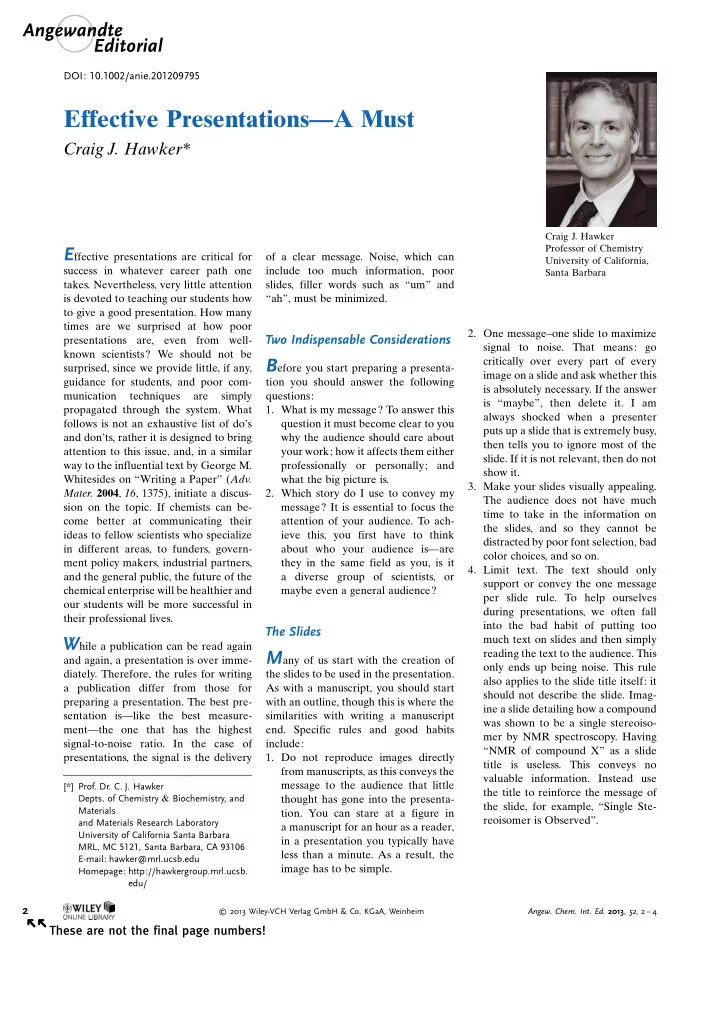
Materials and Materials Research Laboratory University of California Santa Barbara MRL, MC 5121, Santa Barbara, CA 93106 E-mail: hawker@mrl.ucsb.edu Homepage: http://hawkergroup.mrl.ucsb. edu/ Craig J. Hawker Professor of Chemistry University of California, Santa Barbara

.

Angewandte Editorial

2

2013 Wiley-VCH Verlag GmbH & Co. KGaA, Weinheim

  • Angew. Chem. Int. Ed. 2013, 52, 2 – 4
  • These are not the final page numbers!
slide-2
SLIDE 2

Practicing

Presentations rely on both visual cues

(slides) as well as oral reinforcement (speaking). Many of us are comfortable with creating slides, but few researchers enjoy speaking to an audience. There- fore: practice the full presentation, ei- ther in front of co-workers or colleagues. No amount of just looking at your slides will ever make up for actually standing up and verbalizing what you want to say. Time yourself, work on improving the flow of the presentation, and make sure the key messages of the talk are clear. How often do presentations either run

  • ver time, with the presenter skipping

the last 5–10 slides or racing through them at such a rate that no one pays

  • attention. This leaves the audience with

a very poor impression of the whole

  • presentation. Finishing early is actually

a good thing. To more effectively dem-

  • nstrate the importance of practice,

consider the following. A normal pre- sentation may cover many years of work in the laboratory. Certainly this is worth a few hours of practice.

The Talk

To make the actual presentation a suc-

cess the following rules should be taken into account:

  • 1. Engage with the audience. This may

seem simple, but again speakers typically do not do this and, as a result, they lose their audience. As just one example of a common mistake, do not look at the screen, unless you need to illustrate some- thing using the laser pointer. Instead focus on the audience and make eye contact with as many people as

  • possible. In addition, use visual cues

from the audience to quicken, or slow, your presentation. Try to inter- act with people in the audience and welcome comments during the pre-

  • sentation. Audiences are more en-

gaged when a presentation is a two- way discussion rather than a strict monologue.

  • 2. Project a sense of confidence and
  • professionalism. It may seem minor,

but projecting confidence to your audience through well-chosen words, steady delivery, and a professional appearance counts for a lot and is very easy to accomplish. As the saying goes, “first appearances count”, and this is equally true for

  • presentations. But do not forget to be

authentic.

  • 3. Make effective use of voice and
  • pointers. For many researchers the

effective use of their voice is a chal-

  • lenge. While many people know to

avoid filler words such as “um” and “ah”, it is less well known that silence can be one of the most effective tools during a presentation. It helps frame points and brings the audience into your story. Next time you feel like saying “um” or “ah”, use silence instead and see how effective this is. Equally important is to use the cadence and volume of your voice to maximize the impact of your main

  • points. Finally, overuse and erratic

movements of a laser pointer con- tributes significantly to “noise”— laser pointers are for emphasis, noth- ing more.

So what?

Is it important for the chemistry com-

munity to be better communicators? Absolutely! We all go to conferences where we present technical data with

  • ne of the purposes being to receive

advice and suggestions concerning re- search directions. Do we ever ask for feedback on how the data were present- ed or if the presentation was effective? No! This is a major issue as all research- ers, from students to faculty, must be- come more proactive in improving their communication skills by seeking out critical feedback and devoting signifi- cant time to preparation. Our passion and devotion to chemical research must be matched by our ability to communi- cate the results.

Angewandte

Chemie

3

  • Angew. Chem. Int. Ed. 2013, 52, 2 – 4

2013 Wiley-VCH Verlag GmbH & Co. KGaA, Weinheim

www.angewandte.org

These are not the final page numbers!

slide-3
SLIDE 3

Editorial

  • C. J. Hawker*

&&&&—&&&&

Effective Presentations—A Must “… While a publication can be read again and again, a presentation is over immedi-

  • ately. Therefore, the rules for writing a pub-

lication differ from those for preparing a presentation. The best presentation is— like the best measurement—the one that has the highest signal-to-noise ratio …”Read more in the Editorial by Craig J. Hawker.

.

Angewandte

Editorial 4

www.angewandte.org

2013 Wiley-VCH Verlag GmbH & Co. KGaA, Weinheim

  • Angew. Chem. Int. Ed. 2013, 52, 2 – 4
  • These are not the final page numbers!