EFFECTIVE BUSINESS COMMUNICATION AND ETHICS FOR CONSULTANCY IN THE - - PowerPoint PPT Presentation

effective business communication
SMART_READER_LITE
LIVE PREVIEW

EFFECTIVE BUSINESS COMMUNICATION AND ETHICS FOR CONSULTANCY IN THE - - PowerPoint PPT Presentation

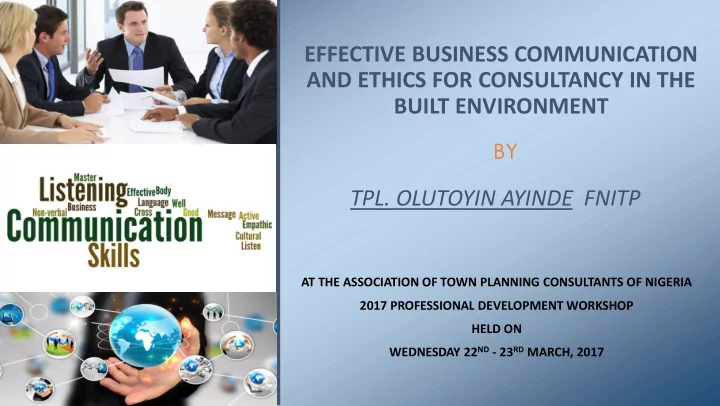
EFFECTIVE BUSINESS COMMUNICATION AND ETHICS FOR CONSULTANCY IN THE BUILT ENVIRONMENT BY TPL. OLUTOYIN AYINDE FNITP AT THE ASSOCIATION OF TOWN PLANNING CONSULTANTS OF NIGERIA 2017 PROFESSIONAL DEVELOPMENT WORKSHOP HELD ON WEDNESDAY 22 ND - 23


slide-1
SLIDE 1

AT THE ASSOCIATION OF TOWN PLANNING CONSULTANTS OF NIGERIA 2017 PROFESSIONAL DEVELOPMENT WORKSHOP HELD ON WEDNESDAY 22ND - 23RD MARCH, 2017

EFFECTIVE BUSINESS COMMUNICATION AND ETHICS FOR CONSULTANCY IN THE BUILT ENVIRONMENT

BY

  • TPL. OLUTOYIN AYINDE FNITP
slide-2
SLIDE 2
slide-3
SLIDE 3

“NO COMMUNICATION, NO BUSINESS; KNOW BUSINESS, KNOW COMMUNICATION”

slide-4
SLIDE 4
slide-5
SLIDE 5
slide-6
SLIDE 6

In order to determine how best to maximize the potentials of planning practice, we must first recognize that we have it!  That is, we must agree that we have a career in planning practice.  The best professions today weren't created with an exceptional amount of qualified persons or resources.  That maximizing it happens when we take calculated, and sometimes, unpopular risks.

slide-7
SLIDE 7

Myles Munroe once said, “The greatest threat to human being is satisfaction with who we are; we have settled for less than

  • ur best and the enemy of our best is good, the strength of

good is the norm and the power of the norm is the curse of

  • ur society”. ”.

In essence, history is always made by individuals who dare to challenge and exceed the accepted norm.

Cont.

slide-8
SLIDE 8

Over the last 3 decades in Nigeria, Town Planning profession has emerged from mere health/social studies into the stream of conventional professional practice, but is yet to gain the popularity, dignity and the status expected as experienced in some professions. This seems to be the result of the communication gap between the public/client and the professionals, on one hand, and also amongst the professionals themselves, on the other. Therefore to overcome this situation, this presentation is set to provide tested and practicable principles that will bring effective business communication and ethics for consultancy in the built environment.

Cont.

slide-9
SLIDE 9

 Introduction  Definition of Terms  Approach to Delivery of this Presentation What is a Profession? Who is a Professional? What is Professionalism?  Communication  Purpose of Communication  Components of Communication  Presentation as mode of Communication  Common Mistakes in Communication  Effective Business Communication  Why is Effective Business Communication Important?  Ethics of Business Communication  Conclusion

slide-10
SLIDE 10

 “Business” : a person's regular occupation, profession, or trade.  “Communication”: the imparting or exchanging of information by speaking, writing, or using some other medium (reading, listening).  “Ethics” : a set of moral principles, especially the ones relating to or affirming a specified group, field, or form of conduct.  “Consultancy”: a professional practice that gives expert advice within a particular field. DEFINITION OF TERMS

slide-11
SLIDE 11

This presentation will focus more on communication as it obviously looks like the strongest word in the sub theme; Simply put we will be discussing communication as it relates to business, that business being consultancy, which is guided by ethics. Whatsoever our means or method of communication may be, we must have it at the back of our minds that it must be within the context of professionalism.  What then is a Profession?  Who is a professional?  And what is Professionalism? Providing sufficient answers to these questions will provide the context within which

  • ur discussion is placed.

APPROACH TO DELIVERY OF THIS PRESENTATION

slide-12
SLIDE 12

What then is a Profession? A profession is a vocation founded upon specialized educational training, the purpose of which is to supply disinterested objective counsel and service to

  • thers, for a direct and definite compensation, wholly apart from expectation of other

business gain. (Professions, Australia, 1997). It may also be said to be a combination of knowledge, skills, trustworthiness and altruism found in those who commit themselves to a life of service to others. Who is a professional? A professional has specialized knowledge which gives him power over his/her clients. Balancing the use of this power for individual and public good, while meeting their own needs, obliges professionals to behave ethically. A certain degree of altruism is expected in the true professional, a certain amount of selfless service. The need for altruism and ethics to direct professional skills is so pressing because of the differential in knowledge that exists between the professional practitioner and the client.

slide-13
SLIDE 13

What is Professionalism? Professionalism is not only a skills set in a given occupation; it is an ineffable something that the person exudes in manner, dress, speech, and standards of practice that is palpably powerful: standards like honesty, due diligence, perseverance, willingness to listen and learn, creative thinking within a framework

  • f training, and other qualities most people would be hard put to describe but which

they expect in the professionals with whom they engage. The power that asymmetric knowledge (the superior knowledge) gives one person

  • ver another must oblige the practitioner to act in the client’s best interest and must

be well communicated, the contrary of which will be termed unprofessional. Professionalism is our business, and this needs to be efficiently communicated in

  • rder to achieve the desired result.
slide-14
SLIDE 14

COMMUNICATION

“The inevitable result of communication is misunderstanding. When we are talking, we have misunderstanding. How much more so, then, when we are not talking at all.” Patrick Morley, 1997. Communication is a complex two-way process that can involve several iterations before mutual understanding is achieved. Communication takes place in many ways. You can communicate using words, symbols, pictures, graphics, voice, tone, facial expressions, clothing, and body language.

The Relationship between Communication and Success

slide-15
SLIDE 15

Good communication is essential for the effective operation and development of

  • business. It ranges from decision-making to policy-making, from education and training

to human resource management. It is imperative to note that, the achievement of strategic goals and plans is virtually impossible if the right people do not receive the right message, in the right way, and at the right time. By employing good communication skills business organisations will work effectively towards creating and keeping clients. More than any other factor, they vote for you or against you based on the effectiveness

  • f your communication. However, few people communicate as effectively and efficiently

as they should in the business environment.

Cont.

slide-16
SLIDE 16

Successful communication methods provide a mechanism to get exceptional

  • results. The form of communication that takes place in an organisation has a

major influence on productivity, morale, energy levels, teamwork, and levels

  • f co-operation on an informal and formal basis.

The professional communicator sets and keeps standards above a certain level and refuses to allow them to slip below minimum standards. Effective communication is a minimum requirement for virtually every other competency. Cont.

slide-17
SLIDE 17

Purpose of Communication

There would have been no need for communication but for the fact that there is a message that must pass from one person (the origin) to the other (destination/receiver). Until the receiving end properly accepts and understands the message being sent (communicated), there will be no “buy-in” or understanding of what the message is all about. This is the reason why communication must be simple and straightforward. Simplicity implies expressing statements without confusing the receiver. A lot of things can happen – frustration, misconception, indignation, irritation, and so on. Purpose of communication will be adjudged as being fulfilled when the destination/receiver receives the message exactly the way the origin intended it.

slide-18
SLIDE 18

The Yorubas indeed understand that communication lies at the very base of fulfilment of purpose when they came up with the statement, “Ai le soro ni ibere

  • riburuku”, which literally means that, “the inability to speak (communicate) is the

beginning of ill-fortune”. In other words, we are doomed if we are unable to

  • communicate. Our businesses could be jinxed if our communication is poor.

Cont.

slide-19
SLIDE 19

Components of Communication

Communication is a dialogue not a monologue. So, a communication is said to be effective only if it brings the desired response from the receiver. But it involves several components to be able to achieve this result. And each of these is very important and much attention must be equally given to each one. Below are some basic components of communication:  Reading  Writing  Speaking  Listening

slide-20
SLIDE 20

Reading: is a complex "cognitive process" of decoding symbols in order to construct or derive meaning (reading comprehension). Reading is a means

  • f language acquisition, communication, and of sharing information and ideas.

Reading is very important as a communication skill because it develops the creative side of a person. The more you read and understand, the better informed you are. Reading to become a better communicator requires a conscious effort to make links, understand opinions, research and apply what you learn to your studies, i.e. we read to gain factual information for practical

  • use. Therefore reading is an essential part of communication, because the more

you read, the vaster you become, and the easier it gets for you to communicate.

slide-21
SLIDE 21

Writing Francis Bacon once said “Reading maketh a full man; conference a ready man; and writing an exact man”. There are three main elements to written communication To become an effective communicator in writing, you must check the following points under the three elements earlier listed above:  Structure (the way the content is laid out).  Style (the way it is written).  Content (what you are writing about).

slide-22
SLIDE 22
  • 1. Structure (the way the content is laid out)

 Is the layout clear and easy to follow?  Do headings stand out (e.g. are they in a larger font size)?  Is the information arranged in a logical sequence with a beginning (introduction), middle, and end (conclusion)?  Does the introduction clearly state the subject and purpose?  Does it briefly summarize the content?

slide-23
SLIDE 23
  • 2. Style (the way it is written)

 Does it look neat, and elegant?  Is it concise, with an exact use of words and economy of style?  Is it simple, direct and lucid?  Are paragraphs too long?  Is a blank line left between paragraphs to aid clarity?  Are sentences too long?  Is the first sentence interesting/ Does it draw the reader in?  Is the style suitable for the intended audience?  Are bulleted lists used where appropriate?  Have you kept wordy phrases to a minimum?  Have you avoided repetition?

slide-24
SLIDE 24
  • 3. Content (what you are writing about)

 Have you carefully checked the spelling and punctuation?  Have you thought through in advance what you want to say?  Have you a clear objective?  Have you listed the essential points you wish to make?  Have you made these points clearly?  Have you developed your argument in a logical way?  Have you allowed detail to obscure the main issues?  Is the content positive and constructive?  Have you shown an interest in the reader by writing with warmth, sensitivity and friendliness?  Have you edited it through several revisions, honing the text until it is just right?  Have you left it overnight if possible? your mind will assimilate it better and you will come back with a fresh view.

slide-25
SLIDE 25

Speaking: Effective speaking concerns being able to speak in a public context with confidence and clarity, whilst at the same time reflecting on your own personality. Aspects of Effective Speaking

  • Accents
  • Finding your voice:
  • The effect of breath on voice and speech
  • Vocal production…….. Volume - To be heard.

Clarity - To be understood. Variety - To add interest.

slide-26
SLIDE 26

Listening (Paying Attention Skills): Listening is the ability to accurately receive and interpret messages in the communication process. Listening is core to all effective communication. Without the ability to listen effectively, messages are easily misunderstood. As a result, communication breaks down and the sender of the message can easily become frustrated or irritated. The two main types of listening - the foundation of all listening sub-types are: Discriminative Listening: Comprehensive Listening:

slide-27
SLIDE 27

Presentations are daily rituals of any business. In fact, how well we succeed in our career can be closely tied to how well we present

  • information. Presentation can also be one of the greatest challenges of

communication; if not well organised this could lead to permanent misrepresentation of the presenter by the listener/client. An organised presentation must have these three critical parts:

  • The Introduction
  • The Body
  • Closure

PRESENTATION AS MODE OF COMMUNICATION

slide-28
SLIDE 28

Delivering a presentation involves nonverbal communication. It is how you express your messages. The following are non-verbal communication that would be essential in making a presentation:

  • Making Eye Contact
  • Using Gestures
  • Paying Attention to Posture and Body Position
  • Using The Voice
  • Pacing Yourself

Cont.

slide-29
SLIDE 29

Common Mistakes in Communication

Even the best of us make common speaking, spelling and grammar mistakes from time to time, and we often do so without realizing it. Speaking, and also writing, are like a very elaborate and nuanced card game; there are so many different rules and guidelines that you can “play” for years before finding out you’ve been doing something incorrectly all along. Some examples of the common mistakes include:

“emphasy“ instead of “emphasis” “loose” instead of “lose” “complimentary” instead of “complementary” “confuse” instead of “convince” “been” instead of “being” or the other way round confusing the use of “its” and “it’s”

slide-30
SLIDE 30

“One of our colleague“ instead of “One of our colleagues” “lied on the floor” instead of “lay on the floor” Knowing the difference among “cite, site, sight” The appropriate use of the word, “had” The wrong use of aspirates e.g. “house”, “as”, “is”, etc.

Cont.

Singular Plural Basis Bases Emphasis Emphases Infrastructure Infrastructure Furniture This Furniture These

slide-31
SLIDE 31

“The inevitable result of communication is misunderstanding because we assume the receiver picks up the same transmission we send. But the receiver always has a separate agenda and his own unique view of the world. Only through dialogue can we be certain we are being understood.” Patrick Morley 1999.

EFFECTIVE BUSINESS COMMUNICATION

The Client’s needs Vs Consultant’s Deliverables

slide-32
SLIDE 32

To become an effective communicator, there are secrets that must be learnt.  Establish rapport with the client.  Maintain a professional attitude throughout the consulting process.  Ask about client’s preferred means of communication and desired frequency

  • f communication.

 Ask the client to explain the importance of the project .  Uncover the client’s real needs.  Confirm deliverables with the client.  Confirm time estimates and deadlines with the client.

Cont.

slide-33
SLIDE 33

What to look out for in your contract  Inform the client on possible alternatives for solving their problem and use your professional expertise to recommend the preferred alternative.  Keep the client in the loop about any anticipated or unanticipated challenges that you encounter while working to solve their problem.  Provide regular updates to your client on the number of hours spent working on the project.  When communication isn’t working, it’s time to reflect, get motivated, and take action. Conflict is inevitable and difficult for everyone. The secret is to find effective ways to address it.  Once motivated to improve communication, take action and focus on what is doable.

Cont.

slide-34
SLIDE 34

 Use reflection after meeting with your clients to understand what worked/didn’t work.  Present your findings in a clear and impactful way.  Be clear about the limitations and implications of the findings you produce for your clients.

Cont.

slide-35
SLIDE 35

 It is key to business success  It generates trust and respect  It builds expertise  It generates repeat business  It helps prevent/resolve conflict

WHY IS EFFECTIVE BUSINESS COMMUNICATION IMPORTANT?

slide-36
SLIDE 36

 Conveying the Point Without Offending the Audience.

 Maintain a Relationship With the Audience.  Accuracy of Information is Necessary.

ETHICS OF BUSINESS COMMUNICATION

slide-37
SLIDE 37
slide-38
SLIDE 38

As a practitioner you will understand and accept that there are no perfect communicators all the time. Everyone makes mistakes. You must realize however that communicating effectively can be learnt. You must also understand that effective communication affects all aspects of your job, including marketing, crisis management, advertising, public relations, selling products and services, negotiations, counseling staff members, influencing stake-holder bosses and clients, making presentations, conducting job interviews, and facilitating problem-solving sessions.

slide-39
SLIDE 39

And know this for sure that your communication skills will be challenged every now and then – use challenges as an opportunity to grow and learn new things. When encountering a challenge, remain positive, objective and open-minded so that you can make the best decisions possible for you and your client.

Cont.

slide-40
SLIDE 40

JUST BEFORE WE CLOSE

slide-41
SLIDE 41